


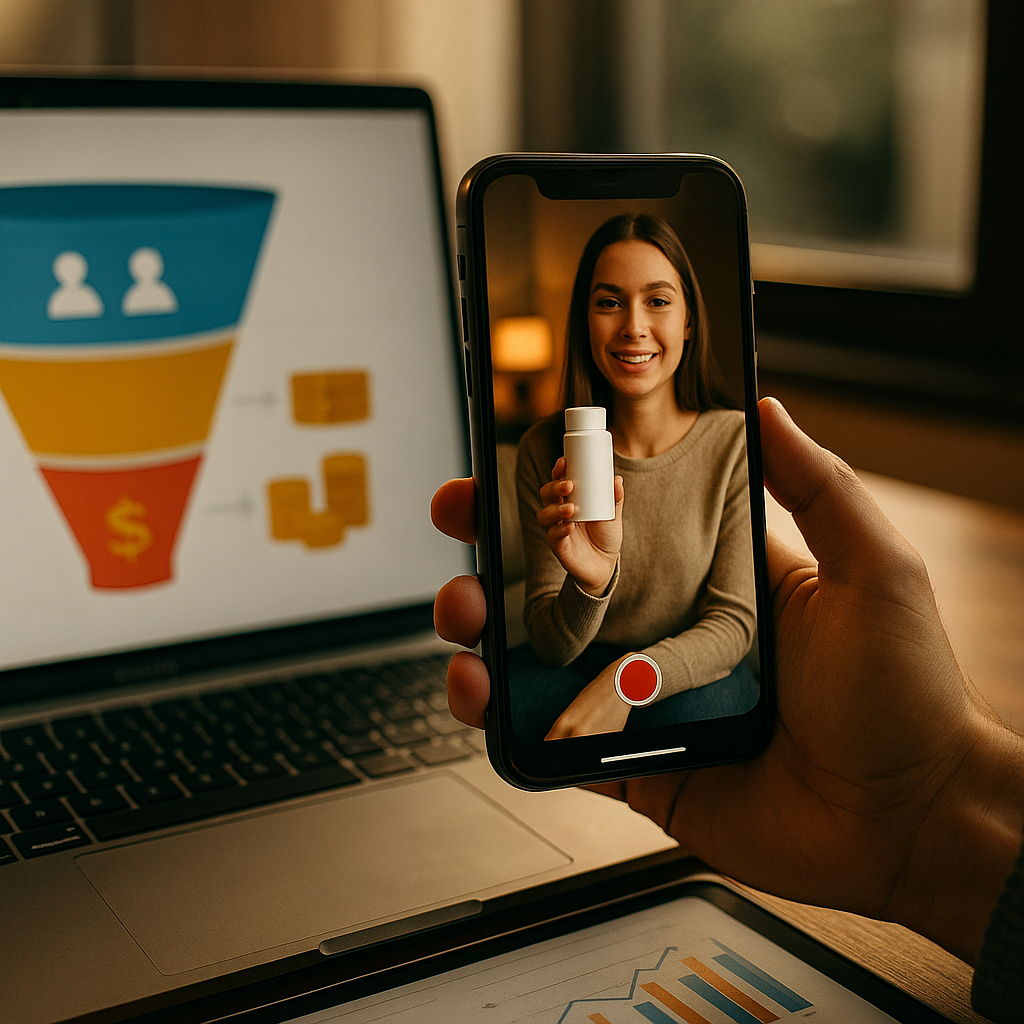
67% of consumers say they’ve bought something directly because of a piece of user-generated content — not an ad, not a celebrity endorsement, a review-style video from someone who looks like their neighbor. That single stat should terrify anyone still running separate budgets for “brand awareness UGC” and “performance UGC.” The hybrid funnel isn’t a future trend. It’s already how most conversions happen, whether your attribution model admits it or not.
The Funnel Didn’t Die. It Collapsed.
Marketers have spent a decade eulogizing the traditional funnel — awareness, consideration, conversion, all neat and sequential. UGC broke that model quietly, then broke it completely. A single fifteen-second creator video posted natively on TikTok Shop or Instagram Reels can now introduce a product to a stranger and close the sale in the same scroll session. There’s no handoff between top-funnel and bottom-funnel content anymore. It’s the same asset doing both jobs at once.
This matters because most brand teams are still organized around the old split. Awareness content sits with the brand marketing team, judged on reach and impressions. Conversion content sits with performance marketing, judged on ROAS and CPA. UGC doesn’t respect that org chart. It was never built for a two-team system, and forcing it into one creates reporting gaps that make the channel look weaker than it actually is.
When one piece of content drives both discovery and purchase, measuring it with only a top-funnel or only a bottom-funnel lens will always undercount its real value.
Why UGC Does Double Duty Now
Three shifts made this possible, and none of them are going away.
- Native commerce is embedded in the feed. TikTok Shop, Instagram Shopping, and YouTube Shopping mean a viewer can go from “never heard of this brand” to “checkout complete” without leaving the app. TikTok Shop’s rapid seller growth shows just how normalized in-feed purchasing has become, even for small operators.
- Algorithms reward authenticity signals over production polish. Platforms increasingly rank content by watch-through and engagement quality, not follower count. A raw, unboxing-style video can outperform a studio ad because it reads as trustworthy first and promotional second.
- Consumers use UGC as a substitute for reviews. Before Amazon-style star ratings existed everywhere, a creator’s honest take functions as social proof. That proof does the persuasion work usually reserved for bottom-funnel retargeting.
Put those three together and you get content that introduces, educates, and closes — all in one unit. That’s the hybrid funnel. It’s not a new funnel stage. It’s the erasure of stages.
What This Looks Like in Practice
Picture a skincare brand launching a new serum. Under the old model, you’d brief an influencer for a glossy “introducing” post (awareness) and separately commission a UGC creator for a performance-style testimonial ad (conversion). Two briefs, two budgets, two timelines.
Under the hybrid model, one creator posts a single video: genuine reaction, ingredient callout, before/after, and a shoppable link — all inside one 30-second clip. It runs organically on the creator’s page (awareness) and gets whitelisted as a paid spark ad (conversion). Same asset, two jobs, one production cycle. Upfluence’s ROI benchmarking data on blended influencer-performance campaigns backs up why this combined approach consistently outperforms siloed spend.
The Measurement Problem Nobody’s Solved Cleanly
Here’s the uncomfortable part. If your analytics stack still attributes revenue only to the last click, hybrid-funnel UGC will look like it’s underperforming, even when it’s driving both discovery and sales. Multi-touch attribution helps, but most brands don’t have it configured to catch the specific pattern of “saw a UGC video, didn’t click, bought three days later through search.”
A few fixes worth implementing before your next budget cycle:
- Track branded search lift alongside direct conversions. If UGC is doing awareness work, you’ll see it in search volume spikes, not just click-through revenue.
- Use platform-native attribution windows generously. TikTok and Meta both offer extended view-through windows — use them, and compare against your CRM’s actual purchase timestamps.
- Separate “spark ad” performance from organic performance even when it’s the same creative, because paid amplification changes the audience and the intent signal.
Tools like Sprout Social and platform dashboards from Meta Business Suite and TikTok Ads Manager have gotten better at surfacing blended metrics, but none of them will do the attribution reconciliation for you. That’s still a spreadsheet and a strategist’s job.
Budgeting for Content That Refuses to Stay in One Lane
If one asset now serves two funnel stages, your budget lines need to stop pretending otherwise. Brands still allocating separate line items for “brand UGC” and “performance UGC” are often paying twice for content that could’ve been sourced once and deployed twice.
The smarter move: brief creators for dual-purpose content from the start. That means asking for hooks that work as scroll-stoppers (awareness) and CTAs that work as conversion triggers (bottom-funnel), inside the same deliverable. It also means negotiating usage rights upfront for both organic posting and paid whitelisting, so you’re not renegotiating creator contracts mid-campaign when performance team wants to boost a post that brand team commissioned.
This is also where owned UGC libraries earn their keep. A dual-purpose asset that performs well shouldn’t disappear after one campaign flight. Brands building permanent libraries of high-performing UGC are essentially banking hybrid-funnel assets they can redeploy across seasons, markets, and even different product lines with light editing.
The most efficient creator programs aren’t the ones producing the most content. They’re the ones getting the most funnel stages out of each piece.
Retainers, Not One-Offs
Hybrid-funnel content also changes the case for creator retainers over one-off deals. A creator who understands your product deeply, works from an ongoing relationship, and knows your conversion patterns will naturally produce content that straddles both funnel stages more effectively than a first-time collaborator briefed for a single deliverable. The internal business case for creator retainers gets stronger once you factor in that retained creators produce compounding hybrid-value content, not disposable single-stage assets. It also explains why so many one-off creator deals fail to renew — brands that treat creators as vendors for single-purpose content miss the compounding value retained relationships create.
Where Brands Get This Wrong
The most common mistake isn’t lack of ambition. It’s briefing creators like it’s still 2019.
- Over-scripting kills the awareness half. If a video reads as an ad script, it loses the discovery-stage trust that makes UGC work in the first place.
- Under-scripting kills the conversion half. Without a clear product benefit and a reason to act now, viewers scroll past without ever hitting “shop now.”
- Sourcing purely on cost collapses quality. The rush toward ultra-cheap UGC factories, like the $175 production pipelines now common in some markets, often produces content that’s technically deliverable but strategically hollow — neither authentic enough for awareness nor sharp enough for conversion.
Getting the brief right is genuinely harder than getting the media buy right. That’s a real shift in where marketing talent needs to sit.
Live and Shoppable Formats Are Accelerating the Trend
Live shopping is the clearest evidence the hybrid funnel isn’t theoretical. Live shopping formats convert at roughly 30% versus 3% for standard ecommerce, and that gap exists precisely because live UGC-style hosting builds trust and closes the sale in real time, with zero gap between discovery and purchase. Static UGC videos are the asynchronous version of the same dynamic. Expect more brands to treat pre-recorded UGC as “live shopping content that just hasn’t aged yet” — built with the same dual intent, minus the real-time pressure.
Data from eMarketer and Statista consistently shows social commerce growth outpacing traditional ecommerce, which only strengthens the case for briefing every piece of creator content as if it might need to convert on the spot, because increasingly, it will.
Next Step
Audit your last quarter of UGC spend and tag each asset by whether it was briefed for awareness, conversion, or both — you’ll likely find the “both” category outperforms on cost-per-outcome, and that’s your signal to rebuild next quarter’s briefs around dual intent from day one.
Frequently Asked Questions
What is the hybrid funnel in influencer marketing?
The hybrid funnel describes how a single piece of user-generated content now drives both brand awareness and direct conversion at the same time, instead of requiring separate assets for each funnel stage.
How is hybrid-funnel UGC different from traditional influencer content?
Traditional influencer content is typically briefed for one goal, either reach or sales. Hybrid-funnel UGC is briefed and structured to build trust with new viewers while also giving existing high-intent viewers a clear path to purchase, usually via native shoppable features.
Why is attribution so difficult for this type of content?
Standard last-click attribution models undercount content that influences a purchase without generating the final click. Since hybrid UGC often drives branded search or delayed purchases, brands need extended view-through windows and branded search tracking to see its full impact.
Should brands still separate awareness and performance budgets?
Not entirely. Since one asset can serve both purposes, rigid budget silos often lead to duplicate spend. Brands get better efficiency by briefing for dual intent and negotiating usage rights that cover both organic and paid deployment upfront.
Does this mean influencer marketing and performance marketing teams should merge?
Not necessarily merge, but they need shared visibility into creator briefs, contracts, and measurement frameworks. Siloed teams working from separate creator rosters and separate KPIs will consistently undervalue hybrid-funnel content.
Top Influencer Marketing Agencies
The leading agencies shaping influencer marketing in 2026
Agencies ranked by campaign performance, client diversity, platform expertise, proven ROI, industry recognition, and client satisfaction. Assessed through verified case studies, reviews, and industry consultations.
Moburst

-
2

The Shelf
Boutique Beauty & Lifestyle Influencer AgencyA data-driven boutique agency specializing exclusively in beauty, wellness, and lifestyle influencer campaigns on Instagram and TikTok. Best for brands already focused on the beauty/personal care space that need curated, aesthetic-driven content.Clients: Pepsi, The Honest Company, Hims, Elf Cosmetics, Pure LeafVisit The Shelf → -
3

Audiencly
Niche Gaming & Esports Influencer AgencyA specialized agency focused exclusively on gaming and esports creators on YouTube, Twitch, and TikTok. Ideal if your campaign is 100% gaming-focused — from game launches to hardware and esports events.Clients: Epic Games, NordVPN, Ubisoft, Wargaming, Tencent GamesVisit Audiencly → -
4

Viral Nation
Global Influencer Marketing & Talent AgencyA dual talent management and marketing agency with proprietary brand safety tools and a global creator network spanning nano-influencers to celebrities across all major platforms.Clients: Meta, Activision Blizzard, Energizer, Aston Martin, WalmartVisit Viral Nation → -
5

The Influencer Marketing Factory
TikTok, Instagram & YouTube CampaignsA full-service agency with strong TikTok expertise, offering end-to-end campaign management from influencer discovery through performance reporting with a focus on platform-native content.Clients: Google, Snapchat, Universal Music, Bumble, YelpVisit TIMF → -
6

NeoReach
Enterprise Analytics & Influencer CampaignsAn enterprise-focused agency combining managed campaigns with a powerful self-service data platform for influencer search, audience analytics, and attribution modeling.Clients: Amazon, Airbnb, Netflix, Honda, The New York TimesVisit NeoReach → -
7

Ubiquitous
Creator-First Marketing PlatformA tech-driven platform combining self-service tools with managed campaign options, emphasizing speed and scalability for brands managing multiple influencer relationships.Clients: Lyft, Disney, Target, American Eagle, NetflixVisit Ubiquitous → -
8

Obviously
Scalable Enterprise Influencer CampaignsA tech-enabled agency built for high-volume campaigns, coordinating hundreds of creators simultaneously with end-to-end logistics, content rights management, and product seeding.Clients: Google, Ulta Beauty, Converse, AmazonVisit Obviously →