


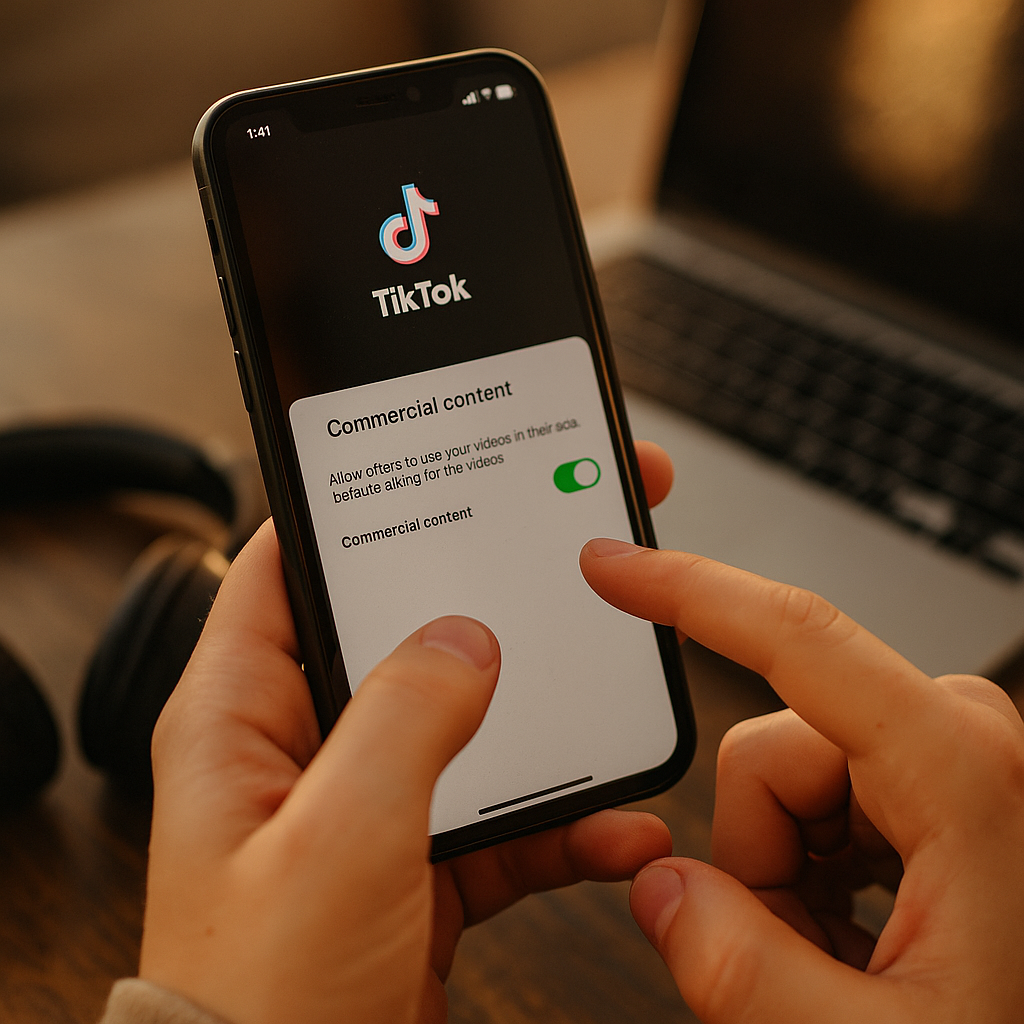
Brands are quietly losing reach on TikTok, and most don’t know why. The culprit isn’t the algorithm’s mood swings — it’s a mislabeled toggle. TikTok’s mandatory commercial-content setting now factors directly into distribution priority, and getting it wrong throttles views before a single comment rolls in.
The Toggle Nobody Reads the Fine Print On
Every creator uploading to TikTok has to declare whether a video is commercial. That’s not new. What’s changed is how aggressively TikTok now enforces the distinction between “Brand Organic” and “Branded Content,” and how the platform’s recommendation system treats each category differently during initial distribution.
Here’s the part that catches teams off guard: TikTok isn’t just checking a compliance box. The commercial-content disclosure now feeds directly into how the For You Page algorithm assesses a video during its first testing window. Mislabel it, or skip it, and you’re not just risking a policy strike. You’re capping your own reach before the content ever gets a fair shot.
A video labeled correctly as Branded Content still competes for organic-style distribution — mislabeling it, or leaving it off entirely, is what actually kills reach.
Why This Matters More in 2026 Than It Did Before
TikTok Shop volume has exploded, and with it, the platform’s incentive to clean up how paid content gets surfaced. Creators are running affiliate links, brand deals, and Shop-tagged product videos simultaneously, often in the same week. TikTok needs a reliable signal to separate “this is an ad” from “this is a genuine recommendation,” partly for FTC disclosure compliance and partly to protect user trust in the feed itself.
That’s the same trust-calibration logic we’ve seen play out in TikTok’s trust-based distribution algorithm, which already rewards accounts with consistent, transparent posting patterns. The commercial-content toggle is another input into that same trust model. Get it right consistently, and your account builds a reputation the algorithm can rely on. Get it wrong, and you’re flagged as noisy or evasive.
Consider the numbers: eMarketer estimates that branded and creator-driven commerce content now accounts for a growing share of total TikTok watch time in core shopping categories. That’s a lot of video competing for the same feed real estate. TikTok has every incentive to prioritize distribution toward creators and brands who label correctly, because it reduces platform risk and keeps the ad ecosystem clean.
What “Enabling It Correctly” Actually Means
This isn’t just flipping a switch to “on.” There are three settings brands need to get right, every time:
- Branded Content Toggle: Required when a creator is paid to promote a third-party brand. This must be enabled on the creator’s account for every sponsored post, not just the ones that feel obviously promotional.
- Brand Organic Toggle: Used when a brand posts from its own account without paid partnership terms. Different distribution rules apply here than to influencer-posted branded content.
- Ad Code Pairing: When content is boosted via Spark Ads or added to a paid campaign, it needs to be properly linked to the original organic post using the correct authorization code, not re-uploaded as a fresh video.
Miss any one of these, and TikTok’s system either under-distributes the content in initial testing or, worse, flags the account for a pattern violation. Repeated pattern violations are what actually tank reach long-term, not a single mislabeled post.
How Mislabeling Quietly Costs You Reach
Nobody gets a rejection notice that says “your reach was capped because of a labeling error.” That’s the trap. The algorithmic penalty is invisible. Videos still publish. They still get some views. But the initial test pool, the small batch of users TikTok shows a video to before deciding whether to push it further, gets sized down when disclosure data is missing or inconsistent.
Think of it like a credit score for your account’s honesty. One missed disclosure won’t tank you. A pattern of it will. And once TikTok’s system flags an account as inconsistent, every future post starts from a smaller test pool by default. That’s a compounding cost, not a one-time hit.
This connects directly to the labeling issues we’ve covered around paid partnership labeling rules, which already showed that reach throttling happens well before manual review ever kicks in. The commercial-content toggle is the upstream version of that same problem: fix it at the source, and the downstream labeling issues mostly disappear.
The Agency Blind Spot
Agencies managing dozens of creator accounts often assume creators handle this themselves. They don’t, not reliably. A Sprout Social survey of creator marketing practices found that disclosure compliance is one of the most inconsistently executed parts of influencer campaigns, largely because brands treat it as a legal checkbox rather than a performance lever.
That’s the mindset shift required here. Commercial-content disclosure isn’t just risk mitigation anymore. It’s a distribution input. Treat it with the same rigor you’d apply to a paid media targeting setting, because functionally, that’s what it now is.
Building It Into Your Creator Ops, Not Just Your Contracts
Most brands bury disclosure requirements in the influencer contract’s boilerplate. That’s not enough anymore. If the setting affects distribution priority, it needs to live in the creative brief and the QA checklist, not just the legal terms.
A few operational fixes that actually move the needle:
- Screen-record the toggle before publish. Require creators to submit a screenshot of the Branded Content toggle enabled, alongside the draft video, before it goes live. This takes thirty seconds and eliminates the most common error.
- Standardize the ad authorization workflow. If content is going into Spark Ads, make sure whoever manages paid media has the authorization code before the organic post goes live, not three days later when someone remembers to boost it.
- Audit monthly, not quarterly. Pull a sample of live campaign content each month and verify labeling. TikTok’s TikTok Ads Manager and Creator Marketplace both show disclosure status; use them.
- Loop in legal early, but don’t let them own the workflow. Compliance teams should set the standard. Marketing ops should own execution. When legal owns the checklist alone, it becomes a document nobody references during production.
This is the same operational discipline we’ve recommended around TikTok Shop compliance risk in regulated categories: build the check into the workflow, don’t rely on someone remembering it under deadline pressure.
Does This Affect TikTok Shop Content Differently?
Yes, and this is where a lot of brands get tripped up. TikTok Shop content carries an additional layer: product-tagged videos need both the commercial-content disclosure and accurate Shop tagging to qualify for full distribution eligibility, including placement in Shop-specific feed surfaces and the shopping tab.
If you’re running affiliate programs at scale, this compounds fast. A creator posting ten Shop-tagged videos a week, with inconsistent disclosure across even two or three of them, creates a pattern that affects the whole account’s standing, not just the individual mislabeled posts. That’s a meaningful risk for brands leaning heavily into affiliate leaderboard programs, where volume and consistency are the whole point of the strategy.
It’s also worth checking how this interacts with checkout-adjacent content. Our breakdown of checkout speed and creative structure touches on how Shop-tagged videos get evaluated differently than standard organic posts, and disclosure accuracy is part of that evaluation.
What About Brand-Owned Accounts?
Brand-owned TikTok accounts posting their own product content don’t need the Branded Content toggle since there’s no third-party creator relationship. But they do need the Brand Organic setting enabled correctly, and TikTok has gotten stricter about verifying business account status matches the content being posted. A brand account posting without proper business verification can face the same test-pool throttling as a mislabeled creator post; the mechanism is different, but the outcome is the same reach penalty.
The Compliance-to-Growth Pipeline
The reframe brands need to make: disclosure compliance and distribution growth are no longer separate workstreams. They used to be. Legal handled disclosure risk, growth teams chased reach. TikTok’s current system has fused those two functions into one setting.
That’s actually good news for brands who get it right, because it means clean compliance practices now come with a built-in reach advantage over competitors still treating disclosure as an afterthought. Every mislabeled competitor post is smaller test-pool distribution you don’t have to fight for attention against.
Next step: Pull your last 30 days of TikTok creator content and audit the commercial-content toggle status against your actual paid partnership agreements. If you find even a 10% mismatch rate, that’s reach you’re leaving on the table for free.
Frequently Asked Questions
What is TikTok’s mandatory commercial-content setting?
It’s the disclosure toggle creators and brands must enable when posting paid or promotional content on TikTok, categorized as either Branded Content (third-party paid partnerships) or Brand Organic (brand-owned account posts). It’s required for FTC compliance and now factors into distribution priority.
How does enabling the commercial-content toggle affect reach?
Correctly labeled content competes for standard distribution during TikTok’s initial test-pool phase. Missing or inconsistent disclosure can shrink that test pool over time, especially if the pattern repeats across multiple posts on the same account.
Does this apply to TikTok Shop affiliate content too?
Yes. Shop-tagged videos need both accurate commercial-content disclosure and correct product tagging to remain eligible for full distribution across Shop-specific feed placements, including the shopping tab.
Who is responsible for enabling the toggle, the brand or the creator?
The creator technically controls the toggle on their own account, but brands and agencies should build verification into their campaign workflow rather than assuming creators will handle it correctly every time.
Can a single mislabeled post hurt an entire account’s distribution?
One mistake rarely causes lasting damage. A repeated pattern of missing or inconsistent disclosure is what triggers ongoing distribution penalties, since TikTok’s system evaluates labeling consistency over time, not just per post.
FAQs
What is TikTok’s mandatory commercial-content setting?
It’s the disclosure toggle creators and brands must enable when posting paid or promotional content on TikTok, categorized as either Branded Content (third-party paid partnerships) or Brand Organic (brand-owned account posts). It’s required for FTC compliance and now factors into distribution priority.
Top Influencer Marketing Agencies
The leading agencies shaping influencer marketing in 2026
Agencies ranked by campaign performance, client diversity, platform expertise, proven ROI, industry recognition, and client satisfaction. Assessed through verified case studies, reviews, and industry consultations.
Moburst

-
2

The Shelf
Boutique Beauty & Lifestyle Influencer AgencyA data-driven boutique agency specializing exclusively in beauty, wellness, and lifestyle influencer campaigns on Instagram and TikTok. Best for brands already focused on the beauty/personal care space that need curated, aesthetic-driven content.Clients: Pepsi, The Honest Company, Hims, Elf Cosmetics, Pure LeafVisit The Shelf → -
3

Audiencly
Niche Gaming & Esports Influencer AgencyA specialized agency focused exclusively on gaming and esports creators on YouTube, Twitch, and TikTok. Ideal if your campaign is 100% gaming-focused — from game launches to hardware and esports events.Clients: Epic Games, NordVPN, Ubisoft, Wargaming, Tencent GamesVisit Audiencly → -
4

Viral Nation
Global Influencer Marketing & Talent AgencyA dual talent management and marketing agency with proprietary brand safety tools and a global creator network spanning nano-influencers to celebrities across all major platforms.Clients: Meta, Activision Blizzard, Energizer, Aston Martin, WalmartVisit Viral Nation → -
5

The Influencer Marketing Factory
TikTok, Instagram & YouTube CampaignsA full-service agency with strong TikTok expertise, offering end-to-end campaign management from influencer discovery through performance reporting with a focus on platform-native content.Clients: Google, Snapchat, Universal Music, Bumble, YelpVisit TIMF → -
6

NeoReach
Enterprise Analytics & Influencer CampaignsAn enterprise-focused agency combining managed campaigns with a powerful self-service data platform for influencer search, audience analytics, and attribution modeling.Clients: Amazon, Airbnb, Netflix, Honda, The New York TimesVisit NeoReach → -
7

Ubiquitous
Creator-First Marketing PlatformA tech-driven platform combining self-service tools with managed campaign options, emphasizing speed and scalability for brands managing multiple influencer relationships.Clients: Lyft, Disney, Target, American Eagle, NetflixVisit Ubiquitous → -
8

Obviously
Scalable Enterprise Influencer CampaignsA tech-enabled agency built for high-volume campaigns, coordinating hundreds of creators simultaneously with end-to-end logistics, content rights management, and product seeding.Clients: Google, Ulta Beauty, Converse, AmazonVisit Obviously →