


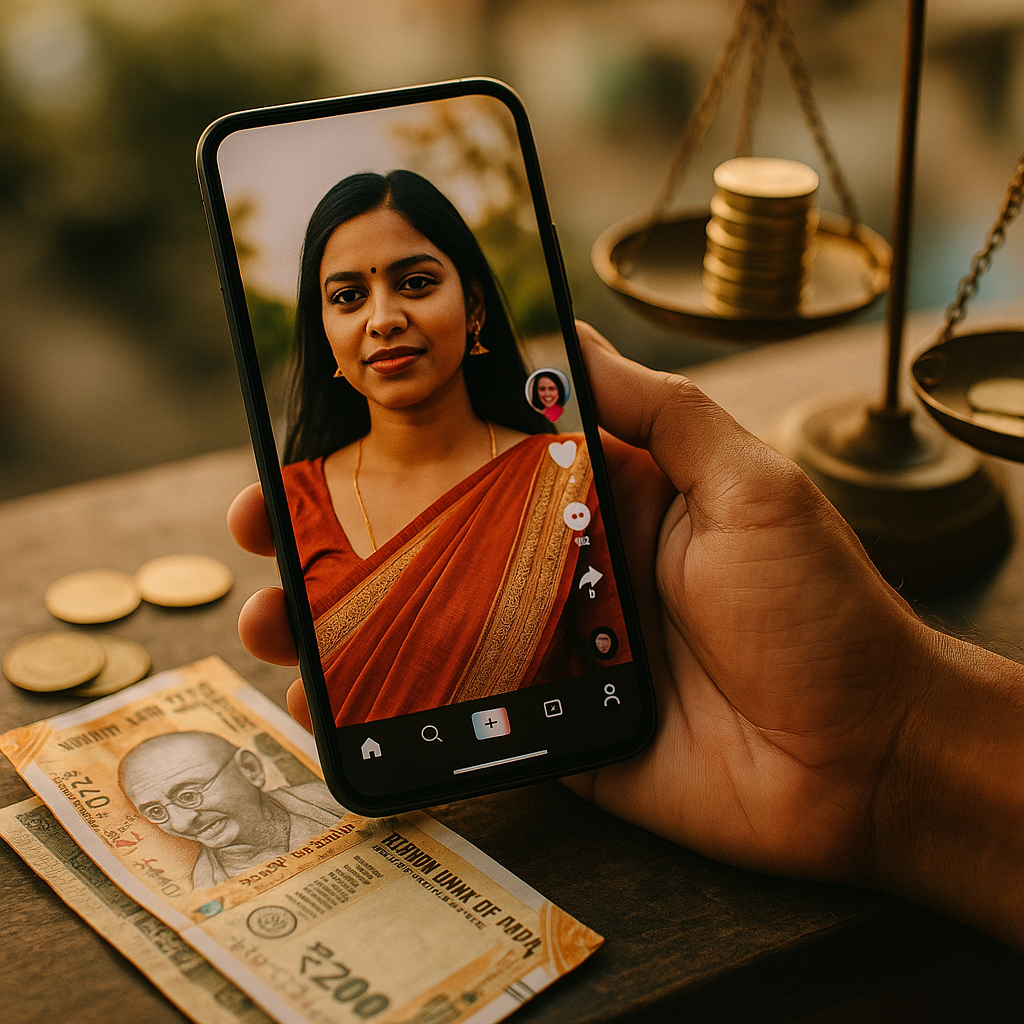
Brands courting Indian UGC talent are getting a pricing shock: a $175 median video rate that looks cheap until the usage-rights invoice lands separately, often doubling or tripling the true cost. India’s UGC creator hustle is no longer a budget hack. It’s a negotiation minefield with its own line-item logic, and brands that don’t model it correctly are bleeding margin on every campaign.
The Headline Rate Is Just the Entry Fee
Ask any procurement lead who’s sourced creators from Mumbai, Bangalore, or Delhi in the last year, and you’ll hear the same complaint: the quote looks great until the scope creeps. A $175 median rate for a 30-to-60-second vertical video is genuinely competitive against US or UK equivalents, where similar deliverables often start north of $300. That’s precisely why global brands have flocked to Indian UGC talent pools through platforms like Billo, Trend, and regional players such as Kofluence and Winkl.
But the $175 figure typically covers organic usage only — the creator posting the content on their own handle, or handing over raw files for the brand’s own organic social. The moment a brand wants to run that footage as a paid ad, embed it on a product page, or repurpose it across multiple SKUs, a second invoice appears. And that second invoice is where the real cost model gets messy.
Why Usage Rights Became a Separate Line Item
This split didn’t happen by accident. Indian creators, many of whom operate as solo freelancers without agency representation, started adopting Western-style licensing tiers after watching how badly undervalued their content was in paid media contexts. A video that earns a creator $175 for a one-time organic post might drive six figures in ad spend efficiency for the brand if it performs well in paid social. Creators caught on.
The unbundling of production fee and usage fee means brands are now paying for reach twice: once to make the content, once to legally use it where it actually drives revenue.
Usage-rights fees in the Indian creator market now commonly range from 50% to 150% of the base production rate, scaled by duration and channel. A three-month paid social license might add $90-$150. A perpetual, cross-platform buyout — the kind brands want for evergreen ad creative — can run two to four times the original fee. This mirrors a trend we’ve tracked closely in UGC bundling and rights sourcing, where the unbundling of production and licensing is forcing brands to rebuild their sourcing contracts from scratch.
What’s Actually Driving the $175 Median
The number itself deserves scrutiny. It’s not arbitrary — it reflects a market that’s matured fast. Three forces are converging:
- Currency arbitrage is narrowing. Indian creators used to price in rupees and accept whatever the dollar conversion yielded. Now many quote directly in USD, benchmarked against global platform rate cards, closing the gap that made India attractive purely on cost.
- Platform standardization. Marketplaces increasingly publish suggested rate bands, nudging creators toward consistent pricing rather than racing to the bottom. This is similar to what’s happening with micro-creator rate cards globally, where transparency is pushing rates up, not down.
- Niche specialization commands premiums. Beauty, fintech, and D2C food creators in urban India routinely price above the median because brands in those categories have shown willingness to pay for conversion-tested formats.
So the $175 figure is a median, not a ceiling. Brands treating it as a flat-rate benchmark are setting themselves up for scope disputes mid-campaign — a costly, avoidable mistake.
The Real Cost Model Brands Need to Build
Here’s the practical problem: most brand procurement templates still treat creator content as a single SKU. One fee, one deliverable, one invoice. That model breaks down completely against India’s two-tier pricing structure.
A more accurate cost model separates three components:
- Production fee — the base rate for filming, editing, and delivering the asset (the ~$175 median).
- Usage license — scoped by duration, platform, and whether it’s organic, paid, or both.
- Exclusivity or category lock — an increasingly common ask, where creators charge extra to avoid promoting competing brands for a defined window.
Brands running always-on UGC programs at volume — think 50-plus videos a month for paid social testing — are finding that unmodeled usage fees can add 30-40% to total program cost when tallied at scale. That’s not a rounding error; that’s a budget line that needs its own approval workflow.
Treating usage rights as an afterthought instead of a budgeted line item is the single most common reason UGC programs blow past their quarterly cap.
Compliance Risk Hiding in the Fine Print
There’s a legal dimension too, and it’s not trivial. Brands that run creator content as paid ads without a documented, scoped usage license are exposed to takedown requests, disputes, and — in markets with active advertising regulators — compliance flags. The FTC’s endorsement guidance already requires clear disclosure for paid partnerships; layering unclear usage rights on top compounds the risk when creators dispute unauthorized use after the fact.
India doesn’t yet have a single unified regulatory body policing influencer usage-rights disputes the way some markets are moving toward, but that’s shifting. Brands operating at scale should assume scrutiny is coming and contract accordingly — explicit terms, defined duration, defined platforms, no ambiguity.
How This Compares to Other Creator Markets
It’s tempting to see India’s pricing structure as an anomaly. It isn’t. It’s an early, faster-moving version of a global pattern. US-based UGC platforms have been unbundling production and usage fees for a couple of years now, and the same logic is spreading to Southeast Asia and Latin America. What makes India distinct is the speed of the shift and the sheer volume of creator supply, which keeps base production rates lower even as usage fees climb toward global norms.
This has an interesting side effect: cost arbitrage on production is shrinking, but cost arbitrage on usage rights is emerging as the new efficiency lever. Brands that negotiate broad, multi-campaign usage licenses upfront — rather than paying per-use each time — are seeing meaningfully better unit economics. It’s the difference between renting content one campaign at a time and building an owned library, a shift we’ve covered in depth around brands moving toward owned UGC libraries instead of rented reach.
According to data referenced by eMarketer, creator economy ad spend continues climbing double digits year over year globally, and India is one of the fastest-growing supply markets feeding that demand. Brands ignoring the rights-fee structure now will simply pay more, later, under worse negotiating conditions.
Negotiation Tactics That Actually Work
Brand-side teams that have adapted well to this market share a few consistent habits:
- Bundle usage rights into the initial brief, not as a follow-up ask. Creators price more fairly when scope is clear from the first conversation.
- Negotiate tiered licenses upfront — organic-only, paid-social, and perpetual buyout — so campaigns can scale usage without renegotiating mid-flight.
- Batch-contract creators for multi-video deals. Volume commitments give brands leverage to flatten the usage-fee premium per asset.
- Centralize licensing records. Losing track of which assets have paid-usage clearance is a common, expensive mistake once UGC libraries exceed a few hundred assets, a problem explored in UGC licensing operations at scale.
None of these tactics eliminate the usage fee. They just make it predictable, which is really what a cost model needs: not the lowest number, but the most forecastable one.
What This Means for Budget Planning
Marketing leaders building next fiscal year’s creator budget should stop anchoring to the $175 headline rate and start modeling total landed cost per usable asset. That means production plus the specific usage tier the campaign actually requires, not the cheapest tier available. A brand planning paid amplification should budget for paid-usage rates from day one, rather than getting surprised when the organic-only quote doesn’t cover the media plan.
This also has implications for agency contracts. Agencies sourcing Indian UGC talent on a brand’s behalf need explicit rights-tier disclosure in their statements of work — otherwise the brand inherits ambiguity it never agreed to. It’s the same governance gap driving broader shifts in agency contract structures across the creator economy right now.
The takeaway for finance and marketing ops teams: India’s UGC market isn’t cheap anymore in the way it used to be cheap. It’s efficient, if you model it correctly. It’s expensive, if you don’t.
FAQs
Frequently Asked Questions
What is the average cost of a UGC video from an Indian creator?
The median production fee sits around $175 for a standard vertical video (30-60 seconds), based on current marketplace data. This typically covers organic usage only; paid or extended usage requires a separate licensing fee.
Why do Indian creators charge separately for usage rights?
Creators separated production and usage fees after recognizing that content used in paid advertising generates significantly more brand value than a single organic post. Usage-rights fees now typically add 50-150% on top of the base production rate, depending on scope and duration.
How much should brands budget for full usage rights?
For a perpetual, cross-platform buyout, brands should expect costs to run two to four times the base production fee. Shorter, single-platform paid licenses (three-month terms, for example) usually add a smaller premium, often 50-100% above the base rate.
Are usage-rights agreements with Indian creators legally binding?
Yes, provided the scope, duration, and platforms are clearly documented in a written agreement. Verbal or ambiguous terms create dispute risk, especially if content is used beyond what the creator originally agreed to.
How can brands avoid usage-fee surprises mid-campaign?
Define the intended usage (organic, paid, or perpetual) in the initial creator brief, not after content delivery. Negotiating tiered licensing upfront prevents renegotiation delays and unplanned cost increases once a campaign is already live.
Next step: audit your last five Indian UGC contracts for undefined usage scope, then rebuild your rate card with production and licensing as two distinct, forecastable line items before your next campaign brief goes out.
Top Influencer Marketing Agencies
The leading agencies shaping influencer marketing in 2026
Agencies ranked by campaign performance, client diversity, platform expertise, proven ROI, industry recognition, and client satisfaction. Assessed through verified case studies, reviews, and industry consultations.
Moburst

-
2

The Shelf
Boutique Beauty & Lifestyle Influencer AgencyA data-driven boutique agency specializing exclusively in beauty, wellness, and lifestyle influencer campaigns on Instagram and TikTok. Best for brands already focused on the beauty/personal care space that need curated, aesthetic-driven content.Clients: Pepsi, The Honest Company, Hims, Elf Cosmetics, Pure LeafVisit The Shelf → -
3

Audiencly
Niche Gaming & Esports Influencer AgencyA specialized agency focused exclusively on gaming and esports creators on YouTube, Twitch, and TikTok. Ideal if your campaign is 100% gaming-focused — from game launches to hardware and esports events.Clients: Epic Games, NordVPN, Ubisoft, Wargaming, Tencent GamesVisit Audiencly → -
4

Viral Nation
Global Influencer Marketing & Talent AgencyA dual talent management and marketing agency with proprietary brand safety tools and a global creator network spanning nano-influencers to celebrities across all major platforms.Clients: Meta, Activision Blizzard, Energizer, Aston Martin, WalmartVisit Viral Nation → -
5

The Influencer Marketing Factory
TikTok, Instagram & YouTube CampaignsA full-service agency with strong TikTok expertise, offering end-to-end campaign management from influencer discovery through performance reporting with a focus on platform-native content.Clients: Google, Snapchat, Universal Music, Bumble, YelpVisit TIMF → -
6

NeoReach
Enterprise Analytics & Influencer CampaignsAn enterprise-focused agency combining managed campaigns with a powerful self-service data platform for influencer search, audience analytics, and attribution modeling.Clients: Amazon, Airbnb, Netflix, Honda, The New York TimesVisit NeoReach → -
7

Ubiquitous
Creator-First Marketing PlatformA tech-driven platform combining self-service tools with managed campaign options, emphasizing speed and scalability for brands managing multiple influencer relationships.Clients: Lyft, Disney, Target, American Eagle, NetflixVisit Ubiquitous → -
8

Obviously
Scalable Enterprise Influencer CampaignsA tech-enabled agency built for high-volume campaigns, coordinating hundreds of creators simultaneously with end-to-end logistics, content rights management, and product seeding.Clients: Google, Ulta Beauty, Converse, AmazonVisit Obviously →