


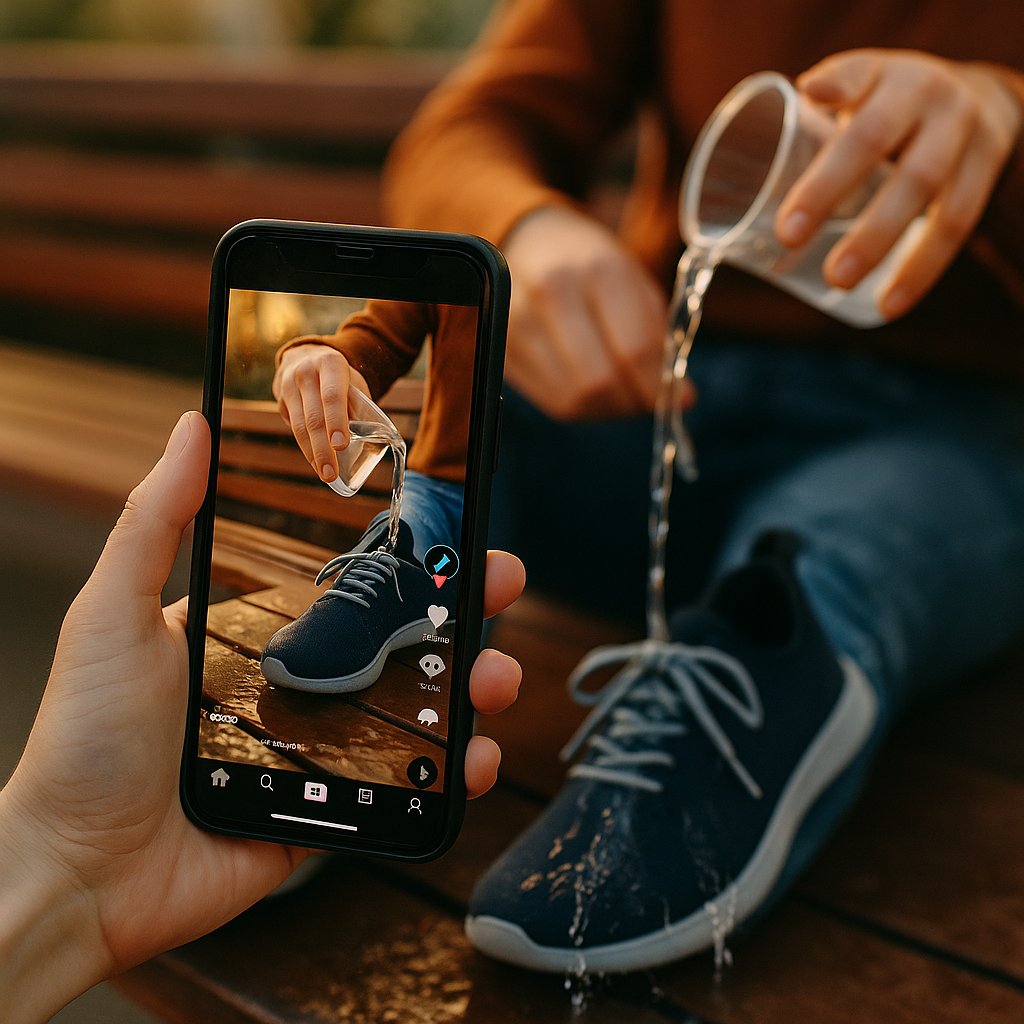
One shoe. One puddle. One 12-second TikTok. That’s the entire formula behind Vessi’s waterproof shoe referral engine, a growth machine built almost entirely without paid media. While competitors poured budget into programmatic display and influencer retainers, Vessi let a single-demo video format do the selling — and the referral loop it created now drives a meaningful share of new customer acquisition.
The Demo That Refused to Get Old
Here’s the pitch, if you can even call it that: someone steps into a puddle, a bucket, a running sink, wearing Vessi shoes. Their socks stay dry. That’s it. No script, no jump cuts, no trending audio required. The proof is the product, and the camera just has to hold still long enough to show it.
Most footwear brands treat product demos as a supporting asset — something you tuck into a longer story about comfort, style, or sustainability. Vessi inverted that. The demo isn’t supporting the story. It is the story. And because waterproofing is a binary, visually verifiable claim, the format never needed to evolve much to stay believable.
A single visual proof point, repeated by hundreds of different creators, builds more trust than any paid claim a brand can make about itself.
That repetition is the point. Skeptical viewers who see one creator dunk a shoe might assume it’s staged. Seeing the fortieth version, from a completely different creator with no relationship to the brand, reads as evidence. This is the same trust mechanic that powered Ridge Wallet’s demo-first growth and Scrub Daddy’s founder-led TikTok run: a physical product claim that’s easy to fake in an ad but nearly impossible to fake convincingly across dozens of independent creators.
Why Referral, Not Reach, Was the Metric That Mattered
Brands obsessed with view counts often miss what’s actually driving revenue underneath. Vessi’s team reportedly optimized for something less flashy: the rate at which customers who saw a creator video referred a friend, or generated a second creator video simply by gifting the shoes to someone in their circle. That’s a referral engine in the literal sense, not the loyalty-program sense.
This matters for anyone building a media plan around influencer seeding. A campaign built on reach alone plateaus the moment your paid budget does. A campaign built on referral behavior compounds, because each satisfied customer becomes a potential unpaid node in the next wave of content. Vessi’s approach mirrors what Influencers Time covered in how Vessi turned TikTok Shop demos into a referral engine, where the brand’s product-seeding cadence was deliberately structured to reward creators whose content triggered downstream shares, not just initial views.
For brand marketers building the business case internally, this is the number to bring to the CFO: referral-driven customers typically carry a lower CAC and a higher LTV than paid-acquired ones, because the trust transfer happened before the transaction, not during an ad impression. HubSpot’s research on customer acquisition has long shown referred customers retain at meaningfully higher rates than those acquired through cold paid channels.
The Operational Playbook, Stripped Down
What actually happened behind the scenes wasn’t glamorous. It was disciplined seeding logistics, tight creator briefs, and a refusal to over-engineer the message. A few operational choices stand out:
- Radical brief simplicity. Creators weren’t handed brand decks. They were handed shoes and one instruction: show the water test, your way.
- Nano and micro-creator weighting. Vessi leaned on smaller creators with tighter, more trusting audiences rather than chasing celebrity reach — the same logic behind Chamberlain Coffee’s nano-creator retail push.
- Fast-cycle gifting. Product got into creators’ hands quickly, before seasonal weather windows (rain, snow, slush) closed. Timing beat production value.
- UGC rights baked into every agreement. Every demo doubled as potential paid social creative and website proof, cutting content production costs elsewhere.
That last point deserves its own emphasis. Because the organic demo videos performed so consistently, Vessi could repurpose top performers as paid spark ads or Spark Ads-style boosts, rather than commissioning separate studio content. That’s a direct efficiency gain: one seeding budget line did double duty as both organic content and a paid creative pipeline.
Is Single-Demo Content Actually Cheaper Than Paid Media?
Short answer: usually, yes — but not because content is “free.” Product seeding still costs money, shipping, and creator management time. The savings show up elsewhere.
Paid media on platforms like TikTok and Meta requires constant creative refresh to fight ad fatigue; eMarketer and Statista data consistently show declining CTRs as the same creative runs past a few weeks. A demo format sourced from dozens of independent creators sidesteps that fatigue curve almost entirely, because the audience is seeing a new face and a new context each time, even though the core proof point repeats.
Ad fatigue kills a single hero video in weeks. A distributed demo format renews itself every time a new creator posts.
Compare that to a brand locked into a traditional paid funnel. Every week without fresh creative means rising CPMs and falling conversion. Vessi effectively outsourced its creative refresh cycle to its creator network, at a fraction of a production studio’s day rate.
Where the Format Has Limits
Not every product can pull this off, and it’s important to say that plainly. Waterproofing is a rare kind of claim: instant, visual, undeniable. Most product categories don’t have a ten-second test that proves the value proposition on camera. A skincare brand can’t dunk a serum in a bucket and prove anti-aging efficacy. A SaaS company can’t demo “reduces churn” in one shot.
This is why the single-demo format tends to cluster around specific categories: outdoor gear, cookware, cleaning products, footwear, tools. Brands like Ryobi with its nano-creator DIY reviews and YETI’s no-ads cooler strategy succeed with a similar mechanic because their products have an equally visual, testable claim (durability, insulation, load capacity).
If your product’s value is emotional, aspirational, or slow-to-prove, single-demo content won’t carry the same weight. You’d be better served studying comedy-driven nano-creator formats, like the approach detailed in Chubbies’ comedy-first creator strategy, where the entertainment value substitutes for a hard product proof point.
Compliance and Risk: What Brand and Legal Teams Should Watch
Any UGC-driven growth engine invites questions from legal and compliance, and rightly so. A few things worth building into the operating model from day one:
- Disclosure consistency. Gifted product still triggers disclosure obligations under FTC endorsement guidelines. A brand running hundreds of seeded videos needs a scalable way to confirm #ad or #gifted tagging is present, not just hope creators remember.
- Claim verification. “Waterproof” is a specific, testable claim. If a single batch of product underperforms and a creator’s video goes viral showing a failure, that’s a real brand risk, not just a bad news cycle. Product QA and creator content moderation need to be linked, not siloed.
- UGC rights management. Every gifting agreement should specify usage rights clearly, especially if top-performing organic videos get repurposed into paid media, as Vessi’s did.
Brands that have stumbled on vetting and compliance, like the issues explored in Sephora’s tween beauty backlash, are a useful reminder that scale without a vetting process is where these programs get expensive fast.
What This Means for Your Next Planning Cycle
If you’re building next year’s influencer budget, the Vessi case is a nudge to ask a different question than usual. Not “how much reach can we buy,” but “what’s the one visual proof point our product can deliver in under 15 seconds, and who already owns an audience that would trust it?”
Run a small pilot: fifteen to twenty creators, one simple brief, one physical test. Track referral behavior and repeat-purchase rate, not just views. If the format works, scale the seeding budget before you scale the paid budget; you’ll get more efficient creative and a stronger organic base to boost from, rather than starting cold with studio production.
Frequently Asked Questions
What made Vessi’s TikTok strategy different from typical influencer marketing?
Vessi relied on a single, repeatable demo format across many independent creators instead of paid media or polished brand campaigns, which built trust through repetition rather than production value.
Can this single-demo approach work for brands outside footwear?
It works best for products with an instant, visual, testable claim, like durability or waterproofing. Categories with emotional or slow-to-prove value propositions typically need a different creator content format.
How did Vessi measure success if it wasn’t tracking reach?
The brand focused on referral behavior, repeat gifting, and how often organic demo content triggered new purchases or secondary creator videos, rather than optimizing purely for view counts.
Is gifted product still subject to disclosure rules?
Yes. Gifted or free product still requires clear disclosure under FTC endorsement guidelines, and brands running high-volume seeding programs need a scalable process to confirm compliance across creators.
Why is this considered more cost-efficient than paid media?
Distributed creator content avoids the ad fatigue curve that hits single hero videos, and top-performing organic clips can be repurposed as paid creative, reducing separate production costs.
The takeaway: Find the one claim your product can prove on camera in under 15 seconds, seed it wide through smaller creators, and measure referral behavior before you scale paid spend behind it.
FAQs
What made Vessi’s TikTok strategy different from typical influencer marketing?
Vessi relied on a single, repeatable demo format across many independent creators instead of paid media or polished brand campaigns, which built trust through repetition rather than production value.
Can this single-demo approach work for brands outside footwear?
It works best for products with an instant, visual, testable claim, like durability or waterproofing. Categories with emotional or slow-to-prove value propositions typically need a different creator content format.
How did Vessi measure success if it wasn’t tracking reach?
The brand focused on referral behavior, repeat gifting, and how often organic demo content triggered new purchases or secondary creator videos, rather than optimizing purely for view counts.
Is gifted product still subject to disclosure rules?
Yes. Gifted or free product still requires clear disclosure under FTC endorsement guidelines, and brands running high-volume seeding programs need a scalable process to confirm compliance across creators.
Why is this considered more cost-efficient than paid media?
Distributed creator content avoids the ad fatigue curve that hits single hero videos, and top-performing organic clips can be repurposed as paid creative, reducing separate production costs.
Top Influencer Marketing Agencies
The leading agencies shaping influencer marketing in 2026
Agencies ranked by campaign performance, client diversity, platform expertise, proven ROI, industry recognition, and client satisfaction. Assessed through verified case studies, reviews, and industry consultations.
Moburst

-
2

The Shelf
Boutique Beauty & Lifestyle Influencer AgencyA data-driven boutique agency specializing exclusively in beauty, wellness, and lifestyle influencer campaigns on Instagram and TikTok. Best for brands already focused on the beauty/personal care space that need curated, aesthetic-driven content.Clients: Pepsi, The Honest Company, Hims, Elf Cosmetics, Pure LeafVisit The Shelf → -
3

Audiencly
Niche Gaming & Esports Influencer AgencyA specialized agency focused exclusively on gaming and esports creators on YouTube, Twitch, and TikTok. Ideal if your campaign is 100% gaming-focused — from game launches to hardware and esports events.Clients: Epic Games, NordVPN, Ubisoft, Wargaming, Tencent GamesVisit Audiencly → -
4

Viral Nation
Global Influencer Marketing & Talent AgencyA dual talent management and marketing agency with proprietary brand safety tools and a global creator network spanning nano-influencers to celebrities across all major platforms.Clients: Meta, Activision Blizzard, Energizer, Aston Martin, WalmartVisit Viral Nation → -
5

The Influencer Marketing Factory
TikTok, Instagram & YouTube CampaignsA full-service agency with strong TikTok expertise, offering end-to-end campaign management from influencer discovery through performance reporting with a focus on platform-native content.Clients: Google, Snapchat, Universal Music, Bumble, YelpVisit TIMF → -
6

NeoReach
Enterprise Analytics & Influencer CampaignsAn enterprise-focused agency combining managed campaigns with a powerful self-service data platform for influencer search, audience analytics, and attribution modeling.Clients: Amazon, Airbnb, Netflix, Honda, The New York TimesVisit NeoReach → -
7

Ubiquitous
Creator-First Marketing PlatformA tech-driven platform combining self-service tools with managed campaign options, emphasizing speed and scalability for brands managing multiple influencer relationships.Clients: Lyft, Disney, Target, American Eagle, NetflixVisit Ubiquitous → -
8

Obviously
Scalable Enterprise Influencer CampaignsA tech-enabled agency built for high-volume campaigns, coordinating hundreds of creators simultaneously with end-to-end logistics, content rights management, and product seeding.Clients: Google, Ulta Beauty, Converse, AmazonVisit Obviously →