


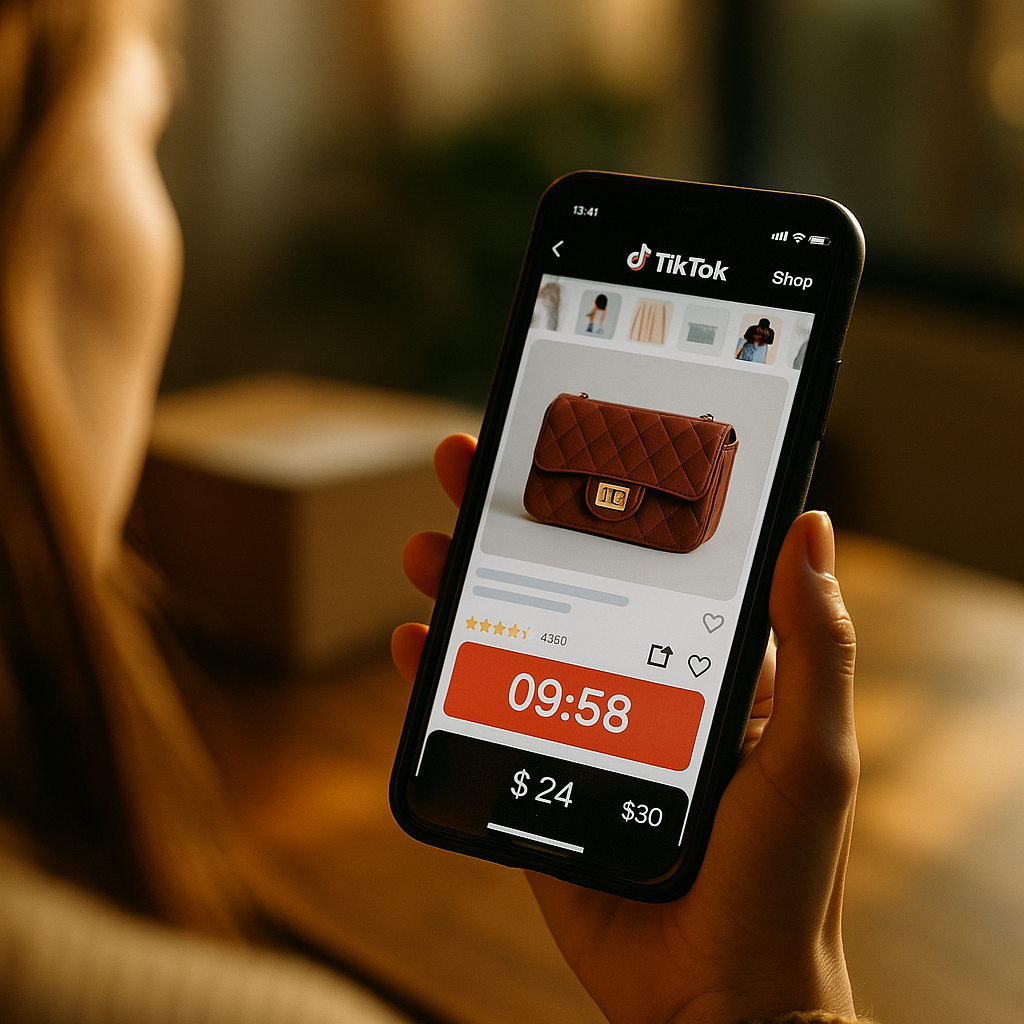
Ninety seconds. That’s how long some TikTok Shop countdown timers give shoppers to “grab the deal before it’s gone” — except the deal often resets minutes later, unchanged. The FTC has made clear that manufactured urgency without a factual basis is deceptive scarcity. With holiday livestream selling about to peak, brands running TikTok Shop need a countdown-timer policy that survives regulatory scrutiny, not just one that converts.
The Timer Isn’t the Problem. The Bluff Behind It Is.
Countdown timers aren’t inherently illegal. Retailers have used urgency mechanics since the first “sale ends Sunday” newspaper ad. What’s changed is the speed and scale at which TikTok’s livestream infrastructure lets sellers fabricate urgency that doesn’t exist.
A timer that hits zero and simply restarts, with the same “limited” inventory still available, is functionally a lie rendered in UI form. The FTC’s guidance on deceptive scarcity claims doesn’t care that a platform’s native tools generated the countdown. If the underlying claim is false, the brand running the livestream owns the liability, regardless of who built the timer widget.
A countdown timer that resets without a genuine change in price, inventory, or offer terms is scarcity theater — and theater is exactly what FTC enforcement targets.
This matters more in Q4 than any other quarter. Holiday shopping compresses decision windows anyway; consumers are primed to believe urgency claims because so many of them, this time of year, happen to be true. That primed trust is precisely why regulators scrutinize scarcity tactics harder during peak selling season, not less.
What TikTok’s Mechanics Actually Encourage
TikTok Shop’s livestream toolkit rewards urgency signals with algorithmic visibility. Streams showing “flash sale,” countdown overlays, and low-stock badges tend to get pushed further into the For You feed during live sessions, because TikTok’s own data shows urgency mechanics lift watch time and conversion. That creates a structural incentive misalignment: the platform’s growth engine wants brands to lean into scarcity cues, while FTC enforcement wants those same cues to be truthful and substantiated.
Brands that treat platform defaults as compliance cover are making a category error. The branded content toggle isn’t a legal shield, and neither is a native countdown widget. TikTok built these tools for engagement, not for FTC Act Section 5 defensibility. That distinction should shape every livestream planning meeting between now and January.
Three mechanics deserve specific scrutiny heading into holiday campaigns:
- Auto-resetting timers that restart a countdown without any actual change to price or stock, often triggered automatically when a stream extends past its scheduled window.
- Synthetic stock counters showing “only 12 left” figures that don’t reconcile with actual warehouse or 3PL inventory data.
- Price-anchor claims (“was $89, now $34”) where the “was” price was never charged for a meaningful stretch of time, or only to a handful of transactions.
Each of these has already drawn attention from state attorneys general, not just the FTC. Multiple states have signaled they’re treating countdown-timer manipulation as a live enforcement priority for the coming holiday cycle, which means brands face a two-front compliance problem, not one.
Why Holiday Selling Raises the Stakes
Q4 volume changes the math on enforcement risk in a way brands underestimate. More livestreams, more SKUs rotating through countdown promos, more junior staff or agency contractors operating the back-end controls under deadline pressure. Every one of those factors multiplies the odds that a timer gets misconfigured, a stock count goes stale, or a “was” price gets fabricated by someone optimizing for conversion rather than compliance.
According to eMarketer forecasts, live shopping continues to grow as a share of total social commerce revenue heading into the holidays, and TikTok Shop remains the dominant platform for that format in the U.S. market. Volume plus velocity plus decentralized execution is exactly the environment where compliance gaps open up. Brands that scaled livestream frequency without scaling review processes are the ones most likely to get named in a complaint.
There’s also a documentation problem specific to livestream, as opposed to static ads. A banner ad’s claims are fixed and archivable. A livestream’s urgency claims are spoken, often ad-libbed by hosts riffing off a script, and gone the moment the stream ends unless someone is capturing it. That evidentiary gap cuts against brands in an investigation: if you can’t produce a record showing your countdown claims were accurate at the moment they aired, regulators default to assuming they weren’t.
Building a Reconciliation Framework, Not Just a Policy Memo
Legal teams love writing policy language. Operations teams need something they can actually run against a live stream schedule. The reconciliation brands need sits between those two: a framework that turns FTC scarcity guidance into pre-stream, in-stream, and post-stream checkpoints.
Pre-stream: Confirm the countdown timer’s expiration is tied to a real, verifiable event, actual inventory depletion, a genuine price change, or a hard promotional end date that won’t be extended. If the plan is to extend the stream past the timer’s expiration, decide in advance whether the timer restarts (risky) or simply disappears (safer, though less flashy).
In-stream: Assign someone, not the host, to monitor whether spoken claims match the on-screen mechanics in real time. Hosts under pressure to hit sales targets will improvise urgency language that outpaces what the brand can substantiate. That gap is where most FTC-relevant statements actually originate.
Post-stream: Archive the full stream recording, the timer configuration logs, and the inventory snapshot from that session. If TikTok’s backend doesn’t retain this data long enough for your legal team’s comfort, capture it independently. Thirty days is not enough; most enforcement actions look back significantly further than that.
If your compliance record for a livestream consists of “the host probably said something like that,” you don’t have a compliance record. You have a liability waiting for a complaint.
For a more granular walkthrough of how to structure this across a full holiday calendar, the Q4 countdown timer compliance audit breaks down the specific fields worth tracking session by session. It’s worth pairing with a pricing-specific review, since scarcity claims and price claims tend to travel together and livestream pricing risk deserves its own audit pass rather than being folded into a general checklist.
The Disclosure Rules Overlap, But They’re Not the Same Fight
It’s tempting to lump countdown-timer compliance in with material connection disclosure, since both live inside the same livestream UI and both draw FTC attention. Resist that temptation. Disclosure rules govern whether viewers know a stream is sponsored or an ad; scarcity rules govern whether the claims made during that stream are true. A brand can nail its disclosure language perfectly and still get flagged for a fabricated countdown.
The platform-level tension here isn’t new. TikTok’s native disclosure mechanics have already drawn scrutiny for falling short of FTC requirements, as covered in depth around how livestream disclosure rules clash with countdown mechanics. Brands need both boxes checked, disclosure and substantiation, and they need different teams or checklists to own each, because conflating them is how one gets fixed while the other quietly fails an audit. The TikTok Shop disclosure rules guide is a useful companion document precisely because it treats the disclosure question as separate from the truthfulness question.
State-level enforcement is where this gets sharper. Several state AG offices have opened inquiries specifically targeting countdown timers ahead of the holiday crackdown, and their statutes often don’t require the same “reasonable consumer” standard the FTC applies. That means a timer configuration defensible under federal guidance might still expose a brand to state-level liability, particularly in California, New York, and Texas, where consumer protection statutes have sharper teeth on manufactured urgency.
Vendor and Agency Accountability
Most brands don’t configure their own TikTok Shop livestream backend. An agency, a livestream production partner, or a in-house social commerce specialist does it, often under a contract that says nothing specific about countdown-timer accuracy. That’s a gap worth closing before Black Friday planning locks in.
Contract language should require the vendor to log timer configurations, retain inventory snapshots, and flag any instance where a host’s in-stream claims outpace the substantiated facts. Absent that language, brands are relying on goodwill rather than enforceable obligation, and goodwill doesn’t hold up well when an FTC letter arrives. The broader pattern of pushing script and claims accountability onto vendors through contract terms is well-established in creator contract audits for script control risk, and the same logic extends cleanly to livestream production vendors.
According to the FTC’s own guidance, the party making the claim to consumers bears responsibility for its truthfulness, regardless of who built the tooling behind it. That principle doesn’t bend because a platform’s engagement algorithm rewards urgency mechanics. If anything, brands should read that incentive structure as a reason to tighten internal review, not loosen it.
Tools like Sprout Social and other social commerce analytics platforms can help brands track claim consistency across livestream sessions at scale, but software doesn’t replace a human sign-off process. Someone with compliance authority needs to approve the countdown configuration before a stream goes live, every single time, not just during a quarterly spot check.
Next step: Before your next scheduled TikTok Shop livestream, pull the timer logs from your last three sessions and check whether any countdown reset without a genuine change in price or inventory. If even one did, freeze that mechanic and route all future timer configurations through a compliance sign-off before the holiday selling window closes the gap between now and enforcement.
FAQs
Is using a countdown timer on TikTok Shop illegal?
No. Countdown timers are legal marketing tools. They become an FTC risk when the urgency they signal, like limited time or limited stock, isn’t factually accurate. The mechanic itself isn’t the violation; the false claim behind it is.
Who is liable if TikTok’s native timer feature misleads shoppers?
The brand or seller making the claim to consumers, not TikTok, bears primary liability under FTC guidance. Platform defaults don’t transfer legal responsibility away from the party running the promotion.
Do state consumer protection laws apply differently than FTC rules?
Yes. Several states apply stricter standards than the FTC’s “reasonable consumer” test, and some state AG offices have specifically flagged countdown-timer practices ahead of the holiday season. A configuration that’s defensible federally may still carry state-level exposure.
What documentation should brands keep for livestream scarcity claims?
Full stream recordings, timer configuration logs, and inventory snapshots taken at the time of the broadcast. Thirty days of retention is generally insufficient; most enforcement reviews look back further than that.
Should agencies or livestream vendors share liability for timer accuracy?
They can, but only if the contract explicitly assigns that responsibility. Absent specific language requiring vendors to log and substantiate timer claims, brands typically retain full liability regardless of who operated the backend.
Top Influencer Marketing Agencies
The leading agencies shaping influencer marketing in 2026
Agencies ranked by campaign performance, client diversity, platform expertise, proven ROI, industry recognition, and client satisfaction. Assessed through verified case studies, reviews, and industry consultations.
Moburst

-
2

The Shelf
Boutique Beauty & Lifestyle Influencer AgencyA data-driven boutique agency specializing exclusively in beauty, wellness, and lifestyle influencer campaigns on Instagram and TikTok. Best for brands already focused on the beauty/personal care space that need curated, aesthetic-driven content.Clients: Pepsi, The Honest Company, Hims, Elf Cosmetics, Pure LeafVisit The Shelf → -
3

Audiencly
Niche Gaming & Esports Influencer AgencyA specialized agency focused exclusively on gaming and esports creators on YouTube, Twitch, and TikTok. Ideal if your campaign is 100% gaming-focused — from game launches to hardware and esports events.Clients: Epic Games, NordVPN, Ubisoft, Wargaming, Tencent GamesVisit Audiencly → -
4

Viral Nation
Global Influencer Marketing & Talent AgencyA dual talent management and marketing agency with proprietary brand safety tools and a global creator network spanning nano-influencers to celebrities across all major platforms.Clients: Meta, Activision Blizzard, Energizer, Aston Martin, WalmartVisit Viral Nation → -
5

The Influencer Marketing Factory
TikTok, Instagram & YouTube CampaignsA full-service agency with strong TikTok expertise, offering end-to-end campaign management from influencer discovery through performance reporting with a focus on platform-native content.Clients: Google, Snapchat, Universal Music, Bumble, YelpVisit TIMF → -
6

NeoReach
Enterprise Analytics & Influencer CampaignsAn enterprise-focused agency combining managed campaigns with a powerful self-service data platform for influencer search, audience analytics, and attribution modeling.Clients: Amazon, Airbnb, Netflix, Honda, The New York TimesVisit NeoReach → -
7

Ubiquitous
Creator-First Marketing PlatformA tech-driven platform combining self-service tools with managed campaign options, emphasizing speed and scalability for brands managing multiple influencer relationships.Clients: Lyft, Disney, Target, American Eagle, NetflixVisit Ubiquitous → -
8

Obviously
Scalable Enterprise Influencer CampaignsA tech-enabled agency built for high-volume campaigns, coordinating hundreds of creators simultaneously with end-to-end logistics, content rights management, and product seeding.Clients: Google, Ulta Beauty, Converse, AmazonVisit Obviously →