


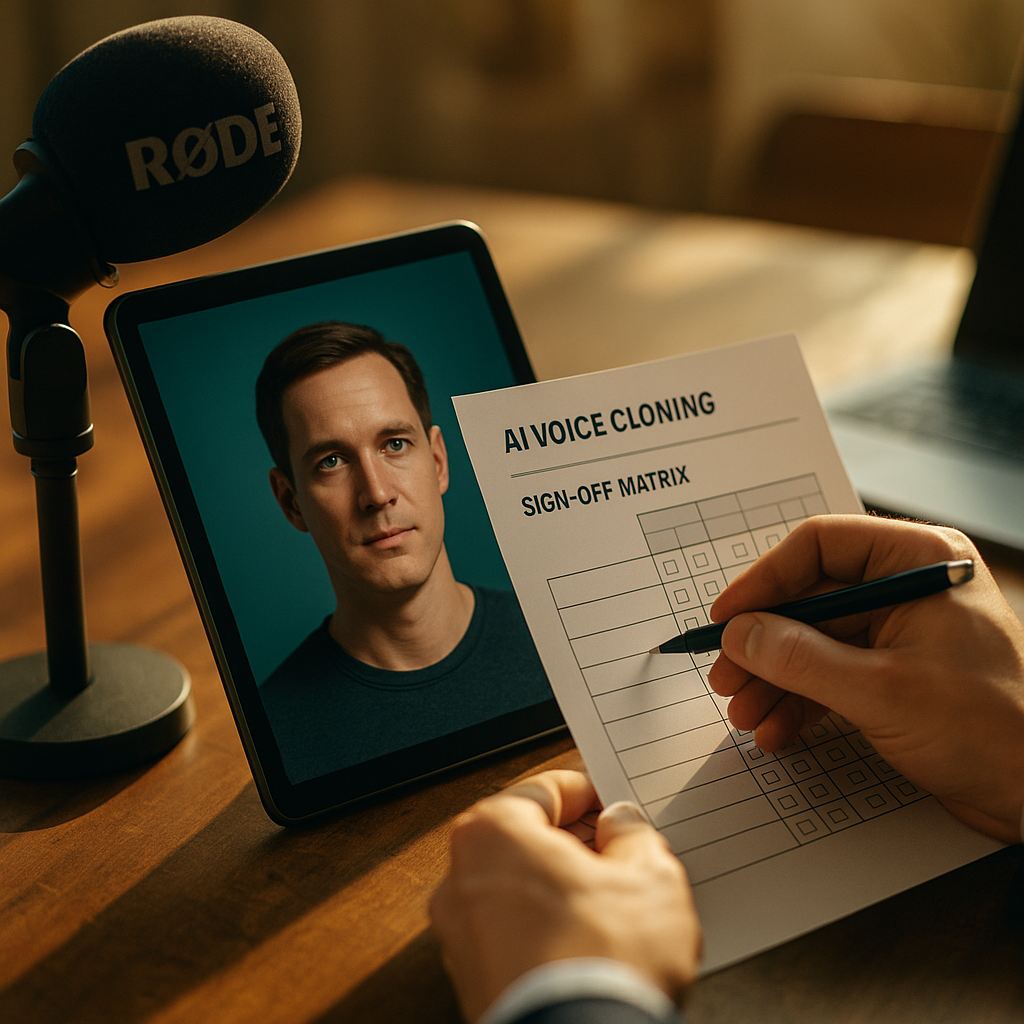
Seventeen states now recognize some form of postmortem or expanded right-of-publicity protection, and at least a dozen have introduced AI-specific voice and likeness bills since last year. If your brand is dubbing creator content into five languages using synthetic voice clones, you’re not running one campaign — you’re running seventeen-plus legal exposures simultaneously. A pre-campaign legal sign-off matrix isn’t optional anymore. It’s the only thing standing between your global content calendar and a state attorney general’s inbox.
Why This Problem Snuck Up on Marketing Teams
Two years ago, “dubbing” meant hiring voice actors or using clunky text-to-speech that nobody mistook for the real creator. Now tools like ElevenLabs, Respeecher, and HeyGen can clone a creator’s actual voice and reproduce it fluently in Spanish, Hindi, Portuguese, or Japanese — with the creator’s original cadence and emotional inflection intact. That’s a massive win for global reach. It’s also a legal minefield most brand teams weren’t staffed to handle.
The core issue: voice cloning implicates right-of-publicity law differently than image or video likeness does, and publicity rights are governed almost entirely at the state level in the US, with wildly inconsistent standards. Tennessee’s ELVIS Act explicitly protects voice as a property right. New York’s synthetic performer statute layers on additional consent requirements for digital replicas. California’s post-Bonner amendments extend publicity protection well beyond a creator’s home state if the content reaches California consumers — which, on the internet, it always does.
A single dubbed asset distributed across six markets can trigger six different consent, disclosure, and licensing obligations — and most brands only have paperwork for one of them.
What a Legal Sign-Off Matrix Actually Is
Think of it less as a legal document and more as an operational gate. A sign-off matrix maps every piece of dubbed content against the specific legal requirements triggered by (a) the creator’s state of residence or contract governing law, (b) the states/countries where the content will run, and (c) the type of AI voice technology used. No content moves to publishing until every applicable box is checked and signed by the right stakeholder.
In practice, it’s a spreadsheet or workflow tool — Airtable, Monday, or a custom Notion database work fine — with columns like: creator name, home jurisdiction, target markets, voice-cloning vendor, consent scope, disclosure language required, and sign-off owner. Simple in concept. Brutal in execution if you don’t build it before the campaign launches.
The Core Columns Every Matrix Needs
- Creator jurisdiction: State/country of residence and the contract’s governing law clause — these can differ.
- Distribution jurisdictions: Every state or country where the dubbed asset will run, including paid amplification.
- Voice consent scope: Does the original agreement cover AI cloning, or just the creator’s live voice performance?
- Disclosure requirements: Does the target state or platform require an “AI-generated” or “synthetic voice” label?
- Vendor data terms: Does the cloning tool’s ToS grant the brand ownership of the trained voice model, or just a license?
- Sign-off owner: Legal, brand marketing, and often a regional compliance lead for markets like the EU or Brazil.
Right-of-Publicity States Are Not Interchangeable
This is where most matrices fail before they start. Teams assume “we got a signed release” covers them everywhere. It doesn’t. Publicity rights vary on three axes that matter enormously for dubbing: whether voice is explicitly protected (not all states name it), whether consent must be in writing and specific to the use, and whether the right survives the creator’s death or contract termination.
Tennessee, New York, and California currently have the most aggressive statutory language around synthetic voice and digital replicas. Illinois and Washington add biometric-adjacent protections that some plaintiffs’ attorneys are already testing against voice clones, arguing a cloned voiceprint functions like a biometric identifier. That argument hasn’t been fully tested in court, but it doesn’t need to win to cost you a six-figure legal bill defending it.
Compare that to states with narrower, name-and-likeness-only statutes that haven’t updated language for AI. A creator based in Texas dubbed into a campaign running in California and New York needs sign-off checked against both destination states’ rules, not just their home state’s. Distribution jurisdiction, not creator residence, usually drives the stricter standard.
This mirrors a pattern our team flagged when covering how synthetic performer law intersects with platform AI labels — the legal requirement and the platform’s own disclosure policy often don’t match, and brands get caught satisfying one while violating the other.
Build the Matrix Before You Sign the Vendor Contract
Here’s the sequencing mistake that trips up otherwise sophisticated teams: they select the voice-cloning vendor, build the campaign, dub the content, and only then loop in legal for a pre-launch review. By that point, changing consent scope or renegotiating creator terms means blowing the launch date.
Flip the order. Legal sign-off criteria should inform vendor selection and creator contracting, not follow it.
Practically, that means three things happen before creative production starts:
- Audit existing creator contracts for AI voice cloning language. Most agreements signed before last year say nothing about synthetic replication — silence is not consent, and several state courts have started treating it that way explicitly.
- Confirm vendor data rights. Read the cloning tool’s terms of service for who owns the trained model. Some platforms retain rights to reuse voice data for training their own systems, which can violate the underlying creator consent you obtained.
- Map target markets against right-of-publicity strength before locking the media plan, so legal isn’t reacting to a distribution list handed to them the week of launch.
This is the same discipline we’ve recommended for auditing creator contracts for script control risk — the earlier legal gets structural visibility, the fewer expensive surprises later.
Consent Language That Actually Holds Up
Generic “brand may use creator’s likeness in marketing materials” language, still common in mid-market influencer contracts, does not cover AI voice cloning in most right-of-publicity states. Courts and regulators are increasingly reading “likeness” narrowly when a new technology wasn’t reasonably contemplated at signing.
What actually holds up: explicit reference to “synthetic,” “AI-generated,” or “digitally cloned” voice, a defined scope of permitted languages and markets, a term limit (perpetual grants are getting challenged more often), and a clear revocation mechanism. Tennessee’s ELVIS Act in particular expects specificity — vague catch-all clauses are exactly what the statute was written to defeat.
If you’re retrofitting older creator agreements, don’t try to reinterpret existing language. Get a signed addendum specific to AI voice cloning. It’s a smaller lift than it sounds, and it closes the exact gap that’s created liability for brands using AI voice cloning consent for employee testimonials — a closely related problem where internal legal teams assumed employment agreements already covered synthetic media use. They didn’t.
Disclosure Rules Multiply the Complexity
Consent and disclosure are separate obligations, and brands routinely conflate them. Getting a creator’s permission to clone their voice doesn’t satisfy an FTC or state-level requirement to disclose that the audio was synthetically generated. The FTC’s updated guidance on endorsements already treats undisclosed AI-generated content as a deceptive practice risk, an issue we broke down in depth when the testimonial rule expanded to cover AI avatars.
Your matrix needs a dedicated disclosure column separate from consent, because the answer to “can we legally clone this voice” and “must we tell the audience it’s cloned” are entirely different questions with different owners and different failure modes.
For multilingual campaigns, disclosure language itself needs localization review. A disclosure disclaimer that satisfies FTC standards in English might not meet equivalent transparency rules under EU digital services regulations or country-specific advertising codes once translated. This is a good moment to loop in the same compliance muscle brands use for cross-border regulatory compliance — the localization problem is structurally similar.
Operationalizing Sign-Off Without Killing Your Timeline
Legal teams get a bad reputation for being launch blockers, usually because they’re brought in too late to move fast. A well-built matrix flips that dynamic. If sign-off criteria are pre-defined and mapped to jurisdiction before production starts, the actual review at launch becomes a checklist exercise, not a fire drill.
Set a service-level target: 48 hours for a matrix-compliant asset moving through final review, versus the 2-3 week scramble that happens when legal is discovering jurisdictional issues asset-by-asset. Assign a single owner — often brand marketing operations, not legal — to maintain the matrix and flag gaps before they become blockers.
According to eMarketer, marketers are accelerating adoption of AI dubbing and synthetic voice tools faster than internal compliance processes are maturing to match — a gap that shows up first in multilingual, multi-market campaigns precisely because the jurisdictional surface area is so much larger. Data from Statista on generative AI adoption in marketing shows similar acceleration, with legal and compliance functions consistently cited as lagging indicators rather than leading ones.
What Happens When You Skip This
The failure mode isn’t hypothetical. Right-of-publicity claims related to AI voice and likeness have already produced settlements in the low millions, and state AGs in Tennessee and California have signaled active interest in enforcement against brands, not just tool vendors. The FTC has also made clear that “the vendor did it” isn’t a defense brands can rely on — the advertiser remains responsible for the endorsement’s accuracy and disclosure, full stop.
Insurance is starting to catch up too. Some media liability policies now explicitly exclude claims arising from unlicensed AI voice replication, which means the financial exposure sits with the brand, not a carrier, if the paperwork wasn’t in order beforehand.
Next Step
Don’t wait for a campaign to force this. Pull your last three multilingual dubbing projects, run them retroactively through a jurisdiction-by-jurisdiction consent and disclosure check, and you’ll likely find at least one gap that would have stalled launch or worse. Build the matrix now, while it’s a planning exercise instead of a crisis response.
FAQs
What is a pre-campaign legal sign-off matrix?
It’s a structured review process, usually a spreadsheet or workflow tool, that maps each piece of AI-dubbed content against the specific consent, disclosure, and licensing requirements triggered by the creator’s jurisdiction and every market where the content will run. Content doesn’t move to publishing until each applicable requirement is checked and signed off by the responsible stakeholder.
Which US states have the strictest right-of-publicity laws for AI voice cloning?
Tennessee’s ELVIS Act, New York’s synthetic performer statute, and California’s expanded publicity provisions are currently the most explicit about protecting voice and digital replicas. Illinois and Washington also carry biometric-adjacent protections that plaintiffs’ attorneys have begun applying to voice cloning cases.
Does a standard influencer contract cover AI voice cloning?
Usually not. Most agreements signed before AI dubbing tools became mainstream reference “likeness” broadly but don’t mention synthetic or AI-generated voice specifically. Courts in several states have started treating that silence as insufficient consent, which means brands need signed addenda specific to AI voice cloning use.
Is creator consent the same as disclosure compliance?
No. Consent covers whether the brand has legal permission to clone and use a creator’s voice. Disclosure covers whether the audience must be told the audio is AI-generated. Both are required in most cases, but they’re governed by different rules and often owned by different teams internally.
How does distribution jurisdiction affect compliance obligations?
The strictest applicable law usually wins. If a creator is based in a state with minimal publicity protections but the dubbed content runs in California, New York, or Tennessee, the campaign must meet those states’ consent and disclosure standards regardless of where the creator lives or where the contract was signed.
Who should own the sign-off matrix internally?
Legal should define the compliance criteria, but a brand marketing operations lead typically owns the day-to-day matrix maintenance and pre-launch checklist process. This keeps legal review fast and predictable instead of becoming a bottleneck discovered at the last minute.
FAQs
What is a pre-campaign legal sign-off matrix?
It’s a structured review process, usually a spreadsheet or workflow tool, that maps each piece of AI-dubbed content against the specific consent, disclosure, and licensing requirements triggered by the creator’s jurisdiction and every market where the content will run. Content doesn’t move to publishing until each applicable requirement is checked and signed off by the responsible stakeholder.
Which US states have the strictest right-of-publicity laws for AI voice cloning?
Tennessee’s ELVIS Act, New York’s synthetic performer statute, and California’s expanded publicity provisions are currently the most explicit about protecting voice and digital replicas. Illinois and Washington also carry biometric-adjacent protections that plaintiffs’ attorneys have begun applying to voice cloning cases.
Does a standard influencer contract cover AI voice cloning?
Usually not. Most agreements signed before AI dubbing tools became mainstream reference “likeness” broadly but don’t mention synthetic or AI-generated voice specifically. Courts in several states have started treating that silence as insufficient consent, which means brands need signed addenda specific to AI voice cloning use.
Is creator consent the same as disclosure compliance?
No. Consent covers whether the brand has legal permission to clone and use a creator’s voice. Disclosure covers whether the audience must be told the audio is AI-generated. Both are required in most cases, but they’re governed by different rules and often owned by different teams internally.
How does distribution jurisdiction affect compliance obligations?
The strictest applicable law usually wins. If a creator is based in a state with minimal publicity protections but the dubbed content runs in California, New York, or Tennessee, the campaign must meet those states’ consent and disclosure standards regardless of where the creator lives or where the contract was signed.
Who should own the sign-off matrix internally?
Legal should define the compliance criteria, but a brand marketing operations lead typically owns the day-to-day matrix maintenance and pre-launch checklist process. This keeps legal review fast and predictable instead of becoming a bottleneck discovered at the last minute.
Top Influencer Marketing Agencies
The leading agencies shaping influencer marketing in 2026
Agencies ranked by campaign performance, client diversity, platform expertise, proven ROI, industry recognition, and client satisfaction. Assessed through verified case studies, reviews, and industry consultations.
Moburst

-
2

The Shelf
Boutique Beauty & Lifestyle Influencer AgencyA data-driven boutique agency specializing exclusively in beauty, wellness, and lifestyle influencer campaigns on Instagram and TikTok. Best for brands already focused on the beauty/personal care space that need curated, aesthetic-driven content.Clients: Pepsi, The Honest Company, Hims, Elf Cosmetics, Pure LeafVisit The Shelf → -
3

Audiencly
Niche Gaming & Esports Influencer AgencyA specialized agency focused exclusively on gaming and esports creators on YouTube, Twitch, and TikTok. Ideal if your campaign is 100% gaming-focused — from game launches to hardware and esports events.Clients: Epic Games, NordVPN, Ubisoft, Wargaming, Tencent GamesVisit Audiencly → -
4

Viral Nation
Global Influencer Marketing & Talent AgencyA dual talent management and marketing agency with proprietary brand safety tools and a global creator network spanning nano-influencers to celebrities across all major platforms.Clients: Meta, Activision Blizzard, Energizer, Aston Martin, WalmartVisit Viral Nation → -
5

The Influencer Marketing Factory
TikTok, Instagram & YouTube CampaignsA full-service agency with strong TikTok expertise, offering end-to-end campaign management from influencer discovery through performance reporting with a focus on platform-native content.Clients: Google, Snapchat, Universal Music, Bumble, YelpVisit TIMF → -
6

NeoReach
Enterprise Analytics & Influencer CampaignsAn enterprise-focused agency combining managed campaigns with a powerful self-service data platform for influencer search, audience analytics, and attribution modeling.Clients: Amazon, Airbnb, Netflix, Honda, The New York TimesVisit NeoReach → -
7

Ubiquitous
Creator-First Marketing PlatformA tech-driven platform combining self-service tools with managed campaign options, emphasizing speed and scalability for brands managing multiple influencer relationships.Clients: Lyft, Disney, Target, American Eagle, NetflixVisit Ubiquitous → -
8

Obviously
Scalable Enterprise Influencer CampaignsA tech-enabled agency built for high-volume campaigns, coordinating hundreds of creators simultaneously with end-to-end logistics, content rights management, and product seeding.Clients: Google, Ulta Beauty, Converse, AmazonVisit Obviously →