


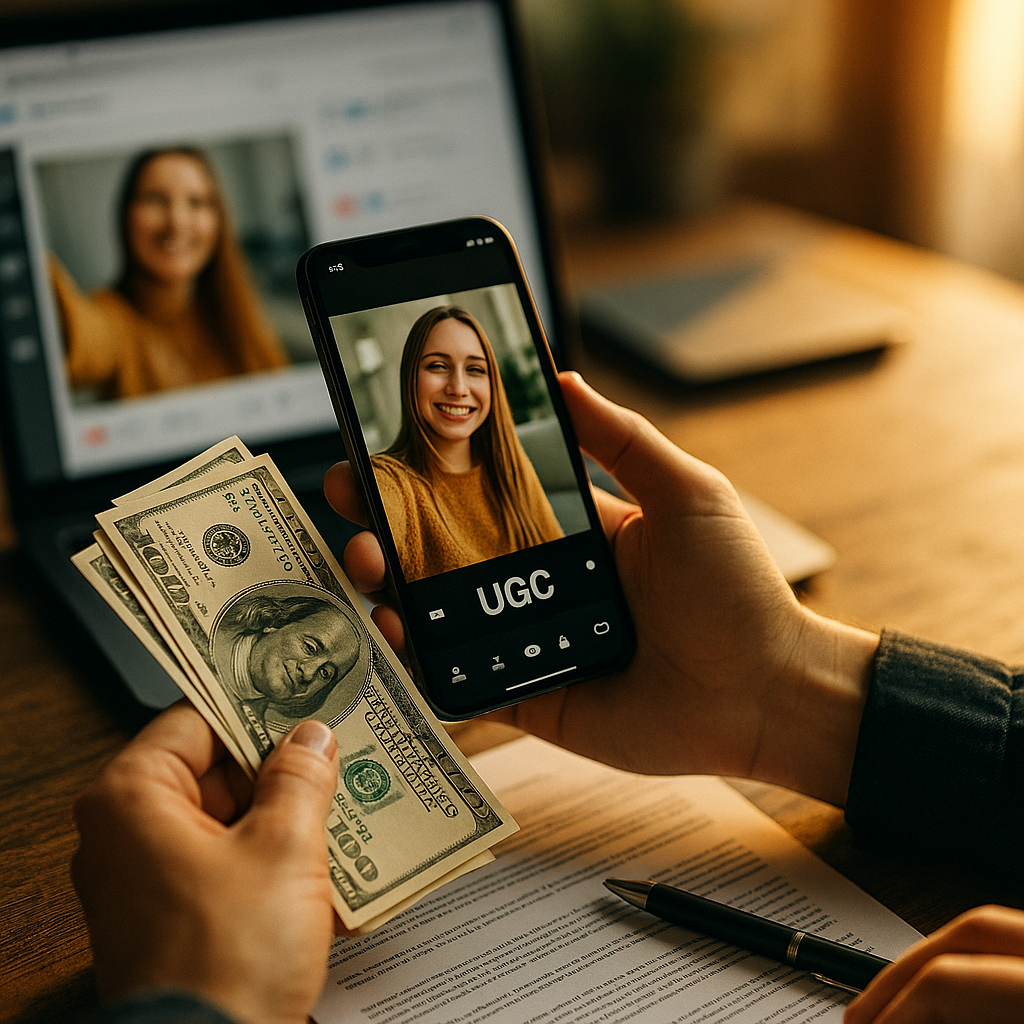
Roughly 60-70% of UGC budget disputes in 2026 aren’t about the content fee at all. They’re about what happens after the video ships — who can run it as an ad, for how long, and on which platforms. If your usage-rights fees line item is still a vague afterthought in your creator contracts, you’re not budgeting. You’re gambling.
Why Usage Rights Broke the Old UGC Pricing Model
Three years ago, most short-form UGC deals were simple: pay a flat fee, get a vertical video, maybe run it organically on the brand handle. Paid amplification wasn’t standard practice. Now it’s the default. Brands are boosting creator content through Spark Ads, Meta’s branded content tools, and whitelisting arrangements as a matter of course — because organic reach on TikTok and Instagram keeps shrinking and paid distribution is the only reliable lever left.
That shift changed the economics entirely. A creator who once charged $400 for a 30-second UGC clip now reasonably asks: are you paying me to make content, or are you paying me to advertise with my face and voice for the next six months? Those are different products with different risk profiles, and pricing them identically is how brands end up in renegotiation fights or, worse, takedown notices.
If you’re not separating creation fees from usage fees in your contract line items, you’re underpricing risk and overpaying for content you may not even need.
What Usage Rights Actually Cover (And What They Don’t)
Usage rights govern where, how long, and in what format a brand can use creator-generated content beyond the creator’s own organic post. This is distinct from ownership. Most UGC agreements grant a license, not a copyright transfer — the creator retains ownership unless the contract explicitly states otherwise (and full buyouts cost significantly more).
Key variables that determine the fee:
- Duration: 30-day, 90-day, 6-month, and perpetual licenses each carry different price points. A 90-day license typically runs 1.5x to 2x a 30-day rate.
- Platform scope: Organic-only, paid social (Spark Ads, Meta ads), or cross-platform including connected TV and web.
- Exclusivity: Does the creator agree not to promote competitor products during the license window? That’s a separate negotiation entirely.
- Whitelisting/spark ads access: Running ads from the creator’s own handle (using their ad account permissions) commands a premium over content-only usage because it borrows their credibility and follower trust signal.
- Territory: Global usage vs. single-market usage matters more for brands running international paid campaigns.
Here’s the part that trips up procurement teams: usage rights and paid amplification are related but not the same line item. You can license content for paid use without ever running a single dollar of ad spend behind it. Conversely, you can run amplification against content where usage terms were vague, and that’s a compliance landmine — the FTC has been explicit that disclosure and consent obligations follow the content wherever it’s distributed, paid or organic.
Building the Cost Model: A Three-Layer Framework
Stop thinking of UGC pricing as one number. Model it in three layers, and negotiate each one separately.
Layer 1: Base production fee. This covers the creator’s time, creative labor, and a single organic post on their own channel. Rates vary wildly by niche and follower count, but most brands are seeing base fees of $150-$600 for a single 15-30 second vertical video from a mid-tier creator (10K-100K followers), per benchmarks tracked by eMarketer and corroborated in agency rate cards circulating this year.
Layer 2: Usage license fee. This is where the real budget conversation happens. A reasonable industry heuristic: a 90-day paid usage license adds 50-100% on top of the base fee. Perpetual or evergreen licenses can run 2-3x base. If you’re licensing for whitelisting (running ads through the creator’s handle), add another 20-40% because you’re also borrowing their account’s trust equity and algorithmic standing.
Layer 3: Amplification spend itself. This isn’t a fee to the creator — it’s your media budget. But it needs to be modeled alongside usage fees because the two decisions are interdependent. There’s no point paying for a 6-month usage license if your media budget only supports a 6-week flight.
For teams that have already mapped out how amplification budgets interact with sponsorship spend more broadly, the analysis in modeling the amplification vs sponsorship spend crossover is a useful companion framework — it addresses the macro budget split, while this piece addresses the per-asset pricing mechanics underneath it.
A Worked Example
Say you’re running a Q1 launch campaign with 20 UGC creators, each producing one 15-second vertical video.
- Base fee: $350 average × 20 = $7,000
- 90-day paid usage license (+75% average): $5,250
- Whitelisting on 8 of the 20 creators (+30% on those 8 base fees): $840
- Total creator-side cost: $13,090
- Amplification media budget (separate line): $25,000 across TikTok and Meta paid
Total program cost: $38,090. Notice that usage rights and whitelisting nearly double the creator-side spend compared to a content-only deal. That’s not a rounding error — it’s the single biggest variable most brands still underestimate when they build campaign budgets off last year’s rate cards.
If your finance team is asking why UGC costs have crept up year over year without a proportional increase in output volume, this is usually the answer. It’s not inflation. It’s usage-rights maturity catching up to how the content actually gets used.
Should You Negotiate Flat Buyouts or Tiered Licenses?
Flat buyouts (perpetual, all-platform, unlimited usage) feel simpler on paper. One invoice, no renewal tracking, no expiration risk. But they’re expensive upfront — often 3-4x a base production fee — and they lock you into paying full price even if the content underperforms and you never actually run paid media behind it.
Tiered licensing is more operationally complex but far more capital-efficient. Start with a 30-day paid license. If the content performs (strong CTR, low CPA, positive brand lift), extend to 90 days or a full quarter at a pre-negotiated renewal rate. This mirrors the logic already common in cost-per-view contract structures, where pay scales with proven performance rather than upfront speculation.
The tradeoff: tiered licensing requires a tracking system. Someone on your team (or your agency of record) needs to own a calendar of license expirations, or you’ll end up running ads against expired usage terms — a real legal exposure, not a theoretical one.
Where Brands Get This Wrong
Three recurring mistakes show up across contracts we’ve reviewed in the trade:
- Treating usage as implied. Some brands assume that once they’ve paid for content, they can run it anywhere, indefinitely. Absent explicit contract language, that assumption is false and creates real legal exposure — creators and their agents increasingly know this and will send cease-and-desist notices when paid usage exceeds licensed terms.
- Under-pricing whitelisting. Running ads through a creator’s own account isn’t the same as running ads with their content on your brand handle. It carries platform-specific permissions, and creators are increasingly aware that whitelisting access has standalone market value — separate from the content fee entirely.
- No renewal workflow. Licenses expire. If your ad ops team doesn’t have a system flagging expiration dates, you’ll either pay penalty renewal rates under duress or get caught running unlicensed content — both are avoidable with basic contract ops discipline.
These aren’t edge cases. They’re the norm at brands that haven’t yet formalized their UGC procurement process. If you’re still working off ad hoc rate negotiations per creator, it’s worth benchmarking against a standardized structure — see the UGC rate card template covering base fees vs usage add-ons for a starting framework you can adapt.
How This Fits Into the Broader Budget Conversation
Usage-rights modeling doesn’t happen in a vacuum. It needs to connect to how your finance team thinks about payback windows and contract structures more broadly — the CFO framework for creator contract payback windows is directly relevant here, since usage license length is effectively a payback-period decision in disguise. A 6-month license only makes financial sense if you can demonstrate ROI within that window; otherwise you’re pre-paying for optionality you won’t use.
It also intersects with platform risk. If you’re licensing content specifically for TikTok Spark Ads and the platform’s operating status shifts (regulatory, algorithmic, or otherwise), your usage investment is exposed. Teams managing this exposure should cross-reference their platform dependency risk register before locking in long-duration, single-platform licenses. Diversifying usage rights across TikTok and Meta simultaneously — rather than platform-exclusive deals — is increasingly the safer default, especially given the volatility discussed in how brands are reassessing TikTok ad spend risk.
One more consideration: algorithmic volatility affects how long content stays relevant, which in turn affects whether a long usage license is even worth the premium. If organic reach patterns shift every few months, per the analysis in budgeting for algorithm volatility on TikTok and Instagram, a shorter, renewable license may actually be the more defensible financial choice — even if it means more contract admin.
Building Your Own Rate Card
Start simple. Pick three usage tiers: organic-only, 90-day paid, and 6-month paid with whitelisting option. Price each as a percentage multiplier over your base production fee, benchmarked against current creator rates in your niche (check Sprout Social’s creator economy reporting and Meta Business guidance on branded content ads for platform-specific requirements). Get legal to draft standard language for each tier once, rather than negotiating from scratch on every deal — that alone will save more budget than most fee negotiations.
Then track actual performance against license spend. If you’re consistently letting 90-day licenses lapse unused after 30 days, you’re overpaying for optionality. Adjust the model. This is a living cost structure, not a one-time contract template.
Next step: Audit your last five UGC contracts this week. If usage terms and amplification rights aren’t itemized as separate fees with explicit duration and platform scope, renegotiate before your next campaign — not after a takedown notice forces the conversation.
FAQs
What’s the difference between a usage-rights fee and a paid amplification fee?
A usage-rights fee pays the creator for permission to run their content as an ad or reuse it beyond their organic post. Paid amplification is your separate media spend — what you pay platforms like TikTok or Meta to actually distribute that content. One is a licensing cost, the other is a media buy.
How much should a 90-day paid usage license cost compared to the base production fee?
Industry norms in 2026 suggest a 50-100% premium over the base production fee for a 90-day paid usage license, though rates vary by creator tier, platform, and whether whitelisting is included.
Do I need a separate fee for whitelisting or Spark Ads access?
Yes. Whitelisting grants access to run ads through the creator’s own account, which carries additional value beyond content usage alone. Expect to pay an additional 20-40% on top of the base fee for this permission.
What happens if I run paid ads against content without a usage license?
You risk contract breach claims, creator-initiated takedown requests, and potential FTC disclosure exposure if the paid usage wasn’t properly consented to and disclosed. It can also damage your standing with creator talent and agencies for future deals.
Should smaller brands bother with tiered licensing, or just do flat buyouts?
Tiered licensing is more cost-efficient for most brands because it ties spend to proven performance rather than paying upfront for usage you might not need. Flat buyouts make sense mainly for evergreen brand content with long-term, multi-platform use cases.
FAQs
What’s the difference between a usage-rights fee and a paid amplification fee?
A usage-rights fee pays the creator for permission to run their content as an ad or reuse it beyond their organic post. Paid amplification is your separate media spend — what you pay platforms like TikTok or Meta to actually distribute that content. One is a licensing cost, the other is a media buy.
How much should a 90-day paid usage license cost compared to the base production fee?
Industry norms in 2026 suggest a 50-100% premium over the base production fee for a 90-day paid usage license, though rates vary by creator tier, platform, and whether whitelisting is included.
Do I need a separate fee for whitelisting or Spark Ads access?
Yes. Whitelisting grants access to run ads through the creator’s own account, which carries additional value beyond content usage alone. Expect to pay an additional 20-40% on top of the base fee for this permission.
What happens if I run paid ads against content without a usage license?
You risk contract breach claims, creator-initiated takedown requests, and potential FTC disclosure exposure if the paid usage wasn’t properly consented to and disclosed. It can also damage your standing with creator talent and agencies for future deals.
Should smaller brands bother with tiered licensing, or just do flat buyouts?
Tiered licensing is more cost-efficient for most brands because it ties spend to proven performance rather than paying upfront for usage you might not need. Flat buyouts make sense mainly for evergreen brand content with long-term, multi-platform use cases.
Top Influencer Marketing Agencies
The leading agencies shaping influencer marketing in 2026
Agencies ranked by campaign performance, client diversity, platform expertise, proven ROI, industry recognition, and client satisfaction. Assessed through verified case studies, reviews, and industry consultations.
Moburst

-
2

The Shelf
Boutique Beauty & Lifestyle Influencer AgencyA data-driven boutique agency specializing exclusively in beauty, wellness, and lifestyle influencer campaigns on Instagram and TikTok. Best for brands already focused on the beauty/personal care space that need curated, aesthetic-driven content.Clients: Pepsi, The Honest Company, Hims, Elf Cosmetics, Pure LeafVisit The Shelf → -
3

Audiencly
Niche Gaming & Esports Influencer AgencyA specialized agency focused exclusively on gaming and esports creators on YouTube, Twitch, and TikTok. Ideal if your campaign is 100% gaming-focused — from game launches to hardware and esports events.Clients: Epic Games, NordVPN, Ubisoft, Wargaming, Tencent GamesVisit Audiencly → -
4

Viral Nation
Global Influencer Marketing & Talent AgencyA dual talent management and marketing agency with proprietary brand safety tools and a global creator network spanning nano-influencers to celebrities across all major platforms.Clients: Meta, Activision Blizzard, Energizer, Aston Martin, WalmartVisit Viral Nation → -
5

The Influencer Marketing Factory
TikTok, Instagram & YouTube CampaignsA full-service agency with strong TikTok expertise, offering end-to-end campaign management from influencer discovery through performance reporting with a focus on platform-native content.Clients: Google, Snapchat, Universal Music, Bumble, YelpVisit TIMF → -
6

NeoReach
Enterprise Analytics & Influencer CampaignsAn enterprise-focused agency combining managed campaigns with a powerful self-service data platform for influencer search, audience analytics, and attribution modeling.Clients: Amazon, Airbnb, Netflix, Honda, The New York TimesVisit NeoReach → -
7

Ubiquitous
Creator-First Marketing PlatformA tech-driven platform combining self-service tools with managed campaign options, emphasizing speed and scalability for brands managing multiple influencer relationships.Clients: Lyft, Disney, Target, American Eagle, NetflixVisit Ubiquitous → -
8

Obviously
Scalable Enterprise Influencer CampaignsA tech-enabled agency built for high-volume campaigns, coordinating hundreds of creators simultaneously with end-to-end logistics, content rights management, and product seeding.Clients: Google, Ulta Beauty, Converse, AmazonVisit Obviously →