


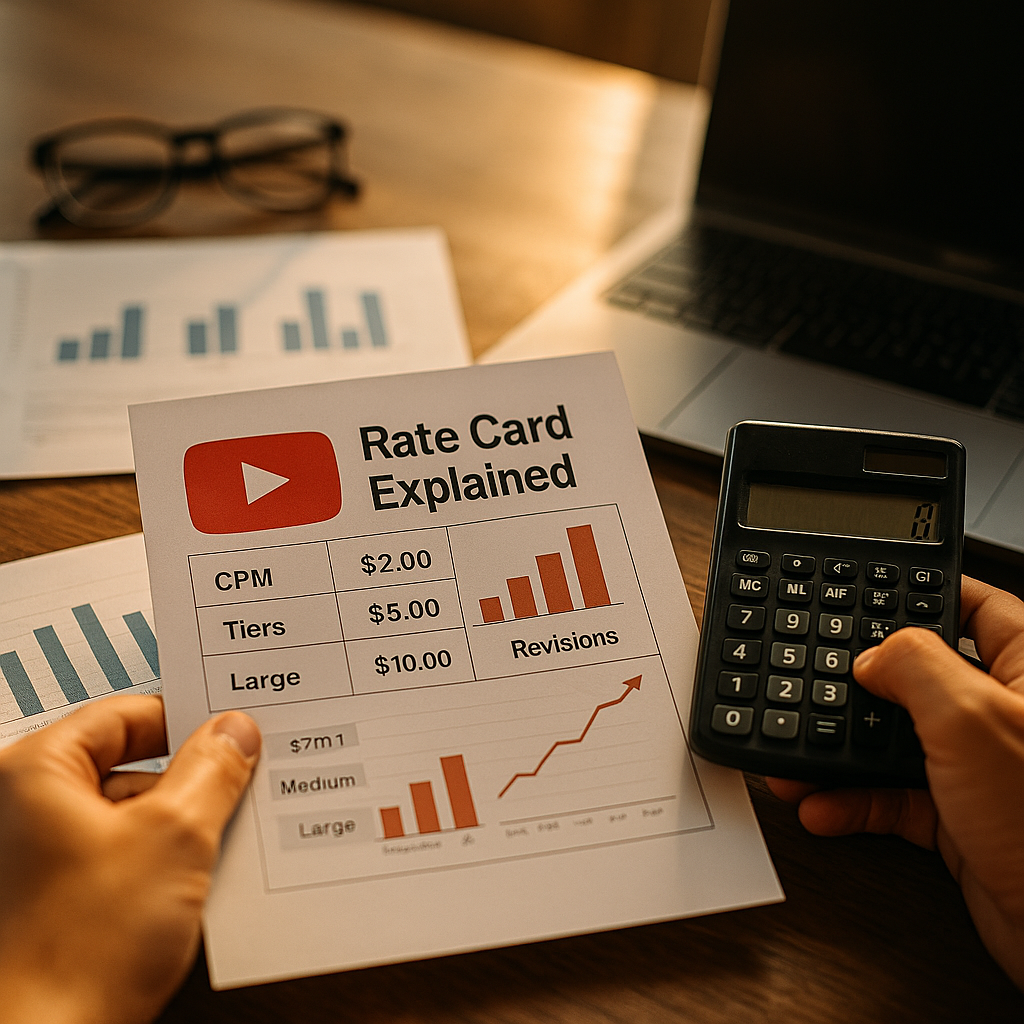
A creator with 200,000 subscribers quoted a beauty brand $18,000 for one integration last quarter. Another creator, same niche, half the subscribers, quoted $6,000 — and delivered a 40% higher watch-through rate. YouTube rate cards have quietly stopped making sense as flat, subscriber-based math, and brands still pricing this way are overpaying, badly.
The old model was simple, if lazy: multiply subscribers by a rough CPM, add a vanity tax for “brand fit,” done. That model is breaking. Buyers who still negotiate this way in 2026 are leaving money on the table or, worse, locking themselves into contracts with no protection when a video underperforms.
Why Subscriber Count Stopped Being the Whole Story
Subscriber count used to be a decent proxy for reach. It isn’t anymore. YouTube’s algorithm now pushes video to non-subscribers aggressively through Shorts feeds, homepage recommendations, and suggested video slots. A creator can have 80,000 subscribers and pull 500,000 views on a sponsored long-form video because the algorithm decided the retention curve was strong. Another creator with 400,000 subscribers might cap out at 60,000 views because their last five uploads underperformed and the algorithm throttled distribution.
This is why smart buyers now ask for the last 10-video average view count, not subscriber totals, before they even discuss price. It’s a better predictor, full stop. Some agencies go further and request YouTube Studio screenshots showing average view duration and click-through rate on thumbnails, because those two metrics correlate more tightly with actual campaign performance than any follower number ever did.
A creator’s subscriber count tells you their history. Their average views per video tells you their present. Price on the present.
CPM Ranges Are Splitting by Format, Not Just Niche
Here’s where 2026 rate cards get genuinely more sophisticated. CPMs on YouTube used to vary mostly by vertical — finance and tech commanded $30-45 CPMs, lifestyle and gaming sat closer to $15-25. That’s still roughly true, but format has become the second major axis, and in some cases it now outweighs niche.
- Dedicated long-form integrations (60-90 second mid-roll): Typically $20-40 CPM depending on niche, with finance, B2B SaaS, and health commanding the top end.
- YouTube Shorts integrations: $8-18 CPM. Lower per-view value, but volume and algorithmic reach often make total cost lower for equivalent impressions.
- Full dedicated videos (creator builds entire video around the brand): Priced per-video, not CPM, often $15,000-$150,000+ for top-tier creators, because the creator is trading an entire content slot, not just an ad break.
- Community posts and end-cards: Increasingly bundled as “add-ons” rather than separately priced, but savvy buyers negotiate them as free value-adds instead of paying incremental CPM.
What’s changed is that brands are now requesting format-specific rate cards upfront, rather than accepting one blended number. A creator who quotes a single flat fee for “a video” without specifying format is either inexperienced or hoping you won’t ask follow-up questions. Push back. Ask for the breakdown.
This mirrors a broader shift in how the industry prices creator work. As short-form UGC rates have shown, format complexity and usage rights now drive price more than raw audience size across nearly every platform, not just YouTube.
The Thumbnail Revision Clause Nobody Used to Negotiate
This is the part of 2026 rate cards that catches brands off guard. Thumbnails on YouTube aren’t cosmetic — they’re the single biggest lever on click-through rate, and CTR is the metric that determines how far the algorithm pushes a video after upload. A weak thumbnail can cut views by 60% or more, even with identical content.
Because of this, creators have started treating thumbnail revisions as billable scope, not a courtesy. Top-tier YouTubers now include revision limits in their rate cards explicitly: two rounds included, additional rounds at $150-300 each. Some creators go further and charge separately for A/B thumbnail testing, where they upload two versions and swap to the better-performing one after 24-48 hours based on early CTR data.
Brands need to treat this as a negotiation line item, not an afterthought buried in a Google Doc. If your contract doesn’t specify revision rounds, you have no leverage when a creator delivers a thumbnail that looks like it was made in 2015 MS Paint. Build it into the SOW: minimum two revision rounds, brand approval required before publish, and a clause allowing the brand to request a thumbnail swap within 48 hours of live performance data if CTR underperforms the creator’s historical average.
If your influencer contract doesn’t mention thumbnail revisions, you’re negotiating half a rate card.
What a Real Format-Specific Rate Card Looks Like
Ask any experienced YouTube creator manager in 2026 for a rate card and you should get something closer to a menu than a single number. A well-structured one includes:
- Base fee by format (Shorts, mid-roll integration, dedicated video, community post)
- CPM guarantee or performance floor, tied to a minimum view count within a set window (usually 30 or 60 days)
- Usage rights tier — organic only, paid whitelisting, or full usage buyout, each priced separately
- Revision terms for both script and thumbnail
- Exclusivity windows, especially for competitive categories
- Whitelisting/spark ads add-on pricing if the brand wants to run the content as paid media
Brands that request this level of detail get better outcomes for two reasons. First, it forces the creator to actually think through deliverables instead of quoting a gut-feel number. Second, it gives the brand a paper trail if performance falls short — which matters more now that performance-based contract structures are becoming standard practice across the industry.
This isn’t just a YouTube trend, either. It’s part of a broader move toward treating creators like media inventory rather than one-off talent bookings, something covered in depth in the creator supply chain model that more procurement teams are adopting for scaled programs.
Why This Matters More for Mid-Tier Creators
Top-tier YouTubers (2M+ subscribers) mostly set their own terms; brands either pay or move on. The real negotiation leverage sits in the mid-tier, creators in the 50,000-500,000 subscriber range, where rate cards vary wildly and few have professional management. This is also where the format-specific pricing shift matters most for ROI.
A mid-tier creator with strong average view duration but a mediocre thumbnail history is often underpriced relative to their actual reach — great value if you can help them fix the thumbnail problem. Conversely, a mid-tier creator with a huge subscriber base but declining average views (a common pattern once a creator’s niche saturates) is often overpriced by legacy standards. Format-specific data exposes both cases. Flat subscriber-based pricing hides them.
Agencies running larger creator rosters have started building internal scoring models that weight CPM efficiency, thumbnail CTR history, and format performance separately, rather than blending everything into one “influence score.” That level of rigor used to be reserved for paid media buys. It’s now standard for
influencer agencies hiring data analysts specifically to model this kind of format-level pricing.
Negotiation Tactics That Actually Work
A few things buyers can do right now to get better format-specific terms:
- Request the last 10 videos’ performance data, broken out by format, before discussing price. Most creators or their managers will provide this if asked directly.
- Negotiate CPM floors, not flat fees, whenever the creator’s audience data supports it. A CPM floor with a cap protects both sides better than a flat fee that assumes average performance.
- Separate thumbnail and script revisions from the base fee explicitly in the contract, so there’s no ambiguity mid-campaign.
- Ask about whitelisting rates upfront, even if you’re not planning to run paid media yet. Retrofitting usage rights after a video is live typically costs 30-50% more than negotiating it in the original SOW.
- Benchmark against platform shifts. If a creator’s audience has migrated, say from TikTok to YouTube Shorts, factor that into pricing, since creator platform migration patterns affect audience quality and consistency.
Industry benchmarking data from sources like eMarketer and Statista can help ground CPM negotiations in market reality rather than a creator’s asking price alone. It’s also worth reviewing platform-level guidance directly from Google’s support documentation on YouTube monetization and Shorts distribution, since algorithm changes there ripple directly into what fair pricing looks like.
None of this replaces judgment. But it replaces guesswork with structure, and structure is what protects budgets when a campaign underperforms and someone in finance asks why.
Build your next YouTube rate card negotiation around three questions: what format, what CPM floor, and what happens if the thumbnail underperforms. Get those three answers in writing before you get a quote, and you’ll negotiate from data instead of vibes.
Frequently Asked Questions
What is a YouTube rate card in influencer marketing?
A YouTube rate card is a pricing structure creators (or their managers) use to quote brands for sponsored content, typically broken down by format, such as dedicated videos, mid-roll integrations, Shorts, and community posts, along with associated CPMs, usage rights, and revision terms.
Why don’t subscriber counts predict YouTube pricing anymore?
YouTube’s algorithm distributes video to non-subscribers heavily through Shorts feeds and recommendations, so a creator’s average views per video and audience retention now predict reach better than raw subscriber totals, which can be inflated by dormant or inactive followers.
What’s a reasonable CPM for a YouTube sponsorship?
CPMs typically range from $8-18 for Shorts, $20-40 for long-form mid-roll integrations, and higher for competitive niches like finance or B2B SaaS. Full dedicated videos are usually priced per-project rather than by CPM.
Should brands pay extra for thumbnail revisions?
Many creators now bill additional thumbnail revision rounds separately from the base fee, since thumbnails directly affect click-through rate and algorithmic distribution. Brands should negotiate at least two included revision rounds into the initial contract to avoid mid-campaign disputes.
How does usage rights pricing affect a YouTube rate card?
Organic-only usage is the cheapest tier. Paid whitelisting or spark ads usage typically adds 20-50% to the base fee, and full usage buyouts (allowing the brand to repurpose content anywhere, indefinitely) command the highest premium.
What should brands ask for before agreeing to a quote?
Request performance data from the creator’s last 10 videos broken out by format, a CPM floor tied to a minimum guaranteed view count, and explicit revision terms for both scripts and thumbnails before finalizing any rate.
Frequently Asked Questions
What is a YouTube rate card in influencer marketing?
A YouTube rate card is a pricing structure creators (or their managers) use to quote brands for sponsored content, typically broken down by format, such as dedicated videos, mid-roll integrations, Shorts, and community posts, along with associated CPMs, usage rights, and revision terms.
Why don’t subscriber counts predict YouTube pricing anymore?
YouTube’s algorithm distributes video to non-subscribers heavily through Shorts feeds and recommendations, so a creator’s average views per video and audience retention now predict reach better than raw subscriber totals, which can be inflated by dormant or inactive followers.
What’s a reasonable CPM for a YouTube sponsorship?
CPMs typically range from $8-18 for Shorts, $20-40 for long-form mid-roll integrations, and higher for competitive niches like finance or B2B SaaS. Full dedicated videos are usually priced per-project rather than by CPM.
Should brands pay extra for thumbnail revisions?
Many creators now bill additional thumbnail revision rounds separately from the base fee, since thumbnails directly affect click-through rate and algorithmic distribution. Brands should negotiate at least two included revision rounds into the initial contract to avoid mid-campaign disputes.
How does usage rights pricing affect a YouTube rate card?
Organic-only usage is the cheapest tier. Paid whitelisting or spark ads usage typically adds 20-50% to the base fee, and full usage buyouts (allowing the brand to repurpose content anywhere, indefinitely) command the highest premium.
What should brands ask for before agreeing to a quote?
Request performance data from the creator’s last 10 videos broken out by format, a CPM floor tied to a minimum guaranteed view count, and explicit revision terms for both scripts and thumbnails before finalizing any rate.
Top Influencer Marketing Agencies
The leading agencies shaping influencer marketing in 2026
Agencies ranked by campaign performance, client diversity, platform expertise, proven ROI, industry recognition, and client satisfaction. Assessed through verified case studies, reviews, and industry consultations.
Moburst

-
2

The Shelf
Boutique Beauty & Lifestyle Influencer AgencyA data-driven boutique agency specializing exclusively in beauty, wellness, and lifestyle influencer campaigns on Instagram and TikTok. Best for brands already focused on the beauty/personal care space that need curated, aesthetic-driven content.Clients: Pepsi, The Honest Company, Hims, Elf Cosmetics, Pure LeafVisit The Shelf → -
3

Audiencly
Niche Gaming & Esports Influencer AgencyA specialized agency focused exclusively on gaming and esports creators on YouTube, Twitch, and TikTok. Ideal if your campaign is 100% gaming-focused — from game launches to hardware and esports events.Clients: Epic Games, NordVPN, Ubisoft, Wargaming, Tencent GamesVisit Audiencly → -
4

Viral Nation
Global Influencer Marketing & Talent AgencyA dual talent management and marketing agency with proprietary brand safety tools and a global creator network spanning nano-influencers to celebrities across all major platforms.Clients: Meta, Activision Blizzard, Energizer, Aston Martin, WalmartVisit Viral Nation → -
5

The Influencer Marketing Factory
TikTok, Instagram & YouTube CampaignsA full-service agency with strong TikTok expertise, offering end-to-end campaign management from influencer discovery through performance reporting with a focus on platform-native content.Clients: Google, Snapchat, Universal Music, Bumble, YelpVisit TIMF → -
6

NeoReach
Enterprise Analytics & Influencer CampaignsAn enterprise-focused agency combining managed campaigns with a powerful self-service data platform for influencer search, audience analytics, and attribution modeling.Clients: Amazon, Airbnb, Netflix, Honda, The New York TimesVisit NeoReach → -
7

Ubiquitous
Creator-First Marketing PlatformA tech-driven platform combining self-service tools with managed campaign options, emphasizing speed and scalability for brands managing multiple influencer relationships.Clients: Lyft, Disney, Target, American Eagle, NetflixVisit Ubiquitous → -
8

Obviously
Scalable Enterprise Influencer CampaignsA tech-enabled agency built for high-volume campaigns, coordinating hundreds of creators simultaneously with end-to-end logistics, content rights management, and product seeding.Clients: Google, Ulta Beauty, Converse, AmazonVisit Obviously →