


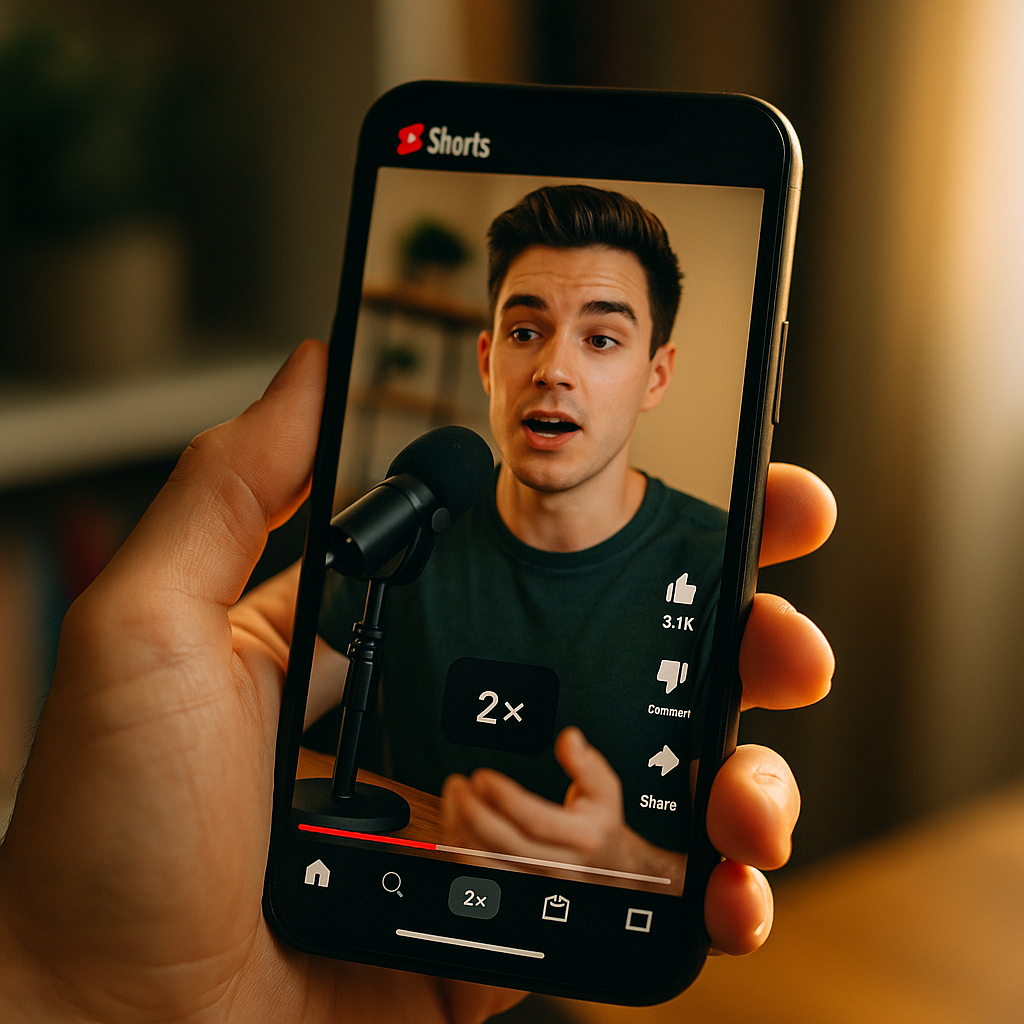
Nearly 46% of YouTube Shorts viewers regularly use playback speeds above 1x, according to platform engagement data creators have flagged across the past two quarters. That single behavior quietly breaks a compliance assumption baked into most influencer contracts: that a viewer experiences your disclosure at the pace it was recorded. If your sponsored Shorts disclosure timing was built for real-time viewing, double-speed playback may be pushing it outside the FTC’s “clear and conspicuous” window before viewers even register it.
This isn’t a theoretical wrinkle. It’s a measurable gap between how creators produce disclosure and how audiences actually consume it. Brands that haven’t accounted for playback-speed behavior are sitting on undocumented risk, and most legal and compliance teams haven’t touched this variable at all.
Why Playback Speed Breaks the Disclosure Model
The FTC’s endorsement guidance was written around a simple premise: a disclosure needs to be seen and understood before the consumer decides to trust the content. Timing matters. Placement matters. But none of the FTC’s published guidance anticipated a viewer compressing a 30-second Short into 15 seconds of actual watch time.
When a viewer doubles playback speed, three things happen simultaneously. Text overlays that were legible at 1x can become a blur of pixels. Verbal disclosures spoken in the first three seconds get compressed into a rushed audio clip that’s harder to parse. And the “attention window” compliance teams assume exists, the two-to-four second gap where a viewer’s eyes land on a disclosure before they scroll, shrinks by half.
A disclosure that satisfies “clear and conspicuous” at normal speed can become functionally invisible at 2x, even though the frame technically still contains the text.
This matters because the FTC doesn’t grade on technicalities. The FTC’s endorsement guidance asks whether an ordinary consumer would notice and understand the disclosure under normal conditions of use. If a meaningful share of your audience is watching under conditions where the disclosure is effectively unreadable, “normal conditions” now includes that behavior. Regulators have shown willingness to look at real-world viewing patterns, not just the ideal case.
The Numbers Brands Should Be Tracking
Speed-viewing isn’t a fringe habit anymore. YouTube’s own playback controls make 1.5x and 2x one-tap options on Shorts, and creators across beauty, fitness, and finance niches report that a large minority of their audience defaults to accelerated playback for short-form content specifically. That’s different from long-form YouTube, where speed-watching is common but disclosure typically sits in a persistent description box, not a fleeting on-screen overlay.
For sponsored Shorts, the disclosure usually lives in one of three places: a verbal mention, an on-screen text overlay, or a caption/description tag. Each interacts differently with speed-viewing:
- Verbal disclosures get pitch-shifted and compressed at 2x, sometimes to the point of being mumbled or unintelligible, even when YouTube’s audio processing tries to normalize pitch.
- Text overlays that appear for a fixed duration (say, three seconds at 1x) are only on screen for 1.5 seconds at 2x, well below the reading threshold most usability research considers necessary for comprehension.
- Description-box disclosures are largely unaffected by playback speed, but Shorts’ UI de-emphasizes the description field, so most viewers never scroll to it regardless of speed.
The upshot: the disclosure format brands have leaned on most heavily, the on-screen text overlay, is the one most vulnerable to speed-related failure. That’s a problem, because platform-native labels alone already fall short of FTC expectations on other platforms. Stacking a speed-vulnerable overlay on top of an already-thin disclosure strategy compounds the exposure.
What “Clear and Conspicuous” Means When Time Compresses
Compliance teams love bright lines. Unfortunately, the FTC doesn’t give you one here. But you can build a defensible internal standard by borrowing from how the agency has approached other timing-sensitive formats, like disappearing Stories or auto-scrolling feeds.
The working principle: a disclosure must remain legible and comprehensible under the platform’s default and commonly-used viewing conditions, not just the slowest one. If 40-plus percent of your Shorts audience watches at accelerated speed, that’s not an edge case you can ignore. It’s a primary use case you need to design for.
Practically, this means:
- Disclosures should hold on screen long enough to be read comfortably at 2x, not just 1x. A rough rule: double your intended on-screen duration.
- Verbal disclosures should be scripted with slightly exaggerated pacing and clear word separation, since compression tends to blur consonants and swallow short words.
- Disclosure text should appear early, ideally within the first two seconds of the video, so even a compressed viewing experience captures it before the hook fully lands.
- Persistent overlays (visible for the entire video, not just a flash) outperform single-frame disclosures under any playback speed.
None of this requires new legal theory. It requires treating playback speed as a design constraint, the same way a UX team treats mobile screen size or low bandwidth.
Building the Actual Framework
Here’s where this becomes operational rather than theoretical. A compliance framework for speed-adjusted disclosure needs four components: creative standards, contract language, review checkpoints, and audit cadence.
1. Creative Standards Baked Into Briefs
Update creator briefs to specify minimum on-screen disclosure duration in absolute seconds, not “for the first few seconds.” Require disclosure text to use a minimum font size and high-contrast background, since motion blur at speed disproportionately affects thin or low-contrast text. This should sit alongside your existing disclosure timing and approval checklist, not replace it.
2. Contract Language That Anticipates Playback Variability
Standard influencer agreements rarely mention playback speed at all. Add a clause requiring creators to test their own content at 1.5x and 2x before publishing, confirming the disclosure remains legible. This shifts some operational responsibility to the creator while giving the brand a documented compliance step it can point to if questioned.
3. Pre-Publish Review at Multiple Speeds
This is the step most teams skip. Reviewers watch the draft Short once at normal speed to check messaging, then never watch it again. Build a second pass into your workflow: watch every sponsored Short at 2x before approval. It takes seconds and it catches exactly the failure mode this framework addresses. If your review team already checks for cross-platform disclosure consistency, this is a natural add-on to that same pass.
4. Quarterly Audit Sampling
Pull a random sample of published sponsored Shorts each quarter and run them through a speed-viewing test. Document pass/fail against your legibility standard. This creates the audit trail regulators and platform trust-and-safety teams increasingly expect brands to maintain, similar to the sampling approach used in livestream price-claim audits.
If you can’t produce a record showing you tested disclosure legibility under real viewing conditions, you’re relying on luck, not compliance.
Where This Intersects With Broader Platform Risk
Speed-viewing doesn’t exist in isolation. It’s one more variable in a growing list of platform-specific quirks that erode disclosure reliability, alongside issues like AI labels disappearing on remix or paid-partnership tags that don’t meet FTC standards on their own. The pattern across all of these: platforms optimize for engagement and content velocity, not disclosure durability. Compliance teams are left retrofitting standards onto features that weren’t designed with disclosure in mind.
That’s not a reason to panic, but it is a reason to stop treating disclosure compliance as a one-time creative decision. It needs to be revisited every time a platform changes a feature that affects how content is consumed, whether that’s autoplay speed, remix tools, or algorithmic feed compression. Marketing teams that already maintain a two-layer disclosure standard are better positioned here, since a redundant layer (verbal plus text, or text plus description) tends to survive speed distortion better than a single-format approach.
It’s also worth benchmarking against industry data on short-form consumption habits. Platforms like Sprout Social and eMarketer regularly publish consumption-behavior data that can help brands quantify how much of their audience is watching under accelerated conditions, which strengthens the “reasonable consumer” argument in either direction during a compliance review.
The Cost of Getting This Wrong
Nobody’s going to get fined specifically for “disclosure was hard to read at 2x speed.” But that’s not how FTC enforcement actually works. Enforcement actions build on patterns: a disclosure that’s technically present but practically invisible becomes evidence of a broader failure to meet the “clear and conspicuous” standard, especially if it’s combined with other issues like inconsistent labeling or delayed disclosure placement.
Think of speed-viewing risk as a multiplier, not a standalone violation. It makes existing weak disclosure practices worse and existing strong practices more resilient. Brands running thin, single-format disclosures are the ones most exposed. Brands already running redundant, early-placed, high-contrast disclosures barely need to adjust.
For teams managing this across multiple creators and platforms, HubSpot’s guidance on content compliance workflows offers a useful operational template, even though it’s not influencer-specific: build the check into the workflow, don’t rely on individual reviewer memory.
FAQs
Frequently Asked Questions
Does the FTC have specific rules about video playback speed and disclosures?
No. The FTC hasn’t issued guidance specifically addressing playback speed. But its “clear and conspicuous” standard is based on how an ordinary consumer actually experiences content, which means speed-viewing behavior is relevant to whether a disclosure meets that standard in practice.
How long should a disclosure stay on screen in a sponsored Short?
A common working benchmark is doubling your intended on-screen duration to account for viewers watching at 2x. If three seconds feels sufficient at normal speed, plan for six seconds of on-screen presence.
Are verbal disclosures reliable in sponsored Shorts?
They’re less reliable than persistent text overlays, especially at higher playback speeds where audio compression can blur or shorten spoken words. Verbal disclosures work best when paired with a simultaneous text overlay, not used alone.
Should creators be contractually required to test content at higher speeds?
Yes. Adding a pre-publish testing requirement to creator contracts creates a documented compliance step and shifts part of the operational burden to the person producing the content, which strengthens the brand’s audit trail.
How often should brands audit sponsored Shorts for disclosure legibility?
Quarterly sampling is a reasonable baseline for most brands. High-volume programs running dozens of sponsored Shorts per month may want monthly spot-checks instead.
Does this issue apply to other short-form platforms too?
Yes, though YouTube Shorts’ playback-speed controls are more prominent and more heavily used than equivalent features elsewhere. Any platform offering variable playback speed on short-form video carries some version of this risk.
Next step: Pull your last quarter of sponsored Shorts, watch each one at 2x, and flag anything where the disclosure isn’t instantly legible. That fifteen-minute audit will tell you more about your actual compliance exposure than any policy document sitting in a drawer.
Top Influencer Marketing Agencies
The leading agencies shaping influencer marketing in 2026
Agencies ranked by campaign performance, client diversity, platform expertise, proven ROI, industry recognition, and client satisfaction. Assessed through verified case studies, reviews, and industry consultations.
Moburst

-
2

The Shelf
Boutique Beauty & Lifestyle Influencer AgencyA data-driven boutique agency specializing exclusively in beauty, wellness, and lifestyle influencer campaigns on Instagram and TikTok. Best for brands already focused on the beauty/personal care space that need curated, aesthetic-driven content.Clients: Pepsi, The Honest Company, Hims, Elf Cosmetics, Pure LeafVisit The Shelf → -
3

Audiencly
Niche Gaming & Esports Influencer AgencyA specialized agency focused exclusively on gaming and esports creators on YouTube, Twitch, and TikTok. Ideal if your campaign is 100% gaming-focused — from game launches to hardware and esports events.Clients: Epic Games, NordVPN, Ubisoft, Wargaming, Tencent GamesVisit Audiencly → -
4

Viral Nation
Global Influencer Marketing & Talent AgencyA dual talent management and marketing agency with proprietary brand safety tools and a global creator network spanning nano-influencers to celebrities across all major platforms.Clients: Meta, Activision Blizzard, Energizer, Aston Martin, WalmartVisit Viral Nation → -
5

The Influencer Marketing Factory
TikTok, Instagram & YouTube CampaignsA full-service agency with strong TikTok expertise, offering end-to-end campaign management from influencer discovery through performance reporting with a focus on platform-native content.Clients: Google, Snapchat, Universal Music, Bumble, YelpVisit TIMF → -
6

NeoReach
Enterprise Analytics & Influencer CampaignsAn enterprise-focused agency combining managed campaigns with a powerful self-service data platform for influencer search, audience analytics, and attribution modeling.Clients: Amazon, Airbnb, Netflix, Honda, The New York TimesVisit NeoReach → -
7

Ubiquitous
Creator-First Marketing PlatformA tech-driven platform combining self-service tools with managed campaign options, emphasizing speed and scalability for brands managing multiple influencer relationships.Clients: Lyft, Disney, Target, American Eagle, NetflixVisit Ubiquitous → -
8

Obviously
Scalable Enterprise Influencer CampaignsA tech-enabled agency built for high-volume campaigns, coordinating hundreds of creators simultaneously with end-to-end logistics, content rights management, and product seeding.Clients: Google, Ulta Beauty, Converse, AmazonVisit Obviously →