


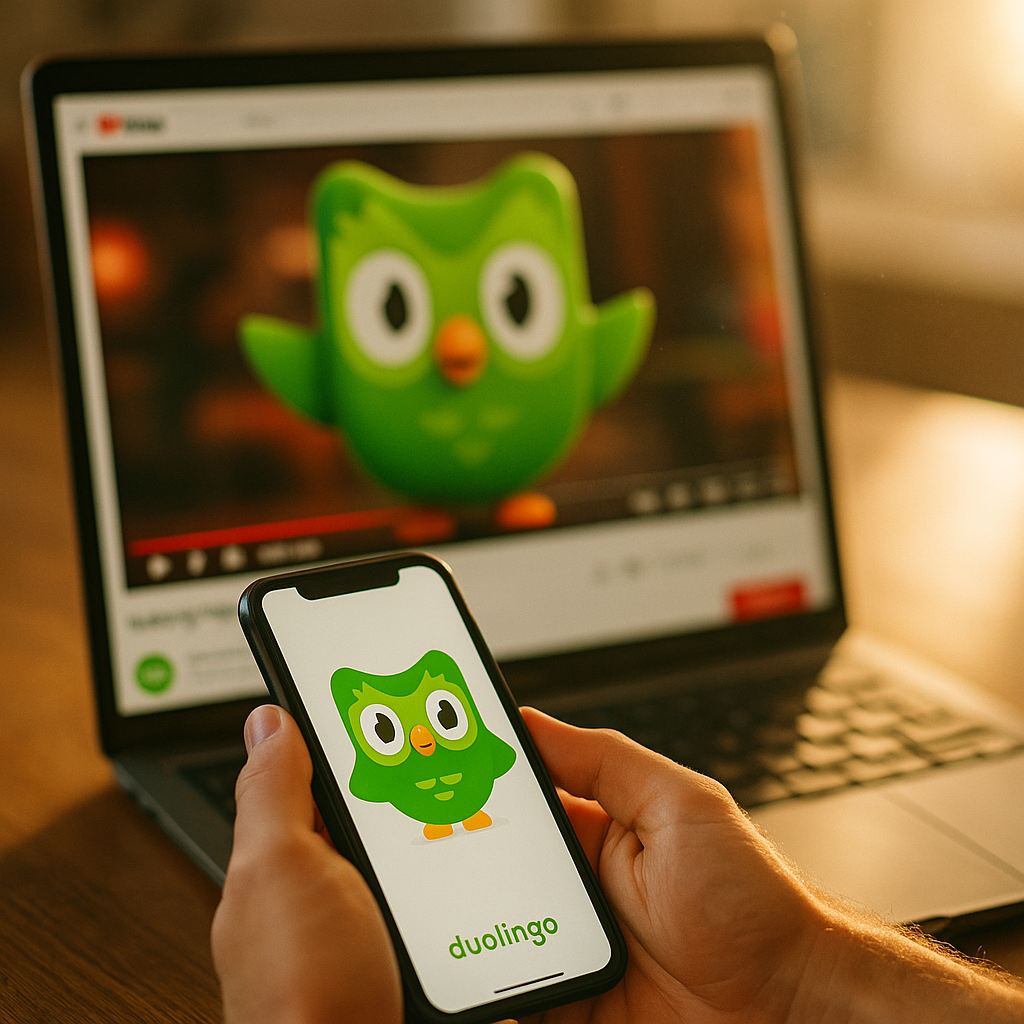
Duolingo’s owl has 15 million TikTok followers and a habit of faking his own death. What most brands miss: that chaos is only half the machine. On YouTube, the same brand runs 10-minute explainers, docuseries-style content, and creator collabs that build the trust TikTok can’t. This is the real story behind Duolingo’s YouTube long-form strategy — and why full-funnel creator presence beats platform-hopping.
Two Platforms, Two Jobs
Marketers love to treat TikTok and YouTube as competitors for the same attention span. Duolingo treats them as different departments. TikTok is the acquisition engine: shock value, meme velocity, absurdist skits that get ripped out of context and reposted across Instagram Reels and X. YouTube is retention and credibility: long-form content that explains why the app works, features actual linguists, and gives skeptical adults a reason to trust a brand best known for a owl doing TikTok dances.
This isn’t accidental. It’s a deliberate full-funnel split, and it’s worth studying if your influencer program is still treating every platform like it needs the same content strategy.
Duolingo’s TikTok chaos drives the discovery. Its YouTube long-form content drives the decision. Neither works as well without the other.
Why TikTok Chaos Alone Doesn’t Convert
Here’s the uncomfortable truth about high-velocity, meme-driven TikTok content: it’s brilliant for awareness and terrible for trust. A 15-second video of the Duolingo owl threatening users doesn’t explain the app’s spaced-repetition methodology, its pricing tiers, or why it’s more effective than Babbel for a busy adult trying to learn Spanish before a trip. Our previous coverage of the owl’s trend-jacking system laid out how Duolingo wins the algorithm. But algorithm wins don’t automatically translate into app downloads or subscription conversions, especially among older or more skeptical users who scroll past chaos and want substance before they commit.
Gen Z might install the app because the owl made them laugh. A 35-year-old professional evaluating language-learning options for a relocation? They want proof. That’s where YouTube comes in.
The YouTube Play: Long-Form as a Trust Layer
Duolingo’s YouTube channel doesn’t try to out-chaos TikTok. It leans into format diversity: explainer videos on how the app’s AI-driven lesson plans adapt to user mistakes, behind-the-scenes content on how new languages get added to the platform, and creator collaborations with polyglots and language teachers who have built genuine authority in that niche. Some videos run past ten minutes. That’s unthinkable on TikTok, where average watch times are measured in seconds, but it’s exactly the format YouTube viewers expect and reward.
This mirrors a pattern we’ve seen elsewhere. In our case study on how a skincare brand fixed TikTok Shop drop-off with YouTube, long-form content filled the exact same gap: TikTok generated interest, but purchase hesitation lingered until buyers found deeper, more credible explanations elsewhere. Duolingo is running the same play for app subscriptions instead of physical product.
YouTube’s own audience research consistently shows that longer sessions correlate with higher purchase intent for considered decisions, which subscription-based edtech absolutely is. Nobody signs up for a paid language app on impulse from a 15-second gag. They need at least one moment of “okay, but does this actually work?” — and that’s a long-form job, not a short-form one.
What Actually Lives on the YouTube Channel
- Explainer content on Duolingo’s methodology, including how spaced repetition and streak mechanics drive retention
- Docuseries-style features on language and culture, positioning Duolingo as an education brand, not just a meme account
- Creator collaborations with linguists, polyglots, and education YouTubers who bring built-in credibility
- Compilation and “best of” content that repackages TikTok chaos for a different consumption habit, since not every YouTube viewer is on TikTok
- Product-adjacent content like study tips and language-learning hacks that double as soft-sell SEO plays on Google’s video search
The Creator Selection Logic Is Different, Too
This is the part brand strategists tend to overlook. Duolingo isn’t just repurposing the same creators across platforms with different edits. The creator profile shifts by platform. TikTok creators skew comedic, chaotic, native to meme culture, and often anonymous or brand-adjacent rather than subject-matter experts. YouTube collaborators skew toward established authority: actual language educators, polyglot influencers with six-figure subscriber bases built over years, and creators whose entire channel identity is credibility-first.
That’s a deliberate risk allocation. High-volume, high-frequency TikTok content can afford to be experimental because the downside of a flop is low; it just doesn’t hit the algorithm. YouTube collaborations carry more brand-safety weight because the content lives longer, ranks in search, and gets referenced by users doing actual research before a purchase decision. Brands managing multi-platform creator rosters should be thinking about this same tiered risk model, not just tiered budget.
Platform-native creator selection isn’t a nice-to-have. It’s risk management. The creators who work for volume plays are rarely the same ones who should carry your credibility plays.
Funnel Mapping: Where Each Platform Actually Sits
If you mapped Duolingo’s creator ecosystem onto a traditional funnel, it would look roughly like this:
- Top of funnel (awareness): TikTok chaos, Reels reposts, meme velocity. Job: interrupt scroll, generate brand recall, seed cultural relevance.
- Mid funnel (consideration): YouTube Shorts and shorter explainer clips that bridge chaos and credibility, often featuring the owl but in a more grounded tone.
- Bottom of funnel (conversion/trust): Long-form YouTube content, creator collaborations with educators, and app store optimization driven by search intent from viewers who watched a 10-minute explainer and typed “Duolingo review” into Google.
This is a textbook full-funnel structure, and it’s rarely executed this cleanly by consumer brands. Most companies either go all-in on short-form (great reach, weak conversion) or over-invest in long-form (strong trust signals, poor discovery). Duolingo runs both simultaneously, with platform-specific KPIs for each. TikTok gets measured on reach, shares, and follower growth. YouTube gets measured on watch time, subscriber conversion, and, increasingly, on-platform search ranking for education-related queries.
Why This Matters More in an AI-Saturated Content Environment
Short-form content is getting cheaper to produce, but it’s also getting noisier. AI generation tools mean every brand can now pump out meme-format TikToks at scale, which means differentiation on TikTok alone is getting harder. We covered how Duolingo itself uses AI content pipelines to scale TikTok chaos safely, but scale isn’t the same as trust. As AI-generated short-form floods every feed, long-form, creator-led content becomes a scarcer, more valuable trust signal, precisely because it’s harder to fake convincingly and more expensive to produce well.
According to eMarketer, video remains the dominant content format across social platforms, but audience expectations for authenticity and depth are rising in parallel with content volume. Brands that only play the short-form game are competing in the most saturated, lowest-differentiation lane available. Duolingo’s YouTube investment is a hedge against that saturation.
What Other Brands Get Wrong Here
Most consumer brands treat YouTube as an afterthought: a place to dump TikTok content in a slightly bigger aspect ratio. That’s a mistake. YouTube’s algorithm and audience behavior reward original, platform-native long-form content, not repurposed short-form. Brands that skip building actual YouTube-native creator relationships are leaving a huge trust-building channel on the table. It’s the same lesson we saw play out in Warby Parker’s YouTube Shorts ad strategy, where skipping the discount-first approach in favor of genuine product storytelling outperformed expectations.
There’s also a compliance angle worth flagging. Long-form creator collaborations, especially with education-focused influencers, carry more disclosure and accuracy obligations under FTC endorsement guidelines, since claims about learning outcomes are more scrutinized than a joke about an owl’s murder threats. Brands running full-funnel creator programs need legal review calibrated by platform and content type, not a single blanket policy.
The Localization Layer Nobody Talks About
Duolingo operates in dozens of markets, and its TikTok localization strategy already shows how the brand adapts chaos for regional humor. The same logic extends to YouTube, where long-form creator collaborations are increasingly market-specific. A polyglot YouTuber credible to a German audience isn’t necessarily the right voice for Japanese or Brazilian audiences. Full-funnel doesn’t just mean top-to-bottom. For a global brand, it means top-to-bottom, market-by-market, which multiplies the operational complexity considerably.
That complexity is exactly why platform-specific creator strategy needs dedicated ownership, not a single social team stretched across every channel and geography.
The Takeaway for Brand Teams
If your creator program lives entirely on TikTok, you’re winning awareness and losing trust. Duolingo’s model proves the fix isn’t choosing a platform, it’s matching format and creator profile to funnel stage: chaos for discovery, long-form authority for conversion. Audit your own creator roster this quarter and ask whether you have a credible answer for the bottom of the funnel, not just the top.
FAQs
Why does Duolingo use different creators on TikTok versus YouTube?
Because the platforms serve different funnel stages. TikTok rewards comedic, high-frequency creators built for discovery and virality. YouTube rewards credible, subject-matter-expert creators whose long-form content builds trust needed for a subscription decision.
Can a full-funnel creator strategy work for smaller brands, or does it require Duolingo’s budget?
Scale changes the volume, not the logic. Smaller brands can apply the same principle: use short-form for reach and discovery, and invest in a handful of longer-form creator collaborations to build trust before purchase. Even one or two well-produced long-form pieces can shift consideration-stage conversion.
How should brands measure success differently across TikTok and YouTube?
TikTok performance is best measured by reach, shares, and follower growth, since it’s an awareness engine. YouTube should be measured on watch time, subscriber conversion, and search ranking for branded or category queries, since it functions as a trust and conversion layer.
Does long-form YouTube content carry more compliance risk than short-form TikTok content?
Often yes, particularly when creators make claims about outcomes or effectiveness. Long-form content is more likely to be referenced during purchase research, which increases scrutiny under FTC endorsement guidelines. Brands should apply stricter review processes to long-form creator collaborations than to short-form meme content.
What’s the biggest mistake brands make when trying to replicate this strategy?
Treating YouTube as a repository for repurposed TikTok clips instead of building platform-native, long-form content with creators who have earned authority in that specific format. Repurposed content rarely performs as well as content built for the platform it lives on.
FAQs
Why does Duolingo use different creators on TikTok versus YouTube?
Because the platforms serve different funnel stages. TikTok rewards comedic, high-frequency creators built for discovery and virality. YouTube rewards credible, subject-matter-expert creators whose long-form content builds trust needed for a subscription decision.
Can a full-funnel creator strategy work for smaller brands, or does it require Duolingo’s budget?
Scale changes the volume, not the logic. Smaller brands can apply the same principle: use short-form for reach and discovery, and invest in a handful of longer-form creator collaborations to build trust before purchase. Even one or two well-produced long-form pieces can shift consideration-stage conversion.
How should brands measure success differently across TikTok and YouTube?
TikTok performance is best measured by reach, shares, and follower growth, since it’s an awareness engine. YouTube should be measured on watch time, subscriber conversion, and search ranking for branded or category queries, since it functions as a trust and conversion layer.
Does long-form YouTube content carry more compliance risk than short-form TikTok content?
Often yes, particularly when creators make claims about outcomes or effectiveness. Long-form content is more likely to be referenced during purchase research, which increases scrutiny under FTC endorsement guidelines. Brands should apply stricter review processes to long-form creator collaborations than to short-form meme content.
What’s the biggest mistake brands make when trying to replicate this strategy?
Treating YouTube as a repository for repurposed TikTok clips instead of building platform-native, long-form content with creators who have earned authority in that specific format. Repurposed content rarely performs as well as content built for the platform it lives on.
Top Influencer Marketing Agencies
The leading agencies shaping influencer marketing in 2026
Agencies ranked by campaign performance, client diversity, platform expertise, proven ROI, industry recognition, and client satisfaction. Assessed through verified case studies, reviews, and industry consultations.
Moburst

-
2

The Shelf
Boutique Beauty & Lifestyle Influencer AgencyA data-driven boutique agency specializing exclusively in beauty, wellness, and lifestyle influencer campaigns on Instagram and TikTok. Best for brands already focused on the beauty/personal care space that need curated, aesthetic-driven content.Clients: Pepsi, The Honest Company, Hims, Elf Cosmetics, Pure LeafVisit The Shelf → -
3

Audiencly
Niche Gaming & Esports Influencer AgencyA specialized agency focused exclusively on gaming and esports creators on YouTube, Twitch, and TikTok. Ideal if your campaign is 100% gaming-focused — from game launches to hardware and esports events.Clients: Epic Games, NordVPN, Ubisoft, Wargaming, Tencent GamesVisit Audiencly → -
4

Viral Nation
Global Influencer Marketing & Talent AgencyA dual talent management and marketing agency with proprietary brand safety tools and a global creator network spanning nano-influencers to celebrities across all major platforms.Clients: Meta, Activision Blizzard, Energizer, Aston Martin, WalmartVisit Viral Nation → -
5

The Influencer Marketing Factory
TikTok, Instagram & YouTube CampaignsA full-service agency with strong TikTok expertise, offering end-to-end campaign management from influencer discovery through performance reporting with a focus on platform-native content.Clients: Google, Snapchat, Universal Music, Bumble, YelpVisit TIMF → -
6

NeoReach
Enterprise Analytics & Influencer CampaignsAn enterprise-focused agency combining managed campaigns with a powerful self-service data platform for influencer search, audience analytics, and attribution modeling.Clients: Amazon, Airbnb, Netflix, Honda, The New York TimesVisit NeoReach → -
7

Ubiquitous
Creator-First Marketing PlatformA tech-driven platform combining self-service tools with managed campaign options, emphasizing speed and scalability for brands managing multiple influencer relationships.Clients: Lyft, Disney, Target, American Eagle, NetflixVisit Ubiquitous → -
8

Obviously
Scalable Enterprise Influencer CampaignsA tech-enabled agency built for high-volume campaigns, coordinating hundreds of creators simultaneously with end-to-end logistics, content rights management, and product seeding.Clients: Google, Ulta Beauty, Converse, AmazonVisit Obviously →