


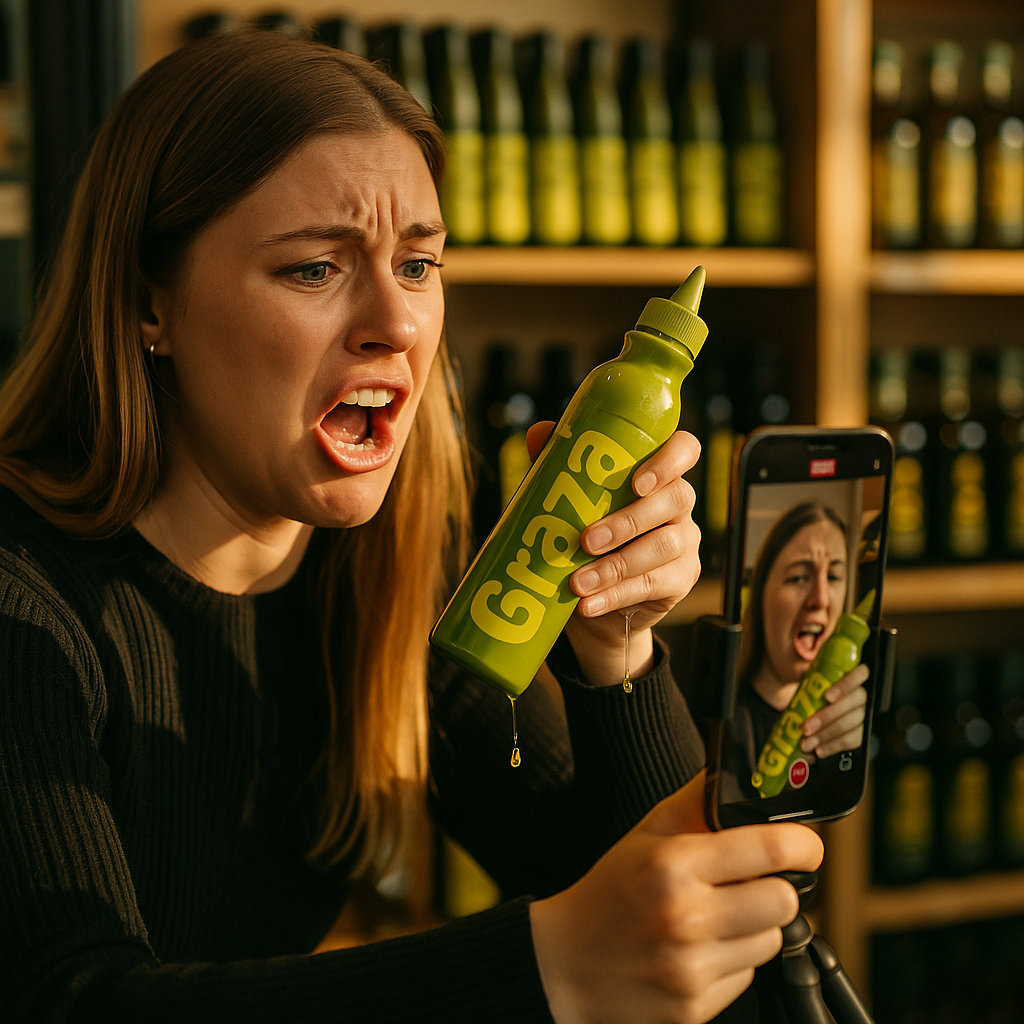
A squirt of olive oil shouldn’t be funny. Yet Graza’s neon-green squeeze bottle has racked up hundreds of millions of organic TikTok views, turned “drizzle season” into a meme, and helped the brand land in over 4,500 retail doors including Whole Foods and Target. This Graza case study breaks down how a condiment packaging decision became a full-blown comedy prop, and why that mattered more for sell-through than any paid influencer deal could have.
The Packaging Decision Nobody Asked For
Olive oil has looked the same for centuries: a dark glass bottle, maybe a tin, always poured with two hands and a wince of concentration. Graza founder Andrew Benin looked at that category and asked a simple question — why does good olive oil have to be treated like a liquid heirloom?
The answer was a squeeze bottle. Bright green, ketchup-shaped, unmistakably not-fancy. It let people squirt oil directly onto pasta, toast, or a sizzling pan without measuring, pouring, or spilling. That’s a real product benefit. But the bottle’s shape did something else nobody fully planned for: it made olive oil usable in a bit.
You can’t do physical comedy with a glass bottle of extra virgin olive oil. You can absolutely do physical comedy with something shaped like Heinz ketchup that squirts, farts air bubbles, and makes a satisfying “thwip” sound when squeezed. Creators noticed almost immediately.
Why Squeeze-Bottle Comedy Works Better Than a Product Demo
Most food brands chase the “satisfying content” formula: slow-motion pours, macro shots of sizzling garlic, moody lighting. Graza’s bottle broke that mold by inviting slapstick instead of sensuality. Creators squeezed it like a whoopee cushion, used it as a prop in kitchen “chaos” skits, and leaned into the bottle’s resemblance to a condiment nobody expects on a cutting board next to fresh basil.
When packaging itself generates the joke, you don’t need a script, a paid partnership, or a briefing document. The product becomes the punchline, and the punchline becomes distribution.
This matters for brand strategists because it flips the usual influencer marketing funnel. Instead of briefing creators on messaging, Graza built a physical object that did the creative work for them. Compare that to categories like beauty or supplements, where creators need scripts, hooks, and B-roll to make a product interesting. Graza skipped that step by engineering a shape that was inherently meme-able.
From TikTok Views to Retail Sell-Through
Views are vanity if they don’t move product off shelves. Graza’s story is compelling precisely because the comedy translated into retail velocity. The brand has cited retail expansion into thousands of doors, and its DTC-to-retail pivot has been widely covered as one of the faster CPG scaling stories in recent memory, with the company reportedly reaching eight-figure annual revenue within a few years of launch.
The mechanism is straightforward, even if it’s hard to replicate: TikTok exposure created top-of-funnel awareness with near-zero media spend, then in-store shoppers recognized the bright green bottle from their feed and picked it up on impulse. Packaging did double duty as both content prop and shelf standout. That’s a rare combination in grocery, where most private-label and legacy brands still rely on beige-and-olive color palettes that blend into the aisle.
Retail buyers pay attention to organic social signal now more than they used to. A SKU with a built-in content engine reduces the marketing burden buyers expect brands to carry post-launch. Graza effectively walked into retail negotiations with proof that consumers were already talking about the product, unprompted, at scale.
What the Data Actually Shows
Precise, brand-disclosed TikTok view counts and sell-through lift numbers are not always public, and marketers should be cautious about repeating rounded-up figures they can’t source. What is verifiable: olive oil and pantry staples have become one of TikTok’s most reliably viral food categories, and eMarketer’s research on social commerce consistently shows grocery and CPG categories benefiting disproportionately from creator-driven discovery compared to traditional media. Graza is frequently cited as the reference example in that trend, alongside brands like Fly By Jing and Chamberlain Coffee.
Marketers building a similar case internally should treat “viral view count” as a leading indicator, not a KPI. The metric that matters to a CFO is sell-through velocity and repeat purchase rate, not view count screenshots.
The Comedy Prop Playbook, Distilled
Graza didn’t hire a comedy writers’ room. It built physical affordances into the product that made jokes easy to generate. That’s a replicable framework, even outside olive oil:
- Shape drives behavior. A squeeze format invites squirting, which invites slapstick. A pour format invites careful, boring b-roll.
- Color drives recall. Neon green is not a traditional olive oil color. That’s the point. It’s instantly identifiable in a six-second scroll or a crowded shelf.
- Naming drives shareability. “Sizzle” for cooking oil and “Drizzle” for finishing oil gave creators built-in vocabulary and made the product feel like a system, not just a bottle.
- Low creative lift invites nano and micro-creators. Nobody needs a script to make a squeeze bottle funny. That lowers the barrier for organic UGC, similar to what drove Chubbies’ comedy-driven UGC formula.
This is the piece brand teams miss when they try to reverse-engineer virality. You can’t brief your way into a meme. You can, however, design a product that removes the friction between “funny idea” and “content creators actually want to make.”
Retail Buyers Are Watching Social Signal Now
Ten years ago, a grocery buyer wanted trade spend history and a distribution plan. Today, a growing share of buyer conversations start with “we’ve seen this on TikTok.” That shift changes how CPG brands should sequence their go-to-market.
Graza built DTC and social buzz first, then used that momentum as leverage in retail conversations. It’s the same sequencing that worked for Chamberlain Coffee’s nano-creator push into Target and for Prime Hydration’s convenience-store velocity story, covered in this breakdown of Prime’s retail strategy. The pattern holds across categories: social proof functions as a pre-sold audience, which de-risks the buyer’s shelf-space bet.
For brand strategists managing limited trade marketing budgets, this is the actionable insight. If your product can generate organic content without a paid influencer program, you walk into retail negotiations with leverage most emerging brands don’t have. If it can’t, you’ll need to manufacture that proof through seeded influencer or nano-creator campaigns before you pitch buyers, similar to the tactics detailed in Zara’s nano-creator store-fit strategy.
Where Brands Get This Wrong
Not every product can or should chase a “comedy prop” strategy. Trying to force humor onto a product with no physical affordance for it usually reads as try-hard. Graza’s advantage was structural: the bottle’s shape and color did the heavy lifting, and the brand simply got out of the way.
The mistake most CPG marketers make is treating packaging as a branding exercise, finalized late, optimized for shelf photography rather than in-hand use. Graza inverted that. Packaging was treated as a content and usability decision from day one, which is closer to how DTC-native brands like Ridge Wallet approached founder-led product demonstrations as core brand infrastructure, not an afterthought.
There’s also a compliance angle brand teams shouldn’t ignore. As UGC and creator content scale, the FTC continues to sharpen guidance around disclosure and endorsement, particularly when brands seed product or pay for amplification even informally. Marketers running seeding programs should stay current with FTC endorsement guidelines to avoid disclosure gaps, especially once a comedy trend starts attracting paid creator partnerships riding the same wave.
What This Means for Brand Strategy Teams
The Graza olive oil TikTok trend isn’t a fluke worth admiring from a distance. It’s a case study in designing for distribution, not just for function. Before your next packaging refresh or new SKU launch, ask whether the physical object gives creators something to do, not just something to describe. Comedy props outperform product demos because they don’t feel like marketing. That’s the entire trick, and it’s worth the extra design sprint to get right.
Frequently Asked Questions
What made Graza’s packaging go viral on TikTok?
The squeeze-bottle format, unlike traditional glass olive oil bottles, invited physical comedy and slapstick use that creators found naturally shareable, without needing a script or paid brief.
Did Graza pay influencers to create this content?
Much of Graza’s early TikTok traction was organic, driven by unpaid creators reacting to the product’s unusual format, though the brand has since run seeded and paid creator partnerships to sustain momentum.
How did TikTok virality translate into retail distribution?
Retail buyers increasingly treat organic social proof as a pre-sold audience signal, which reduced the perceived risk of allocating shelf space and helped Graza expand into thousands of grocery doors.
Can other CPG brands replicate this strategy?
Brands can replicate the underlying principle, designing packaging that invites organic use and content, but not every product category has a physical format that lends itself to comedy the way a squeeze bottle does.
What metrics should brands track instead of view counts?
Retail sell-through velocity, repeat purchase rate, and organic mention volume are stronger indicators of real business impact than raw TikTok view counts.
Top Influencer Marketing Agencies
The leading agencies shaping influencer marketing in 2026
Agencies ranked by campaign performance, client diversity, platform expertise, proven ROI, industry recognition, and client satisfaction. Assessed through verified case studies, reviews, and industry consultations.
Moburst

-
2

The Shelf
Boutique Beauty & Lifestyle Influencer AgencyA data-driven boutique agency specializing exclusively in beauty, wellness, and lifestyle influencer campaigns on Instagram and TikTok. Best for brands already focused on the beauty/personal care space that need curated, aesthetic-driven content.Clients: Pepsi, The Honest Company, Hims, Elf Cosmetics, Pure LeafVisit The Shelf → -
3

Audiencly
Niche Gaming & Esports Influencer AgencyA specialized agency focused exclusively on gaming and esports creators on YouTube, Twitch, and TikTok. Ideal if your campaign is 100% gaming-focused — from game launches to hardware and esports events.Clients: Epic Games, NordVPN, Ubisoft, Wargaming, Tencent GamesVisit Audiencly → -
4

Viral Nation
Global Influencer Marketing & Talent AgencyA dual talent management and marketing agency with proprietary brand safety tools and a global creator network spanning nano-influencers to celebrities across all major platforms.Clients: Meta, Activision Blizzard, Energizer, Aston Martin, WalmartVisit Viral Nation → -
5

The Influencer Marketing Factory
TikTok, Instagram & YouTube CampaignsA full-service agency with strong TikTok expertise, offering end-to-end campaign management from influencer discovery through performance reporting with a focus on platform-native content.Clients: Google, Snapchat, Universal Music, Bumble, YelpVisit TIMF → -
6

NeoReach
Enterprise Analytics & Influencer CampaignsAn enterprise-focused agency combining managed campaigns with a powerful self-service data platform for influencer search, audience analytics, and attribution modeling.Clients: Amazon, Airbnb, Netflix, Honda, The New York TimesVisit NeoReach → -
7

Ubiquitous
Creator-First Marketing PlatformA tech-driven platform combining self-service tools with managed campaign options, emphasizing speed and scalability for brands managing multiple influencer relationships.Clients: Lyft, Disney, Target, American Eagle, NetflixVisit Ubiquitous → -
8

Obviously
Scalable Enterprise Influencer CampaignsA tech-enabled agency built for high-volume campaigns, coordinating hundreds of creators simultaneously with end-to-end logistics, content rights management, and product seeding.Clients: Google, Ulta Beauty, Converse, AmazonVisit Obviously →