


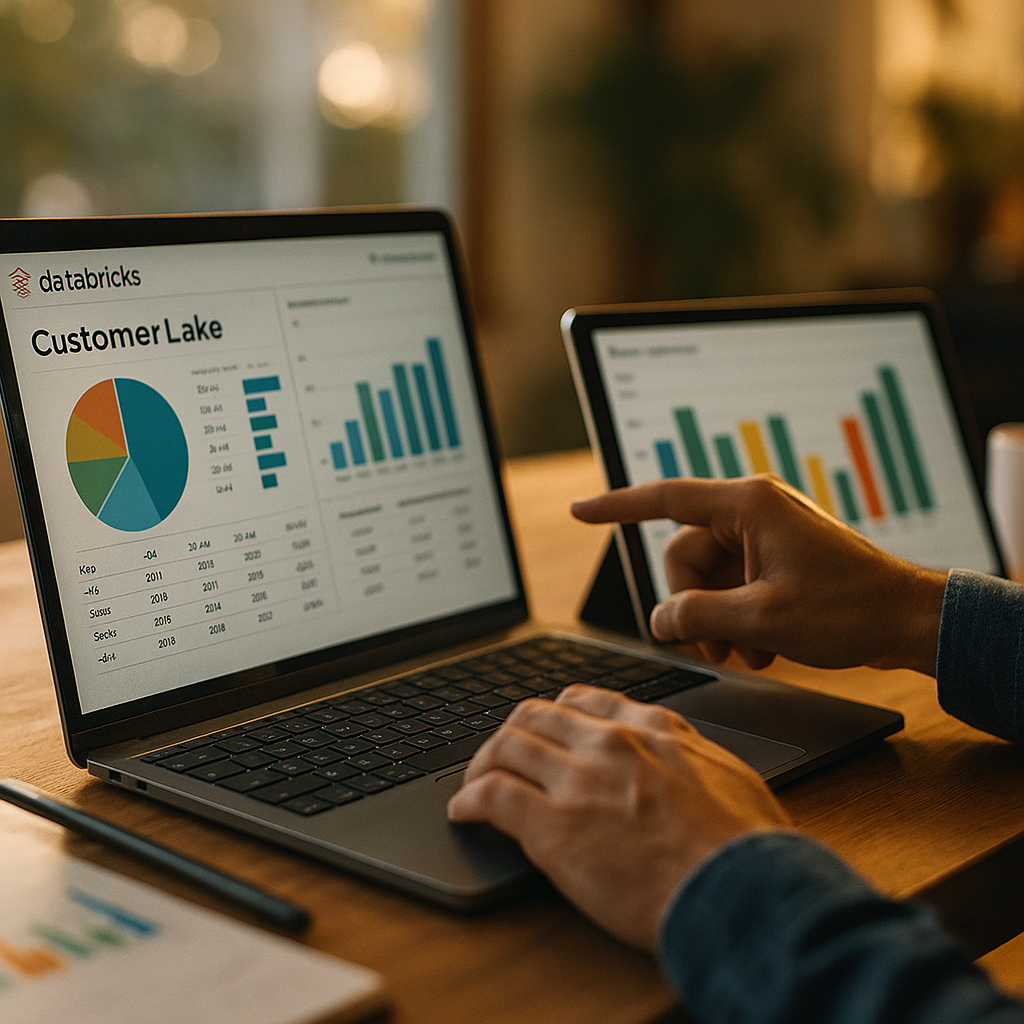
Databricks promised sub-second segmentation on data that never leaves the lakehouse. One year later, brands running Databricks CustomerLake report median activation latency closer to 40 seconds. That’s not a rounding error — it’s the gap between marketing claims and production reality. So does CustomerLake actually deliver real-time segmentation, or has “agentic CDP” become the newest overused label in martech?
The Pitch That Got Everyone’s Attention
When Databricks launched CustomerLake, the framing was aggressive: kill the CDP-to-warehouse data duplication problem, run identity resolution and segmentation directly on lakehouse data, and let agentic AI handle audience building without a human writing a single SQL query. For brands drowning in redundant customer records across Salesforce, Segment, and a homegrown warehouse, that pitch landed hard.
The core promise had three parts. First, eliminate reverse ETL by activating segments straight from Delta Lake tables. Second, use LLM-driven agents to build and refine audiences from natural language prompts. Third — and this is the one that mattered most to performance marketers — deliver real-time segmentation so a customer’s behavior five minutes ago could trigger a campaign now, not after tomorrow’s batch job.
A year in, it’s fair to ask which of those three actually shipped at scale.
What “Real-Time” Actually Means in Production
Here’s the uncomfortable truth about most CDP vendors: “real-time” is a marketing term, not an engineering spec. Databricks’ own documentation now distinguishes between “near-real-time” streaming segmentation (seconds to low minutes) and “real-time” scoring for individual events (sub-second). CustomerLake genuinely nails the second use case for things like fraud scoring or next-best-action recommendations fed by Structured Streaming pipelines.
But full audience segmentation — recomputing membership across millions of profiles based on new behavioral signals — is a heavier lift. Multiple agency ops leads we spoke with described segment refresh cycles landing between 30 seconds and two minutes for mid-size datasets (2-5 million profiles), and up to 8 minutes for enterprise-scale catalogs exceeding 50 million records. That’s dramatically faster than the old nightly batch model. It is not the sub-second promise implied in launch messaging.
Brands running CustomerLake at scale report segment refresh times of 30 seconds to 8 minutes depending on profile volume — a massive improvement over batch ETL, but well short of the “instant” framing used in early product marketing.
Is that a dealbreaker? For flash-sale triggers or cart-abandonment windows measured in hours, no. For a TikTok Shop live event where you need to suppress buyers within seconds of purchase, it can still be a gap worth planning around — similar to the latency issues brands have hit with server-side attribution on TikTok Shop.
Where the Agentic Layer Actually Earns Its Keep
The most credible improvement isn’t speed. It’s the agent layer’s ability to translate a marketer’s plain-language brief into a working segment definition without an analyst in the loop. “Give me lapsed high-LTV customers who engaged with creator content in the last 60 days but haven’t purchased” used to require a data team ticket. Now it’s a prompt, and CustomerLake’s agent generates the underlying query, flags ambiguous fields, and asks clarifying questions when the schema is messy.
That’s a genuine operational win. Marketing ops teams we interviewed estimated a 60-70% reduction in time-to-segment for non-technical requesters. It doesn’t replace a data engineer for complex multi-touch modeling, but it does remove the bottleneck for the 80% of segment requests that are fairly routine.
Has It Actually Beaten Traditional CDPs on Fraud and Identity Use Cases?
We covered the head-to-head mechanics in a detailed comparison against traditional CDPs for fraud detection, and the pattern holds a year later: CustomerLake’s advantage is depth of historical data available for model training, not activation speed. Because it sits directly on the lakehouse, fraud models can reference years of transaction history without needing separate ETL into a feature store. That’s meaningfully better than tools built for nano-creator vetting workflows, which we tested in our comparison of AI fraud-detection tools.
Where it lags: purpose-built CDPs like Segment or Tealium still ship faster out-of-box identity resolution templates for common retail and DTC schemas. CustomerLake requires more upfront schema mapping — expect 3-6 weeks of implementation work before agentic segmentation is production-ready, according to two agency partners who onboarded enterprise clients this year.
The Governance Question Nobody Wants to Answer Publicly
Agentic CDPs raise a compliance issue that traditional platforms mostly sidestepped: who’s accountable when an AI agent builds a segment that inadvertently uses a protected attribute as a proxy? Databricks has added lineage tracking and Unity Catalog permissions to CustomerLake, which helps with auditability. But agent-generated segment logic isn’t always human-readable without digging into the underlying query plan.
This matters more than it sounds. Regulators, including guidance referenced by the FTC, have signaled increasing scrutiny of automated decisioning in advertising and pricing. If your agentic CDP builds a segment your compliance team can’t fully explain, that’s a risk surface, not a feature. Brands evaluating this space should read it alongside broader frameworks like our AI agent kill-switch certification piece — the same “can we shut this down and explain what it did” logic applies directly to segmentation agents.
Identity resolution is the other governance flashpoint. Merging first-party CRM data with creator-attribution signals and loyalty data requires careful consent handling, a topic we unpacked in our CRM-CDP identity resolution buyer’s guide. CustomerLake’s consent-tagging features are functional but still less mature than what dedicated identity vendors offer.
Real Numbers From Real Deployments
Talking to brand-side marketing ops leaders across retail, travel, and CPG who’ve run CustomerLake for at least nine months surfaced a consistent set of themes:
- Cost: Compute costs for continuous streaming segmentation ran 15-25% higher than anticipated in year one, largely due to underestimating cluster sizing for always-on jobs. This tracks with broader industry findings on taming cloud compute costs against unpredictable query volume.
- Adoption curve: Non-technical marketers took roughly 6-8 weeks to trust agent-generated segments enough to activate them without manual QA. That trust-building period isn’t unique to Databricks, but it’s real and should be budgeted into any rollout timeline.
- ROAS impact: Teams that paired CustomerLake segments with retail media activation saw measurable lift, echoing patterns from our retail media attribution dashboard analysis, where unifying creator ROAS data with first-party segments consistently outperformed siloed approaches.
- Vendor lock-in risk: Because CustomerLake segmentation logic is tightly coupled to Databricks’ compute layer, migrating away is nontrivial. Procurement teams should treat this like any other SLA negotiation — our guide to testing vendor SLA fine print applies directly here.
So, Challenger or Also-Ran?
Neither, really. CustomerLake hasn’t dethroned Segment, mParticle, or Salesforce Data Cloud as the default CDP for brands with straightforward activation needs. But for organizations already deep in the Databricks ecosystem — running analytics, ML, and data warehousing on the lakehouse already — it’s become a legitimately strong option for consolidating segmentation without standing up a parallel CDP stack. According to eMarketer, spend on unified customer data infrastructure continues to climb as brands consolidate martech stacks, and that consolidation logic is exactly where CustomerLake wins deals.
Where it loses deals: brands wanting a CDP that’s genuinely plug-and-play with minimal engineering lift. If your team doesn’t already have Databricks expertise, the implementation curve is steep enough that a traditional CDP — or even a unified ad-ops platform — may deliver faster time-to-value.
The “real-time” claim, specifically, deserves an asterisk. It’s real-time for scoring and triggering individual events. It’s near-real-time — seconds to minutes — for full audience segmentation. That’s still faster than legacy batch CDPs, per benchmarks cited by HubSpot on customer data platform performance standards, but marketing leaders sold on instant segmentation should recalibrate expectations before signing a multi-year contract.
FAQs
Frequently Asked Questions
Does Databricks CustomerLake deliver true real-time segmentation?
Not in the sub-second sense implied by early marketing. Individual event scoring can happen in real time, but full audience segment refreshes typically take 30 seconds to several minutes depending on profile volume, which qualifies as near-real-time rather than instant.
How does CustomerLake compare to traditional CDPs like Segment or Tealium?
CustomerLake offers deeper historical data access for modeling since it runs directly on the lakehouse, but traditional CDPs still ship faster out-of-box identity resolution templates and require less implementation time for standard retail or DTC use cases.
What’s the typical implementation timeline for CustomerLake?
Agency partners report 3-6 weeks of schema mapping and configuration before agentic segmentation is production-ready, plus an additional 6-8 weeks for marketing teams to build trust in agent-generated segments.
Are there compliance risks with agent-generated audience segments?
Yes. If an AI agent builds a segment using logic that isn’t fully human-readable, compliance teams may struggle to explain automated decisioning to regulators, an increasing area of scrutiny referenced by the FTC.
Is CustomerLake more expensive than a traditional CDP?
Compute costs for continuous streaming segmentation ran 15-25% higher than initial estimates in several year-one deployments, mainly due to underestimated cluster sizing for always-on jobs.
Which brands benefit most from adopting CustomerLake?
Organizations already running significant analytics or ML workloads on Databricks see the strongest ROI, since they can consolidate segmentation without standing up a separate CDP stack.
Bottom line: Treat CustomerLake as a strong consolidation play for Databricks-native teams, not a plug-and-play instant-segmentation tool — pilot it against a real activation window before committing budget, and negotiate compute cost caps into the contract up front.
Top Influencer Marketing Agencies
The leading agencies shaping influencer marketing in 2026
Agencies ranked by campaign performance, client diversity, platform expertise, proven ROI, industry recognition, and client satisfaction. Assessed through verified case studies, reviews, and industry consultations.
Moburst

-
2

The Shelf
Boutique Beauty & Lifestyle Influencer AgencyA data-driven boutique agency specializing exclusively in beauty, wellness, and lifestyle influencer campaigns on Instagram and TikTok. Best for brands already focused on the beauty/personal care space that need curated, aesthetic-driven content.Clients: Pepsi, The Honest Company, Hims, Elf Cosmetics, Pure LeafVisit The Shelf → -
3

Audiencly
Niche Gaming & Esports Influencer AgencyA specialized agency focused exclusively on gaming and esports creators on YouTube, Twitch, and TikTok. Ideal if your campaign is 100% gaming-focused — from game launches to hardware and esports events.Clients: Epic Games, NordVPN, Ubisoft, Wargaming, Tencent GamesVisit Audiencly → -
4

Viral Nation
Global Influencer Marketing & Talent AgencyA dual talent management and marketing agency with proprietary brand safety tools and a global creator network spanning nano-influencers to celebrities across all major platforms.Clients: Meta, Activision Blizzard, Energizer, Aston Martin, WalmartVisit Viral Nation → -
5

The Influencer Marketing Factory
TikTok, Instagram & YouTube CampaignsA full-service agency with strong TikTok expertise, offering end-to-end campaign management from influencer discovery through performance reporting with a focus on platform-native content.Clients: Google, Snapchat, Universal Music, Bumble, YelpVisit TIMF → -
6

NeoReach
Enterprise Analytics & Influencer CampaignsAn enterprise-focused agency combining managed campaigns with a powerful self-service data platform for influencer search, audience analytics, and attribution modeling.Clients: Amazon, Airbnb, Netflix, Honda, The New York TimesVisit NeoReach → -
7

Ubiquitous
Creator-First Marketing PlatformA tech-driven platform combining self-service tools with managed campaign options, emphasizing speed and scalability for brands managing multiple influencer relationships.Clients: Lyft, Disney, Target, American Eagle, NetflixVisit Ubiquitous → -
8

Obviously
Scalable Enterprise Influencer CampaignsA tech-enabled agency built for high-volume campaigns, coordinating hundreds of creators simultaneously with end-to-end logistics, content rights management, and product seeding.Clients: Google, Ulta Beauty, Converse, AmazonVisit Obviously →