


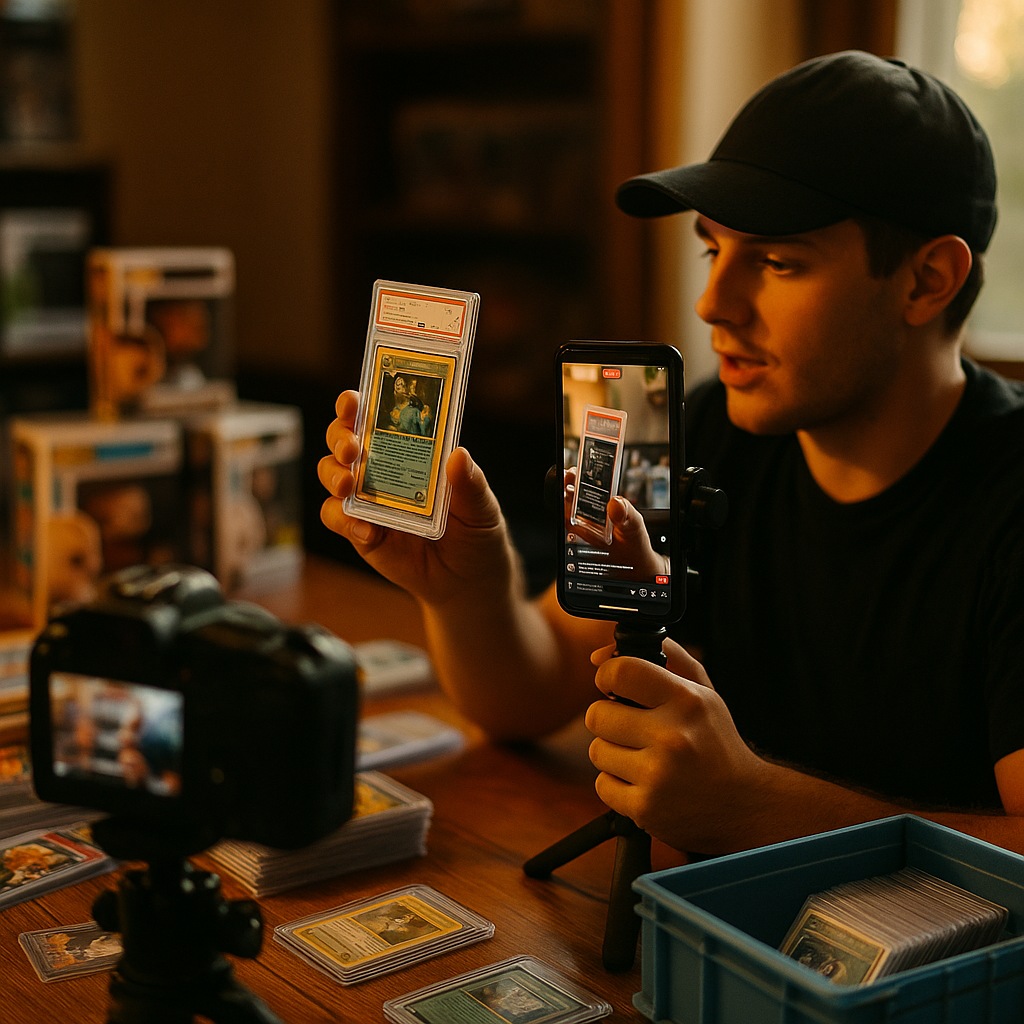
One category on Whatnot generates buyer sessions averaging over an hour, repeat purchase rates north of most e-commerce benchmarks, and creator retention that most platforms would kill for. It’s not beauty. It’s not sneakers. It’s trading cards and collectibles — and the Whatnot livestream auction format is the reason why.
This is a case study in format-market fit. Whatnot didn’t just recruit collectibles sellers, it built mechanics that made them its stickiest, highest-spending creator cohort. Here’s how, and what it means for brands evaluating livestream commerce.
Why Collectibles Found a Home in Live Auctions
Collectibles resellers existed long before Whatnot. eBay auctions, Facebook groups, card show tables — the hustle is decades old. What Whatnot did was compress the entire transaction loop: discovery, bidding, social proof, and payment, into a single live session. No listing photography. No waiting three days for an auction to close. No DMs to negotiate price.
That compression matters because collectibles buying is inherently emotional and time-sensitive. A rare parallel card or a graded PSA 10 creates urgency the moment it’s revealed on camera. Auction dynamics — ascending bids, countdown timers, “going once” tension — turn that urgency into immediate revenue instead of a bookmarked listing someone forgets about.
Whatnot’s own reporting has pointed to trading cards and collectibles as the platform’s largest and fastest-growing vertical, with resellers in the category showing repeat purchase behavior that outpaces general merchandise sellers by a wide margin.
Compare that to TikTok Shop or Instagram Shopping, where the buying journey is asynchronous. A viewer watches a video, maybe taps a product tag, maybe abandons the cart. Whatnot’s auction format removes that gap entirely. The sale happens while the emotional peak is happening. That’s the mechanical edge collectibles sellers exploit better than almost any other category on the platform.
The Economics: Why Resellers Became the Highest-LTV Cohort
LTV in creator commerce isn’t just about a single transaction size. It’s frequency, retention, and the compounding trust between a seller and their buyer base. Collectibles resellers hit all three.
- Frequency: Top card sellers stream multiple times per week, sometimes daily, because inventory turns fast and demand is constant.
- Basket size via auction stacking: A single stream can run dozens or hundreds of individual auction lots, each a micro-transaction that adds up to meaningful cart totals per viewer.
- Repeat buyers as a built-in audience: Collectors don’t just buy once. They follow specific sellers for months or years, chasing specific sets, players, or franchises.
This is the same principle brands have seen play out in other creator-led retail contexts — where format and repeat-purchase psychology matter more than raw reach. Grocery and CPG brands have learned similar lessons with cook-along formats driving in-store traffic lift, and yogurt brands turning habitual consumption into a TikTok Shop engine. The format matched the buying behavior. Whatnot did the same thing for collectibles, just with auction mechanics instead of recipe content.
Trust Signals Do the Heavy Lifting
Collectibles is a category built on authentication anxiety. Is the card real? Is it actually the grade claimed? Did it ship the way it looked on camera? Whatnot’s format solves for this better than static listings ever could, because the seller is showing the item live, often flipping it under a loupe or comparing it against a pop report on screen.
Seller ratings, buyer protection guarantees, and return policies reinforce that trust layer. But the real differentiator is behavioral: a seller who streams five nights a week and has sold to the same 200 collectors repeatedly builds a reputation that a one-off Instagram post never could. That reputation becomes the moat. New entrants can’t easily replicate years of on-camera consistency.
This mirrors what’s happened in other trust-sensitive categories. Skincare brands, for instance, have had to solve for a similar drop-off problem when short-form hype didn’t translate into retention, eventually fixing TikTok Shop drop-off with YouTube long-form trust content. Whatnot’s collectibles sellers essentially built that trust layer natively, inside the live format itself, without needing a second channel.
The Creator Incentive Structure Nobody Talks About
Whatnot’s commission and fee structure rewards volume and consistency, which naturally favors categories where sellers can move a high number of low-to-mid ticket items quickly. Collectibles fits that model almost perfectly. A single break event (opening sealed packs live) can generate 50+ transactions in under an hour, each carrying its own shipping and commission economics.
Compare that to categories like apparel or beauty, where a single item takes longer to describe, model, and negotiate. The velocity mismatch is real. It’s part of why collectibles sellers report earning more per stream hour than many creators in higher-follower categories elsewhere in the creator economy.
For brands watching from outside the collectibles world, the lesson isn’t “sell trading cards.” It’s this: livestream commerce formats reward categories with fast decision cycles, visual proof points, and built-in scarcity. If your product doesn’t have those traits, don’t force it into an auction format expecting the same results.
What Brands Outside Collectibles Can Actually Borrow
Marketers evaluating livestream shopping platforms often ask the wrong question: “Should we do a Whatnot show?” The better question is: “Does our product have auction-compatible urgency?” A few transferable principles:
- Scarcity beats reach. A limited drop of 20 units sold live will often outperform a broad awareness push, because scarcity compresses the buying decision.
- Trust compounds with frequency. One-off livestreams rarely build the reseller-level trust Whatnot creators enjoy. Recurring cadence matters more than a single big event.
- Visual proof beats copywriting. Collectibles sellers show grading, condition, and authenticity live. Brands in categories like beauty or apparel can borrow this by demoing texture, fit, or function on camera instead of relying on product descriptions.
- Micro-transactions add up. Instead of one big-ticket push, structure livestream events around multiple smaller, sequential offers to keep engagement and purchase momentum going.
Brands have applied similar micro-commerce thinking in adjacent formats. Poppi’s approach to rebuilding trust through smaller, repeated creator touchpoints on TikTok Shop is a good parallel — see how Poppi used nano-creators to rebuild trust. It’s a different platform and product, but the underlying mechanic — frequent, smaller, trust-building transactions — echoes what’s happening in Whatnot’s collectibles category.
Where This Breaks Down
Not every category can replicate this. Auction fatigue is real; buyers who feel constantly pressured into bidding wars can burn out. There’s also regulatory exposure to watch. Grading and authenticity claims made live, on camera, carry the same disclosure and deceptive-marketing risks as any other advertising claim, and the FTC has been increasingly active on influencer disclosure enforcement. Brands entering livestream auction formats need clear, on-screen disclosure practices, not just verbal disclaimers buried mid-stream.
There’s also a channel-fit problem. Livestream auction formats work because the audience is already primed to expect bidding and urgency. Try transplanting that mechanic onto a cold audience with no auction context, and conversion craters. Platforms like TikTok Shop have experimented with live shopping too, but the audience expectation and pacing differ meaningfully from Whatnot’s collector-native crowd.
The Data Behind the Loyalty
Industry data on livestream commerce backs up the pattern anecdotally visible on Whatnot. Reports from eMarketer and Statista have tracked steady growth in U.S. live shopping adoption, with repeat engagement rates consistently higher in category-specific communities (collectibles, trading cards, vintage fashion) than in general marketplace livestreams. That’s the pattern Whatnot built its entire business around: instead of chasing broad e-commerce categories first, it leaned into hobbyist communities with pre-existing auction culture.
That’s a strategic lesson brands and agencies should sit with. The platforms winning in creator commerce right now aren’t necessarily the ones with the biggest reach. They’re the ones that matched format to buyer psychology first, then scaled. It’s the same logic behind Gymshark’s approach to creator whitelisting for lower CPAs — find the mechanic that fits your audience’s actual behavior, then optimize spend around it, rather than forcing a format because it’s trending.
Operationalizing This for Brand and Agency Teams
If you’re weighing livestream commerce as a channel, run this checklist before greenlighting budget:
- Does the product have a scarcity or drop mechanic that justifies real-time bidding or countdown urgency?
- Can the seller/creator demonstrate authenticity or quality live, without relying on pre-produced content?
- Is there an existing community with auction or collector culture, or would you be building that behavior from zero?
- Do you have disclosure and compliance protocols in place for live, unscripted claims?
- Can you commit to a recurring cadence, not a one-off event, to build the trust loop that drives repeat purchase?
If most of those answers are “no,” livestream auctions probably aren’t your channel yet. That’s fine. Not every format needs to be forced onto every brand.
Next step: before pitching a livestream auction pilot internally, map your product catalog against the scarcity and trust checklist above, and test it with a single limited-run drop rather than a full program commitment.
FAQs
What makes the Whatnot livestream auction format different from standard livestream shopping?
Whatnot structures sales as live, timed auctions with real-time bidding, rather than fixed-price product tags used on platforms like TikTok Shop or Instagram Live. That auction tension creates urgency that drives faster purchase decisions.
Why are collectibles resellers considered Whatnot’s highest-LTV creator cohort?
Collectibles sellers stream frequently, sell high volumes of low-to-mid ticket items per session, and build long-term repeat buyer relationships based on trust and authenticity, all of which compound into higher lifetime value than most other categories on the platform.
Can brands outside collectibles replicate this success on Whatnot?
Yes, but only if the product has genuine scarcity, visual proof points, and a recurring content cadence. Categories without natural urgency or authenticity concerns tend to see weaker results with auction-style formats.
What compliance risks should brands watch for in livestream auctions?
Live, unscripted claims about product condition, authenticity, or grading carry the same disclosure obligations as any influencer marketing claim. Brands should have clear on-screen disclosure practices and review FTC guidance on endorsements before launching a program.
How does livestream auction LTV compare to typical influencer marketing ROI?
Because auction formats combine immediate purchase with repeat viewership, LTV per creator relationship tends to be higher than one-off sponsored content, though it requires sustained cadence rather than single-campaign bursts to realize that value.
FAQs
What makes the Whatnot livestream auction format different from standard livestream shopping?
Whatnot structures sales as live, timed auctions with real-time bidding, rather than fixed-price product tags used on platforms like TikTok Shop or Instagram Live. That auction tension creates urgency that drives faster purchase decisions.
Why are collectibles resellers considered Whatnot’s highest-LTV creator cohort?
Collectibles sellers stream frequently, sell high volumes of low-to-mid ticket items per session, and build long-term repeat buyer relationships based on trust and authenticity, all of which compound into higher lifetime value than most other categories on the platform.
Can brands outside collectibles replicate this success on Whatnot?
Yes, but only if the product has genuine scarcity, visual proof points, and a recurring content cadence. Categories without natural urgency or authenticity concerns tend to see weaker results with auction-style formats.
What compliance risks should brands watch for in livestream auctions?
Live, unscripted claims about product condition, authenticity, or grading carry the same disclosure obligations as any influencer marketing claim. Brands should have clear on-screen disclosure practices and review FTC guidance on endorsements before launching a program.
How does livestream auction LTV compare to typical influencer marketing ROI?
Because auction formats combine immediate purchase with repeat viewership, LTV per creator relationship tends to be higher than one-off sponsored content, though it requires sustained cadence rather than single-campaign bursts to realize that value.
Top Influencer Marketing Agencies
The leading agencies shaping influencer marketing in 2026
Agencies ranked by campaign performance, client diversity, platform expertise, proven ROI, industry recognition, and client satisfaction. Assessed through verified case studies, reviews, and industry consultations.
Moburst

-
2

The Shelf
Boutique Beauty & Lifestyle Influencer AgencyA data-driven boutique agency specializing exclusively in beauty, wellness, and lifestyle influencer campaigns on Instagram and TikTok. Best for brands already focused on the beauty/personal care space that need curated, aesthetic-driven content.Clients: Pepsi, The Honest Company, Hims, Elf Cosmetics, Pure LeafVisit The Shelf → -
3

Audiencly
Niche Gaming & Esports Influencer AgencyA specialized agency focused exclusively on gaming and esports creators on YouTube, Twitch, and TikTok. Ideal if your campaign is 100% gaming-focused — from game launches to hardware and esports events.Clients: Epic Games, NordVPN, Ubisoft, Wargaming, Tencent GamesVisit Audiencly → -
4

Viral Nation
Global Influencer Marketing & Talent AgencyA dual talent management and marketing agency with proprietary brand safety tools and a global creator network spanning nano-influencers to celebrities across all major platforms.Clients: Meta, Activision Blizzard, Energizer, Aston Martin, WalmartVisit Viral Nation → -
5

The Influencer Marketing Factory
TikTok, Instagram & YouTube CampaignsA full-service agency with strong TikTok expertise, offering end-to-end campaign management from influencer discovery through performance reporting with a focus on platform-native content.Clients: Google, Snapchat, Universal Music, Bumble, YelpVisit TIMF → -
6

NeoReach
Enterprise Analytics & Influencer CampaignsAn enterprise-focused agency combining managed campaigns with a powerful self-service data platform for influencer search, audience analytics, and attribution modeling.Clients: Amazon, Airbnb, Netflix, Honda, The New York TimesVisit NeoReach → -
7

Ubiquitous
Creator-First Marketing PlatformA tech-driven platform combining self-service tools with managed campaign options, emphasizing speed and scalability for brands managing multiple influencer relationships.Clients: Lyft, Disney, Target, American Eagle, NetflixVisit Ubiquitous → -
8

Obviously
Scalable Enterprise Influencer CampaignsA tech-enabled agency built for high-volume campaigns, coordinating hundreds of creators simultaneously with end-to-end logistics, content rights management, and product seeding.Clients: Google, Ulta Beauty, Converse, AmazonVisit Obviously →