


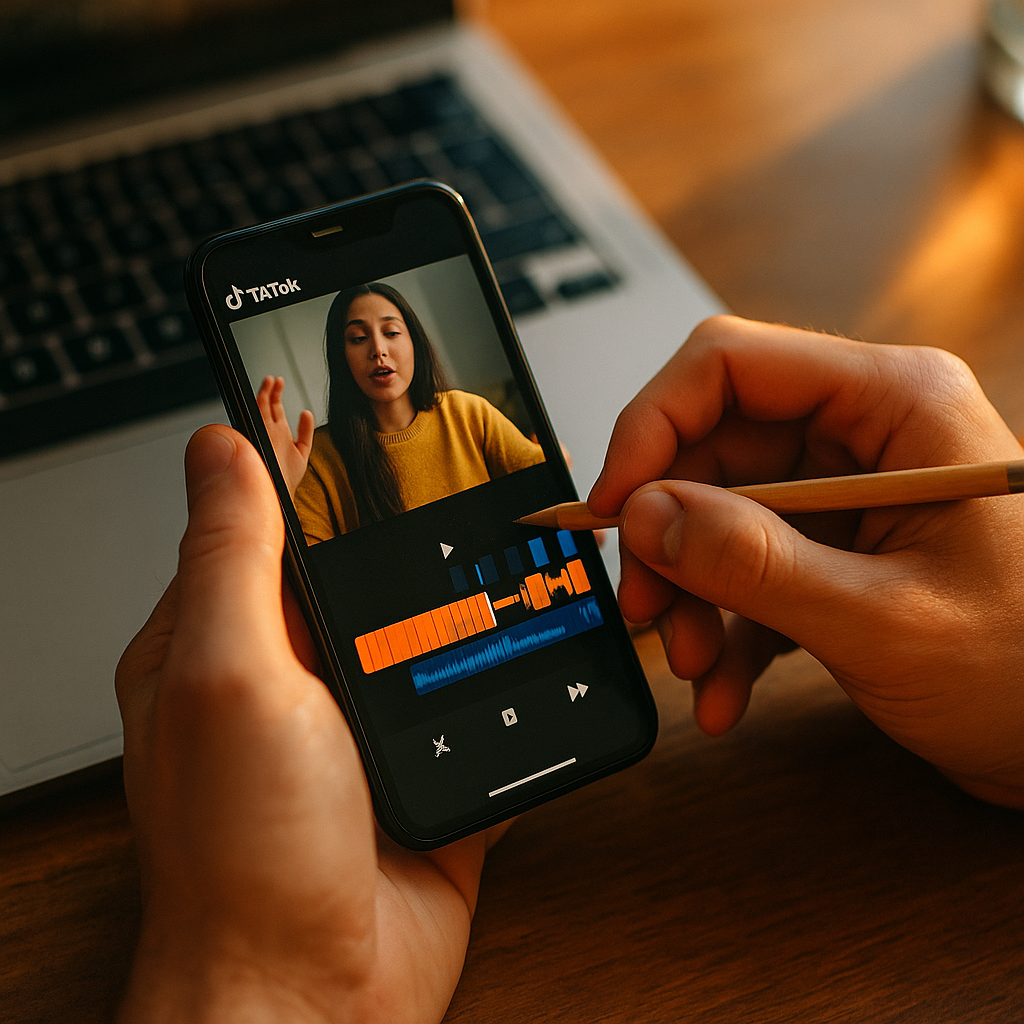
Three seconds. That’s roughly how long TikTok’s ranking model needs to decide whether your sponsored video lives or dies in the feed. But here’s the twist nobody briefed you on: the TikTok watch-time-weighted feed doesn’t just care if someone watches — it cares how long, how often they rewatch, and whether they bail at second four or second forty. If your creator briefs still treat “hook” as a single opening line, you’re optimizing for a platform that stopped existing months ago.
What Changed, Exactly?
TikTok has always weighted completion rate and rewatches in its recommendation system. That’s not new. What’s shifted is the granularity and aggressiveness of the weighting. Internal creator tools now surface second-by-second retention curves, and TikTok’s own advertising platform has pushed advertisers toward optimizing for “average watch time” as a primary bid signal rather than a vanity metric buried in analytics.
In practice, this means the algorithm is less forgiving of front-loaded hooks that spike attention for two seconds and then let it collapse. It rewards sustained engagement curves: content that holds, dips slightly, then re-engages viewers through pattern interrupts. Think of it less like a single hook and more like a chain of hooks, spaced across the runtime.
A video with 9 seconds average watch time on a 15-second clip will often outperform a video with 4 seconds average watch time on a 60-second clip — even though the second video has “more content.” Duration doesn’t matter. Retention ratio does.
For brands running sponsored content, this is a fundamental strategy problem, not a creative tweak. Agencies that built briefs around punchy openers and CTA-heavy closers are watching those same formats underperform, because the middle third of the video — the part nobody used to script carefully — is where retention now lives or dies.
Why Your Old Hook Formula Is Losing Reach
Most sponsored content briefs still follow a template lifted from 2021-era short-form best practices: cold open, pattern interrupt, product reveal, CTA. It’s not wrong, exactly. It’s incomplete.
The watch-time-weighted model doesn’t stop evaluating after the hook. It evaluates continuously, and it disproportionately rewards videos where viewers rewatch a specific segment — a phenomenon TikTok’s system interprets as high-value content worth showing to lookalike audiences. A single strong hook with a flat, sales-pitchy middle gets initial impressions, then throttles hard once completion data comes in.
This mirrors what we’ve already seen play out on other platforms. YouTube’s shift toward watch-time-equivalence forced creators to rethink pacing across entire videos, not just intros. TikTok is now applying similar logic to short-form, which is arguably a bigger disruption because short-form briefs were never built with mid-roll retention in mind.
- Videos under 20 seconds are being rewarded for near-100% completion plus rewatch loops.
- Videos between 30-90 seconds need at least two additional “hooks” beyond the opener to sustain the curve.
- Sponsored content with hard product pitches in the first 5 seconds shows measurably higher drop-off than content that delays the brand reveal.
The Data Behind the Shift
Marketers running paid amplification on TikTok Ads Manager have noticed CPMs creeping up on creative that would have crushed it a year ago. Industry trackers including eMarketer have flagged rising short-form CPMs as platforms compete for attention against a saturated content pool — and TikTok’s answer has been to get pickier about what “quality” means at the ranking layer.
Sprout Social’s platform research has similarly noted that engagement quality metrics, not just volume, increasingly determine organic reach on algorithm-driven feeds (Sprout Social). Watch time is the cleanest proxy TikTok has for “quality,” so it’s leaning on it harder.
Restructuring the Hook: It’s Not One Moment, It’s a Sequence
Stop thinking of the hook as seconds 0-3. Start thinking of it as a rhythm that repeats every 5-8 seconds throughout the video.
That sounds exhausting to script. It’s not, once you build a template around it. Here’s the restructured framework we’re seeing top-performing sponsored content follow:
- Micro-hook 1 (0-3 sec): Visual or verbal pattern interrupt. No branding, no product name yet.
- Curiosity gap (3-8 sec): Introduce a question, contradiction, or unexpected claim that the video promises to resolve.
- Micro-hook 2 (8-15 sec): A visual cut, on-screen text change, or tonal shift. This is where drop-off typically spikes, so treat it as a second opener.
- Proof or payoff (15-25 sec): Deliver on the curiosity gap. This is often where rewatches start, because viewers who missed a detail loop back.
- Product integration (25-40 sec): Brand and product enter here, not at the top. Frame it as the resolution to the setup, not an ad interruption.
- Soft CTA + loop bait (40-60 sec): End on a visual or verbal cue that encourages a rewatch — an incomplete sentence, a callback to the opening frame, or a “wait, watch that again” moment.
This structure isn’t theoretical. It’s a direct response to how TikTok’s force-feed algorithm distributes early impressions and then decides, within the first few hundred views, whether to keep pushing the video into more feeds. If your retention curve dips hard at any single point in that sequence, distribution stalls immediately.
Briefing Creators for Retention, Not Just Views
Here’s where most brand-creator relationships fall apart on this topic: creators know their audience’s attention patterns intuitively, but brand briefs often override that instinct with rigid script requirements. If you’re mandating a specific opening line, a specific product callout timestamp, and a specific CTA phrasing, you’re removing the creator’s ability to adjust pacing for their own audience’s watch behavior.
Better approach: brief the emotional beats, not the exact script.
Tell the creator what curiosity gap needs to open in the first eight seconds. Tell them where the product needs to land contextually, not at what second. Let them build the micro-hooks using formats their audience already responds to — because a creator who knows their audience rewatches humor beats twice will structure pacing differently than one whose audience rewatches tutorial steps.
This is the same logic driving TikTok’s discovery-over-reach approach to briefing: prioritize signals the algorithm actually rewards over vanity follower counts or historical reach numbers.
Briefs built around exact scripts optimize for brand safety. Briefs built around retention beats optimize for distribution. You need both, but if you have to choose which one bends, bend the script.
Pacing Mistakes That Kill Watch Time
- Front-loaded disclosures. Yes, FTC disclosure requirements are non-negotiable (FTC.gov guidance is clear on timing and placement), but burying “#ad” in a way that reads as a dead-stop before any hook lands is a self-inflicted retention wound. Integrate disclosure into the pacing, don’t let it interrupt it.
- Static B-roll stretches. Any segment longer than 3-4 seconds without a visual or audio change invites scroll-away.
- CTA-only endings. A flat “link in bio” close with no loop-back element wastes the rewatch opportunity entirely.
- Over-editing the hook, under-editing the middle. Teams spend 80% of production time on the first three seconds and treat the middle as filler. The data says the middle is now just as make-or-break.
What This Means for Budget and Testing Cadence
Operationally, this shift demands more testing volume, not more testing complexity. You don’t need ten variations of the opening hook anymore. You need three or four full-video pacing structures tested against each other, with retention curves — not just view counts — as the success metric.
Pull the audience retention graph for every sponsored post. If you’re not already doing this weekly, start now. It’s the single most underused piece of data in influencer reporting decks.
Budget-wise, this also changes how you evaluate creator rates. A creator whose average watch time consistently outperforms category benchmarks is worth a premium, even with a smaller following. That’s a harder metric to negotiate around than follower count, but it’s the one that actually predicts algorithmic distribution. If you’re building comparative budget frameworks across formats, the same logic applies that we’ve outlined in short-form versus long-form budget planning — pacing efficiency should factor into rate cards, not just reach.
It’s also worth stress-testing your content against platform behavior shifts more broadly. TikTok’s recent lean toward human-shot video over AI-generated content reinforces the same point: the algorithm is getting better at detecting authentic engagement patterns, and pacing that feels genuinely human — slightly imperfect, reactive, conversational — tends to sustain watch time better than polished, over-produced sequences.
Next Step
Pull your last ten sponsored TikTok posts and overlay their retention graphs. Find the exact second where drop-off spikes hardest, then rebuild your next brief around inserting a micro-hook right before that point — not at the start, there.
Frequently Asked Questions
What is TikTok’s watch-time-weighted feed?
It’s a ranking approach where TikTok’s recommendation system prioritizes average watch time, completion rate, and rewatch frequency over raw view counts or likes when deciding how widely to distribute a video.
How long should a sponsored TikTok video be under this model?
There’s no fixed ideal length. What matters is the ratio of watch time to total duration. A tightly paced 15-second video with near-full completion often outperforms a 60-second video with heavy drop-off.
Does this mean the opening hook doesn’t matter anymore?
No, the opening hook still matters enormously for stopping the scroll. But it’s no longer the only moment that determines distribution. Mid-video retention and rewatch behavior now carry significant weight too.
How should brands change creator briefs for this shift?
Brief emotional and structural beats — where curiosity opens, where the product lands, where a loop-back moment occurs — rather than mandating exact scripts. Give creators room to pace content for their specific audience.
What metrics should brands track beyond views and likes?
Average watch time, audience retention graphs, rewatch rate, and the specific timestamp where drop-off spikes. These are available in TikTok’s native analytics and should be reviewed per sponsored post.
Does FTC disclosure placement affect watch time?
Disclosure timing must comply with FTC guidance regardless of retention impact, but how it’s integrated into pacing matters. Abrupt, disconnected disclosures can cause drop-off; disclosures woven naturally into the opening sequence tend to preserve retention better.
Frequently Asked Questions
Top Influencer Marketing Agencies
The leading agencies shaping influencer marketing in 2026
Agencies ranked by campaign performance, client diversity, platform expertise, proven ROI, industry recognition, and client satisfaction. Assessed through verified case studies, reviews, and industry consultations.
Moburst

-
2

The Shelf
Boutique Beauty & Lifestyle Influencer AgencyA data-driven boutique agency specializing exclusively in beauty, wellness, and lifestyle influencer campaigns on Instagram and TikTok. Best for brands already focused on the beauty/personal care space that need curated, aesthetic-driven content.Clients: Pepsi, The Honest Company, Hims, Elf Cosmetics, Pure LeafVisit The Shelf → -
3

Audiencly
Niche Gaming & Esports Influencer AgencyA specialized agency focused exclusively on gaming and esports creators on YouTube, Twitch, and TikTok. Ideal if your campaign is 100% gaming-focused — from game launches to hardware and esports events.Clients: Epic Games, NordVPN, Ubisoft, Wargaming, Tencent GamesVisit Audiencly → -
4

Viral Nation
Global Influencer Marketing & Talent AgencyA dual talent management and marketing agency with proprietary brand safety tools and a global creator network spanning nano-influencers to celebrities across all major platforms.Clients: Meta, Activision Blizzard, Energizer, Aston Martin, WalmartVisit Viral Nation → -
5

The Influencer Marketing Factory
TikTok, Instagram & YouTube CampaignsA full-service agency with strong TikTok expertise, offering end-to-end campaign management from influencer discovery through performance reporting with a focus on platform-native content.Clients: Google, Snapchat, Universal Music, Bumble, YelpVisit TIMF → -
6

NeoReach
Enterprise Analytics & Influencer CampaignsAn enterprise-focused agency combining managed campaigns with a powerful self-service data platform for influencer search, audience analytics, and attribution modeling.Clients: Amazon, Airbnb, Netflix, Honda, The New York TimesVisit NeoReach → -
7

Ubiquitous
Creator-First Marketing PlatformA tech-driven platform combining self-service tools with managed campaign options, emphasizing speed and scalability for brands managing multiple influencer relationships.Clients: Lyft, Disney, Target, American Eagle, NetflixVisit Ubiquitous → -
8

Obviously
Scalable Enterprise Influencer CampaignsA tech-enabled agency built for high-volume campaigns, coordinating hundreds of creators simultaneously with end-to-end logistics, content rights management, and product seeding.Clients: Google, Ulta Beauty, Converse, AmazonVisit Obviously →