


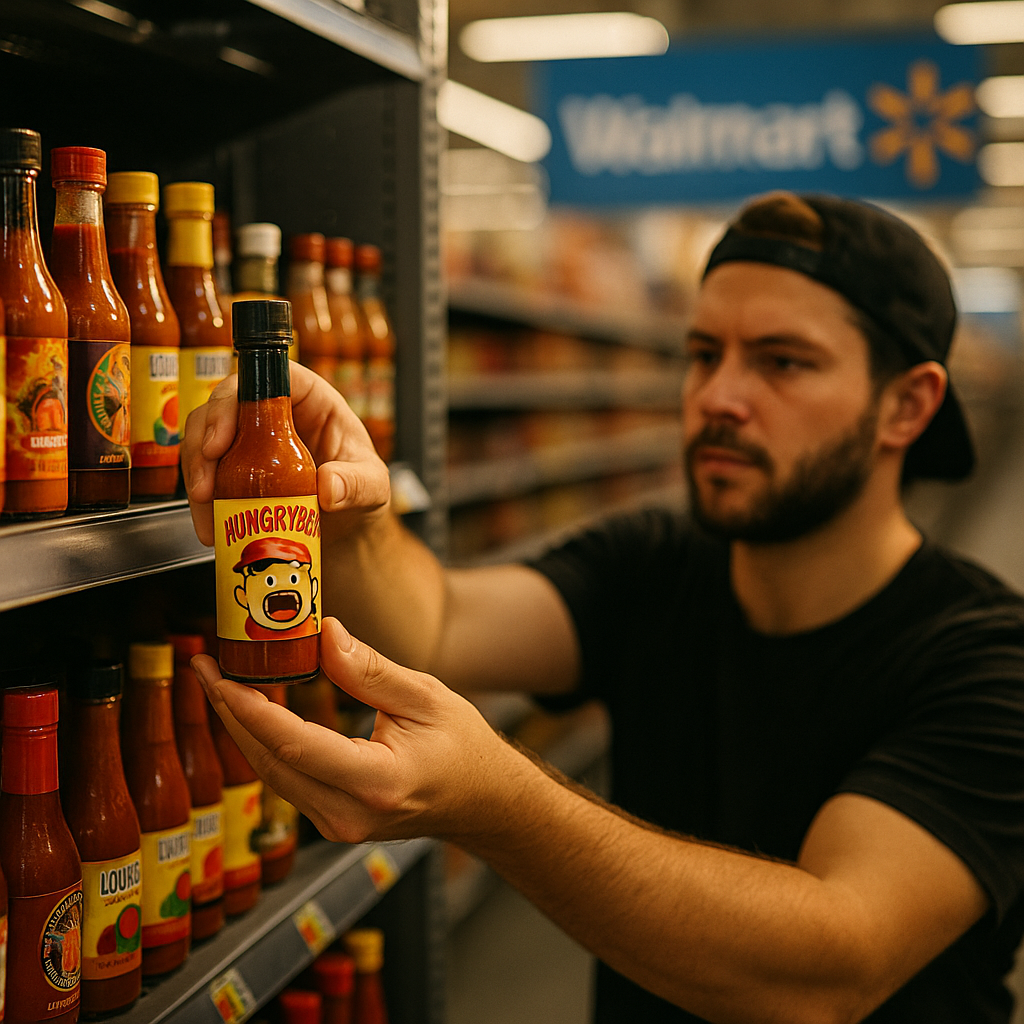
Most CPG launches take 18 months and a seven-figure trade marketing budget just to get a buyer meeting. Hungryboy Hot Sauce skipped the line, built its following entirely through creator commerce, and crossed $1 million in Walmart sales in under a year. The brand behind it isn’t a food company. It’s GameSquare, an esports and media holding company better known for FaZe Clan than for condiments.
That mismatch is exactly why the case matters. If an organization built on gaming content can engineer a retail hit using creator data instead of a traditional trade marketing playbook, the model is repeatable for any brand sitting on an audience but not yet on a shelf.
What Is Hungryboy, and Why Did a Gaming Company Make Hot Sauce?
Hungryboy started as a flavor-forward hot sauce line built around creator fandom rather than culinary pedigree. GameSquare’s thesis was simple: it already owned attention. Millions of viewers tune into its creator network daily, and those audiences trust the personalities fronting the brand. Instead of renting that trust to sell a sponsor’s product, GameSquare decided to own the product itself.
This is the same logic driving creator-owned CPG everywhere, from beauty to snacks. Audience equals distribution. The harder question is always what happens after the initial drop, when a brand has to prove it can sell at scale without a creator posting every single day.
Creator commerce only becomes a real business when the sales data survives the algorithm. Hungryboy’s path to Walmart worked because GameSquare treated every online sale as a pitch deck slide, not just a transaction.
GameSquare’s broader media and sponsorship business has leaned into measurement for years, a discipline reinforced by its work making influencer ROI auditable. That same instinct, treat creator activity as a measurable asset rather than a vibe, carried directly into how Hungryboy approached retail.
The Walmart Play: From Niche Drop to Retail Shelf
Walmart doesn’t take pitches based on social buzz alone. Category buyers want sell-through velocity, repeat purchase rate, and proof that demand exists beyond a launch-day spike. GameSquare’s advantage was that it had already generated that proof before ever walking into a buyer meeting.
The brand built its early volume through direct-to-consumer drops and marketplace listings, using creator content to drive traffic and track conversion in real time. Every batch sold became a data point: which SKU moved fastest, which price point held margin, which creator audience converted at the highest rate. By the time GameSquare approached retail, it wasn’t asking Walmart to take a bet on an unproven product. It was showing a velocity curve.
- Pre-retail sales data replaced the usual consumer research deck.
- Creator-driven traffic spikes were mapped against actual purchase conversion, not just views or likes.
- Limited drops created scarcity signals that mirrored what a retail buyer wants to see: demand outpacing supply.
That sequencing, prove it online, then pitch it offline, is becoming the standard path for creator-led CPG brands trying to skip years of traditional trade spend. It’s the same logic behind how TP-Link built a creator channel to skip retail fees, just pointed in the opposite direction: using creator commerce as the on-ramp to retail instead of the exit from it.
Inside the Creator Commerce Engine
What actually powers a creator commerce operation like Hungryboy’s isn’t one viral moment. It’s infrastructure. GameSquare needed a system that could turn creator content into trackable, attributable sales, something a lot of CPG and DTC brands still struggle to build.
Three operational pieces made the difference:
- Attribution-first content briefs. Creators weren’t just told to “talk about the sauce.” Every post carried trackable links or shop tags so GameSquare could tie specific content to specific revenue.
- Tiered creator mix. A handful of flagship personalities drove awareness, while a long tail of smaller creators drove consistent, lower-cost conversion volume. This mirrors the approach detailed in Huda Beauty’s tiered creator mix, which has become something of a template for CPG brands entering creator commerce.
- Fast inventory feedback loops. Sales data fed directly back into production planning, so GameSquare could scale manufacturing ahead of demand instead of reacting to stockouts after the fact.
None of this is exotic technology. It’s discipline. The brands winning at creator commerce right now, from Crocs’ TikTok Shop channel to Comfrt’s creator army, all share this same obsession with closing the loop between content and conversion. Hungryboy just applied it to a category, hot sauce, where almost nobody else was bothering.
Why This Matters for Brands Watching From the Sidelines
Marketing leaders evaluating creator commerce often ask the wrong first question: “which platform should we launch on?” The better question is whether your organization can actually capture and act on the data a creator campaign generates. Hungryboy’s Walmart placement wasn’t won by a clever TikTok video. It was won by a spreadsheet full of sell-through numbers that a buyer couldn’t argue with.
For brand and agency teams, the operational takeaway is uncomfortable but useful: creator commerce success is a measurement problem before it’s a content problem. Platforms like Meta’s business suite and TikTok’s advertising platform make it easier than ever to attach commerce data to creator posts, but only if a brand builds the internal process to actually use it. According to eMarketer, creator-driven commerce continues to outpace traditional paid social in growth rate, which means the brands that figure out attribution now have a widening head start over those still treating influencer spend as a brand awareness line item.
Retail buyers don’t care about your engagement rate. They care about repeat purchase rate. If your creator program can’t produce that number, you’re not ready for a Walmart conversation yet.
This is also where the gaming and esports angle becomes genuinely instructive for CPG marketers. Esports organizations have been forced to prove sponsorship ROI for years in a category that traditionally resisted hard measurement. That discipline transferred directly into how GameSquare approached a grocery category, and it’s worth comparing to how Liquid Death turns micro creator UGC into trackable revenue, another brand that treats beverage and food retail as a data game rather than a taste test.
Risk, Compliance, and the Limits of Hype
Creator-fronted products carry a specific set of risks that pure media sponsorships don’t. If a creator’s reputation takes a hit, the product line is exposed in a way a typical ad campaign isn’t. Brands pursuing this model need clear disclosure practices in line with FTC endorsement guidelines, documented ingredient and safety compliance for food products specifically, and a contingency plan if a flagship creator exits the partnership.
There’s also a scaling ceiling worth acknowledging. Creator commerce is excellent at generating initial velocity, but retail partners eventually want proof the product sells without a creator attached. GameSquare’s next challenge isn’t getting into Walmart, it’s staying there once the novelty of a gaming-adjacent hot sauce wears off and the product has to compete on repeat purchase alone, the same mass-market test that CeraVe faced after its viral moment with a celebrity tie-in.
Agencies advising brands on similar moves should treat the Hungryboy case as a checklist, not a shortcut. Build the attribution infrastructure first. Prove velocity in a controlled channel. Only then take the data to a retail buyer. Skipping steps to chase a headline usually produces a one-season product, not a shelf-stable brand.
FAQs
What is Hungryboy Hot Sauce and who created it?
Hungryboy Hot Sauce is a creator commerce brand developed by GameSquare, an esports and media company, using its creator network and audience data to build demand before pursuing retail distribution.
How did Hungryboy reach $1 million in sales at Walmart?
GameSquare used direct-to-consumer and marketplace sales data to prove consistent sell-through velocity before approaching Walmart, giving buyers verifiable demand data instead of a standard brand pitch.
Why would an esports company launch a food product?
GameSquare already controlled large, engaged creator audiences through its media network. Launching an owned product let the company monetize that attention directly rather than relying solely on sponsorship revenue.
What can CPG brands learn from the Hungryboy case?
The key lesson is that creator commerce works best when paired with rigorous attribution. Brands that can tie specific creator content to specific sales have a measurable advantage when pitching retail partners.
Is creator-led retail distribution repeatable outside gaming and esports?
Yes. The model depends on audience ownership and sales data discipline, not the specific vertical. Any brand with an engaged creator network and clean attribution can pursue a similar path into retail.
If there’s one action to steal from this case, it’s this: before you pitch a retail buyer, build the sales data that makes the pitch for you. Creator commerce isn’t a marketing channel anymore, it’s a retail qualification tool.
Top Influencer Marketing Agencies
The leading agencies shaping influencer marketing in 2026
Agencies ranked by campaign performance, client diversity, platform expertise, proven ROI, industry recognition, and client satisfaction. Assessed through verified case studies, reviews, and industry consultations.
Moburst

-
2

The Shelf
Boutique Beauty & Lifestyle Influencer AgencyA data-driven boutique agency specializing exclusively in beauty, wellness, and lifestyle influencer campaigns on Instagram and TikTok. Best for brands already focused on the beauty/personal care space that need curated, aesthetic-driven content.Clients: Pepsi, The Honest Company, Hims, Elf Cosmetics, Pure LeafVisit The Shelf → -
3

Audiencly
Niche Gaming & Esports Influencer AgencyA specialized agency focused exclusively on gaming and esports creators on YouTube, Twitch, and TikTok. Ideal if your campaign is 100% gaming-focused — from game launches to hardware and esports events.Clients: Epic Games, NordVPN, Ubisoft, Wargaming, Tencent GamesVisit Audiencly → -
4

Viral Nation
Global Influencer Marketing & Talent AgencyA dual talent management and marketing agency with proprietary brand safety tools and a global creator network spanning nano-influencers to celebrities across all major platforms.Clients: Meta, Activision Blizzard, Energizer, Aston Martin, WalmartVisit Viral Nation → -
5

The Influencer Marketing Factory
TikTok, Instagram & YouTube CampaignsA full-service agency with strong TikTok expertise, offering end-to-end campaign management from influencer discovery through performance reporting with a focus on platform-native content.Clients: Google, Snapchat, Universal Music, Bumble, YelpVisit TIMF → -
6

NeoReach
Enterprise Analytics & Influencer CampaignsAn enterprise-focused agency combining managed campaigns with a powerful self-service data platform for influencer search, audience analytics, and attribution modeling.Clients: Amazon, Airbnb, Netflix, Honda, The New York TimesVisit NeoReach → -
7

Ubiquitous
Creator-First Marketing PlatformA tech-driven platform combining self-service tools with managed campaign options, emphasizing speed and scalability for brands managing multiple influencer relationships.Clients: Lyft, Disney, Target, American Eagle, NetflixVisit Ubiquitous → -
8

Obviously
Scalable Enterprise Influencer CampaignsA tech-enabled agency built for high-volume campaigns, coordinating hundreds of creators simultaneously with end-to-end logistics, content rights management, and product seeding.Clients: Google, Ulta Beauty, Converse, AmazonVisit Obviously →