


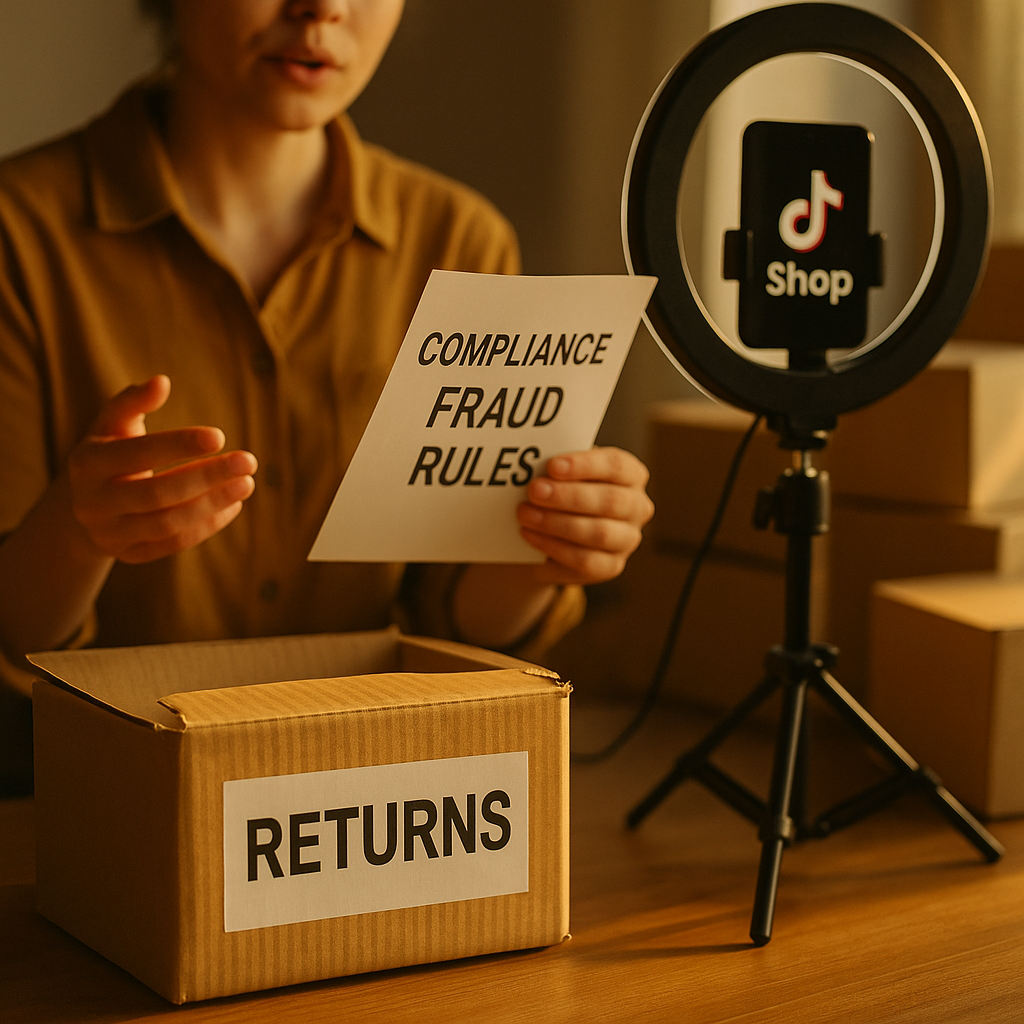
One flagged livestream. That’s all it takes to trigger a 72-hour seller review under TikTok Shop’s revised US enforcement model. If your hosts are still glossing over return timing or dodging shipping fraud disclosures mid-stream, TikTok Shop US livestream compliance is no longer a nice-to-have policy footnote — it’s the difference between a thriving shop and a frozen one.
The July policy update didn’t just tighten wording. It rewired how disclosures need to appear, when they need to appear, and who’s liable when a host skips them. This playbook breaks down what changed and how to structure your livestream scripts, moderator prompts, and post-sale messaging so your program survives the next enforcement sweep.
What Actually Changed in the July Update
TikTok Shop’s trust and safety team has been under pressure. Chargebacks tied to “item not as described” and “shipment never arrived” claims spiked sharply across US livestream commerce, according to internal seller-support data shared during TikTok Shop Partner briefings. The platform responded by tightening two specific disclosure categories: return timing accuracy and shipping fraud risk language.
In plain terms: sellers and hosts can no longer state a general “easy returns” policy without specifying the exact window, the condition requirements, and who covers return shipping. Separately, any livestream mentioning delivery speed, “guaranteed” shipping, or scarcity-driven fast checkout now requires a visible fraud-risk disclosure overlay, not just a buried terms-of-service link.
The core shift is this: TikTok Shop moved return and shipping disclosures from “policy page” territory into “real-time, on-screen” territory. Compliance now happens in the moment of the sale, not after it.
This mirrors a broader regulatory trend. The FTC has been increasingly vocal about live commerce disclosures resembling infomercial-era deception risks — vague promises made verbally, unsupported by visible text. TikTok’s update is, in part, a preemptive move to avoid becoming the next enforcement target.
Why Return Timing Language Is Now a Liability Trigger
Here’s the problem most brands don’t realize until it’s too late: a host saying “you’ve got plenty of time to return this” is now considered a compliance violation if it doesn’t match the shop’s stated return window exactly. Vague reassurance language — “no rush,” “we’ll take care of you,” “returns are super easy” — gets flagged by TikTok’s automated transcript scanning tools far more aggressively than before.
The fix isn’t complicated, but it requires discipline. Every livestream script needs a locked return-window statement, delivered verbatim, ideally reinforced with an on-screen sticker or pinned comment. Something like:
- “This item can be returned within 30 days of delivery, unworn and with tags attached.”
- “Return shipping is buyer-paid unless the item arrives damaged or defective.”
- “Refunds process within 5-7 business days after we receive the return.”
Notice the specificity. No adjectives, no reassurance filler. Just numbers and conditions. That’s what TikTok’s review team wants to see when they pull transcripts, and it’s what protects you if a buyer disputes a return later.
If your affiliate creators are running their own livestreams under your product catalog, this gets harder to control. You’ll need a locked disclosure card in every creator brief, non-negotiable, similar to how top sellers are already restructuring hooks and pacing for algorithm compliance — a pattern covered in our breakdown of sponsored hook restructuring.
The Shipping Fraud Disclosure Nobody’s Ready For
This is the part catching sellers off guard. TikTok Shop now requires a distinct disclosure whenever a livestream references delivery speed claims, limited-stock urgency, or “guaranteed by [date]” language. Why? Because shipping fraud complaints — items marked delivered that never arrived, or hosts overpromising expedited delivery that never happens — became one of the fastest-growing dispute categories in US live commerce last year, per data referenced in TikTok’s own seller policy briefings.
The required disclosure isn’t subtle. It has to appear as an on-screen overlay, not just a spoken line, whenever urgency or delivery-speed claims are made. TikTok’s suggested format:
“Delivery times are estimates, not guarantees. If your order doesn’t arrive within [X] days, contact support for a refund or replacement — not a chargeback.”
That last line matters more than it looks. TikTok wants sellers steering buyers away from chargebacks and toward in-platform resolution. Chargebacks hurt TikTok Shop’s standing with payment processors; in-platform refunds don’t. This is as much a payments-risk play as a consumer-protection one.
If you’ve dealt with the platform’s earlier crackdown on unverified accounts, this will feel familiar. It’s the same enforcement logic behind the Real IP freeze policy, where TikTok prioritized traceability and accountability over seller convenience.
Building the Compliant Livestream Script Structure
Most compliance failures aren’t malicious. They’re structural. Hosts improvise, get excited, promise things off-script because engagement metrics reward urgency and reassurance. So the fix has to be built into the show format itself, not left to a host’s memory.
Here’s a workable structure for every product segment in a livestream:
- Opening product claim — feature and benefit language, no return/shipping mentions yet.
- Pinned disclosure card — return window and shipping fraud disclosure appear on-screen for the full duration the product is featured, not just for three seconds.
- Verbal reinforcement — host reads the locked return-window line verbatim, once per product segment.
- Urgency language check — if the host mentions stock levels or delivery speed, the fraud disclosure overlay must trigger simultaneously.
- Post-sale confirmation — automated checkout message repeats both disclosures in text.
This isn’t just about compliance for compliance’s sake, either. Brands that ran structured disclosure segments during the platform’s beta testing phase reported fewer return disputes and lower chargeback rates than unstructured streams, according to seller feedback shared in TikTok Shop’s partner community forums. Clarity reduces disputes. It’s not a tradeoff against conversion, it’s often a lift to trust.
Compare this to how urgency messaging around countdown timers has already been restructured to avoid scarcity-related enforcement risk, detailed in our guide to countdown timer compliance. The same logic applies here: urgency language isn’t banned, it just needs a disclosure partner attached to it.
Who’s Actually Liable Here?
This is the question every brand ops lead should be asking legal right now. TikTok Shop’s updated seller agreement places primary liability on the shop account holder, not the individual host or affiliate creator, even when the creator is an independent contractor running their own stream. That means brands can’t outsource compliance risk to their creator roster and assume they’re covered.
If you’re running affiliate-heavy programs — and most TikTok Shop sellers are — you need a signed compliance addendum in every creator agreement. Not a generic “follow platform guidelines” clause. A specific addendum referencing the exact return-window and shipping-disclosure language your shop uses, with financial penalties for creators who go off-script.
This isn’t overkill. It’s the same operational rigor brands have had to apply to affiliate tracking and commission structures as TikTok tightened real-time attribution requirements, a shift we covered in detail in our piece on affiliate tracking compliance. Disclosure enforcement is following the same trajectory: more granular, more automated, less forgiving of “the creator said it, not us” defenses.
Training Hosts Without Killing Conversion
Compliance teams tend to overcorrect, and hosts hate reading legal disclaimers on camera. The tension is real. But the brands getting this right treat disclosure language as part of the sales pitch, not an interruption to it.
Framing matters. Instead of treating the return-window statement as a disclaimer, position it as a trust signal: “We’re so confident in this product, here’s exactly how our returns work.” Same information, different energy. Buyers respond better to specificity delivered confidently than vague reassurance delivered nervously anyway.
Run mock streams before launch. Record hosts delivering the disclosure language naturally, at conversational pace, not rushed like a pharmaceutical ad. TikTok’s transcript scanning tools care about content accuracy, not delivery style, but your conversion rate cares about delivery style a great deal.
What Happens If You Ignore This
TikTok’s enforcement ladder for disclosure violations under the new policy runs through warning, temporary livestream suspension, and full shop feature restriction. Sellers who accumulate three or more flagged streams within a rolling 90-day window lose livestream selling privileges entirely, forced back to catalog-only listings. For a shop built around live commerce, that’s not a slap on the wrist. That’s an existential threat to the business model.
The broader context matters too. Social commerce platforms across the board are under increasing regulatory scrutiny, from the FTC’s ongoing focus on deceptive marketing practices to growing consumer protection pressure documented by research groups like eMarketer. TikTok’s policy tightening isn’t happening in isolation. It’s a preview of where Instagram Checkout and YouTube Shopping enforcement are likely headed too, a dynamic worth watching if you’re comparing platforms for social commerce strategy.
Build your disclosure playbook now, not after your first strike. Audit every live script this week, lock your return-window language, and get compliance addendums into every creator contract before your next scheduled stream.
Frequently Asked Questions
What is the July policy update for TikTok Shop US livestreams?
It’s an enforcement update requiring sellers to disclose exact return windows and shipping fraud risk language visibly on-screen during livestreams, rather than relying on general policy pages or verbal reassurance.
Who is liable if a creator violates disclosure rules during a livestream?
TikTok Shop places primary liability on the seller account holder, even when an independent affiliate creator is hosting the stream. Brands need signed compliance addendums in creator contracts to manage this risk.
What counts as a shipping fraud disclosure violation?
Making delivery-speed guarantees or urgency claims (like “guaranteed by Friday” or limited stock messaging) without an accompanying on-screen fraud-risk disclosure overlay is considered a violation under the updated policy.
How many compliance strikes before a shop loses livestream privileges?
Three or more flagged livestreams within a rolling 90-day window can result in full livestream feature restriction, forcing the shop back to catalog-only selling.
Does this policy apply to affiliate creators, not just shop owners?
Yes. Affiliate creators running livestreams under a brand’s product catalog are subject to the same disclosure requirements, and brands remain liable for their compliance.
Visible FAQ (HTML)
(See FAQ section above.)
Top Influencer Marketing Agencies
The leading agencies shaping influencer marketing in 2026
Agencies ranked by campaign performance, client diversity, platform expertise, proven ROI, industry recognition, and client satisfaction. Assessed through verified case studies, reviews, and industry consultations.
Moburst

-
2

The Shelf
Boutique Beauty & Lifestyle Influencer AgencyA data-driven boutique agency specializing exclusively in beauty, wellness, and lifestyle influencer campaigns on Instagram and TikTok. Best for brands already focused on the beauty/personal care space that need curated, aesthetic-driven content.Clients: Pepsi, The Honest Company, Hims, Elf Cosmetics, Pure LeafVisit The Shelf → -
3

Audiencly
Niche Gaming & Esports Influencer AgencyA specialized agency focused exclusively on gaming and esports creators on YouTube, Twitch, and TikTok. Ideal if your campaign is 100% gaming-focused — from game launches to hardware and esports events.Clients: Epic Games, NordVPN, Ubisoft, Wargaming, Tencent GamesVisit Audiencly → -
4

Viral Nation
Global Influencer Marketing & Talent AgencyA dual talent management and marketing agency with proprietary brand safety tools and a global creator network spanning nano-influencers to celebrities across all major platforms.Clients: Meta, Activision Blizzard, Energizer, Aston Martin, WalmartVisit Viral Nation → -
5

The Influencer Marketing Factory
TikTok, Instagram & YouTube CampaignsA full-service agency with strong TikTok expertise, offering end-to-end campaign management from influencer discovery through performance reporting with a focus on platform-native content.Clients: Google, Snapchat, Universal Music, Bumble, YelpVisit TIMF → -
6

NeoReach
Enterprise Analytics & Influencer CampaignsAn enterprise-focused agency combining managed campaigns with a powerful self-service data platform for influencer search, audience analytics, and attribution modeling.Clients: Amazon, Airbnb, Netflix, Honda, The New York TimesVisit NeoReach → -
7

Ubiquitous
Creator-First Marketing PlatformA tech-driven platform combining self-service tools with managed campaign options, emphasizing speed and scalability for brands managing multiple influencer relationships.Clients: Lyft, Disney, Target, American Eagle, NetflixVisit Ubiquitous → -
8

Obviously
Scalable Enterprise Influencer CampaignsA tech-enabled agency built for high-volume campaigns, coordinating hundreds of creators simultaneously with end-to-end logistics, content rights management, and product seeding.Clients: Google, Ulta Beauty, Converse, AmazonVisit Obviously →