


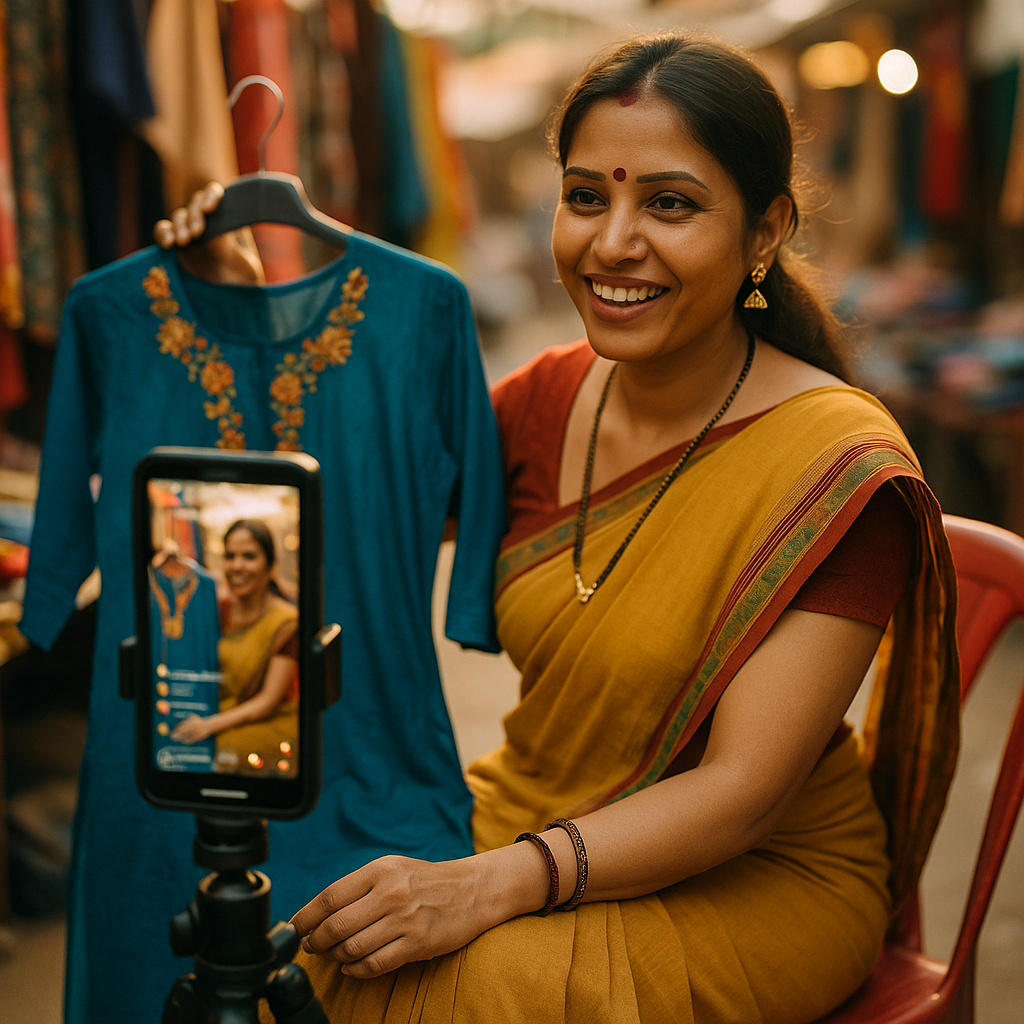
Nineteen percent of India’s 230 million online shoppers now buy directly through social channels. That’s roughly 44 million people treating Instagram, WhatsApp, and YouTube as checkout counters, not just discovery feeds. If you run a livestream or social commerce program in the US or Europe and that number doesn’t make you nervous, it should. India’s social commerce boom isn’t a regional curiosity — it’s a preview of where Western shopping behavior is headed, minus the years of platform hesitation slowing it down here.
Western brands have spent three years running livestream pilots. India skipped the pilot phase and went straight to scale.
The numbers behind the shift
India’s e-commerce base is enormous and still growing fast, but the social commerce slice is what should catch a CMO’s attention. Roughly one in five online shoppers there is already comfortable completing a purchase without leaving a social app. Compare that to the US, where eMarketer estimates social commerce penetration still sits well behind India’s rate, despite heavier ad spend and more mature platform tooling.
Why the gap? A few structural reasons matter more than culture or trend-chasing:
- Payment friction is nearly gone. UPI (Unified Payments Interface) lets shoppers pay instantly inside a chat thread or livestream overlay, no card entry, no redirect.
- WhatsApp is a commerce layer, not just messaging. Catalogs, order confirmations, and customer service run natively inside the app most Indians already use daily.
- Regional creators carry outsized trust. Vernacular-language livestreamers on platforms like Meesho and Flipkart’s live formats convert at rates that would make a US paid social manager weep.
- Mobile-first was never a migration. There was no desktop era to unlearn. Every commerce experience was built for a five-inch screen from day one.
India didn’t adopt social commerce faster because shoppers there are more trusting or more impulsive. They adopted it faster because the payment and platform infrastructure removed friction that Western checkout flows still haven’t solved.
What Western livestream strategy keeps getting wrong
Most US and European brands still treat livestream shopping as a marketing event, a one-hour spectacle with a countdown clock and an influencer reading a script. India’s model treats it as a retail channel that happens to be live. That distinction changes everything about how you staff it, budget it, and measure it.
Consider conversion. Data covered in livestream commerce conversion benchmarks shows live formats converting at roughly 30% versus 2% for standard paid social. That gap isn’t a fluke of novelty. It’s the product of real-time trust signals: live Q&A, visible stock counters, host credibility. India’s creators have simply run more reps at this than most Western brands have, and the muscle memory shows in their retention numbers.
There’s also a structural issue with how Western brands staff these programs. Livestream shopping in India runs on dedicated commerce hosts, people trained specifically to sell on camera, not general-purpose influencers moonlighting for a flat fee. Western brands are only now catching up, as seen in the shift toward tiered influencer models that separate top-of-funnel creators from dedicated commerce performers.
Platform fragmentation is the real obstacle
India’s advantage isn’t just cultural readiness. It’s platform consolidation. WhatsApp, Meesho, and Flipkart Live all point toward the same checkout rails. In the US, a brand running livestream commerce has to juggle TikTok Shop, Instagram Live Shopping, YouTube Shopping, and Amazon Live, each with different inventory sync requirements, different creator payout structures, and different attribution models.
That fragmentation is exactly why multi-touch attribution has become table stakes rather than a nice-to-have. Without it, brands can’t tell whether a livestream sale originated from an in-app discovery moment or a retargeted ad that happened to land during the stream. India’s tighter platform ecosystem sidesteps a lot of that measurement mess simply by having fewer seams to stitch together.
TikTok Shop is the closest Western parallel
If there’s one Western platform behaving like India’s social commerce ecosystem, it’s TikTok Shop. The platform has quietly moved from marketing add-on to genuine retail channel, a shift detailed in TikTok Shop’s retail platform evolution. It has in-app checkout, creator affiliate structures, and a subsidy model that, per TikTok’s recent subsidy shift, is now prioritizing retention over pure acquisition.
That retention pivot matters. India’s social commerce growth isn’t built on one-time discount-chasers. It’s built on repeat buyers who trust specific hosts and specific catalogs. Western brands chasing the same durability need to stop optimizing livestream campaigns for a single event’s GMV and start optimizing for repeat viewership and repeat purchase, the same logic now driving conversion rate over reach as the primary success metric across the industry.
Regional creators outperform global ambassadors
Here’s an uncomfortable truth for global brand teams: the influencers driving India’s social commerce numbers are rarely the ones with the biggest follower counts. They’re regional, vernacular-language hosts with deep category trust, often selling saris, kitchenware, or skincare to audiences who’ve watched them for years. That mirrors a broader trend already reshaping Western influencer ROI models, where audience quality is rewriting influencer ROI calculations away from vanity metrics.
For Western marketers, this means rethinking who gets the livestream slot. A mega-influencer with three million followers might drive spectacle. A mid-tier creator with a hyper-engaged niche audience and a track record of answering every comment during a live session will drive sales. India’s platforms have essentially proven the micro-and-mid-tier thesis at national scale.
It also raises staffing questions internally. Brands running serious livestream programs increasingly need dedicated creator ops, not just campaign managers, a shift reflected in how influencer manager roles now require CAC and LTV fluency. Livestream commerce is retail. It needs retail-grade unit economics thinking, not campaign-grade vanity reporting.
What about compliance and disclosure risk?
Live selling introduces disclosure risk that pre-recorded content doesn’t. A host improvising claims in real time, promising results, comparing competitors, quoting prices that change mid-stream, creates a paper trail that’s harder to audit than a scripted post. US brands need to be especially careful here given ongoing FTC enforcement around commercial intent, which increasingly looks past hashtags to actual viewer perception.
India’s regulatory environment around live commerce is comparatively looser today, which is precisely why Western brands can’t just copy the growth tactics wholesale. Build disclosure checkpoints into every livestream script. Record everything. Brief hosts on claim boundaries before they go live, not after a legal review flags the replay. The FTC has made clear that live and ephemeral content carries the same disclosure obligations as static posts, just with less room for correction.
Building a livestream strategy that borrows the right lessons
Copying India’s exact playbook won’t work outside markets with UPI-level payment infrastructure. But three structural lessons transfer cleanly:
- Reduce checkout friction to near zero. Every extra tap between “I want this” and “I bought this” costs conversion. Audit your livestream checkout flow the way you’d audit a landing page.
- Invest in dedicated commerce hosts, not borrowed influencers. Selling live is a distinct skill from posting content. Train for it or hire for it specifically.
- Measure repeat behavior, not single-event GMV. A livestream that generates one big sales spike and no return viewership is a marketing stunt. A livestream that builds a recurring audience is a retail channel.
There’s also an attribution lesson worth stealing. As platforms consolidate identity and measurement, per the trend covered in enterprise identity and CDP consolidation, brands running livestream programs need a single view of the shopper across TikTok Shop, Instagram, and owned e-commerce. India’s ecosystem gets this almost for free through platform concentration. Western brands have to build it deliberately.
None of this requires waiting for US infrastructure to catch up to India’s. It requires treating livestream commerce as a retail P&L line, not a marketing experiment, starting with the next quarter’s budget conversation.
FAQs
What percentage of Indian online shoppers buy through social media?
Roughly 19% of India’s estimated 230 million online shoppers, around 44 million people, now complete purchases directly through social channels like Instagram, WhatsApp, and platform-native livestreams, according to recent social commerce adoption data.
Why is India’s social commerce adoption faster than the West’s?
India’s adoption outpaces Western markets largely due to infrastructure: instant UPI payments embedded directly in chat and livestream apps, WhatsApp functioning as a native commerce layer, and a mobile-first shopping culture that never had to migrate away from desktop habits.
Which Western platform most closely resembles India’s social commerce model?
TikTok Shop is the closest parallel, having evolved from a marketing feature into a genuine retail platform with in-app checkout, creator affiliate programs, and a subsidy structure now shifting toward retention rather than pure acquisition.
Is livestream commerce actually more effective than standard social ads?
Yes. Livestream commerce formats have shown conversion rates around 30% compared to roughly 2% for standard paid social, driven by real-time trust signals like live Q&A, visible stock counts, and host credibility.
What compliance risks should brands watch for in livestream selling?
Live, unscripted selling raises disclosure risk because hosts may make real-time claims or comparisons that are harder to audit than pre-recorded content. The FTC treats live content under the same disclosure standards as static posts, so brands should brief hosts on claim boundaries and record all sessions.
Top Influencer Marketing Agencies
The leading agencies shaping influencer marketing in 2026
Agencies ranked by campaign performance, client diversity, platform expertise, proven ROI, industry recognition, and client satisfaction. Assessed through verified case studies, reviews, and industry consultations.
Moburst

-
2

The Shelf
Boutique Beauty & Lifestyle Influencer AgencyA data-driven boutique agency specializing exclusively in beauty, wellness, and lifestyle influencer campaigns on Instagram and TikTok. Best for brands already focused on the beauty/personal care space that need curated, aesthetic-driven content.Clients: Pepsi, The Honest Company, Hims, Elf Cosmetics, Pure LeafVisit The Shelf → -
3

Audiencly
Niche Gaming & Esports Influencer AgencyA specialized agency focused exclusively on gaming and esports creators on YouTube, Twitch, and TikTok. Ideal if your campaign is 100% gaming-focused — from game launches to hardware and esports events.Clients: Epic Games, NordVPN, Ubisoft, Wargaming, Tencent GamesVisit Audiencly → -
4

Viral Nation
Global Influencer Marketing & Talent AgencyA dual talent management and marketing agency with proprietary brand safety tools and a global creator network spanning nano-influencers to celebrities across all major platforms.Clients: Meta, Activision Blizzard, Energizer, Aston Martin, WalmartVisit Viral Nation → -
5

The Influencer Marketing Factory
TikTok, Instagram & YouTube CampaignsA full-service agency with strong TikTok expertise, offering end-to-end campaign management from influencer discovery through performance reporting with a focus on platform-native content.Clients: Google, Snapchat, Universal Music, Bumble, YelpVisit TIMF → -
6

NeoReach
Enterprise Analytics & Influencer CampaignsAn enterprise-focused agency combining managed campaigns with a powerful self-service data platform for influencer search, audience analytics, and attribution modeling.Clients: Amazon, Airbnb, Netflix, Honda, The New York TimesVisit NeoReach → -
7

Ubiquitous
Creator-First Marketing PlatformA tech-driven platform combining self-service tools with managed campaign options, emphasizing speed and scalability for brands managing multiple influencer relationships.Clients: Lyft, Disney, Target, American Eagle, NetflixVisit Ubiquitous → -
8

Obviously
Scalable Enterprise Influencer CampaignsA tech-enabled agency built for high-volume campaigns, coordinating hundreds of creators simultaneously with end-to-end logistics, content rights management, and product seeding.Clients: Google, Ulta Beauty, Converse, AmazonVisit Obviously →