


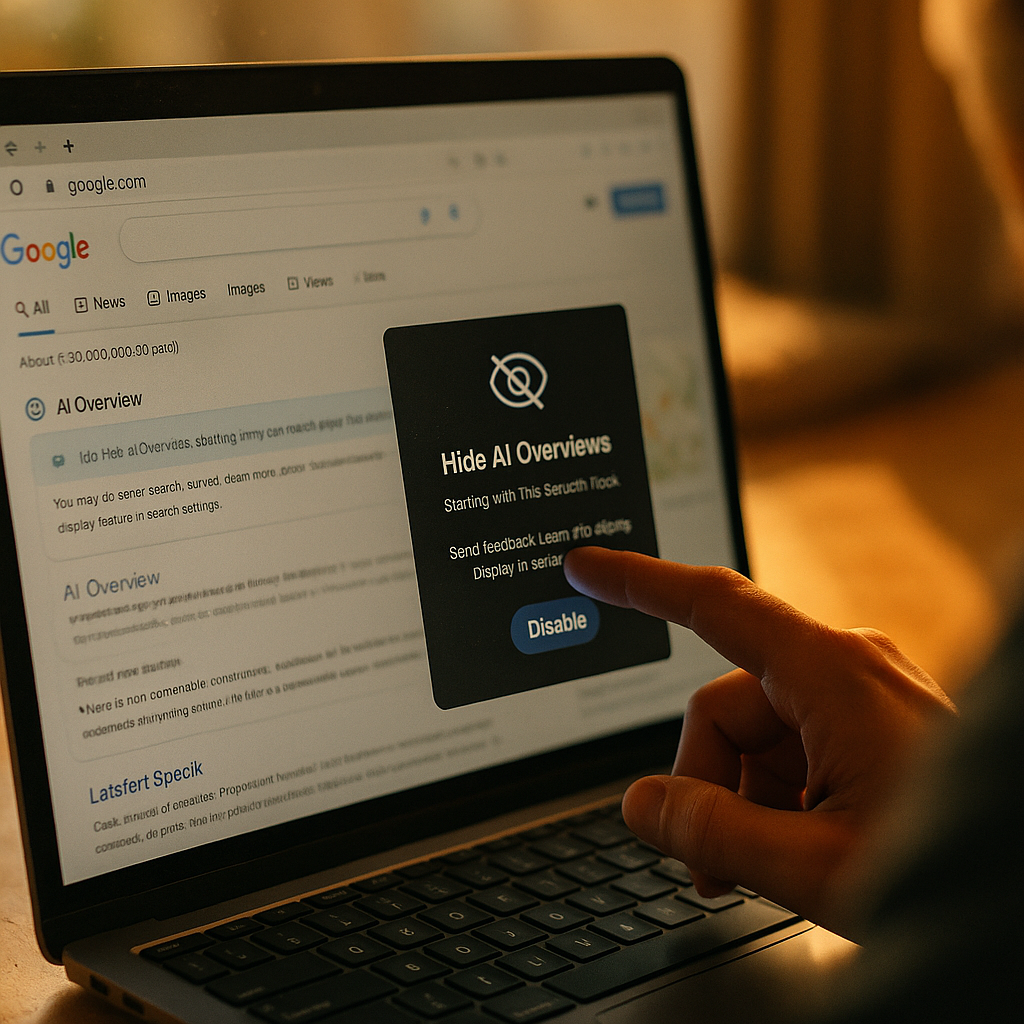
Roughly 60% of Google searches now end without a click, according to recent industry estimates, thanks to AI Overviews absorbing the answer before users ever reach a publisher’s page. Now Google has quietly rolled out an opt-out option for AI search overviews, and it’s forcing a reckoning nobody planned for. Do you protect your traffic, or protect your visibility? You can’t fully have both anymore.
This isn’t a minor technical toggle buried in Search Console. It’s a strategic fork in the road for every brand and publisher that depends on organic search for demand generation. Choose wrong, and you either bleed referral traffic or vanish from the answers people actually see.
What the Opt-Out Actually Does
Google’s opt-out mechanism lets site owners exclude their content from being summarized inside AI Overviews and the broader AI Mode search experience, while — in theory — still allowing that content to rank in traditional blue-link results. It’s implemented through a new directive that sits alongside existing robots.txt and meta robots controls, giving publishers a lever they didn’t have before.
Sounds like a win for control, right? The catch is Google hasn’t confirmed whether opting out carries zero ranking penalty in traditional search. Early tests from SEO practitioners suggest a mixed picture: some sites saw stable rankings, others noticed a dip in visibility for query types that overlap heavily with AI Overview triggers. Nothing is confirmed at scale yet, and Google’s own guidance remains vague on the tradeoff.
The opt-out doesn’t restore the old search economy. It just gives publishers a choice between two imperfect outcomes: reduced visibility in AI answers, or continued content scraping with no guarantee of click-through.
Why Publishers Are Split Down the Middle
News publishers, comparison sites, and review-driven media are the loudest voices pushing for opt-out adoption. Their business model depends on the click. If Google’s AI summarizes a product comparison using your reviewer’s work and the reader never visits your site, you’ve lost the ad impression, the affiliate link, and the subscription pitch — all in one shot.
But B2B brands and SaaS marketers are approaching this differently. For many of them, appearing inside an AI Overview is now a brand awareness play, not a traffic play. Being cited as the source, even without a click, still builds authority signals and keeps the brand name in front of decision-makers researching a category. This is the same logic driving the convergence of GEO, AEO, and SEO strategies — visibility inside generative answers is becoming its own KPI, separate from click-through rate.
So the split isn’t really about publishers versus brands. It’s about whether your revenue model is transaction-based (you need the visit) or trust-based (you need the mention).
The Traffic Math Doesn’t Lie
Multiple studies, including data referenced by eMarketer, point to double-digit declines in organic click-through rates for queries that trigger AI Overviews compared to standard search results. That’s not a rounding error. For content teams whose entire budget justification rests on organic traffic growth, this is an existential metric shift.
Marketing leaders now have to answer an uncomfortable question in board meetings: if the traffic isn’t there, what are we actually measuring?
The Brand Content Strategy Shift Nobody Budgeted For
Here’s where it gets operationally messy. Content teams built entire calendars around ranking for high-intent, informational queries — the “how to,” “best,” and “vs” content that used to drive steady blog traffic. AI Overviews now answer most of those queries directly on the results page. The opt-out doesn’t fix that; it just decides whether your content is the one being quoted.
Brands are responding in three ways:
- Doubling down on proprietary data and original research that AI models can’t easily replicate or summarize without attribution, making the source harder to bypass.
- Shifting budget toward owned-audience channels — email, community, and creator partnerships — that don’t depend on Google’s algorithm at all. This mirrors the trend covered in owned audience channel strategies gaining traction across the creator economy.
- Restructuring content for citation, not clicks — writing in a way that makes the brand the obvious authoritative source, even if the reader never visits the site.
None of this is theoretical. Teams that built their content ops around permanent content operations are now reallocating those resources toward formats built for AI citation rather than SERP ranking alone.
Should Your Brand Actually Opt Out?
There’s no universal answer here, and anyone telling you otherwise is selling something. A few practical filters help narrow the decision:
- Is your content transactional or educational? Product pages and pricing content rarely benefit from AI summarization anyway. Educational and comparison content is where the opt-out debate matters most.
- Does your revenue depend on ad impressions or subscriptions? If yes, the click is everything, and opting out may protect more traffic than it costs in visibility.
- Is brand authority more valuable than the visit itself? B2B marketers selling long-consideration-cycle products often care more about being the trusted name than the immediate session.
Agencies advising enterprise clients are already building this into governance frameworks, not unlike the shift toward structured oversight described in AI marketing governance models. Expect opt-out decisions to become a standing line item in quarterly content audits, reviewed alongside crawl budgets and technical SEO health.
Risk, Compliance, and the Attribution Problem
There’s a legal and compliance layer here too, and it’s getting louder. Publishers and creators alike are questioning whether AI Overviews constitute fair use of their original reporting and analysis, especially when summaries reproduce substantial portions of the original work without meaningful attribution. Regulatory bodies, including scrutiny referenced by the Federal Trade Commission, have signaled interest in how AI-generated summaries affect competition and consumer access to original sources.
For brand marketers, this connects directly to a problem already familiar from influencer attribution work: proving where value actually came from. The same identity resolution challenges outlined in coverage of the AI attribution trust gap now apply to organic content performance. If AI Overviews obscure the source of a click (or eliminate the click entirely), attribution models built on last-touch or even multi-touch frameworks start breaking down.
This is why forward-thinking teams are pairing their opt-out decisions with a broader review of measurement infrastructure, similar to the shift toward multi-touch attribution already underway in influencer and paid media.
What This Means for Agencies Managing Multiple Clients
Agencies sit in an especially tricky spot. A client in e-commerce with thin margins per transaction needs every click protected. A client selling enterprise software with a six-month sales cycle might actually want AI Overview visibility, because brand recall matters more than session count. Running a blanket opt-out policy across an entire client roster is lazy strategy, and clients will notice when their competitors show up in AI answers and they don’t.
The smarter move: segment opt-out decisions by content type and business model, not by blanket account-level settings. Track it in the same tiered framework agencies use for tiered content models, where different content categories get different visibility strategies based on funnel stage and revenue contribution.
Practical Steps for the Next Quarter
Waiting for Google to clarify the ranking impact isn’t a strategy. Here’s what marketing teams should actually be doing right now:
- Audit which pages are currently being cited or summarized in AI Overviews using rank tracking tools that flag AI Overview presence, such as those offered by HubSpot or dedicated SEO platforms.
- Segment content by business model: transactional pages likely benefit from opt-out testing, top-of-funnel educational content may benefit from staying visible.
- Run a controlled test on a subset of pages before applying the opt-out site-wide. Measure both organic traffic and brand mention frequency in AI answers over a full quarter.
- Reallocate a portion of content budget toward creator and community channels that don’t depend on Google’s crawl-and-summarize pipeline at all.
- Build AI Overview visibility into existing social listening and brand monitoring workflows, the same way teams already track sentiment via tools like Sprout Social.
Marketers who treat this as a one-time settings change will miss the bigger shift. This is a recurring strategic decision, one that needs revisiting every time Google updates how AI Overviews source and attribute content.
Visible FAQ
What is Google’s opt-out option for AI Search Overviews?
It’s a mechanism that lets website owners exclude their content from being summarized in Google’s AI Overviews and AI Mode search results, while attempting to preserve eligibility for standard organic rankings.
Does opting out of AI Overviews hurt search rankings?
Google hasn’t confirmed a guaranteed ranking penalty, but early practitioner testing shows mixed results. Some sites retain stable rankings, others see reduced visibility on queries that heavily overlap with AI Overview triggers. Results appear to vary by industry and query type.
Should B2B brands opt out of AI Overviews?
It depends on the revenue model. Brands relying on direct traffic and ad impressions often benefit from opting out. Brands prioritizing authority and brand recall in long sales cycles may prefer staying visible inside AI answers, even without the click.
How does the opt-out affect content strategy?
It’s pushing brands toward proprietary research, owned-audience channels like email and creator partnerships, and content written for citation rather than pure click-through, since AI summarization has already changed how informational queries get answered.
Is there a legal risk tied to AI Overviews summarizing publisher content?
Publishers and regulators are actively questioning whether AI summaries constitute fair use when they reproduce substantial original reporting without adequate attribution. This remains an evolving area with no settled legal precedent yet.
The opt-out isn’t a fix, it’s a fork. Pick your lane based on revenue model, test it against a real content segment for a full quarter, and stop treating AI Overview visibility as an afterthought in your search strategy.
Top Influencer Marketing Agencies
The leading agencies shaping influencer marketing in 2026
Agencies ranked by campaign performance, client diversity, platform expertise, proven ROI, industry recognition, and client satisfaction. Assessed through verified case studies, reviews, and industry consultations.
Moburst

-
2

The Shelf
Boutique Beauty & Lifestyle Influencer AgencyA data-driven boutique agency specializing exclusively in beauty, wellness, and lifestyle influencer campaigns on Instagram and TikTok. Best for brands already focused on the beauty/personal care space that need curated, aesthetic-driven content.Clients: Pepsi, The Honest Company, Hims, Elf Cosmetics, Pure LeafVisit The Shelf → -
3

Audiencly
Niche Gaming & Esports Influencer AgencyA specialized agency focused exclusively on gaming and esports creators on YouTube, Twitch, and TikTok. Ideal if your campaign is 100% gaming-focused — from game launches to hardware and esports events.Clients: Epic Games, NordVPN, Ubisoft, Wargaming, Tencent GamesVisit Audiencly → -
4

Viral Nation
Global Influencer Marketing & Talent AgencyA dual talent management and marketing agency with proprietary brand safety tools and a global creator network spanning nano-influencers to celebrities across all major platforms.Clients: Meta, Activision Blizzard, Energizer, Aston Martin, WalmartVisit Viral Nation → -
5

The Influencer Marketing Factory
TikTok, Instagram & YouTube CampaignsA full-service agency with strong TikTok expertise, offering end-to-end campaign management from influencer discovery through performance reporting with a focus on platform-native content.Clients: Google, Snapchat, Universal Music, Bumble, YelpVisit TIMF → -
6

NeoReach
Enterprise Analytics & Influencer CampaignsAn enterprise-focused agency combining managed campaigns with a powerful self-service data platform for influencer search, audience analytics, and attribution modeling.Clients: Amazon, Airbnb, Netflix, Honda, The New York TimesVisit NeoReach → -
7

Ubiquitous
Creator-First Marketing PlatformA tech-driven platform combining self-service tools with managed campaign options, emphasizing speed and scalability for brands managing multiple influencer relationships.Clients: Lyft, Disney, Target, American Eagle, NetflixVisit Ubiquitous → -
8

Obviously
Scalable Enterprise Influencer CampaignsA tech-enabled agency built for high-volume campaigns, coordinating hundreds of creators simultaneously with end-to-end logistics, content rights management, and product seeding.Clients: Google, Ulta Beauty, Converse, AmazonVisit Obviously →