


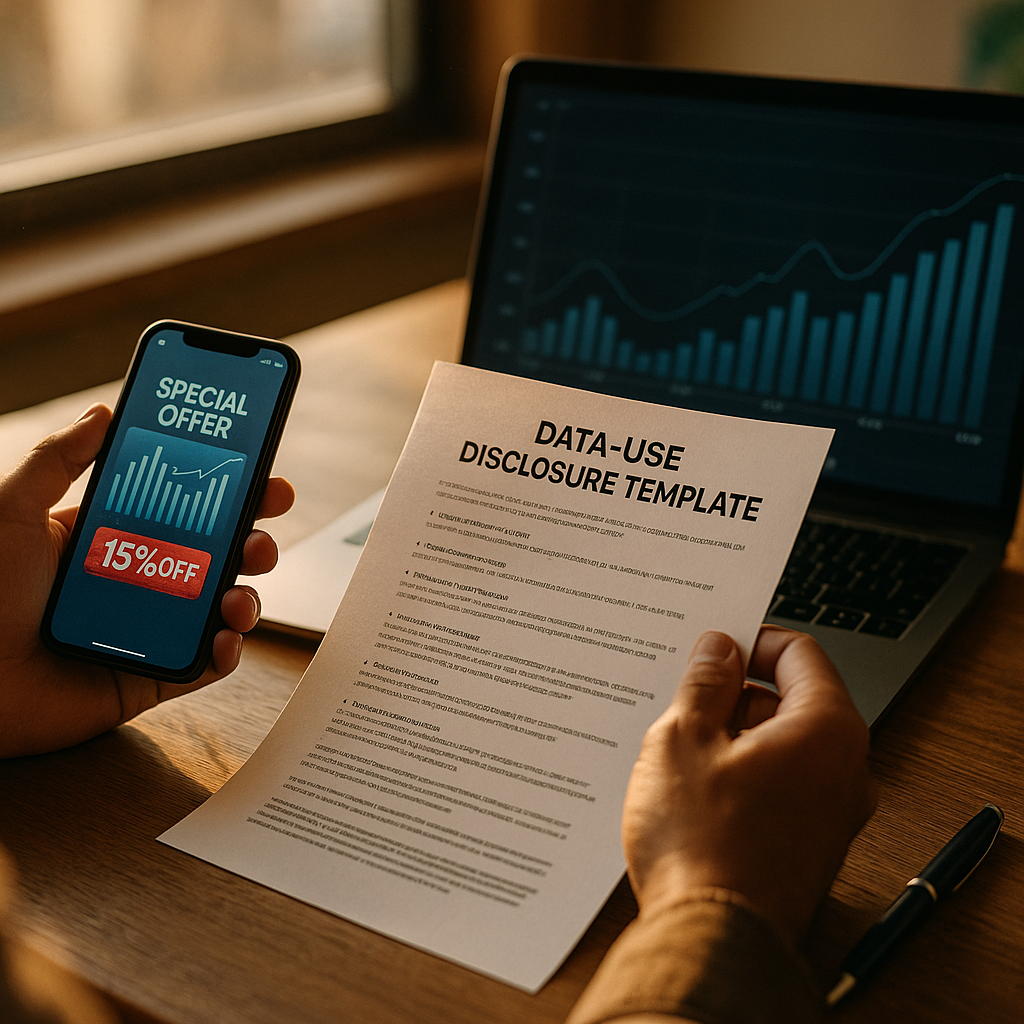
73% of consumers say they’ll switch brands after discovering personalized pricing they weren’t told about. Yet most companies running algorithm-driven offers still bury the “how” behind a vague privacy policy link. A proper data-use disclosure template isn’t paperwork — it’s the difference between a defensible personalization program and a class-action headline waiting to happen.
Personalization has quietly become the FTC’s favorite enforcement target. Algorithmic pricing, dynamic discounts, “just for you” product feeds — all of it runs on behavioral data that most customers never explicitly agreed to share for that purpose. Brands that can’t produce a clear, specific disclosure explaining what data drives the offer, and why, are exposed. Not eventually. Now.
Why This Suddenly Matters More Than It Did Last Year
Surveillance pricing hit the regulatory mainstream fast. The FTC’s ongoing scrutiny of algorithmic and personalized pricing practices has moved from studies and workshops into active enforcement posture, and state attorneys general are following suit with their own disclosure mandates. If you’ve been tracking the FTC personalized pricing enforcement timeline, you already know the grace period is closing.
At the same time, retail media networks and creator commerce platforms have made algorithm-driven offers the default, not the exception. TikTok Shop, Amazon, Instagram Shop — they’re all running some form of dynamic personalization behind the scenes. Brands plugging into these ecosystems inherit the disclosure obligation, whether their legal team realized it or not.
A disclosure that says “we use data to personalize your experience” is functionally useless in an enforcement action. Regulators want specificity: what data, which algorithm inputs, what outcome it produces.
What a Real Data-Use Disclosure Template Actually Needs
Forget the boilerplate. A disclosure template built for algorithm-driven personalized offers needs six components, and skipping any one of them creates a gap that plaintiffs’ attorneys will find eventually.
- Data inputs, named explicitly. Browsing history, purchase frequency, loyalty tier, device type, geolocation, third-party enrichment data — list what actually feeds the model. “Various data points” doesn’t cut it.
- Offer logic, in plain language. You don’t need to publish your pricing algorithm’s source code. You do need to explain, in a sentence a customer can understand, what the data does to the offer they see.
- Opt-out mechanism, functional and visible. A working toggle or link, not a dead-end contact form. If a customer opts out, the offer experience should demonstrably change.
- Timing of disclosure. Before the offer is shown, not buried three clicks into a privacy policy after the purchase.
- Data retention and sharing scope. How long is this behavioral profile kept, and does it get shared with ad partners, creators, or affiliate networks?
- Update trigger language. A clause committing to re-disclosure whenever the underlying data sources or algorithm logic materially change.
Notice what’s missing from that list: legal jargon. The template works because it’s built for comprehension, not just compliance-box-checking. That’s also exactly what regulators are checking for now — the FTC has been explicit that disclosures need to be “clear and conspicuous,” not technically present.
Borrowing From Adjacent Compliance Work
If your team already built a personalized pricing disclosure template for FTC compliance, don’t start from scratch. Algorithm-driven offer disclosures share most of their DNA with pricing disclosures — the core difference is scope. Pricing disclosure covers the number a customer sees. Data-use disclosure covers everything upstream of that number: the inputs, the model, the vendor chain.
Treat the two as companion documents, not competitors. Legal teams that maintain them separately tend to create contradictory language — one document says “we don’t share data with third parties,” the other quietly admits a retail media partnership does exactly that. Reconcile them before either goes live.
Where Brands Get This Wrong
Three failure patterns show up again and again in audits.
First: disclosure written by legal, reviewed by no one who understands the actual data pipeline. The result reads as compliant but describes a system that doesn’t match what marketing ops is actually running. When the FTC or a state AG requests documentation, the mismatch becomes the case.
Second: static disclosure, dynamic model. Personalization algorithms get retrained, retuned, and fed new data sources constantly. A disclosure written eighteen months ago and never updated is a liability, not a shield. This is the same failure mode documented in TikTok Shop algorithm audits for FTC surveillance pricing — the paperwork froze while the model kept moving.
Third: disclosure that lives in one place but the offer shows up in five. A personalized discount surfaced via a creator’s TikTok Shop storefront, an email campaign, and a retargeted ad might draw on the same underlying data model but present three different (or zero) disclosures. Consistency across every channel where the algorithm-driven offer appears isn’t optional.
If your disclosure only lives on your website, but your personalized offers run through creator storefronts and paid social, you have a compliance gap on every channel outside your own domain.
Building the Template: A Practical Structure
Here’s a workable skeleton brands can adapt rather than build from zero:
- Header statement: “This offer was generated using automated personalization based on the following data.”
- Data source table: Category (e.g., browsing behavior), specific examples, source (first-party, third-party, data broker).
- Purpose statement: One sentence per data category explaining what it influences (price, product recommendation, discount tier, ad creative).
- Human review disclosure: State whether a human reviews or can override algorithmic decisions, and how.
- Opt-out block: Direct link or toggle, plus what the customer should expect to see differently after opting out.
- Contact and escalation path: Who to reach if a customer believes the personalization was inaccurate or unfair.
- Version and effective date: Every disclosure should be dated and versioned like a contract, because in an enforcement action, it functionally is one.
This isn’t dramatically different from the governance work brands have already done for identity resolution data processing agreements. The same rigor around documenting data flow and vendor accountability applies here, just surfaced for the end customer instead of buried in a vendor contract.
Who Owns This Inside the Org?
This is where most brands stall. Data-use disclosure sits at the intersection of legal, marketing ops, and whichever team owns the personalization engine (often a martech or data science function reporting elsewhere entirely). No single department has full visibility into all three layers.
The fix isn’t complicated, just uncomfortable: someone has to own the template as a living document, with a standing quarterly review that pulls in legal, the algorithm owner, and a marketing lead who understands how offers actually reach customers. Miss the quarterly cadence and the template drifts out of sync with the model — see failure pattern number two, above.
Creator and Affiliate Channels Add Another Layer
If personalized offers get distributed through creators — think TikTok Shop affiliate codes, personalized discount links, or algorithm-tuned product recommendations pushed to specific creator audiences — the disclosure obligation extends to that channel too. A creator promoting a personalized discount code without disclosing that the offer amount is data-driven creates exposure for both the creator and the brand. Compare this to the disclosure gaps already flagged in TikTok Shop creator codes and FTC personalized pricing rules.
Brands running creator programs should push a simplified version of the disclosure template into creator briefs directly. Not the full legal document — a one-paragraph summary creators can adapt into their own captions or story overlays, with a link back to the full disclosure. This keeps creator content compliant without turning every affiliate post into a legal memo.
Industry data backs the urgency here. Research from eMarketer shows personalized commerce experiences now touch the majority of digital retail interactions, while consumer trust research from Sprout Social consistently finds transparency as a top driver of brand trust on social platforms. The gap between how much personalization brands run and how clearly they explain it is exactly where regulatory and reputational risk concentrates.
Testing the Template Before It Goes Live
A disclosure template is only as good as its weakest real-world application. Before rolling it out, run it against three scenarios:
A customer who opts out mid-session — does the offer actually change, or does the backend keep using the same data anyway? A customer who requests their data profile — can you produce, within a reasonable window, the exact inputs that generated their specific offer? A regulator who requests documentation — does your disclosure language match what the algorithm actually does, or does it describe an idealized version of the system?
If any of those three scenarios exposes a gap, the template isn’t ready. Better to find that in an internal stress test than in a Federal Trade Commission inquiry.
The parallel work brands have done on reconciling FTC and state law disclosure rules is instructive here — a template that satisfies federal guidance but ignores California’s or Colorado’s stricter algorithmic transparency requirements will fail the moment a customer in the wrong zip code files a complaint.
Next step: pull your current personalization disclosure, run it against the six-component checklist above, and flag every gap before your next algorithm update ships. If you can’t complete that audit internally within two weeks, that’s the clearest signal you need a dedicated cross-functional owner for this document, starting now.
Frequently Asked Questions
What is a data-use disclosure template for personalized offers?
It’s a standardized document that explains, in plain language, what customer data feeds an algorithm-driven offer, how that data influences pricing or recommendations, and how customers can opt out. It’s distinct from a general privacy policy because it focuses specifically on the personalization mechanism, not overall data collection practices.
Does the FTC require brands to disclose algorithmic personalization?
The FTC has signaled increasing scrutiny of personalized and algorithmic pricing practices, particularly around clear and conspicuous disclosure requirements. While a single universal federal mandate is still evolving, enforcement actions and state-level laws already require meaningful transparency about data-driven offers in many jurisdictions.
How often should a data-use disclosure be updated?
At minimum, quarterly, and immediately after any material change to data sources, algorithm logic, or third-party data sharing arrangements. A disclosure that doesn’t match the live system creates more legal risk than having no disclosure at all.
Do creators need to disclose algorithm-driven personalized offers too?
Yes, if a creator is promoting a discount code or offer that was generated through personalization logic, that connection should be disclosed to their audience. Brands should provide creators with simplified disclosure language in campaign briefs to keep affiliate and influencer content compliant.
What’s the biggest mistake brands make with these disclosures?
Writing a disclosure that describes an idealized or outdated version of the personalization system rather than what the algorithm actually does today. This mismatch is exactly what regulators and plaintiffs’ attorneys look for during an investigation or lawsuit.
FAQs
What is a data-use disclosure template for personalized offers?
It’s a standardized document that explains, in plain language, what customer data feeds an algorithm-driven offer, how that data influences pricing or recommendations, and how customers can opt out. It’s distinct from a general privacy policy because it focuses specifically on the personalization mechanism, not overall data collection practices.
Does the FTC require brands to disclose algorithmic personalization?
The FTC has signaled increasing scrutiny of personalized and algorithmic pricing practices, particularly around clear and conspicuous disclosure requirements. While a single universal federal mandate is still evolving, enforcement actions and state-level laws already require meaningful transparency about data-driven offers in many jurisdictions.
How often should a data-use disclosure be updated?
At minimum, quarterly, and immediately after any material change to data sources, algorithm logic, or third-party data sharing arrangements. A disclosure that doesn’t match the live system creates more legal risk than having no disclosure at all.
Do creators need to disclose algorithm-driven personalized offers too?
Yes, if a creator is promoting a discount code or offer that was generated through personalization logic, that connection should be disclosed to their audience. Brands should provide creators with simplified disclosure language in campaign briefs to keep affiliate and influencer content compliant.
What’s the biggest mistake brands make with these disclosures?
Writing a disclosure that describes an idealized or outdated version of the personalization system rather than what the algorithm actually does today. This mismatch is exactly what regulators and plaintiffs’ attorneys look for during an investigation or lawsuit.
Top Influencer Marketing Agencies
The leading agencies shaping influencer marketing in 2026
Agencies ranked by campaign performance, client diversity, platform expertise, proven ROI, industry recognition, and client satisfaction. Assessed through verified case studies, reviews, and industry consultations.
Moburst

-
2

The Shelf
Boutique Beauty & Lifestyle Influencer AgencyA data-driven boutique agency specializing exclusively in beauty, wellness, and lifestyle influencer campaigns on Instagram and TikTok. Best for brands already focused on the beauty/personal care space that need curated, aesthetic-driven content.Clients: Pepsi, The Honest Company, Hims, Elf Cosmetics, Pure LeafVisit The Shelf → -
3

Audiencly
Niche Gaming & Esports Influencer AgencyA specialized agency focused exclusively on gaming and esports creators on YouTube, Twitch, and TikTok. Ideal if your campaign is 100% gaming-focused — from game launches to hardware and esports events.Clients: Epic Games, NordVPN, Ubisoft, Wargaming, Tencent GamesVisit Audiencly → -
4

Viral Nation
Global Influencer Marketing & Talent AgencyA dual talent management and marketing agency with proprietary brand safety tools and a global creator network spanning nano-influencers to celebrities across all major platforms.Clients: Meta, Activision Blizzard, Energizer, Aston Martin, WalmartVisit Viral Nation → -
5

The Influencer Marketing Factory
TikTok, Instagram & YouTube CampaignsA full-service agency with strong TikTok expertise, offering end-to-end campaign management from influencer discovery through performance reporting with a focus on platform-native content.Clients: Google, Snapchat, Universal Music, Bumble, YelpVisit TIMF → -
6

NeoReach
Enterprise Analytics & Influencer CampaignsAn enterprise-focused agency combining managed campaigns with a powerful self-service data platform for influencer search, audience analytics, and attribution modeling.Clients: Amazon, Airbnb, Netflix, Honda, The New York TimesVisit NeoReach → -
7

Ubiquitous
Creator-First Marketing PlatformA tech-driven platform combining self-service tools with managed campaign options, emphasizing speed and scalability for brands managing multiple influencer relationships.Clients: Lyft, Disney, Target, American Eagle, NetflixVisit Ubiquitous → -
8

Obviously
Scalable Enterprise Influencer CampaignsA tech-enabled agency built for high-volume campaigns, coordinating hundreds of creators simultaneously with end-to-end logistics, content rights management, and product seeding.Clients: Google, Ulta Beauty, Converse, AmazonVisit Obviously →