


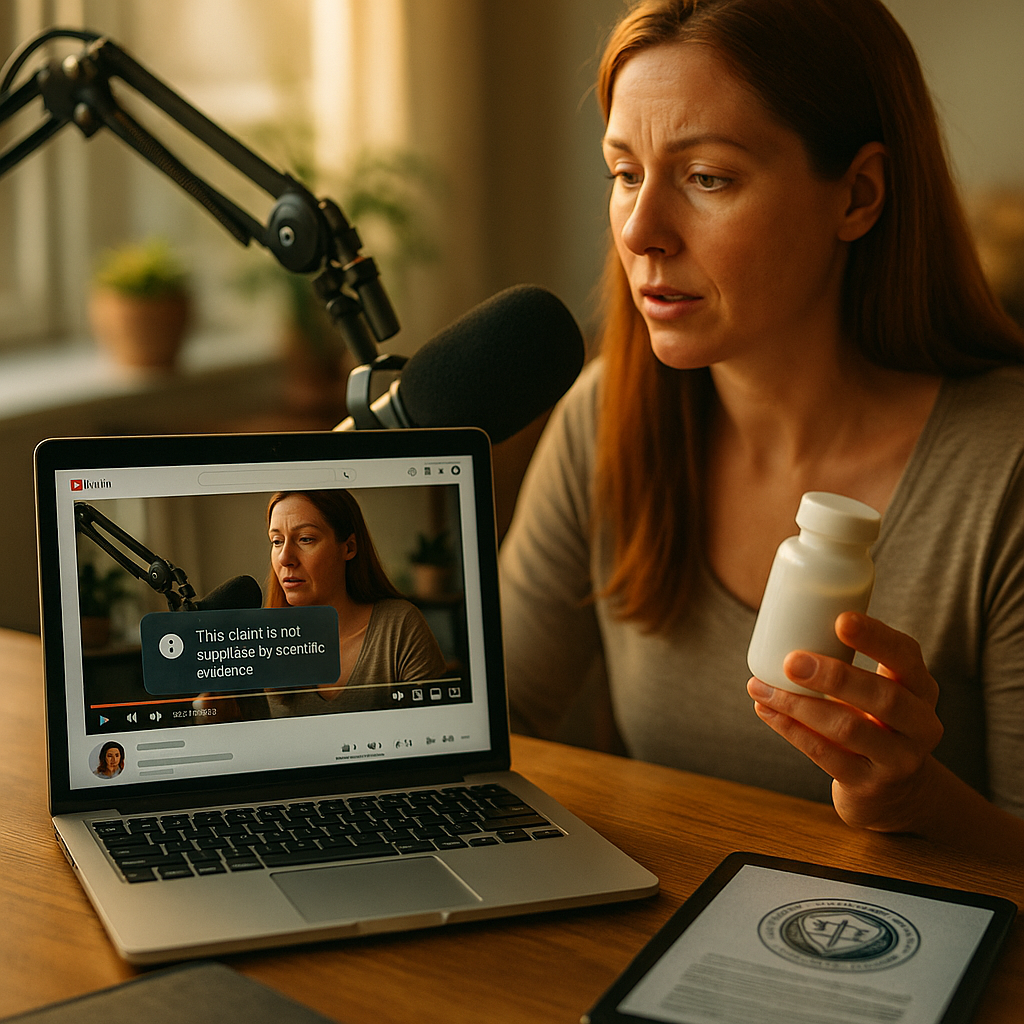
A supplement brand ran a fully substantiated testimonial, complete with clinical citations and an FTC-compliant disclosure, and YouTube’s algorithm demonetized it within four hours. No human review. No appeal until the damage was done. This is the collision point defining influencer marketing right now: FTC testimonial substantiation standards were built for regulators, not for machine learning classifiers trained to nuke anything resembling a health claim.
Two Systems, One Piece of Content, Zero Coordination
The FTC’s Endorsement Guides require that testimonials reflect the honest, current opinion of the endorser and, critically, that any claims made be substantiated with competent and reliable evidence. That’s a legal standard. It’s about truth, evidence, and disclosure. YouTube’s content moderation system, by contrast, is a pattern-matching machine trained to catch misleading medical claims at scale, across hundreds of millions of uploads a day.
These two systems were never designed to talk to each other. One asks: “Is this claim true and can you prove it?” The other asks: “Does this content resemble patterns we’ve flagged as risky?” A perfectly substantiated claim about a supplement’s clinically-tested benefits can still trip YouTube’s health-claim classifier because the language pattern — before/after framing, specific symptom language, dosage mentions — matches training data for scams and misinformation.
Brand teams are stuck in the middle. Legal signs off on the script because it meets FTC substantiation requirements. Then the platform’s algorithm flags it anyway, strikes the channel, or throttles distribution. Nobody at YouTube is reading the clinical study your compliance team attached to the brief.
Substantiation proves a claim is true. Algorithmic flagging only cares whether a claim looks risky. Brands optimizing for one without the other are solving half the problem.
What FTC Substantiation Actually Requires
Let’s get precise, because vague understanding of the standard is what gets brands in trouble on both fronts. Under FTC guidance, health and efficacy claims made in testimonials need a “reasonable basis” before the claim is made, not after a complaint. For most health-adjacent claims, that means competent and reliable scientific evidence: think controlled clinical studies, not a founder’s personal experience or a single influencer’s before-and-after.
The FTC has been explicit that atypical results in testimonials must be paired with clear disclosure of what consumers can generally expect, or the underlying claim itself needs to be substantiated for the general population. This is where a lot of brands get sloppy. They’ll disclose “results not typical” and think that discharges their obligation. It doesn’t. Disclosure doesn’t fix an unsubstantiated claim; it just admits the claim might not apply to everyone. The FTC can still act if there’s no evidence behind the core assertion at all. You can review the source language directly at the FTC’s official guidance portal.
For brands running influencer testimonials at scale, this means every health or wellness claim in a script needs a documented evidence trail before it ever reaches a creator. Not after legal gets a takedown notice. Before.
The YouTube Algorithm Doesn’t Read Your Substantiation File
Here’s the uncomfortable truth: YouTube’s automated systems have no mechanism to ingest your clinical citations. The classifier scores content based on linguistic and visual signals correlated with policy violations in its training set. It’s pattern recognition, not fact-checking.
This creates a strange asymmetry. A creator can make a wildly unsubstantiated claim using vague, hedge-heavy language (“this might help some people feel better”) and sail through untouched, while a properly substantiated claim using precise clinical terminology (“clinically shown to reduce inflammation markers by 23% in an eight-week trial”) gets flagged because the specificity and format resemble supplement-scam patterns YouTube has seen before.
Google’s own transparency reporting shows the platform removed tens of millions of videos in recent enforcement cycles, with health misinformation among the fastest-growing flag categories. That volume means the system leans heavily automated, with human review reserved for appeals rather than first-pass moderation. Brands should assume the first strike will always be a machine. For platform-specific mechanics on how watch-time optimization interacts with disclosure requirements, see our breakdown of the YouTube watch-time algorithm and how it complicates FTC-mandated transparency.
Where the Two Standards Actually Conflict
The friction isn’t hypothetical. It shows up in three predictable places:
- Specificity penalties. FTC substantiation rewards precise, quantified claims backed by data. YouTube’s classifier often treats specificity (exact percentages, symptom names, before/after timelines) as a risk signal rather than a credibility signal.
- Disclosure placement collisions. The FTC wants disclosures clear and conspicuous, often meaning on-screen text or verbal statements early in the video. YouTube’s auto-crop and thumbnail-generation tools can bury or clip that same text, similar to the issue documented in our piece on auto-crop erasing FTC disclosures in paid media.
- Repetition triggers. Running the same substantiated claim across multiple creator videos to build reach can trigger YouTube’s duplicate-content and coordinated-messaging detectors, which sometimes conflate consistent, compliant messaging with astroturfing.
None of this means the FTC and YouTube are working at cross purposes philosophically. Both want to reduce consumer harm. But operationally, a brand that builds its compliance program purely around FTC checklists will still get blindsided by platform enforcement, and vice versa.
Building a Dual-Compliance Review Process
The fix isn’t choosing one standard over the other. It’s building a review layer that checks content against both simultaneously, before it goes live.
Start with a claims registry. Every health, efficacy, or performance claim used in a testimonial should live in a shared document with its evidence source, the study or data it references, and the exact language approved for use. This is the same discipline brands are already applying to pricing claims under FTC scrutiny — see the parallel approach in our livestream shopping substantiation framework. Health claims deserve the same rigor, arguably more, given the enforcement stakes.
Next, run a platform-risk pass separately from the legal-risk pass. Ask: does this language pattern resemble content YouTube has historically flagged? Tools like TubeBuddy and VidIQ offer some signal on flagged terminology trends, but the more reliable method is maintaining an internal log of what’s been struck before, across your own channels and competitors’, and treating that as a living blocklist of high-risk phrasing.
Then build redundancy into disclosure placement. Don’t rely on a single on-screen text card. Pair verbal disclosure, description-box text, and on-screen text so that if one element gets clipped by auto-generated shorts or algorithmic re-editing, the others survive. This mirrors guidance we’ve given on AI labeling and material connection compliance on other platforms, where redundant disclosure has become standard practice.
If your disclosure strategy depends on a single text overlay surviving every platform’s auto-editing tools, you don’t have a compliance strategy. You have a hope.
Documentation Isn’t Optional Anymore
When YouTube flags a video and a brand appeals, the appeal succeeds or fails based on how quickly and clearly the brand can demonstrate substantiation. Waiting until a strike happens to go find the clinical study is too slow. Regulators are also paying closer attention to how brands document creator relationships and claims generally, a trend visible across the enforcement patterns discussed in our Meta liability trial coverage, where documentation gaps, not the underlying claims, sank several brand defenses.
Practical documentation checklist for every health-adjacent testimonial:
- The specific study or data source backing the claim, with publication date and sample size
- Written confirmation the creator’s experience aligns with, or is disclosed as atypical relative to, that data
- Screenshot or archive of the approved script and final published version
- Timestamped record of when disclosure elements were live on the video
- A log of any platform flags received, with timestamps and appeal outcomes
Marketing teams often treat this as legal’s job. It shouldn’t be. The creator manager who briefed the video needs to know this evidence trail exists before publish, not scramble to build it after a strike. According to eMarketer’s influencer spend forecasts, health and wellness remains one of the fastest-growing creator marketing categories, which means enforcement scrutiny in this vertical is only going to intensify.
What Happens When You Ignore Both Standards
The downside isn’t symmetrical. An FTC violation can mean fines, consent decrees, and years of compliance monitoring. A YouTube strike can mean demonetization, reduced distribution, or channel termination, sometimes within hours and with limited human recourse. Brands that get hit by both at once, an FTC complaint triggered by a platform-flagged video that a regulator happened to see, face compounding reputational damage that’s hard to walk back.
There’s also a slower-burning cost: creator trust. Creators who get their channels struck over brand-approved scripts remember which brands left them exposed. Best-in-class influencer programs are starting to include indemnification and platform-risk review as standard contract terms, not afterthoughts, similar to the escalation frameworks outlined in our compliance escalation matrix for stopping NAD referrals before they reach the FTC.
Platforms like Sprout Social and Meta Business Suite now offer some compliance-adjacent monitoring features, but none fully bridge the substantiation-versus-algorithm gap. That gap has to be closed by process, not software alone.
The Practical Next Step
Don’t wait for a strike to build your evidence trail. Create a two-column review template today, FTC substantiation on one side, platform-risk language patterns on the other, and require both sign-offs before any health-adjacent testimonial goes live.
Frequently Asked Questions
What is FTC testimonial substantiation, in plain terms?
It means any claim made in a testimonial, especially about health or efficacy, must be backed by competent and reliable evidence before the ad runs, not justified after the fact if someone complains.
Why does YouTube flag testimonials that are already FTC-compliant?
YouTube’s moderation algorithm scores content based on language and visual patterns associated with past policy violations. It has no way to verify clinical evidence, so precise, data-backed claims can trip the same filters as unsubstantiated scam content.
Can a disclosure fix an unsubstantiated health claim?
No. Disclosing that results aren’t typical only addresses expectation-setting. It doesn’t create evidence for the underlying claim. The FTC can still pursue action if there’s no reasonable scientific basis behind the core assertion.
What should brands document before publishing a health-related testimonial?
The specific study or data source, confirmation the creator’s experience matches or is disclosed as atypical, an archived copy of the approved script, and a timestamped record of disclosure placement on the final video.
How can brands reduce the risk of algorithmic flagging without weakening their claims?
Maintain an internal log of previously flagged phrasing, use redundant disclosure placement across on-screen text, verbal statements, and description boxes, and route content through a platform-risk review separate from legal review.
Top Influencer Marketing Agencies
The leading agencies shaping influencer marketing in 2026
Agencies ranked by campaign performance, client diversity, platform expertise, proven ROI, industry recognition, and client satisfaction. Assessed through verified case studies, reviews, and industry consultations.
Moburst

-
2

The Shelf
Boutique Beauty & Lifestyle Influencer AgencyA data-driven boutique agency specializing exclusively in beauty, wellness, and lifestyle influencer campaigns on Instagram and TikTok. Best for brands already focused on the beauty/personal care space that need curated, aesthetic-driven content.Clients: Pepsi, The Honest Company, Hims, Elf Cosmetics, Pure LeafVisit The Shelf → -
3

Audiencly
Niche Gaming & Esports Influencer AgencyA specialized agency focused exclusively on gaming and esports creators on YouTube, Twitch, and TikTok. Ideal if your campaign is 100% gaming-focused — from game launches to hardware and esports events.Clients: Epic Games, NordVPN, Ubisoft, Wargaming, Tencent GamesVisit Audiencly → -
4

Viral Nation
Global Influencer Marketing & Talent AgencyA dual talent management and marketing agency with proprietary brand safety tools and a global creator network spanning nano-influencers to celebrities across all major platforms.Clients: Meta, Activision Blizzard, Energizer, Aston Martin, WalmartVisit Viral Nation → -
5

The Influencer Marketing Factory
TikTok, Instagram & YouTube CampaignsA full-service agency with strong TikTok expertise, offering end-to-end campaign management from influencer discovery through performance reporting with a focus on platform-native content.Clients: Google, Snapchat, Universal Music, Bumble, YelpVisit TIMF → -
6

NeoReach
Enterprise Analytics & Influencer CampaignsAn enterprise-focused agency combining managed campaigns with a powerful self-service data platform for influencer search, audience analytics, and attribution modeling.Clients: Amazon, Airbnb, Netflix, Honda, The New York TimesVisit NeoReach → -
7

Ubiquitous
Creator-First Marketing PlatformA tech-driven platform combining self-service tools with managed campaign options, emphasizing speed and scalability for brands managing multiple influencer relationships.Clients: Lyft, Disney, Target, American Eagle, NetflixVisit Ubiquitous → -
8

Obviously
Scalable Enterprise Influencer CampaignsA tech-enabled agency built for high-volume campaigns, coordinating hundreds of creators simultaneously with end-to-end logistics, content rights management, and product seeding.Clients: Google, Ulta Beauty, Converse, AmazonVisit Obviously →