


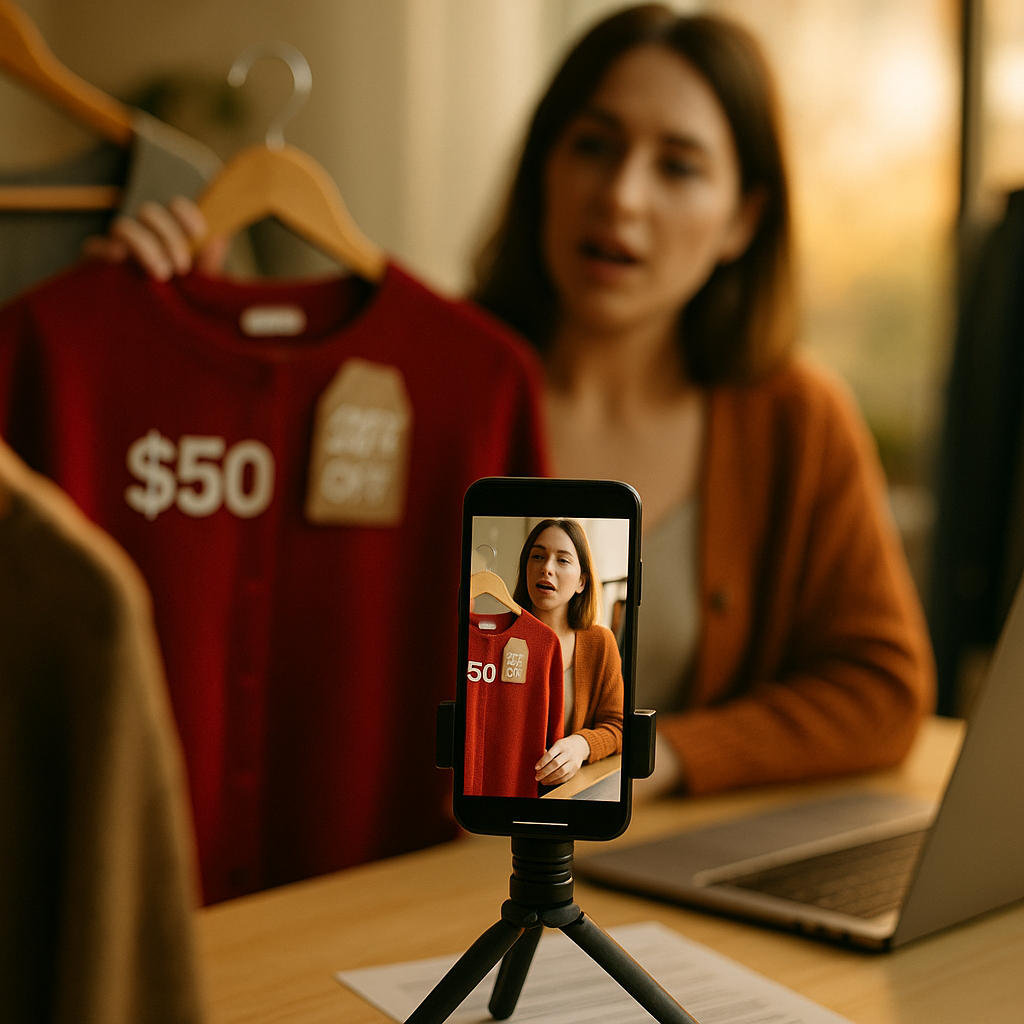
A “was $89, now $29” flash sale flashes across a livestream for eleven seconds before the host moves to the next SKU. Multiply that by forty products a session, three sessions a week, and a roster of a dozen creators, and you’ve got a discount-claims audit nightmare waiting to happen. The FTC’s rules on price and discount substantiation don’t care that the format is new. They care whether the claim was true, and whether you can prove it.
Livestream shopping is projected to top $68 billion in US sales by the end of this year, according to eMarketer estimates, and every dollar of that volume runs through pricing claims made in real time, by humans, often off-script. That’s a compliance surface most legal teams haven’t fully mapped yet.
Why “Was/Now” Pricing Is Riskier Live Than in Static Ads
A banner ad gets reviewed. A product page gets legal sign-off. A livestream host improvising for ninety minutes straight? Nobody’s proofreading that in real time. And that’s exactly the gap the FTC’s Guides Against Deceptive Pricing exploit when they show up in an investigation.
The core rule hasn’t changed since it was written decades ago: a “former price” comparison is deceptive unless the reference price was a genuine, prevailing market price offered in good faith for a reasonable period. Livestream commerce breaks this in three specific ways.
- Reference prices get invented. A host says “regularly $120” when the item never sold above $75. Sometimes it’s sloppy prep. Sometimes it’s the brand’s own MAP sheet being outdated.
- Urgency claims outlive their truth. “This price ends when I go off air” gets repeated in the next stream, and the one after that. Suddenly a fake deadline becomes a permanent price.
- Discount math gets fudged for effect. Rounding “31% off” up to “nearly half price” sounds better on camera. It’s also a textbook deceptive claim.
If your host can’t point to a dated price history showing the item actually sold at the “original” price for a reasonable stretch of time, you don’t have a discount claim — you have a liability.
What “Substantiation” Actually Means Here
The FTC doesn’t require perfection. It requires a reasonable basis for the claim, established before the claim is made, not reconstructed afterward when a regulator or a state AG comes asking. That distinction matters enormously in livestream formats where claims are generated on the fly.
Practically, substantiation for a price claim means you can produce, on request:
- A documented price history for the SKU, showing the “regular” price was charged for a substantial period (the FTC has historically looked at roughly 30 days as a rough benchmark, though it’s not a bright-line rule).
- Evidence the discounted price is actually a departure from that regular price, not the de facto everyday price dressed up as a sale.
- A record of what the host actually said on air, timestamped, matched against the SKU’s real pricing data.
- Proof that any urgency or scarcity claim (“only 12 left,” “price goes up at midnight”) was factually accurate at the moment it was spoken.
That last point trips up more brands than anything else. Scarcity claims are technically price-adjacent claims — they influence purchase decisions the same way a discount does — and the FTC treats false urgency as a form of deceptive pricing when it’s used to pressure a sale.
The Documentation Gap Between Marketing and Legal
Here’s the uncomfortable truth: most livestream shopping programs are run by social and commerce teams, not legal. The talking points get built in a Google Doc, handed to a host or creator, and then improvised live. Legal sees the aftermath, if anything, only when a complaint lands.
That workflow is backwards for a claim category this sensitive. Price and discount claims need the same substantiation rigor brands already apply (or should apply) to health claims, environmental claims, or performance claims. The mechanism is different, but the standard is identical: have proof before you speak, not after.
A few operational fixes close this gap without slowing commerce teams down to a crawl:
- Pre-approved price bands. Give hosts a locked script element for pricing language, generated automatically from the pricing system, not typed manually into a briefing doc.
- Live pricing feeds tied to the script. If the e-commerce platform’s real price disagrees with the script, the segment gets flagged before it airs, not after a viewer screenshots it.
- Session recording with searchable transcripts. You need to be able to pull every instance a host said “regular price” or “was” across a quarter of streams in minutes, not weeks.
- A 30-60-90 day price history log maintained by whoever owns pricing, refreshed automatically, and accessible to legal without a data request.
This isn’t dramatically different from the discipline brands are already building around creator codes and personalized pricing rules, where the same principle applies: if the claim varies by audience or moment, you need a system that logs the variance, not a human trusting memory.
Personalized Discounts Add a Second Layer of Risk
Livestream shopping increasingly serves different viewers different offers, based on watch history, past purchases, or loyalty tier. That’s smart commerce. It’s also a second compliance track running parallel to price substantiation: personalized pricing disclosure.
The FTC has been explicit that algorithmically-driven personalized offers require their own disclosure treatment, separate from the accuracy of the underlying price claim. A discount can be perfectly true and still non-compliant if the brand fails to disclose that the price shown was personalized rather than universal.
Brands running livestream commerce with any kind of dynamic pricing layer should be cross-referencing their personalized pricing enforcement timeline against their livestream production calendar. The two compliance obligations stack, they don’t substitute for each other.
For teams building disclosure language from scratch, there’s real utility in adapting an existing personalized pricing disclosure template for the livestream format specifically, since on-screen real estate and spoken disclosure timing both differ from a static product page.
Platform-Specific Wrinkles: TikTok Shop and Beyond
TikTok Shop’s scale makes it the highest-risk venue for price claim exposure right now, particularly after the platform’s $400 million privacy settlement put regulators in a more aggressive posture toward the platform generally. A brand running livestream sales through TikTok Shop should assume any pricing claim gets more scrutiny than the identical claim made on a brand-owned site.
Brands already working through a TikTok Shop compliance checklist should treat pricing claims as a distinct line item, not folded into general disclosure hygiene. The checklist logic that applies to material connections and sponsorship disclosure applies just as cleanly to “was/now” pricing: document it, timestamp it, keep the receipts.
There’s also a algorithmic angle worth flagging. Platforms increasingly surface discount badges, strikethrough pricing, and “deal” labels automatically, sometimes without brand input on the exact numbers displayed. If a platform’s system generates a reference price that doesn’t match the brand’s actual price history, the brand can still be on the hook. Running a periodic algorithm audit for pricing claims catches this before a regulator does.
Building the Audit Trail That Survives Scrutiny
If an FTC inquiry or an NAD challenge lands on your desk, the question isn’t “was the discount real?” It’s “can you prove, with contemporaneous records, that it was real at the moment the claim was made?” Those are different questions, and the second one is the one that actually determines outcomes.
Regulators don’t expect brands to never make mistakes. They expect brands to have a system that catches mistakes before they scale across a hundred livestream sessions.
A workable audit trail includes:
- SKU-level price history exportable by date range
- Livestream session recordings retained for a minimum period aligned with your legal team’s statute-of-limitations guidance
- Transcripts tagged for pricing language, scarcity language, and urgency language
- Host briefing documents version-controlled, showing what talking points were approved versus improvised
- A named owner for pricing claim compliance, distinct from the social team running the show
Brands that already run structured escalation processes for advertising disputes have a head start here. The logic in a compliance escalation matrix designed to stop NAD referrals from becoming FTC matters applies almost directly to livestream pricing complaints: catch it internally, fix it fast, document the fix, and you materially reduce the odds of it becoming a referral at all.
What This Means for Budget and Vendor Contracts
None of this is free. Real-time price verification tooling, transcript monitoring, and legal review cycles cost money and slow production timelines that commerce teams have spent years trying to speed up. But compare that cost to a state AG inquiry, or a class action built on a pattern of inflated reference prices across a hundred livestream sessions. The math favors prevention every time.
Contracts with livestream production vendors and host talent agencies should explicitly assign responsibility for pricing accuracy, require access to session recordings, and build in a right for the brand to review and approve pricing scripts before air. If your current agreements are silent on this, that’s a gap worth closing before your next campaign cycle, not after an inquiry letter arrives.
FAQs
Frequently Asked Questions
What counts as a “former price” under FTC guidance?
A former price is one the brand actually offered, in good faith, to the public for a reasonable period of time before the discount was introduced. It cannot be a price invented solely to make a discount look larger, and it cannot be a price that was itself rarely or never actually charged.
How long does a price need to be in effect before it can be called the “regular” price?
The FTC hasn’t set a strict universal rule, but a common reference point drawn from its guidance is roughly 30 days of genuine sales at that price. Shorter windows increase risk significantly and should be paired with stronger documentation if used at all.
Are verbal claims made live by a host treated the same as written ad copy?
Yes. The FTC evaluates deceptive pricing claims based on the overall impression created, regardless of format. A spoken claim during a livestream carries the same substantiation obligation as text on a landing page.
Does a brand bear responsibility if a platform automatically generates a discount badge?
In most cases, yes. Brands are generally responsible for ensuring pricing displayed in connection with their products is accurate, even when a platform’s system generates the visual treatment. Relying on a platform default is not a reliable substitute for verifying the underlying price data.
What’s the difference between price substantiation and personalized pricing disclosure?
Price substantiation concerns whether a discount claim is factually true. Personalized pricing disclosure concerns whether consumers are told that the price they see was determined algorithmically or individually, rather than being a universal offer. A brand can satisfy one obligation and still fail the other.
Who should own pricing claim compliance for livestream commerce?
Ideally, a named individual or small team bridging legal and commerce, with authority to review scripts, pull price history, and pause a livestream segment if a claim can’t be verified in real time. Leaving this solely with the social or production team creates the documentation gaps regulators tend to find.
Start with an audit of your last quarter of livestream sessions: pull the transcripts, match every “was/now” claim against actual price history, and flag the gaps before a regulator does it for you. The brands that treat pricing claims as a documentation discipline, not an improv exercise, are the ones that won’t be writing a settlement check next year.
Top Influencer Marketing Agencies
The leading agencies shaping influencer marketing in 2026
Agencies ranked by campaign performance, client diversity, platform expertise, proven ROI, industry recognition, and client satisfaction. Assessed through verified case studies, reviews, and industry consultations.
Moburst

-
2

The Shelf
Boutique Beauty & Lifestyle Influencer AgencyA data-driven boutique agency specializing exclusively in beauty, wellness, and lifestyle influencer campaigns on Instagram and TikTok. Best for brands already focused on the beauty/personal care space that need curated, aesthetic-driven content.Clients: Pepsi, The Honest Company, Hims, Elf Cosmetics, Pure LeafVisit The Shelf → -
3

Audiencly
Niche Gaming & Esports Influencer AgencyA specialized agency focused exclusively on gaming and esports creators on YouTube, Twitch, and TikTok. Ideal if your campaign is 100% gaming-focused — from game launches to hardware and esports events.Clients: Epic Games, NordVPN, Ubisoft, Wargaming, Tencent GamesVisit Audiencly → -
4

Viral Nation
Global Influencer Marketing & Talent AgencyA dual talent management and marketing agency with proprietary brand safety tools and a global creator network spanning nano-influencers to celebrities across all major platforms.Clients: Meta, Activision Blizzard, Energizer, Aston Martin, WalmartVisit Viral Nation → -
5

The Influencer Marketing Factory
TikTok, Instagram & YouTube CampaignsA full-service agency with strong TikTok expertise, offering end-to-end campaign management from influencer discovery through performance reporting with a focus on platform-native content.Clients: Google, Snapchat, Universal Music, Bumble, YelpVisit TIMF → -
6

NeoReach
Enterprise Analytics & Influencer CampaignsAn enterprise-focused agency combining managed campaigns with a powerful self-service data platform for influencer search, audience analytics, and attribution modeling.Clients: Amazon, Airbnb, Netflix, Honda, The New York TimesVisit NeoReach → -
7

Ubiquitous
Creator-First Marketing PlatformA tech-driven platform combining self-service tools with managed campaign options, emphasizing speed and scalability for brands managing multiple influencer relationships.Clients: Lyft, Disney, Target, American Eagle, NetflixVisit Ubiquitous → -
8

Obviously
Scalable Enterprise Influencer CampaignsA tech-enabled agency built for high-volume campaigns, coordinating hundreds of creators simultaneously with end-to-end logistics, content rights management, and product seeding.Clients: Google, Ulta Beauty, Converse, AmazonVisit Obviously →