


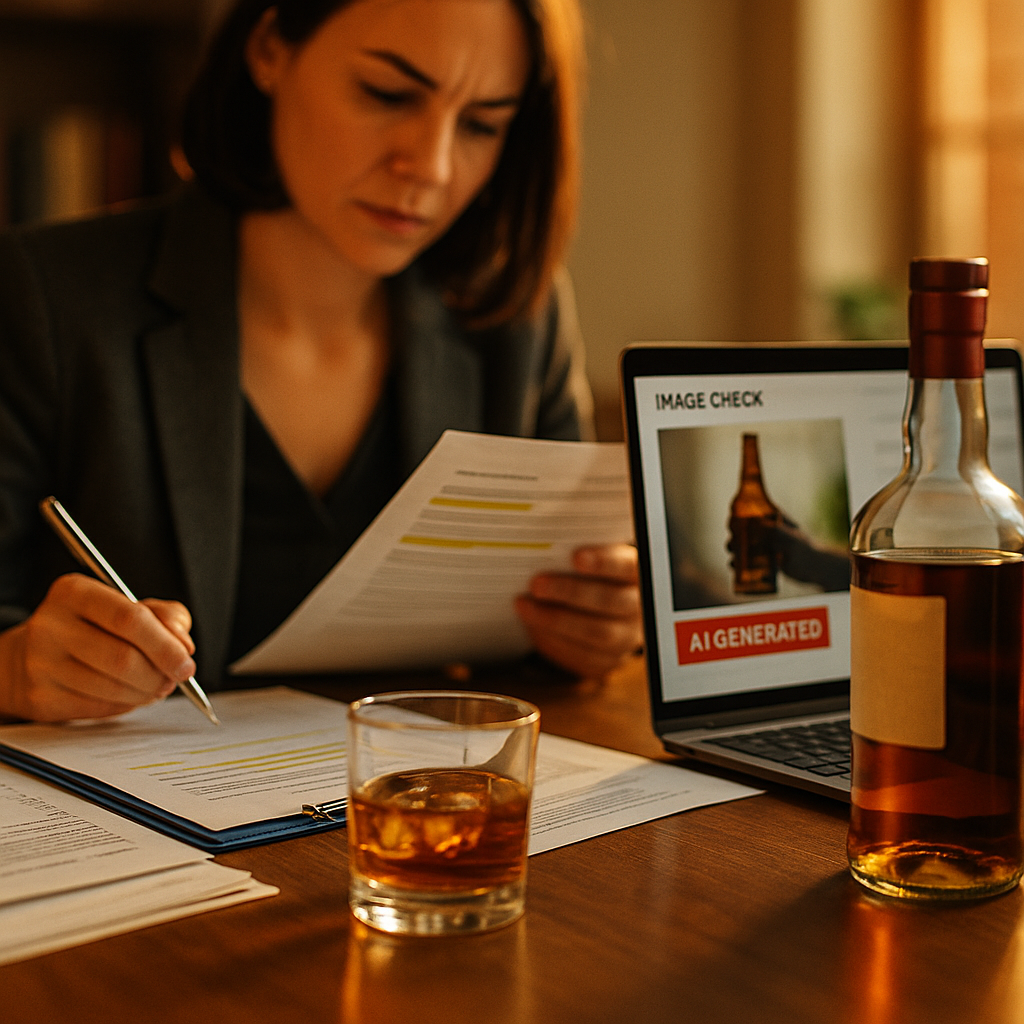
One AI-generated image of a “25-year-old” model holding a seltzer can just triggered a state ABC board inquiry — except the model was synthetic, had no verifiable age, and the can label was itself an AI hallucination. This is the new frontier of AI ad compliance risk for alcohol brands, and most legal teams haven’t caught up. Generative creative is moving faster than the regulatory frameworks built to police alcohol marketing, and that gap is exactly where enforcement actions live.
Alcohol advertising has always been one of the most heavily regulated categories in marketing. Age verification, health claims, geographic restrictions, appellation rules — the compliance surface was already dense before anyone added a generative model into the creative pipeline. Now brands are running AI-generated imagery, AI-written copy, and AI-composited video through channels that were never designed to flag synthetic content. Regulators are noticing.
Why This Is Different From Standard Influencer Compliance
Most compliance conversations in this industry center on disclosure — did the creator label the post as sponsored, did the brand retain approval rights, does the FTC material connection standard hold up. Alcohol brands using generative AI face a second, layered problem: the creative itself can misrepresent facts that regulators specifically require to be accurate.
Think about what generative models are prone to doing. They hallucinate. They invent label text. They generate faces that look underage or ambiguously aged. They composite scenes that imply health benefits (“relaxing after a workout,” “boosts your mood”) that alcohol marketing rules explicitly prohibit in most jurisdictions. A human copywriter knows not to claim a spirit is “heart healthy.” An AI model optimizing for engagement doesn’t inherently know that’s a regulatory landmine — it just knows the phrase performs well.
The core risk isn’t that AI creative is inaccurate. It’s that inaccuracy in this category isn’t just a brand reputation problem — it’s a licensing, labeling, and public health violation with real regulatory teeth.
This is a fundamentally different risk category than most influencer marketing compliance work Influencers Time covers. It’s not about who said what and whether it was disclosed. It’s about whether the content itself is legally sayable, in any voice, human or synthetic.
What Regulators Are Actually Watching For
The Alcohol and Tobacco Tax and Trade Bureau (TTB) and state Alcoholic Beverage Control boards have historically relied on pre-clearance review and post-hoc complaint investigation. Generative AI breaks both models. Pre-clearance assumes a finite set of assets reviewed before launch. AI-driven creative pipelines can generate hundreds of variants per campaign, many never seen by a human reviewer before they go live on paid social.
That volume alone changes the risk calculus. A brand running programmatic creative testing across TikTok, Instagram, and connected TV might be serving dozens of AI-assisted variants simultaneously, with no single person having reviewed each one against TTB labeling and advertising rules.
Specific flashpoints regulators and industry watchdogs are tracking right now:
- Apparent age of models. AI-generated faces frequently skew younger than intended, and there’s no verifiable birth certificate behind a synthetic person. If a generated model appears to be under 21 (or the applicable legal drinking age in a target market), that’s a direct violation risk regardless of intent.
- Health and lifestyle claims. Generative copy tools trained on broad marketing corpora will happily produce “wellness” framing for alcohol products — language the TTB and FTC have long restricted.
- Label and packaging accuracy. AI image generators asked to render a product photo often invent label details, proof statements, or certifications that don’t match the actual approved label on file.
- Geographic and cultural targeting. AI-driven ad personalization can inadvertently target dry counties, specific demographic groups, or jurisdictions with stricter alcohol marketing bans, especially when campaign targeting is automated and loosely audited.
None of this requires malicious intent. It requires a creative pipeline that moves faster than compliance review — which describes most AI-accelerated marketing operations today.
The Human Review Gap Is the Real Liability
Here’s the uncomfortable truth: a lot of alcohol brands have quietly adopted AI creative tools for speed and cost savings without updating their legal review workflows to match. The old model assumed every asset touched a compliance reviewer before launch. The new reality is that AI tools can auto-generate and auto-publish variants through ad platform optimization features, sometimes with minimal human sign-off.
This is the same structural problem Influencers Time has covered in the context of platform auto-approval tools — when AI auto-approves creative without a documented human review clause, liability doesn’t disappear. It just becomes harder to assign, and regulators tend to resolve that ambiguity against the advertiser, not the platform.
For alcohol brands specifically, the stakes are higher because the downside isn’t just an FTC complaint. It’s potential license suspension, state-level fines, and in egregious cases, criminal referral for underage marketing violations. That’s a different order of risk than a disclosure fine.
Where Contracts and SOPs Are Falling Short
Most influencer and agency contracts for alcohol campaigns still reference “creative approval” in vague terms — a human “will review” content before publication. Few specify:
- Who is qualified to review AI-generated content for age representation accuracy
- What documentation proves a human reviewed and approved each specific asset variant, not just the campaign concept
- How label and claims accuracy is verified against the TTB Certificate of Label Approval (COLA) on file
- What happens when a third-party ad platform’s optimization engine generates or modifies creative post-approval
This mirrors a pattern Influencers Time has flagged in adjacent compliance areas — the same way script editing creates FTC material connection risk when disclosure language gets altered downstream, AI creative pipelines create a parallel risk when label or claims language gets altered or invented after legal sign-off.
Building an Actual Compliance Checkpoint
So what does a defensible process look like in practice? Brands that are getting ahead of this aren’t banning AI tools — that ship has sailed, and the efficiency gains are real. Instead, they’re building specific checkpoints into the creative pipeline.
A workable framework includes:
- Asset-level sign-off, not campaign-level. Every individual AI-generated variant that will run in market needs a documented human review against a specific checklist: apparent age, label accuracy, absence of health claims, geographic targeting rules.
- A synthetic-model age policy. If AI-generated people appear in ads, brands need an internal standard (and documentation) establishing that the depicted age reads as clearly, unambiguously over 25 — building in a buffer above the legal minimum precisely because AI-generated ages are inherently imprecise.
- Claims-matching against COLA records. Any generated copy or label imagery should be checked against the actual approved label and permitted claims on file with the TTB, not just against a general “no health claims” rule of thumb.
- Platform auto-optimization audits. If running on Meta, TikTok, or programmatic platforms with dynamic creative optimization, brands need visibility into what variants the platform’s algorithm is auto-generating or auto-combining, not just what the agency submitted.
- Vendor and agency contract updates. Explicit human review clauses, similar to what’s now standard practice in influencer content approval, need to extend to AI creative tools and the vendors operating them.
This isn’t dramatically different in spirit from compliance frameworks Influencers Time has recommended for other high-risk categories — see the consent mechanism audit framework for a comparable structured approach applied to data practices. The mechanics differ, but the underlying discipline — document the checkpoint, assign the reviewer, retain the record — is identical.
Is This Actually Being Enforced Yet?
Fair question. Enforcement specifically targeting AI-generated alcohol ad content is still early — most current TTB and FTC actions against alcohol marketers still stem from traditional violations: unapproved label claims, underage-appearing models in traditionally produced content, or unlicensed interstate shipping promotion. But regulatory bodies rarely wait for a crisis before signaling intent.
The FTC has already made clear through its broader AI enforcement posture (including guidance on deceptive AI-generated content) that synthetic media doesn’t get a compliance pass just because no human created it. Expect alcohol-specific guidance to follow the same trajectory other regulated categories have followed with AI-generated health and financial claims.
State ABC boards, which often move faster and more aggressively than federal regulators, are the more immediate risk. Several have already updated advertising guidance to explicitly reference “digitally generated or altered imagery” in the context of age representation requirements.
What Brand Marketing Teams Should Do This Quarter
Waiting for a formal enforcement wave before acting is a bad bet. The brands that will avoid becoming the test case are the ones auditing their creative pipelines now, before regulators pick an example to make.
Practical near-term steps:
- Inventory every AI tool currently touching creative production, from image generation to ad copy to dynamic creative optimization on ad platforms
- Map which of those tools’ outputs go live without a documented human compliance check
- Update creative approval SOPs to require asset-level, not just concept-level, sign-off
- Add explicit AI-content clauses to agency and platform vendor contracts
- Brief legal and compliance teams on how generative tools specifically fail (hallucinated labels, ambiguous age, invented claims) so review checklists reflect actual failure modes, not generic AI risk language
Industry data on marketing AI adoption from sources like eMarketer continues to show accelerating use of generative tools across creative production — alcohol brands are not exempt from that trend, and the compliance infrastructure needs to move at the same speed as adoption, not years behind it.
FAQs
Frequently Asked Questions
Why are alcohol brands at higher AI ad compliance risk than other categories?
Alcohol advertising is subject to strict federal (TTB) and state ABC board rules around age representation, health claims, and label accuracy. Generative AI tools can hallucinate label details, generate ambiguously-aged models, or produce prohibited health claims without any human intent, creating violations that wouldn’t occur in less regulated categories.
What specific AI-generated content triggers the most regulatory concern?
Three areas draw the most scrutiny: synthetic models that appear underage, AI-invented label or product claims that don’t match approved TTB certificates, and lifestyle or health claims generated by AI copy tools that violate longstanding alcohol advertising restrictions.
Does human review of the campaign concept satisfy compliance requirements?
Not reliably. Because generative tools and ad platform optimization engines can produce or modify dozens of creative variants after initial concept approval, brands need documented sign-off at the individual asset level, not just campaign-level approval.
Has the FTC or TTB issued specific guidance on AI-generated alcohol ads?
Formal category-specific guidance is still emerging. However, the FTC has made clear that synthetic and AI-generated content is held to the same deceptive advertising standards as traditional content, and several state ABC boards have already updated guidance to reference digitally generated imagery explicitly.
What contract language should brands add to address this risk?
Agency and vendor contracts should include explicit human review clauses covering AI-generated creative specifically, documentation requirements proving asset-level compliance checks, and provisions addressing liability when ad platform auto-optimization tools generate or alter creative post-approval.
The next TTB or state ABC enforcement action involving AI-generated alcohol creative isn’t a matter of if — it’s a matter of which brand gets made an example of first. Audit your creative pipeline’s human review checkpoints this quarter, not after the complaint arrives.
Top Influencer Marketing Agencies
The leading agencies shaping influencer marketing in 2026
Agencies ranked by campaign performance, client diversity, platform expertise, proven ROI, industry recognition, and client satisfaction. Assessed through verified case studies, reviews, and industry consultations.
Moburst

-
2

The Shelf
Boutique Beauty & Lifestyle Influencer AgencyA data-driven boutique agency specializing exclusively in beauty, wellness, and lifestyle influencer campaigns on Instagram and TikTok. Best for brands already focused on the beauty/personal care space that need curated, aesthetic-driven content.Clients: Pepsi, The Honest Company, Hims, Elf Cosmetics, Pure LeafVisit The Shelf → -
3

Audiencly
Niche Gaming & Esports Influencer AgencyA specialized agency focused exclusively on gaming and esports creators on YouTube, Twitch, and TikTok. Ideal if your campaign is 100% gaming-focused — from game launches to hardware and esports events.Clients: Epic Games, NordVPN, Ubisoft, Wargaming, Tencent GamesVisit Audiencly → -
4

Viral Nation
Global Influencer Marketing & Talent AgencyA dual talent management and marketing agency with proprietary brand safety tools and a global creator network spanning nano-influencers to celebrities across all major platforms.Clients: Meta, Activision Blizzard, Energizer, Aston Martin, WalmartVisit Viral Nation → -
5

The Influencer Marketing Factory
TikTok, Instagram & YouTube CampaignsA full-service agency with strong TikTok expertise, offering end-to-end campaign management from influencer discovery through performance reporting with a focus on platform-native content.Clients: Google, Snapchat, Universal Music, Bumble, YelpVisit TIMF → -
6

NeoReach
Enterprise Analytics & Influencer CampaignsAn enterprise-focused agency combining managed campaigns with a powerful self-service data platform for influencer search, audience analytics, and attribution modeling.Clients: Amazon, Airbnb, Netflix, Honda, The New York TimesVisit NeoReach → -
7

Ubiquitous
Creator-First Marketing PlatformA tech-driven platform combining self-service tools with managed campaign options, emphasizing speed and scalability for brands managing multiple influencer relationships.Clients: Lyft, Disney, Target, American Eagle, NetflixVisit Ubiquitous → -
8

Obviously
Scalable Enterprise Influencer CampaignsA tech-enabled agency built for high-volume campaigns, coordinating hundreds of creators simultaneously with end-to-end logistics, content rights management, and product seeding.Clients: Google, Ulta Beauty, Converse, AmazonVisit Obviously →