


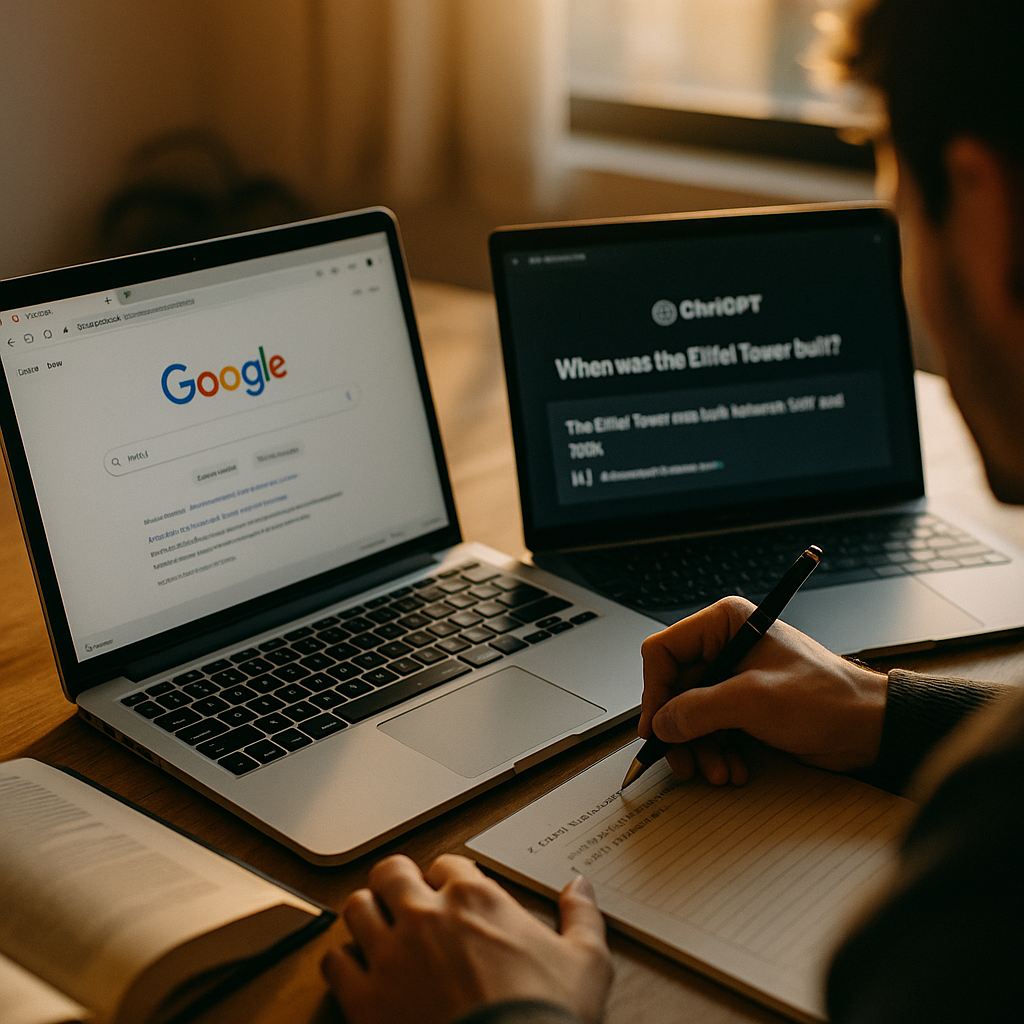
Google surfaces a citation within the first two seconds of a query. OpenAI often waits until turn three or four of a conversation before naming a source at all. That gap isn’t a bug — it’s a fundamentally different retrieval philosophy, and it’s quietly breaking the AI search optimization playbooks brands built for search engines. If your team is applying the same citation strategy to ChatGPT that worked for Google’s AI Overviews, you’re likely optimizing for the wrong moment in the funnel entirely.
The Citation Timing Problem Nobody’s Talking About
Most brand teams treat “getting cited by AI” as a single objective. It isn’t. Google’s AI Overviews and ChatGPT retrieve, rank, and expose sources through completely different architectures, and that changes when a citation actually appears in the user’s experience.
Google’s system is built on its existing web index. It pulls sources almost instantly because the infrastructure — crawling, indexing, ranking — already exists at massive scale. A citation in an AI Overview typically appears in the very first response, often as a clickable link sitting right next to the answer.
OpenAI’s approach is different by design. ChatGPT is a conversational system first, a search tool second. Early turns in a conversation tend to be generative and exploratory: the model reasons through an answer using its trained knowledge before it decides a live web lookup is warranted. Citations frequently don’t surface until the user asks a follow-up, requests specifics, or pushes for “sources” explicitly.
Optimizing only for first-response citations means brands are invisible during the exact moment ChatGPT users are still forming their decision criteria — and by the time citations do appear, competitors who planned for mid-funnel visibility have already claimed the spot.
Why the Architectures Diverge
It helps to think about what each system is actually optimizing for.
Google’s AI Overviews sit on top of a search query. The user has already signaled intent by typing something specific into a search box. Google’s job is to answer fast and back it up, because the entire product is built around the expectation of instant, source-backed results — a habit trained into users over two decades.
OpenAI’s ChatGPT sits on top of a conversation. The user might start vague (“I’m trying to figure out a skincare routine for sensitive skin”) and only get specific three or four messages in (“what SPF moisturizers have the fewest fragrance additives”). The model’s retrieval-augmented generation layer — the part that decides whether to search the live web — activates based on confidence gaps and specificity, not on the first message alone.
This matters enormously for brands relying on probabilistic attribution models to track where AI-driven purchases actually originate. If your model assumes citation-equals-first-response, you’re miscounting the conversational touchpoints that actually swayed the buyer.
What This Means for Content Strategy
Brands built entire content programs around “answer the question in the first 100 words” for AI Overview visibility. That’s still valid for Google. But for ChatGPT, the more valuable content asset might be the one that answers the third question in a category, not the first.
- Google-optimized content should front-load direct answers, structured data, and clear factual claims that a crawler can extract in a single pass.
- ChatGPT-optimized content should anticipate follow-up questions — comparison points, edge cases, “what about” scenarios — because that’s where retrieval actually triggers.
Our comparison of AI Overviews and ChatGPT citation patterns found that pages structured around anticipated follow-ups saw meaningfully higher citation rates in extended ChatGPT conversations than pages optimized purely for single-query answers.
The Funnel Implication: Rethinking Where You Show Up
Here’s the uncomfortable part. If OpenAI cites sources later in the conversation, that means brand visibility on ChatGPT increasingly happens during consideration and decision stages, not awareness. Google, by contrast, still captures a huge share of top-of-funnel, informational queries where citations appear immediately.
For a supplement brand, a fashion retailer, or a B2B SaaS company, this is a real strategic fork:
- Google AI Overviews reward brands that win the broad, informational query — “what is,” “how does,” “best type of.”
- ChatGPT rewards brands that survive into turn three or four — the specific, comparative, decision-stage query where the user has already narrowed their options.
That’s a different content calendar. That’s a different keyword strategy. And frankly, it’s a different budget conversation with leadership, because most teams still allocate AI search budget as if it’s one channel.
Category research backs this up. Nearly all supplement retail sites now appear somewhere in Google’s AI Overviews, per recent supplement industry citation data — but appearing in an Overview and appearing in a ChatGPT purchase-stage conversation are not the same win. One might drive brand awareness with near-zero click-through. The other might sit directly next to a purchase decision.
Rebuilding Distribution Tactics Per Engine
Distribution teams need to stop treating “AI search” as a monolith and start treating it like paid media: different platforms, different placements, different creative requirements.
For Google’s AI Overviews
- Prioritize structured data markup and clear, extractable factual statements near the top of the page.
- Keep authority signals (author credentials, citations, first-party data) visible and crawlable — Google’s system leans heavily on established E-E-A-T signals.
- Monitor Google Search Central guidance for updates to how AI Overviews source and attribute content, since this shifts quarterly.
For OpenAI’s ChatGPT
- Build content clusters that map to a buyer’s follow-up questions, not just their opening query.
- Invest in comparison content, spec sheets, and “vs.” pages — these are exactly the formats that trigger live retrieval mid-conversation.
- Track how OpenAI’s ad and commerce playbook is evolving, since ad placements inside ChatGPT are increasingly tied to these later-funnel, citation-rich moments.
There’s also a geographic dimension worth watching. As OpenAI expands ad availability across dozens of markets, brands need region-specific verification of how citations and sourcing rules apply, especially given the EU’s stricter transparency expectations under evolving digital services regulation.
Measurement Has to Catch Up
None of this matters if your analytics stack can’t distinguish between an early-funnel Google citation and a late-funnel ChatGPT citation. Most GA4 setups weren’t built with this distinction in mind, which is why teams are now rebuilding dashboards specifically to separate AI referral traffic by engine and by funnel stage. Our guide on building GA4 dashboards for AI assistant traffic walks through the practical setup, but the core principle is simple: if you can’t segment by engine, you can’t optimize by engine.
Attribution vendors are catching on too. Industry data from eMarketer shows brands increasingly demanding platform-level breakdowns rather than lumped “AI search” reporting, precisely because the behavioral patterns are this divergent.
There’s also a compliance angle brand teams shouldn’t ignore. Citation timing affects disclosure obligations too — if a ChatGPT response cites a brand’s paid content deep in a conversation, the line between organic citation and sponsored placement can blur fast. Marketers should keep an eye on how the FTC’s endorsement guidelines apply as AI-driven recommendations increasingly resemble influencer endorsements in structure, if not in format.
What to Do This Quarter
Don’t wait for a unified AI search strategy to emerge from a vendor deck. Audit your existing content against both retrieval patterns now: which pages answer the first question well, and which ones anticipate the third? Build the gap, tag your analytics by engine, and treat Google and OpenAI as separate distribution channels with separate playbooks — because that’s exactly what they’ve become.
Frequently Asked Questions
Why does OpenAI cite sources later than Google in AI-generated answers?
ChatGPT is built around conversational exchanges, and its retrieval-augmented generation layer typically activates once a query becomes specific enough to warrant a live web lookup. Google’s AI Overviews sit directly on top of a search query with clear intent, so citations surface immediately using its existing web index.
Does this mean Google AI Overviews are more valuable for brand visibility than ChatGPT?
Not necessarily — they serve different funnel stages. Google Overviews tend to capture broad, top-of-funnel informational queries, while ChatGPT citations often appear during consideration and decision-stage conversations, closer to purchase intent.
How should content strategy differ for Google versus ChatGPT citations?
Content for Google should front-load direct, extractable answers near the top of the page. Content for ChatGPT should anticipate follow-up and comparison questions, since that’s typically when the model triggers a live source lookup.
Can brands track which AI engine is driving conversions?
Yes, but it requires rebuilding analytics dashboards to segment AI referral traffic by engine and funnel stage rather than lumping all AI search traffic together. Standard GA4 setups often need customization to capture this distinction.
Are there compliance risks tied to AI citation timing?
Potentially. As AI responses cite branded or sponsored content deeper into conversations, the distinction between organic citation and paid placement can blur, raising questions similar to influencer endorsement disclosure rules enforced by the FTC.
Top Influencer Marketing Agencies
The leading agencies shaping influencer marketing in 2026
Agencies ranked by campaign performance, client diversity, platform expertise, proven ROI, industry recognition, and client satisfaction. Assessed through verified case studies, reviews, and industry consultations.
Moburst

-
2

The Shelf
Boutique Beauty & Lifestyle Influencer AgencyA data-driven boutique agency specializing exclusively in beauty, wellness, and lifestyle influencer campaigns on Instagram and TikTok. Best for brands already focused on the beauty/personal care space that need curated, aesthetic-driven content.Clients: Pepsi, The Honest Company, Hims, Elf Cosmetics, Pure LeafVisit The Shelf → -
3

Audiencly
Niche Gaming & Esports Influencer AgencyA specialized agency focused exclusively on gaming and esports creators on YouTube, Twitch, and TikTok. Ideal if your campaign is 100% gaming-focused — from game launches to hardware and esports events.Clients: Epic Games, NordVPN, Ubisoft, Wargaming, Tencent GamesVisit Audiencly → -
4

Viral Nation
Global Influencer Marketing & Talent AgencyA dual talent management and marketing agency with proprietary brand safety tools and a global creator network spanning nano-influencers to celebrities across all major platforms.Clients: Meta, Activision Blizzard, Energizer, Aston Martin, WalmartVisit Viral Nation → -
5

The Influencer Marketing Factory
TikTok, Instagram & YouTube CampaignsA full-service agency with strong TikTok expertise, offering end-to-end campaign management from influencer discovery through performance reporting with a focus on platform-native content.Clients: Google, Snapchat, Universal Music, Bumble, YelpVisit TIMF → -
6

NeoReach
Enterprise Analytics & Influencer CampaignsAn enterprise-focused agency combining managed campaigns with a powerful self-service data platform for influencer search, audience analytics, and attribution modeling.Clients: Amazon, Airbnb, Netflix, Honda, The New York TimesVisit NeoReach → -
7

Ubiquitous
Creator-First Marketing PlatformA tech-driven platform combining self-service tools with managed campaign options, emphasizing speed and scalability for brands managing multiple influencer relationships.Clients: Lyft, Disney, Target, American Eagle, NetflixVisit Ubiquitous → -
8

Obviously
Scalable Enterprise Influencer CampaignsA tech-enabled agency built for high-volume campaigns, coordinating hundreds of creators simultaneously with end-to-end logistics, content rights management, and product seeding.Clients: Google, Ulta Beauty, Converse, AmazonVisit Obviously →