


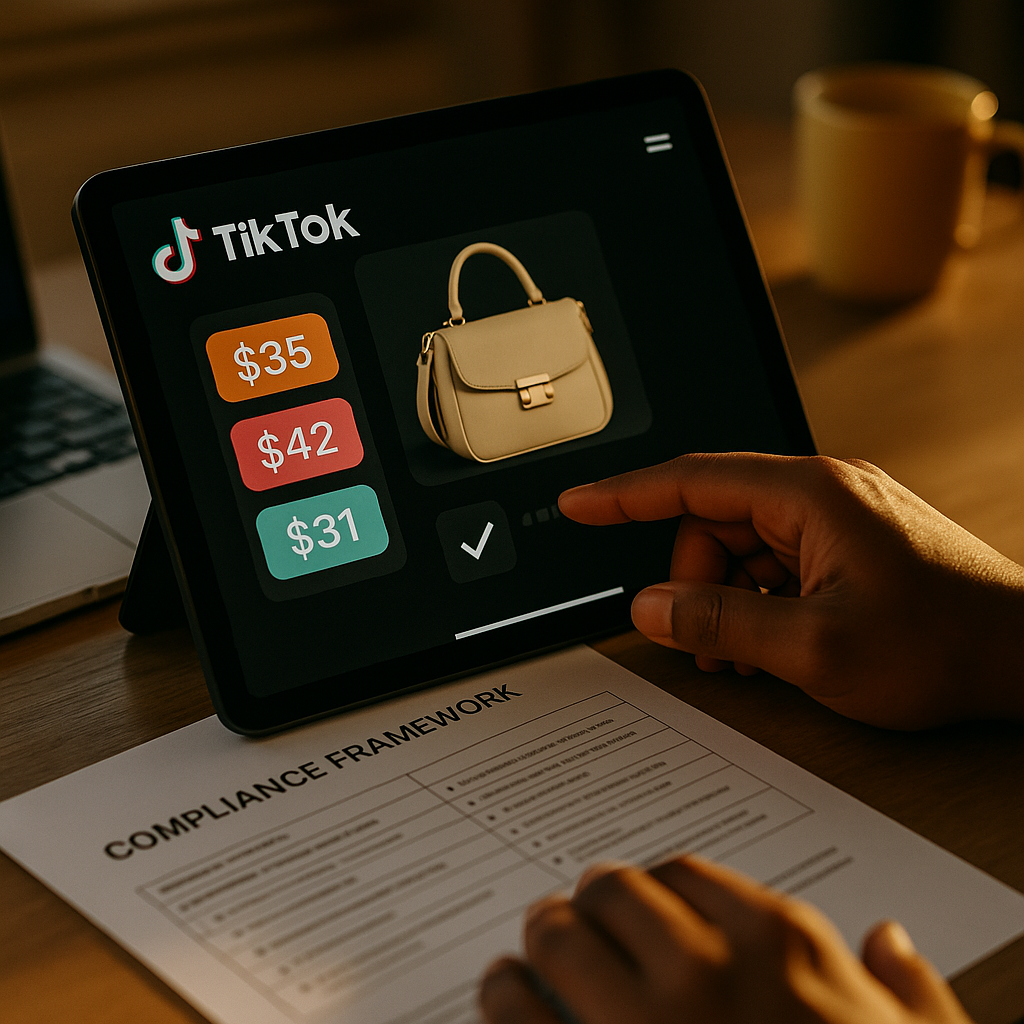
Sixty-two percent of shoppers say they’d stop buying from a retailer if they learned its prices were personalized without disclosure, according to consumer trust research cited widely in retail circles. Now layer that onto TikTok Shop, a platform running dynamic pricing, flash discounts, and algorithmic offers at a scale most compliance teams have never had to govern. TikTok Shop personalized pricing disclosures are about to become a regulatory flashpoint, and brands still treating this as a “wait and see” issue are already behind.
The FTC’s 2027 rulemaking on algorithmic and surveillance-based pricing isn’t a rumor anymore. It’s a published priority. Brands running TikTok Shop storefronts, live shopping events, and creator-driven flash sales need a compliance framework now, not a reactive scramble once the rule drops.
Why This Is Different From Standard Pricing Disclosures
Traditional pricing compliance is static: post the price, honor the price, disclose the terms. Personalized pricing on TikTok Shop breaks that model entirely. The same product can show different prices to different users based on browsing history, purchase frequency, device type, or even how long someone lingered on a livestream. That’s not a pricing strategy anymore — it’s a data processing operation wearing a retail costume.
The FTC has already signaled where this is heading. Its ongoing work on surveillance pricing, combined with enforcement actions against algorithmic discrimination, makes clear that personalization without disclosure is being treated as a deceptive practice, not a clever merchandising tactic. Brands can review the agency’s own framing of these issues directly at ftc.gov.
If your pricing engine can explain why a customer saw a specific price, but your customer can’t, you have a disclosure gap — and disclosure gaps are exactly what the FTC’s 2027 rulemaking is designed to close.
Our earlier coverage of the FTC personalized pricing rule laid out the retail-wide readiness checklist. TikTok Shop just adds creator-driven urgency and live commerce speed to an already complex picture.
Where TikTok Shop’s Mechanics Create Unique Risk
TikTok Shop isn’t a static storefront. It’s live commerce, affiliate-driven discovery, and algorithmic recommendation stacked on top of each other. That combination creates at least four distinct risk surfaces brands need to map before regulators do it for them.
- Livestream flash pricing: Hosts often announce “exclusive” prices in real time, sometimes tied to viewer count or watch-time triggers. If those prices vary by viewer segment, disclosure has to happen live, not buried in terms.
- Affiliate-linked discounts: Creators drive traffic through unique codes that can trigger different pricing tiers. Who owns disclosure when the creator, not the brand, controls the price shown?
- Algorithmic bundling: TikTok’s recommendation engine can surface different bundle configurations to different users, effectively creating personalized pricing without a single number changing.
- Retargeting-triggered discounts: Cart abandonment offers that vary by predicted purchase intent are a textbook example of the exact behavior the FTC has flagged in prior surveillance pricing commentary.
Our related analysis on FTC personalized pricing enforcement signals breaks down why TikTok Shop specifically is drawing regulatory attention faster than other commerce platforms.
Building the Framework: Five Structural Components
A durable compliance framework isn’t a single policy document. It’s an operating system with clear ownership at each layer. Here’s how mature brands are structuring it ahead of the rulemaking.
1. Data Provenance Mapping
You cannot disclose what you cannot trace. Every pricing variable — browsing behavior, purchase history, device signals, geographic data — needs a documented origin and a documented use case. This isn’t a one-time audit. It’s a living map that gets updated every time TikTok changes its Shop API or ad targeting parameters. Brands already working through data lineage issues on other platforms should look at the vendor data provenance audit framework as a template for structuring this work.
2. Disclosure Language That Actually Discloses
Buried terms-of-service language won’t satisfy a 2027-era FTC standard. Disclosures need to be contextual, meaning they appear at the moment a personalized price is shown, not three clicks later in a privacy policy. Our team built out a data-use disclosure template for algorithm-driven offers specifically because generic disclosure boilerplate doesn’t hold up when regulators start asking “did the consumer actually understand this?”
3. Creator Contract Clauses
Here’s the uncomfortable truth: most influencer contracts say nothing about pricing disclosure obligations. If a creator hosts a livestream showing a “special” price that’s actually an algorithmically-targeted offer, and there’s no contractual language requiring real-time disclosure, the brand is exposed regardless of what the creator said on camera. Legal teams should be updating templates now, borrowing structure from the TikTok Shop DPA drafting guidance already circulating among retail compliance leads.
4. Escalation Protocols
When a pricing anomaly surfaces — a customer complaint, a journalist inquiry, an internal audit flag — who owns the response? Too many brands don’t have an answer. Build an escalation path that moves from marketing ops to legal to executive sign-off within a defined timeframe, not an ad hoc email chain. The escalation protocol framework we’ve published previously is a solid starting structure, adaptable to TikTok Shop’s faster commerce cycle.
5. Vendor and Platform Accountability
TikTok Shop’s pricing algorithms are, from the brand’s perspective, a black box. That doesn’t mean brands get to shrug and point at TikTok when regulators come calling. Data processing agreements need explicit language about pricing logic transparency, audit rights, and incident notification timelines. This mirrors work already underway around identity resolution DPA governance, where the core question is the same: who’s accountable when the algorithm, not the brand, makes the decision?
The Compliance Calendar Brands Should Be Running Now
Waiting for the final rule text is a mistake. The comment period alone typically generates enough signal to start building. Here’s a realistic internal timeline:
- Immediate: Audit current TikTok Shop pricing mechanics and map every personalization trigger in use today.
- Next quarter: Update creator contracts and internal disclosure templates; pressure-test escalation protocols with a tabletop exercise.
- Mid-year: Renegotiate DPAs with TikTok Shop integration partners to include audit rights and algorithmic transparency clauses.
- Pre-rulemaking: Run a full mock audit simulating FTC inquiry response, including data provenance documentation and disclosure evidence trails.
This isn’t overkill. It’s the same maturity curve brands went through with GDPR-adjacent ad compliance, a process well documented in the EU ads compliance checklist covering AI Act risk. The regulatory pattern repeats: disclosure obligations expand faster than platforms update their default settings.
Brands that built GDPR-era consent infrastructure early spent less on remediation later. The same math applies here — early framework investment is cheaper than post-rule retrofitting.
What Happens If You Don’t Build This Now
Skip the framework and you’re not just risking an FTC fine down the line. You’re risking the kind of consumer trust collapse that’s harder to repair than any settlement check. TikTok’s own $400 million COPPA settlement, detailed in our parental consent checklist, shows how fast platform-level enforcement can cascade into brand-level scrutiny. Regulators increasingly look at the full commerce chain, not just the platform.
There’s also a practical operations risk. Brands without documented pricing logic can’t respond quickly to customer disputes, chargebacks, or press inquiries. That slows everything down and makes legal exposure worse, not better. Industry data from eMarketer continues to show live commerce growth accelerating on TikTok Shop specifically, which means the volume of pricing interactions — and the volume of potential disclosure failures — is only going up.
Marketing teams should also loop in whoever owns influencer attribution data, since attribution audit work often surfaces pricing inconsistencies nobody flagged as a compliance issue at the time. It usually was one.
Next Step
Don’t wait for the FTC’s final text to start building. Run a 30-day internal audit of every TikTok Shop pricing trigger your brand uses today, assign ownership for disclosure language, and get creator contracts updated before the next livestream campaign launches.
FAQs
What counts as personalized pricing on TikTok Shop?
Any price variation driven by user-specific data — browsing behavior, purchase history, device signals, or predicted intent — rather than a uniform list price applied to all customers equally.
Is TikTok Shop legally required to disclose personalized pricing today?
Current FTC guidance treats non-disclosure as a potential deceptive practice under existing Section 5 authority, but the 2027 rulemaking is expected to create more specific, enforceable disclosure standards.
Who is liable if a creator shows a personalized price during a livestream?
Liability typically falls on the brand unless contracts explicitly shift disclosure responsibility to the creator, which is why updated creator contract clauses are essential.
How should brands document pricing algorithm decisions?
Through a data provenance map that traces every pricing variable back to its source and use case, updated whenever platform targeting parameters change.
What’s the biggest mistake brands make with pricing disclosure?
Relying on generic terms-of-service language instead of contextual disclosures shown at the exact moment a personalized price appears.
FAQs
Top Influencer Marketing Agencies
The leading agencies shaping influencer marketing in 2026
Agencies ranked by campaign performance, client diversity, platform expertise, proven ROI, industry recognition, and client satisfaction. Assessed through verified case studies, reviews, and industry consultations.
Moburst

-
2

The Shelf
Boutique Beauty & Lifestyle Influencer AgencyA data-driven boutique agency specializing exclusively in beauty, wellness, and lifestyle influencer campaigns on Instagram and TikTok. Best for brands already focused on the beauty/personal care space that need curated, aesthetic-driven content.Clients: Pepsi, The Honest Company, Hims, Elf Cosmetics, Pure LeafVisit The Shelf → -
3

Audiencly
Niche Gaming & Esports Influencer AgencyA specialized agency focused exclusively on gaming and esports creators on YouTube, Twitch, and TikTok. Ideal if your campaign is 100% gaming-focused — from game launches to hardware and esports events.Clients: Epic Games, NordVPN, Ubisoft, Wargaming, Tencent GamesVisit Audiencly → -
4

Viral Nation
Global Influencer Marketing & Talent AgencyA dual talent management and marketing agency with proprietary brand safety tools and a global creator network spanning nano-influencers to celebrities across all major platforms.Clients: Meta, Activision Blizzard, Energizer, Aston Martin, WalmartVisit Viral Nation → -
5

The Influencer Marketing Factory
TikTok, Instagram & YouTube CampaignsA full-service agency with strong TikTok expertise, offering end-to-end campaign management from influencer discovery through performance reporting with a focus on platform-native content.Clients: Google, Snapchat, Universal Music, Bumble, YelpVisit TIMF → -
6

NeoReach
Enterprise Analytics & Influencer CampaignsAn enterprise-focused agency combining managed campaigns with a powerful self-service data platform for influencer search, audience analytics, and attribution modeling.Clients: Amazon, Airbnb, Netflix, Honda, The New York TimesVisit NeoReach → -
7

Ubiquitous
Creator-First Marketing PlatformA tech-driven platform combining self-service tools with managed campaign options, emphasizing speed and scalability for brands managing multiple influencer relationships.Clients: Lyft, Disney, Target, American Eagle, NetflixVisit Ubiquitous → -
8

Obviously
Scalable Enterprise Influencer CampaignsA tech-enabled agency built for high-volume campaigns, coordinating hundreds of creators simultaneously with end-to-end logistics, content rights management, and product seeding.Clients: Google, Ulta Beauty, Converse, AmazonVisit Obviously →