


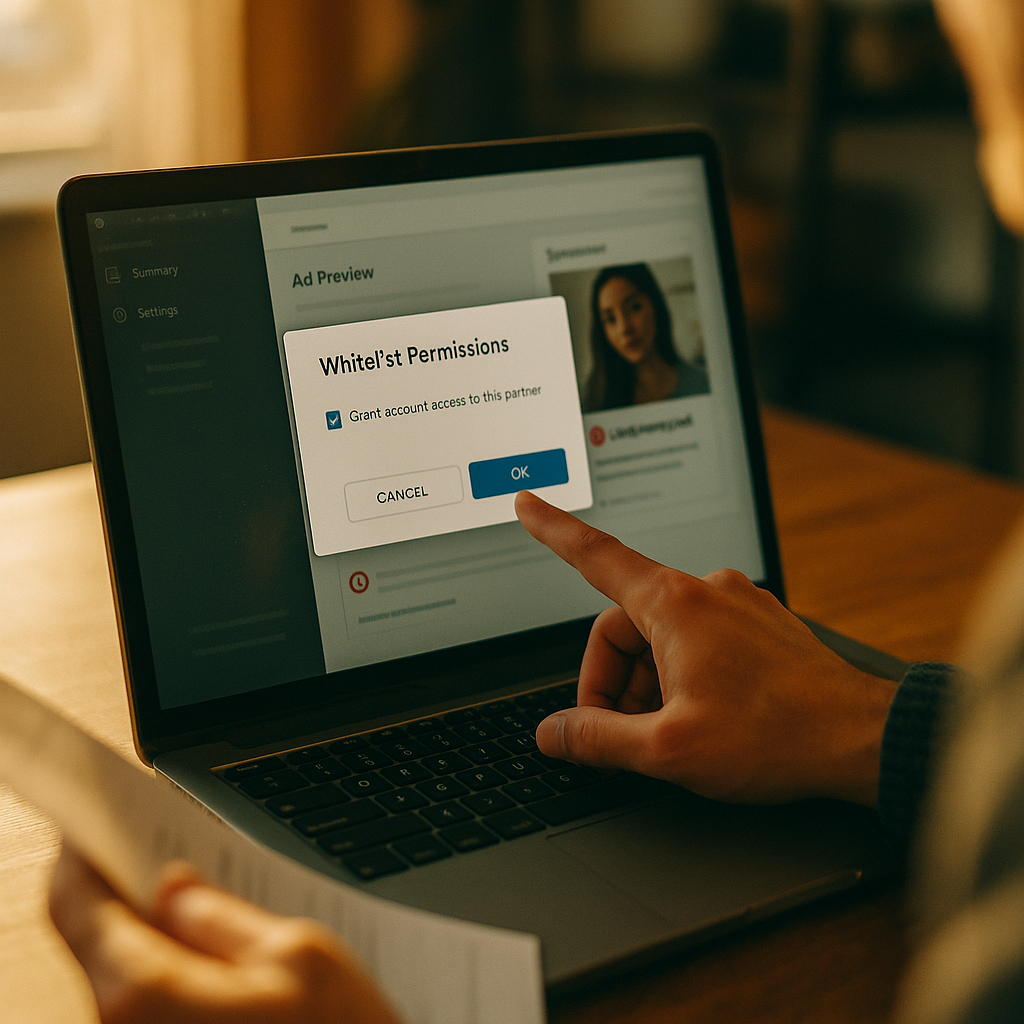
Sixty percent of paid social spend tied to creator content now runs through whitelisting arrangements, yet a huge share of those contracts never specify where the ad can actually run. That gap is not a paperwork oversight. It is the reason brands get mid-flight takedowns, surprise invoices from creator managers, and platform disapprovals that stall a campaign the week it launches. A distribution rights clause is the unglamorous paragraph that decides whether your whitelisted content is an asset or a liability.
If your legal team still treats “paid partnership ads” as a single checkbox on a standard influencer agreement, you are underwriting risk you cannot see until it surfaces as a rejected ad or a cease and desist.
Why Whitelisting Needs Its Own Clause, Not a Footnote
Whitelisting, also called creator-authorized advertising or boosted content, lets a brand run paid media through a creator’s handle rather than its own. The ad shows the creator’s name, profile photo, and handle, which borrows their credibility and often outperforms brand-only creative. Meta’s business tools document the mechanics of Partnership Ads clearly enough, but the legal scaffolding around them is where most contracts fall short.
Here is the problem: a standard content license (the kind that covers reposting or organic usage) does not automatically authorize paid distribution. Running whitelisted ads without an explicit distribution rights clause is functionally using someone’s identity to advertise without clear consent for that specific use. That is a right of publicity issue layered on top of a copyright issue, and regulators and courts treat them separately.
A content license lets you post. A distribution rights clause lets you pay to amplify. Brands that conflate the two are one legal letter away from an expensive lesson.
This distinction matters more as creator-fronted ads scale. eMarketer has tracked the steady migration of influencer budgets into paid amplification rather than organic-only deals, which means the contract clause covering distribution is no longer a nice-to-have. It is the clause carrying the most financial weight in the entire agreement.
What a Distribution Rights Clause Actually Needs to Specify
Vague language like “brand may use content for advertising purposes” is not a distribution clause. It is an invitation to dispute. A defensible clause needs to nail down specifics across several dimensions.
- Platform scope. Name the exact platforms (Meta, TikTok Spark Ads, YouTube, Pinterest) where whitelisted ads can run. A clause silent on platform scope does not default to “anywhere.”
- Ad format. Feed ads, Stories, Reels, Spark Ads boosts, and Advantage+ placements are not interchangeable. Specify which formats are authorized, because some creators object to certain placements (interstitials, pre-roll) even when they are fine with feed boosts.
- Duration of the authorization. This is separate from content usage rights. A creator might grant 12 months of organic usage but only 60 days of paid distribution authority. Mismatched timelines are one of the most common whitelisting disputes, and they connect directly to the kind of expiration tracking failures covered in our piece on usage rights expiration.
- Geographic reach. Global ad accounts can target far beyond the creator’s home market. If the contract does not cap geography, brands can inadvertently run ads in territories with different disclosure or advertising laws.
- Spend caps or no caps. Some creators negotiate a ceiling on total media spend behind their likeness. Others leave it open. Either way, it needs to be written down, not assumed.
- Handle access mechanism. Specify whether access is granted via Meta Business Manager partnership permissions, TikTok’s Spark Ads authorization code, or another method, and whether that access auto-expires or must be manually revoked.
Leaving any of these undefined does not make the ad illegal outright, but it does make the agreement unenforceable if a dispute arises. “We assumed” is not a defense a general counsel wants to make in front of a client or a regulator.
Revocation and Early Termination: The Clause Most Brands Skip
Creators change their minds. Maybe they signed with a competing brand. Maybe the partnership soured after a controversy. Either way, the contract needs a revocation mechanism that specifies how fast the brand must pull ads once authorization ends.
A 48 to 72 hour wind-down window is becoming the informal industry standard, long enough for a brand’s media team to pause active campaigns across ad accounts, short enough that a creator is not stuck endorsing something they no longer want associated with their name. Without a stated window, brands default to whatever the platform’s technical permission revocation does, which can lag actual ad delivery by days.
This also intersects with agency-managed talent rosters. If an agency controls the authorization token and the creator terminates with the agency, does the brand’s distribution right survive? That question belongs in the contract, not in a frantic phone call. Our breakdown of agency licensing structures covers how brands can protect themselves when the contracting party is not the creator directly.
Disclosure Compliance Does Not Disappear Just Because It’s Paid Media
Whitelisted ads are still endorsements. The FTC’s Endorsement Guides apply whether the audience sees the content organically or because a brand paid to put it in their feed. In fact, paid distribution often raises the compliance bar because the brand is now the clear party responsible for the ad buy, not just the creator posting independently.
The distribution rights clause should require that original disclosure language (#ad, #sponsored, paid partnership tags) stays intact through the whitelisting process and cannot be edited out to make the ad look more “native.” Some brands try to strip disclosures to improve click-through rates. That is precisely the scenario FTC enforcement actions have targeted. For a deeper look at how fast brands need to react when disclosure problems surface, see our piece on the creator correction protocol.
Paying to amplify an undisclosed or improperly disclosed post does not dilute the violation. It documents it, with a media spend receipt attached.
Contracts should also address edits. Can the brand trim the video, add captions, or reformat for a different aspect ratio? Minor technical edits are typically fine if specified, but substantive changes to the message (adding claims the creator did not make, altering pricing, implying a different product benefit) require separate creator sign off. This is where the clause overlaps with broader usage rights chain of custody issues discussed in our UGC rights chain of custody coverage.
Cross-Border Campaigns Add a Layer Most Contracts Ignore
Run a whitelisted ad from a US-based creator into EU ad accounts, and you may be stepping into GDPR territory, VAT obligations, and advertising standards that differ from US FTC rules. The distribution rights clause should state explicitly which countries or regions the brand is authorized to target, and flag that expanding geography later requires an amendment, not a verbal nod from the creator’s manager.
Brands running EU campaigns should also check rate card and fee disclosure obligations that increasingly apply to influencer deals, detailed in our coverage of EU rate card transparency rules, and the tax implications covered in our EU VAT guidance. None of this is whitelisting-specific, but it compounds when paid distribution pushes content into new jurisdictions the original organic agreement never anticipated.
AI-Generated Variations of Whitelisted Content
A newer complication: brands increasingly use AI tools to generate alternate cuts, voiceovers, or localized versions of whitelisted creator ads for testing at scale. Does the original distribution clause cover an AI-modified version of the creator’s likeness and voice? Almost certainly not, unless the contract explicitly says so.
This is a fast-moving gray area. Creators have started pushing back hard on AI-generated variations of their content being used in ways they never approved, and regulators are paying attention. If your team is testing AI-assisted ad variations on whitelisted content, read our analysis of voice cloning consent clauses before you scale a single test into a six-figure media buy.
Building the Clause: A Practical Checklist
For brand and agency legal teams drafting or reviewing whitelisting language, a few operational steps keep the clause enforceable rather than ornamental.
- Separate the distribution rights clause from the general content license section. Do not bury it in a single sentence.
- Require platform-specific authorization codes (TikTok’s Spark Ads code, Meta’s Partnership Ads permission) to be issued and logged at campaign kickoff, not after creative is already built.
- Build a tracking system, even a simple shared spreadsheet, that maps every active whitelisted asset to its platform, expiration date, and spend cap.
- Assign a named internal owner responsible for pulling ads within the revocation window if authorization lapses or is withdrawn.
- Route any AI-modified or reformatted versions of whitelisted content through a fresh approval step rather than assuming blanket coverage.
None of this requires exotic legal theory. It requires treating the distribution rights clause as operational infrastructure, not boilerplate. Tools like HubSpot or Sprout Social can help track campaign timelines, but the underlying contract terms still have to be precise enough for a tool to enforce in the first place.
FAQs
Frequently Asked Questions
What is the difference between a content license and a distribution rights clause?
A content license grants permission to use and post creator content, typically organically. A distribution rights clause specifically authorizes paid amplification of that content through ad platforms, including the creator’s handle, and must cover platform scope, duration, and geography separately from the organic license.
Can a brand whitelist content without a specific distribution rights clause?
Technically a brand might get platform-level permission granted, but without contractual backing that spells out scope, duration, and revocation terms, the brand has no enforceable protection if the creator revokes access, disputes the usage, or claims the ad exceeded agreed terms.
How long should whitelisting authorization typically last?
There is no universal standard, but most agreements run 30 to 90 days per campaign cycle, renewable by amendment. The key is stating a defined period rather than leaving distribution rights open-ended or tied vaguely to the overall contract term.
Does whitelisted content need the same FTC disclosure as organic posts?
Yes. Paid distribution does not reduce disclosure obligations under FTC Endorsement Guides. If anything, scrutiny increases because the brand is directly responsible for the ad buy and cannot claim the creator acted independently.
Who is liable if a whitelisted ad runs after a creator revokes authorization?
Liability typically falls on whichever party failed to act within the contractual revocation window. This is why a clearly stated wind-down period (commonly 48 to 72 hours) and a named internal owner responsible for pulling ads are essential contract elements.
The fastest way to de-risk your next whitelisting campaign is to pull your current contract template and check whether distribution rights live in their own clearly worded section, separate from general content licensing. If they do not, fix that before your next media buy goes live, not after a creator’s manager sends a termination notice mid-flight.
Top Influencer Marketing Agencies
The leading agencies shaping influencer marketing in 2026
Agencies ranked by campaign performance, client diversity, platform expertise, proven ROI, industry recognition, and client satisfaction. Assessed through verified case studies, reviews, and industry consultations.
Moburst

-
2

The Shelf
Boutique Beauty & Lifestyle Influencer AgencyA data-driven boutique agency specializing exclusively in beauty, wellness, and lifestyle influencer campaigns on Instagram and TikTok. Best for brands already focused on the beauty/personal care space that need curated, aesthetic-driven content.Clients: Pepsi, The Honest Company, Hims, Elf Cosmetics, Pure LeafVisit The Shelf → -
3

Audiencly
Niche Gaming & Esports Influencer AgencyA specialized agency focused exclusively on gaming and esports creators on YouTube, Twitch, and TikTok. Ideal if your campaign is 100% gaming-focused — from game launches to hardware and esports events.Clients: Epic Games, NordVPN, Ubisoft, Wargaming, Tencent GamesVisit Audiencly → -
4

Viral Nation
Global Influencer Marketing & Talent AgencyA dual talent management and marketing agency with proprietary brand safety tools and a global creator network spanning nano-influencers to celebrities across all major platforms.Clients: Meta, Activision Blizzard, Energizer, Aston Martin, WalmartVisit Viral Nation → -
5

The Influencer Marketing Factory
TikTok, Instagram & YouTube CampaignsA full-service agency with strong TikTok expertise, offering end-to-end campaign management from influencer discovery through performance reporting with a focus on platform-native content.Clients: Google, Snapchat, Universal Music, Bumble, YelpVisit TIMF → -
6

NeoReach
Enterprise Analytics & Influencer CampaignsAn enterprise-focused agency combining managed campaigns with a powerful self-service data platform for influencer search, audience analytics, and attribution modeling.Clients: Amazon, Airbnb, Netflix, Honda, The New York TimesVisit NeoReach → -
7

Ubiquitous
Creator-First Marketing PlatformA tech-driven platform combining self-service tools with managed campaign options, emphasizing speed and scalability for brands managing multiple influencer relationships.Clients: Lyft, Disney, Target, American Eagle, NetflixVisit Ubiquitous → -
8

Obviously
Scalable Enterprise Influencer CampaignsA tech-enabled agency built for high-volume campaigns, coordinating hundreds of creators simultaneously with end-to-end logistics, content rights management, and product seeding.Clients: Google, Ulta Beauty, Converse, AmazonVisit Obviously →