


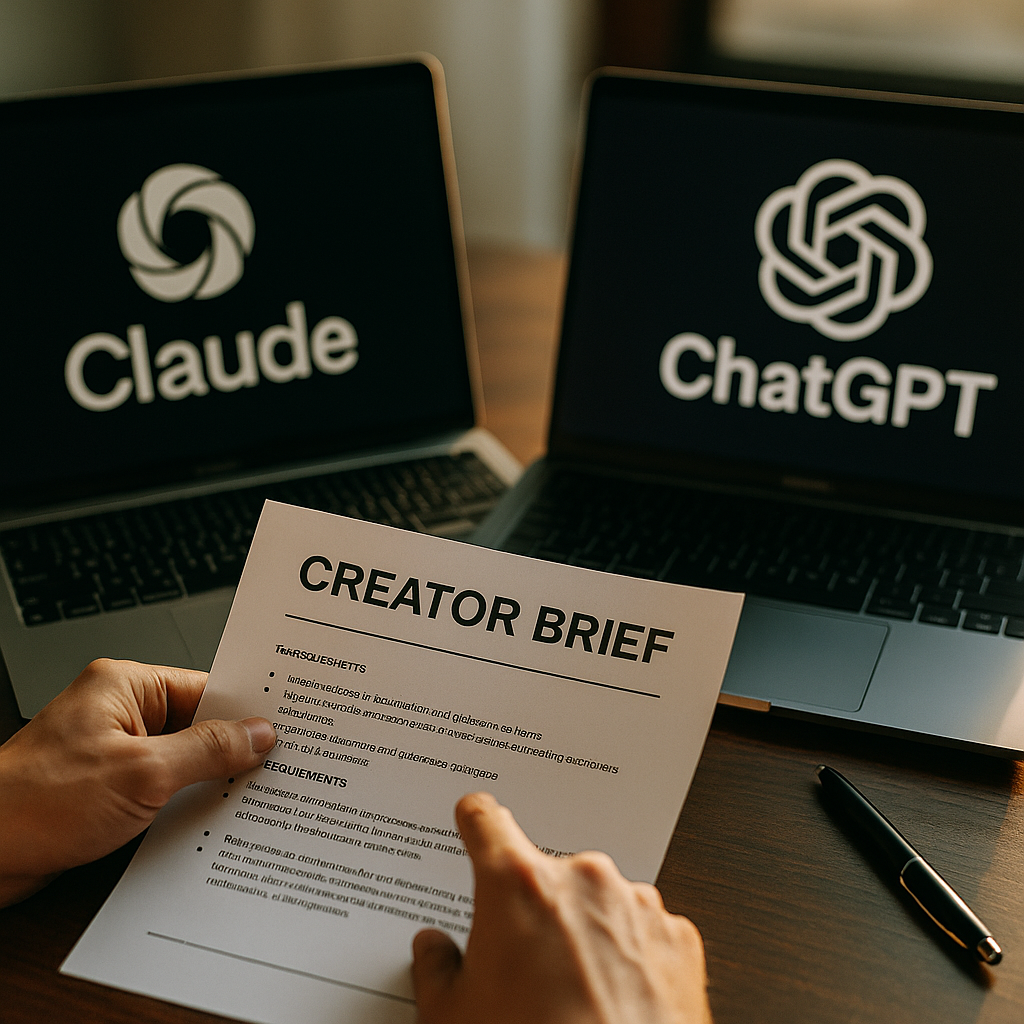
Sixty-one percent of marketing teams now lean on AI for media and content planning, yet most still can’t tell you which model actually gets the facts right. That gap matters more than ever when you’re asking an LLM to draft a creator brief citing product claims, competitor data, or regulatory language. Claude’s enterprise search grounding and OpenAI’s retrieval tools both promise fewer hallucinations. They don’t deliver it the same way, and for brand teams the difference shows up in legal review, not in the demo.
This isn’t an academic AI comparison. Creator briefs get forwarded to influencers, published in captions, and sometimes quoted in FTC disclosure language. A hallucinated stat in a brief becomes a hallucinated stat in a sponsored post, and now it’s your brand’s problem, not the model’s.
Why Grounding Matters More for Briefs Than for Blog Drafts
A blog draft gets edited by a human before it goes live. A creator brief often gets skimmed, forwarded, and acted on fast, especially when a campaign has a 48-hour turnaround and twelve creators waiting on direction. There’s less friction between AI output and public-facing content than most teams admit.
That’s the real risk. Marketing teams building briefs at scale are essentially asking an LLM to do lightweight research: pull a competitor’s pricing, summarize a study, confirm a claim about ingredient safety, cite a stat about engagement rates. If the retrieval layer is weak, the model fills gaps with plausible-sounding fiction. Creators repeat it. Then compliance finds out during a post-campaign audit, not before launch.
The cost of a hallucinated claim in a creator brief isn’t a bad blog post — it’s a disclosure violation sitting on a public Instagram feed with your brand tag on it.
Claude’s Enterprise Search Grounding: What It Actually Does
Anthropic’s approach centers on retrieval-augmented grounding tied directly into enterprise search connectors: Google Drive, Slack, SharePoint, Confluence, and increasingly, direct web search citations through Claude’s own tool-use framework. The pitch is straightforward — instead of relying purely on parametric memory, Claude pulls from a defined, permissioned corpus and cites its sources inline.
For marketing teams, this matters in a specific way. If your brand’s product claims live in a shared Confluence workspace, and your legal team’s approved messaging lives in a locked SharePoint folder, Claude’s enterprise connectors can ground a creator brief in your actual approved language, not a generic web summary. That’s a meaningfully different failure mode than a model guessing at what your brand probably says about SPF ratings or protein content.
The tradeoff: setup overhead. You need clean, well-labeled internal documentation for grounding to work well. Teams that haven’t done a real content audit tend to get grounding that’s only as good as their messiest shared drive. That’s not a Claude problem specifically, but it’s one this platform surfaces faster because it leans so heavily on your internal sources.
Where Claude Pulls Ahead
- Tighter integration with document-heavy enterprise workflows (Notion, Confluence, Google Workspace)
- Stronger citation transparency — Claude tends to show its retrieval path more explicitly in enterprise deployments
- Better handling of long-context brand style guides fed directly into the grounding layer
OpenAI’s Retrieval Tools: Broader Web Reach, Different Tradeoffs
OpenAI’s retrieval stack, built around the Assistants API’s file search and its web-browsing tool integrations, takes a different bet. It’s optimized for breadth: fast web retrieval, strong general knowledge synthesis, and tight integration with the broader ChatGPT Enterprise ecosystem many marketing teams already use for ideation and copywriting.
The strength here is speed and familiarity. If your team is already running content workflows through ChatGPT Enterprise, adding retrieval-grounded brief generation is a smaller lift than standing up a parallel Claude workflow. OpenAI’s web search grounding, particularly with recent model updates, does a credible job citing live sources for time-sensitive claims — competitor launch dates, recent policy changes from the FTC, current platform algorithm updates.
Where it gets shakier: internal knowledge grounding. OpenAI’s file search tool works well for static document sets uploaded per-session, but it’s less seamlessly wired into ongoing enterprise document ecosystems compared to Claude’s connector-first approach. If your brief-writing process depends on referencing a living, constantly updated internal claims database, you may find yourself re-uploading documents more often than you’d like.
A Side-by-Side That Actually Matters for Compliance Teams
Forget benchmark leaderboards for a second. Here’s what a brand compliance lead actually needs to know before greenlighting either tool for brief generation:
- Source transparency: Can you audit exactly what the model retrieved and cited? Claude’s enterprise grounding tends to expose this more explicitly in its citation trail.
- Freshness of web data: Need a same-day competitor claim or regulatory update? OpenAI’s retrieval tools currently edge ahead on live web freshness.
- Internal document fidelity: Building briefs from your own approved messaging library? Claude’s connector model reduces re-upload friction and keeps grounding tied to a single source of truth.
- Cost at scale: Both platforms charge per-token retrieval costs that add up fast across hundreds of creator briefs monthly. Model your usage before committing to one as your default.
Neither tool eliminates the need for human fact-checking. Both reduce the volume of errors a human reviewer needs to catch, which is the realistic goal. Nobody’s shipping fully autonomous brief generation into a creator’s inbox without a review step, and if your team is, that’s a separate conversation about risk tolerance.
The Hallucination Problem Doesn’t Disappear, It Relocates
Here’s the uncomfortable truth vendors don’t lead with: grounding reduces hallucination rates, it doesn’t eliminate them. A recent comparison of ad-copy generation between Claude and ChatGPT found meaningful differences in how each model handled ambiguous prompts and sourced factual claims — worth reading if you’re deciding which model anchors your workflow, and we covered the specifics in our Claude vs ChatGPT ad copy comparison.
The pattern holds for briefs too. Grounding tools reduce fabricated statistics and invented sources. They don’t reliably catch subtler errors: a slightly misquoted percentage, an outdated regulatory threshold, a competitor claim that was true six months ago but isn’t anymore. Those errors are more dangerous precisely because they’re plausible enough to slip past a fast human review.
Teams that get this right treat AI-grounded output as a first draft requiring a specific, narrow verification pass — not a full rewrite, just a targeted check of every number, date, and named entity. That’s a fundamentally different QA process than reviewing a fully human-written brief, and most creative ops teams haven’t formalized it yet.
Building a Verification Layer Around Either Tool
Whichever platform you choose, the retrieval layer is only half the system. You still need a verification workflow wrapped around it. A few practical patterns worth adopting:
- Require inline citations in every generated brief, even if you strip them before sending to creators. A brief with no visible sourcing is a brief nobody can audit later.
- Separate the claims-heavy sections from the creative-direction sections. Ground the former hard, let the latter flow more loosely. Creative tone doesn’t need a citation; a stat about your product’s shelf life absolutely does.
- Run a monthly audit sample. Pull 5-10% of generated briefs and check every factual claim against source documents. This is the same verification discipline outlined in our verification checklist for autonomous decision engines, and it applies just as directly to content generation as it does to media buying.
- Keep a living claims library that both tools can be grounded against, updated by legal or regulatory affairs, not just marketing ops. This is the unsung fix behind most successful AI content programs — and it echoes the data-foundation argument we’ve made about why AI marketing agents underdeliver without solid data infrastructure underneath them.
None of this is exotic. It’s the same operational discipline good marketing ops teams already apply to campaign briefs, extended to a new tool. The teams struggling aren’t struggling because the AI is bad. They’re struggling because they skipped the audit step and assumed grounding meant “correct.”
What This Means for Budget and Vendor Selection
If your team is choosing a single primary tool, the decision usually comes down to where your existing document infrastructure lives. Heavy Google Workspace or Notion users with well-organized internal wikis tend to get more immediate value from Claude’s connector-based grounding. Teams already deep into ChatGPT Enterprise for ideation, and who prioritize live web freshness over internal document fidelity, often find OpenAI’s retrieval tools a lower-friction add-on.
Some larger agencies run both, using Claude for claims-heavy regulated categories (supplements, finance, health) and OpenAI’s tools for faster-turnaround lifestyle and entertainment briefs where the compliance bar is lower. That’s not indecision, it’s risk-tiering, and it mirrors how eMarketer’s research on marketing technology adoption consistently shows brands running multi-vendor AI stacks rather than betting on a single provider.
Whatever you choose, don’t skip the compliance conversation. The FTC’s endorsement guidelines don’t care whether a false claim originated from a human copywriter or an ungrounded LLM. The liability lands on the brand either way. Build your review process assuming the model will get something wrong occasionally, because it will, and design your workflow to catch it before a creator hits publish.
Next Step
Pick one high-volume, low-risk campaign category and run a two-week pilot comparing Claude and OpenAI retrieval grounding side by side, scoring every generated brief against your existing fact-check checklist before you commit budget to either platform at scale.
FAQs
What’s the main difference between Claude’s search grounding and OpenAI’s retrieval tools?
Claude’s grounding leans heavily on enterprise document connectors (Drive, Confluence, SharePoint) and shows a more explicit citation trail, while OpenAI’s retrieval tools prioritize live web search freshness and integrate more tightly with existing ChatGPT Enterprise workflows.
Can either tool fully eliminate hallucinations in creator briefs?
No. Both reduce the frequency of fabricated statistics and invented sources, but neither reliably catches subtler errors like outdated figures or slightly misquoted claims. A human verification pass remains necessary.
Which tool is better for regulated categories like supplements or finance?
Claude’s connector-based grounding tends to perform better when briefs must stay tightly anchored to an approved internal claims library, which matters most in regulated categories where every stat needs a defensible source.
How should marketing teams verify AI-generated creator briefs before sending them out?
Require inline citations during drafting, separate factual claims sections from creative-direction sections, and run a monthly audit sampling 5-10% of briefs against source documents to catch drift before it reaches creators.
Is it worth running both Claude and OpenAI retrieval tools simultaneously?
Some agencies do, using Claude for higher-risk, claims-heavy categories and OpenAI for faster-turnaround, lower-compliance-bar content, treating the choice as risk-tiering rather than a single vendor decision.
Top Influencer Marketing Agencies
The leading agencies shaping influencer marketing in 2026
Agencies ranked by campaign performance, client diversity, platform expertise, proven ROI, industry recognition, and client satisfaction. Assessed through verified case studies, reviews, and industry consultations.
Moburst

-
2

The Shelf
Boutique Beauty & Lifestyle Influencer AgencyA data-driven boutique agency specializing exclusively in beauty, wellness, and lifestyle influencer campaigns on Instagram and TikTok. Best for brands already focused on the beauty/personal care space that need curated, aesthetic-driven content.Clients: Pepsi, The Honest Company, Hims, Elf Cosmetics, Pure LeafVisit The Shelf → -
3

Audiencly
Niche Gaming & Esports Influencer AgencyA specialized agency focused exclusively on gaming and esports creators on YouTube, Twitch, and TikTok. Ideal if your campaign is 100% gaming-focused — from game launches to hardware and esports events.Clients: Epic Games, NordVPN, Ubisoft, Wargaming, Tencent GamesVisit Audiencly → -
4

Viral Nation
Global Influencer Marketing & Talent AgencyA dual talent management and marketing agency with proprietary brand safety tools and a global creator network spanning nano-influencers to celebrities across all major platforms.Clients: Meta, Activision Blizzard, Energizer, Aston Martin, WalmartVisit Viral Nation → -
5

The Influencer Marketing Factory
TikTok, Instagram & YouTube CampaignsA full-service agency with strong TikTok expertise, offering end-to-end campaign management from influencer discovery through performance reporting with a focus on platform-native content.Clients: Google, Snapchat, Universal Music, Bumble, YelpVisit TIMF → -
6

NeoReach
Enterprise Analytics & Influencer CampaignsAn enterprise-focused agency combining managed campaigns with a powerful self-service data platform for influencer search, audience analytics, and attribution modeling.Clients: Amazon, Airbnb, Netflix, Honda, The New York TimesVisit NeoReach → -
7

Ubiquitous
Creator-First Marketing PlatformA tech-driven platform combining self-service tools with managed campaign options, emphasizing speed and scalability for brands managing multiple influencer relationships.Clients: Lyft, Disney, Target, American Eagle, NetflixVisit Ubiquitous → -
8

Obviously
Scalable Enterprise Influencer CampaignsA tech-enabled agency built for high-volume campaigns, coordinating hundreds of creators simultaneously with end-to-end logistics, content rights management, and product seeding.Clients: Google, Ulta Beauty, Converse, AmazonVisit Obviously →