


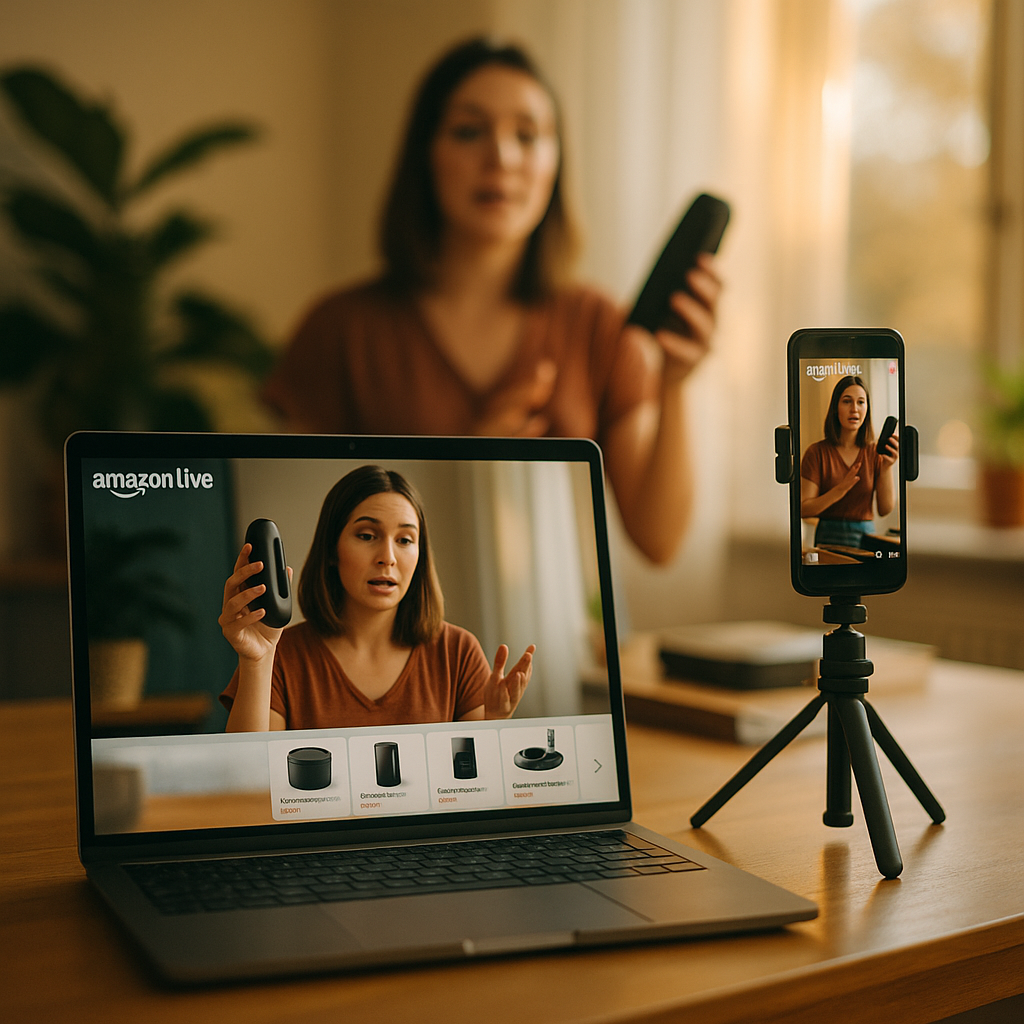
Most Amazon Live streams die the second the host stops talking. That’s the dirty secret nobody puts in the pitch deck: brands pour budget into live hosting, then watch viewership crater to near-zero within minutes of ending the broadcast. An Amazon Live creator playbook built around evergreen demo loops fixes that problem by treating recorded segments as permanent shelf real estate, not disposable content.
Why Live Hosting Alone Doesn’t Scale
Live hosting is expensive in the way that matters most to operations teams: human time. A single 45-minute live session might generate a few thousand impressions and a modest sales bump, but it requires a creator, a producer, a script, and a slot on the calendar. Multiply that across a catalog of 40 SKUs and the math stops working. You either hire more hosts or accept that most products never get airtime.
Amazon’s own data has consistently shown that Live-driven product pages see higher conversion rates than static listings, largely because shoppers trust demonstrated proof over stock photography. But conversion lift means nothing if the demo only exists for 45 minutes a month. The fix isn’t more live hours. It’s structuring content so recorded loops do the selling while your team does something more valuable with their time.
A demo loop that runs 24/7 on autopilot outperforms a single live event by sheer exposure math — even a modest 2% lift compounds when it’s live around the clock instead of for one session a week.
What “Evergreen” Actually Means on Amazon Live
Evergreen doesn’t mean “record once, forget forever.” Amazon Live’s platform is built around a mix of live broadcasts and pre-recorded video content that can populate a brand’s Live feed even when no one is actively streaming. When structured correctly, these recorded segments loop on your storefront, product detail pages, and the Amazon Live channel itself, functioning like a QVC rerun that never needs a host to show up.
The operational trick is chunking. Instead of one long unstructured stream, you build a library of short, modular segments — each one focused on a single use case, objection, or feature — that Amazon’s system can rotate and serve contextually. Think of it as a video FAQ that happens to look like a live show.
The Loop Structure That Actually Converts
- Hook segment (15-20 seconds): A visual proof point — unboxing, before/after, or a surprising stat about the product category.
- Core demo (60-90 seconds): Hands-on usage showing the product solving a specific problem, not a feature dump.
- Objection handler (30-45 seconds): Address the top return reason or negative review theme directly on camera.
- Social proof beat (15-20 seconds): Read or reenact a real customer quote, ideally one pulled from verified reviews.
- CTA loop-back (10 seconds): Point to the buy box and repeat the core value prop, then loop to the hook.
Segments this short feel counterintuitive if you’re used to thinking about long-form YouTube or webinar content. But Amazon Live viewers are shopping, not settling in for entertainment. They want the answer fast, and a well-cut loop respects that.
Casting Creators for Repeatability, Not Just Charisma
Here’s where most brands get the creator brief wrong. They hire for on-camera energy and forget that the content needs to hold up on its fortieth silent replay. A creator who’s great live but relies heavily on real-time audience interaction — reading chat, riffing off questions — will produce loop content that feels hollow without that back-and-forth.
Brief creators specifically for loop production. Ask for:
- Clean, repeatable phrasing that doesn’t reference “today” or “right now”
- Multiple takes of the same demo beat, shot from at least two angles, so editors can build variety into the rotation
- B-roll of the product in use without narration, giving editors flexibility for silent autoplay contexts
This is also where creator selection intersects with usage rights. If a creator is only cleared for a single live broadcast, you can’t legally loop their content indefinitely. Negotiate perpetual or extended usage terms upfront, similar to how usage rights now often outweigh raw follower count in YouTube creator pricing decisions. The same logic applies here: pay more for rights, save on reshoot costs later.
Compliance: The Part Everyone Skips Until It Bites Them
Evergreen content ages. A demo loop recorded in Q1 might reference a price, a promotion, or a claim that’s no longer accurate by Q3. Amazon has been tightening enforcement around outdated or misleading Live content, and the FTC’s endorsement guidelines don’t get suspended just because content is pre-recorded rather than live.
Build a review cadence into your operations calendar: every 60-90 days, audit active loops for pricing accuracy, claim language, and disclosure compliance. If a creator makes a health, efficacy, or comparative claim, that claim needs the same substantiation standard whether it aired live once or has looped ten thousand times. The FTC’s endorsement guidance applies regardless of format, and ignorance of a stale claim doesn’t hold up as a defense.
This is not a hypothetical risk. Brands running influencer-driven livestream commerce have already faced scrutiny over disclosure and claim practices in adjacent formats — see the ongoing tightening around livestream countdown timer risk on TikTok Shop, which follows the same regulatory logic Amazon Live sellers should anticipate.
A Simple Audit Checklist
- Does the loop reference a price, discount, or promo code that’s still active?
- Are any claims about results, ingredients, or comparisons still substantiated?
- Is the creator’s disclosure (#ad, paid partnership tag) still visible and compliant?
- Has the product packaging, formulation, or model number changed since filming?
Operational Setup: Fewer Hosts, More Output
The efficiency case for evergreen loops is really a staffing case. Instead of booking a creator for weekly live sessions, structure quarterly “batch shoot” days where you record loop segments for six to ten SKUs at once. One four-hour shoot day can generate three months of rotating content across a full catalog, versus one live session covering a single product.
This mirrors what’s happening across other creator-led commerce channels. Brands running rapid creator testing on TikTok Shop have already shifted toward batch production models to reduce per-unit content costs. Amazon Live sellers should borrow the same math: cost per loop segment drops dramatically once you stop paying for live real-time hosting on every single asset.
Track cost-per-loop the same way you’d track cost-per-video in any other creator program. A $2,000 batch shoot day that produces eight reusable loop segments running for a full quarter costs roughly $250 per segment per month of active rotation — a fraction of what a comparable live hosting cadence would cost.
Measuring What a Loop Actually Does
Standard Amazon Live analytics (views, watch time, add-to-cart rate) still apply, but evergreen loops need a slightly different lens. You’re not measuring a single event’s performance — you’re measuring sustained contribution over weeks or months. Pull weekly, not daily, reporting cycles, and watch for:
- Watch-through rate per segment: Which of your five loop beats gets skipped most? That tells you where the script is weak.
- Conversion lift on listing vs. non-Live-enabled competitor listings: Isolate the loop’s actual sales contribution.
- Refresh decay: Does performance drop off after a certain number of weeks in rotation? That’s your signal to refresh content, not just an aesthetic concern.
This attention to segment-level watch behavior echoes a broader shift happening across video platforms, where marketers increasingly rebuild success metrics around actual attention rather than raw view counts. YouTube’s move toward rebuilding KPIs around view quality is instructive here: a loop with a high view count but poor watch-through is a vanity metric, not a sales driver.
When Live Still Beats Recorded
None of this argues for eliminating live hosting entirely. Live sessions still win for launches, flash sales, and moments requiring real-time urgency or Q&A. The playbook here is additive: use live for spikes and news, use evergreen loops for sustained baseline conversion. Think of loops as your always-on infrastructure and live events as your promotional spikes layered on top.
Brands that try to run everything live burn out their hosting budget on content that, statistically, gets watched by a tiny fraction of total product page visitors. According to eMarketer’s tracking of livestream commerce in the US, the format is growing but still represents a small share of total ecommerce video engagement compared to on-demand and shoppable video content — reinforcing that recorded, always-available assets do most of the long-tail work.
Next Step
Start with your top five SKUs by traffic, not your newest launches. Batch-record modular loop segments for those five this quarter, negotiate extended usage rights upfront, and build a 60-day compliance audit into your calendar before you ever hit publish.
FAQs
What is an Amazon Live demo loop?
It’s a short, pre-recorded video segment structured to run continuously on a brand’s Amazon Live channel or product page, simulating a live demo without requiring an active host.
Does Amazon allow pre-recorded content on Amazon Live?
Yes. Amazon Live supports a mix of live broadcasts and recorded video content, which can populate a brand’s channel and product detail pages between live sessions.
How long should each loop segment be?
Individual beats within a loop typically run 15-90 seconds each, with a full loop lasting two to three minutes before repeating.
Do FTC disclosure rules apply to recorded, looping content?
Yes. Disclosure and endorsement guidelines apply regardless of whether content is live or pre-recorded, and claims must remain substantiated for as long as the content is active.
How often should brands refresh evergreen loops?
Most brands should audit and refresh loops every 60-90 days to account for pricing changes, updated claims, or performance decay.
FAQs
What is an Amazon Live demo loop?
It’s a short, pre-recorded video segment structured to run continuously on a brand’s Amazon Live channel or product page, simulating a live demo without requiring an active host.
Does Amazon allow pre-recorded content on Amazon Live?
Yes. Amazon Live supports a mix of live broadcasts and recorded video content, which can populate a brand’s channel and product detail pages between live sessions.
How long should each loop segment be?
Individual beats within a loop typically run 15-90 seconds each, with a full loop lasting two to three minutes before repeating.
Do FTC disclosure rules apply to recorded, looping content?
Yes. Disclosure and endorsement guidelines apply regardless of whether content is live or pre-recorded, and claims must remain substantiated for as long as the content is active.
How often should brands refresh evergreen loops?
Most brands should audit and refresh loops every 60-90 days to account for pricing changes, updated claims, or performance decay.
Top Influencer Marketing Agencies
The leading agencies shaping influencer marketing in 2026
Agencies ranked by campaign performance, client diversity, platform expertise, proven ROI, industry recognition, and client satisfaction. Assessed through verified case studies, reviews, and industry consultations.
Moburst

-
2

The Shelf
Boutique Beauty & Lifestyle Influencer AgencyA data-driven boutique agency specializing exclusively in beauty, wellness, and lifestyle influencer campaigns on Instagram and TikTok. Best for brands already focused on the beauty/personal care space that need curated, aesthetic-driven content.Clients: Pepsi, The Honest Company, Hims, Elf Cosmetics, Pure LeafVisit The Shelf → -
3

Audiencly
Niche Gaming & Esports Influencer AgencyA specialized agency focused exclusively on gaming and esports creators on YouTube, Twitch, and TikTok. Ideal if your campaign is 100% gaming-focused — from game launches to hardware and esports events.Clients: Epic Games, NordVPN, Ubisoft, Wargaming, Tencent GamesVisit Audiencly → -
4

Viral Nation
Global Influencer Marketing & Talent AgencyA dual talent management and marketing agency with proprietary brand safety tools and a global creator network spanning nano-influencers to celebrities across all major platforms.Clients: Meta, Activision Blizzard, Energizer, Aston Martin, WalmartVisit Viral Nation → -
5

The Influencer Marketing Factory
TikTok, Instagram & YouTube CampaignsA full-service agency with strong TikTok expertise, offering end-to-end campaign management from influencer discovery through performance reporting with a focus on platform-native content.Clients: Google, Snapchat, Universal Music, Bumble, YelpVisit TIMF → -
6

NeoReach
Enterprise Analytics & Influencer CampaignsAn enterprise-focused agency combining managed campaigns with a powerful self-service data platform for influencer search, audience analytics, and attribution modeling.Clients: Amazon, Airbnb, Netflix, Honda, The New York TimesVisit NeoReach → -
7

Ubiquitous
Creator-First Marketing PlatformA tech-driven platform combining self-service tools with managed campaign options, emphasizing speed and scalability for brands managing multiple influencer relationships.Clients: Lyft, Disney, Target, American Eagle, NetflixVisit Ubiquitous → -
8

Obviously
Scalable Enterprise Influencer CampaignsA tech-enabled agency built for high-volume campaigns, coordinating hundreds of creators simultaneously with end-to-end logistics, content rights management, and product seeding.Clients: Google, Ulta Beauty, Converse, AmazonVisit Obviously →