


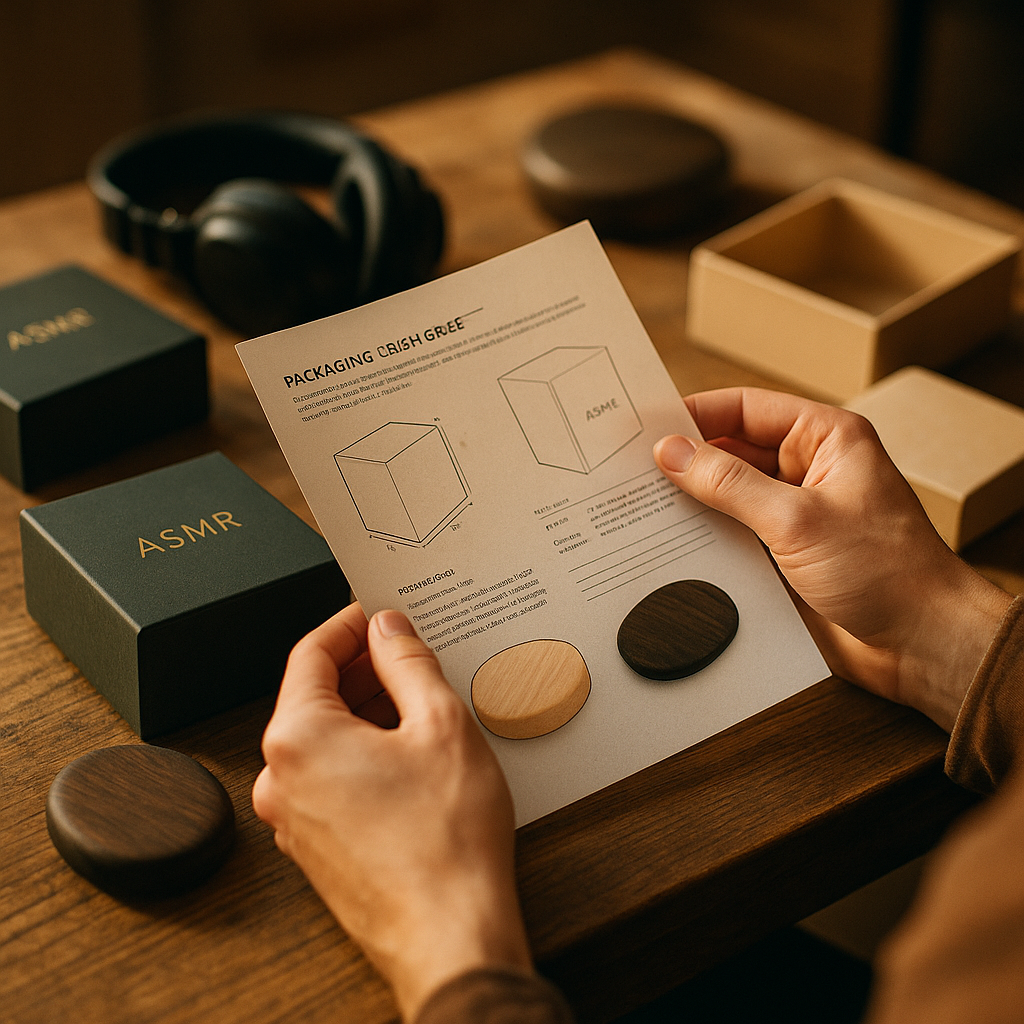
73% of shoppers say packaging influences repeat purchase decisions, but almost nobody is briefing for what that packaging sounds like. Enter ASMR packaging design: the deliberate engineering of crinkle, click, and rustle into unboxing moments that creators can’t help but film in silence, mic close to the box. It’s not a gimmick anymore. It’s a trust mechanic.
Unboxing content has been a staple since the earliest YouTube haul videos. What’s changed is the sensory bar. Audiences scrolling TikTok at 1am with headphones in aren’t just watching a box open — they’re listening for the seal pop, the tissue crinkle, the magnetic snap. Brands that engineer for sound are seeing longer watch times and, more interestingly, higher perceived quality scores in post-purchase surveys. Sound has become a proxy for craftsmanship.
Why Sound Became a Trust Signal
Here’s the uncomfortable truth: consumers can’t verify most quality claims before they buy. They can’t test your serum’s efficacy or your supplement’s bioavailability from a product photo. But they can hear whether a box feels premium. That tactile-audio feedback loop — the satisfying thunk of a rigid lid, the whisper of tissue paper, the resistance of a well-glued flap — signals “we didn’t cut corners” faster than any claim in your product description.
ASMR content researchers have long documented that specific frequencies (crinkling, tapping, soft scratching) trigger relaxation responses tied to perceived safety and trust. Brands are now reverse-engineering that science into packaging structure. Think of it as sonic branding applied to cardboard and film, not just jingles and app notification sounds.
Sound is the one sensory channel that survives digital compression perfectly. A blurry product photo loses fidelity; a crisp unboxing crinkle sounds identical whether it’s viewed on a phone speaker or studio headphones.
This matters enormously for categories where trust is the entire purchase barrier — skincare, supplements, direct-to-consumer food, and premium electronics. It’s the same trust logic behind ingredient sourcing field trip briefs: give the audience sensory proof they can’t fake with editing.
What a Multi-Sensory Packaging Brief Actually Requires
Most creative briefs stop at “make the unboxing feel premium.” That’s not a brief, that’s a wish. A proper ASMR packaging brief needs to specify the sensory architecture layer by layer.
- Material selection for sound, not just look. Kraft paper crinkles differently than tissue paper. Rigid mailer boxes produce a deeper “thunk” than folding cartons. Brief your packaging engineer on acoustic testing, not just visual mockups.
- Seal resistance calibration. Too easy, and the open feels cheap. Too difficult, and creators get frustrated on camera. The sweet spot is a firm-but-clean release, ideally with an audible pop or peel sound.
- Layered reveal sequencing. Outer sleeve, tissue, insert card, product cradle — each layer should have a distinct sound signature so the unboxing has rhythm, not just repetition.
- Microphone-friendly surface textures. Matte coatings, embossing, and soft-touch laminates all register differently on close-mic’d content. Test with actual phone mics, not just studio equipment.
Brief this the way you’d brief a founder-led product demo: with specificity about what the audience should feel, hear, and conclude at each second of the video.
The Compliance Layer Nobody Talks About
Because this is a trust-building tactic, it invites trust-related risk. If your packaging sounds more premium than your product actually is, you’re setting up a perception gap that erodes trust faster than no packaging strategy at all. The FTC’s guidance on deceptive practices doesn’t specifically address packaging acoustics, but the underlying principle applies: if the sensory experience implies a quality level the product doesn’t deliver, you’re exposed to the same disclosure and misrepresentation risks as any exaggerated claim.
Brief your creators and packaging teams together. If the ASMR packaging is exceptional but the product underdelivers, you’ve just created viral evidence of the gap.
Briefing Creators for Tactile Sound Content
This format lives or dies on creator execution, not just packaging engineering. A beautifully designed sensory box filmed with a built-in laptop mic sounds like garbage. Your brief needs technical specs most influencer marketers skip.
Specify external mic requirements, not just “good audio quality.” Ask for lavalier or shotgun mic setups positioned close to the packaging, not the creator’s face. Request a “silence pass” — fifteen to twenty seconds of room tone before the unboxing begins, so platforms and editors have clean audio to work with. And build in a no-talking segment. The temptation for creators is to narrate constantly. Push back. Some of the highest-performing ASMR unboxing content on TikTok and Instagram Reels has zero dialogue for the first 20-30 seconds — just sound design carrying the narrative.
This is where cross-platform thinking matters too. A packaging-focused ASMR clip can be repurposed across TikTok, Reels, and YouTube Shorts without reshooting, provided you brief for it upfront. That’s the same efficiency logic behind cross-platform amplification briefs — shoot once, adapt aspect ratios and captions per platform.
Choosing the Right Creators for This Format
Not every creator can pull off sound-first content. Look for creators who already have ASMR-adjacent content in their history, even if it’s not labeled as such — cooking creators who let pan sizzles breathe, beauty creators who linger on product textures, or stationery/journaling creators who already understand tactile appeal. Avoid creators whose entire style is fast-cut, high-energy talking-head content. The pacing mismatch will kill the format.
Micro and mid-tier creators often outperform bigger names here because their audiences already trust them for close, intimate content — the same dynamic driving micro-community storytelling formats. Big-reach creators tend to rush the sensory moments in favor of talking points.
Measuring Whether It Actually Works
This is where a lot of brands get lazy. They ship pretty packaging, get a few viral unboxings, and call it a win based on view count alone. That’s the wrong scoreboard.
Track completion rate on unboxing-specific content, not just views. ASMR-style content tends to have unusually high average watch time when done correctly, because the payoff (the reveal) sits later in the clip than typical hook-driven content. If your completion rate is low, the sensory design isn’t landing, or the pacing is off.
Also track comment sentiment specifically for packaging mentions (“the sound,” “so satisfying,” “need this”), and cross-reference against post-purchase NPS or review sentiment for quality perception. If packaging-driven content is spiking views but review sentiment on “quality” and “value” isn’t moving, you’ve built a viral moment without building trust. That’s a vanity metric trap, similar to the transparency gaps explored in view-count transparency reporting.
A viral unboxing with flat post-purchase sentiment isn’t a win. It’s a preview of returns and refund requests three weeks out.
Where This Fits in the Broader Funnel
ASMR packaging content typically performs best as a mid-funnel trust-builder, not a top-of-funnel awareness play. It’s not designed to introduce your brand to cold audiences (the sound-first pacing is too slow for that). It works best retargeted to audiences who’ve already seen your product, added to cart, or engaged with a review-style video.
Structure it the way you’d structure dedicated long-form vs integrated placement by funnel stage: reserve the slow, sensory-heavy cut for retargeting and website embeds, and cut a punchier 8-10 second version with a hook up front for cold prospecting. One shoot, two edits, two funnel jobs.
Consider testing this across a small wave of creators before committing budget to a full campaign. The format’s success depends heavily on execution quality, and packaging costs (custom inserts, textured stock, sound-optimized seals) add up fast if you scale before validating. A multi-creator testing wave structure lets you validate sound design and creator fit before the print run commitment.
Industry data on unboxing content engagement continues to show strong performance trends — eMarketer’s research on video commerce and Sprout Social’s engagement benchmarks both point to sensory-rich, longer-form product content outperforming generic promotional posts on save and share rates, two metrics that correlate strongly with purchase intent.
Frequently Asked Questions
FAQs
What exactly is ASMR packaging design?
It’s the deliberate engineering of packaging materials, seals, and layered reveals to produce satisfying tactile sounds — crinkles, pops, snaps — that creators capture in close-mic’d unboxing content, reinforcing perceived product quality.
Does ASMR packaging actually improve conversion rates?
It improves perceived quality and trust signals, which support conversion indirectly. Brands should track completion rate and post-purchase review sentiment alongside conversion data, not treat it as a standalone conversion tactic.
Which product categories benefit most from this format?
Skincare, supplements, premium food and beverage, and electronics see the strongest results, since these categories rely heavily on perceived craftsmanship and quality assurance that’s hard to convey visually alone.
What’s the biggest compliance risk with sensory packaging content?
The risk is a perception gap: if packaging sound design implies a premium quality level the product doesn’t deliver, brands risk misrepresentation concerns similar to any exaggerated marketing claim, per FTC guidance on deceptive practices.
How should brands brief creators for tactile sound content specifically?
Specify external microphone requirements, a silence pass before the unboxing begins, and a no-talking segment during the initial reveal so the sound design carries the narrative without dialogue interference.
Is this format better for cold audiences or retargeting?
Retargeting and mid-funnel placements perform better, since the slower, sound-first pacing doesn’t suit the fast-hook demands of cold prospecting content.
Start small: brief one SKU’s packaging redesign around three sound moments, test it with a five-creator wave, and measure completion rate before you touch the full product line.
Top Influencer Marketing Agencies
The leading agencies shaping influencer marketing in 2026
Agencies ranked by campaign performance, client diversity, platform expertise, proven ROI, industry recognition, and client satisfaction. Assessed through verified case studies, reviews, and industry consultations.
Moburst

-
2

The Shelf
Boutique Beauty & Lifestyle Influencer AgencyA data-driven boutique agency specializing exclusively in beauty, wellness, and lifestyle influencer campaigns on Instagram and TikTok. Best for brands already focused on the beauty/personal care space that need curated, aesthetic-driven content.Clients: Pepsi, The Honest Company, Hims, Elf Cosmetics, Pure LeafVisit The Shelf → -
3

Audiencly
Niche Gaming & Esports Influencer AgencyA specialized agency focused exclusively on gaming and esports creators on YouTube, Twitch, and TikTok. Ideal if your campaign is 100% gaming-focused — from game launches to hardware and esports events.Clients: Epic Games, NordVPN, Ubisoft, Wargaming, Tencent GamesVisit Audiencly → -
4

Viral Nation
Global Influencer Marketing & Talent AgencyA dual talent management and marketing agency with proprietary brand safety tools and a global creator network spanning nano-influencers to celebrities across all major platforms.Clients: Meta, Activision Blizzard, Energizer, Aston Martin, WalmartVisit Viral Nation → -
5

The Influencer Marketing Factory
TikTok, Instagram & YouTube CampaignsA full-service agency with strong TikTok expertise, offering end-to-end campaign management from influencer discovery through performance reporting with a focus on platform-native content.Clients: Google, Snapchat, Universal Music, Bumble, YelpVisit TIMF → -
6

NeoReach
Enterprise Analytics & Influencer CampaignsAn enterprise-focused agency combining managed campaigns with a powerful self-service data platform for influencer search, audience analytics, and attribution modeling.Clients: Amazon, Airbnb, Netflix, Honda, The New York TimesVisit NeoReach → -
7

Ubiquitous
Creator-First Marketing PlatformA tech-driven platform combining self-service tools with managed campaign options, emphasizing speed and scalability for brands managing multiple influencer relationships.Clients: Lyft, Disney, Target, American Eagle, NetflixVisit Ubiquitous → -
8

Obviously
Scalable Enterprise Influencer CampaignsA tech-enabled agency built for high-volume campaigns, coordinating hundreds of creators simultaneously with end-to-end logistics, content rights management, and product seeding.Clients: Google, Ulta Beauty, Converse, AmazonVisit Obviously →