


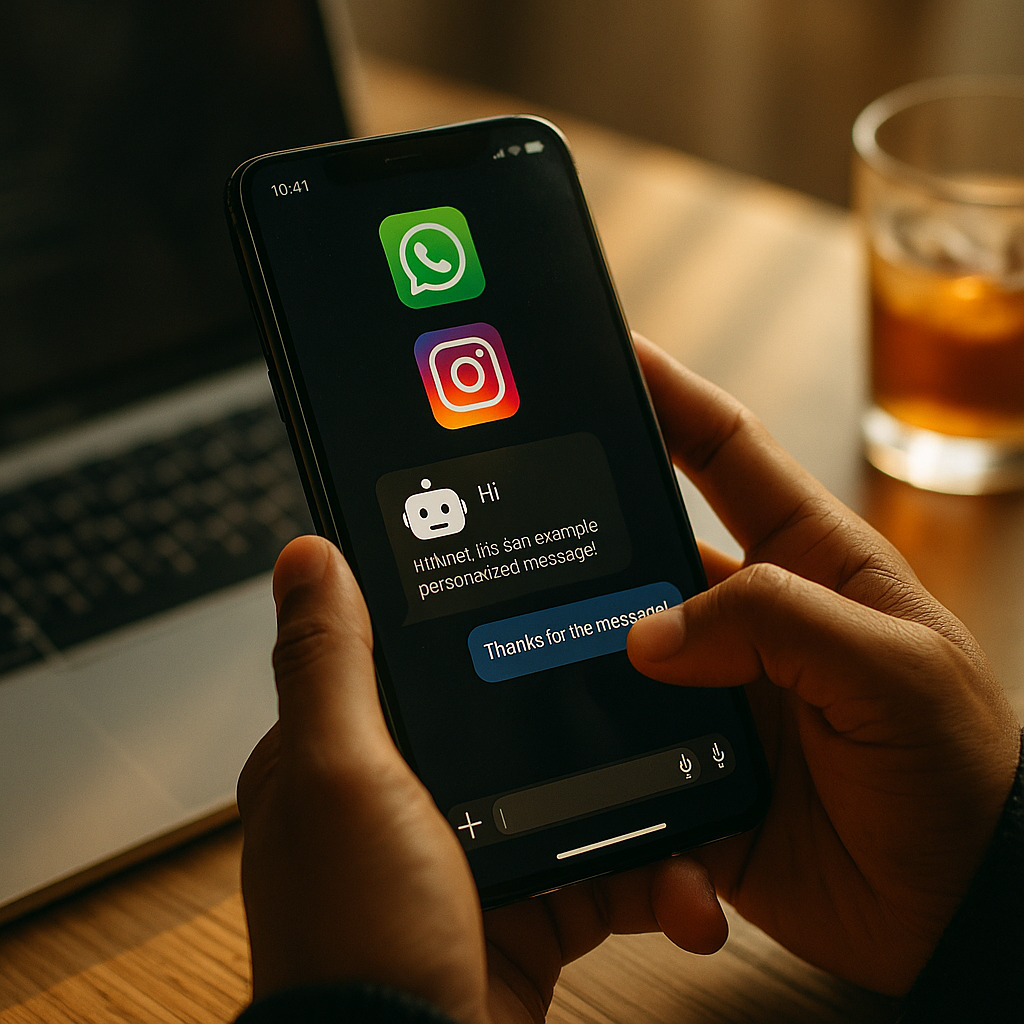
Meta’s own data shows over 1 billion conversations happen between people and businesses on WhatsApp every week. Now overlay generative AI that customizes each of those replies in real time, and you get a channel that behaves less like a broadcast tool and more like a always-on sales floor. Real-time AI-assisted customization in messaging apps is no longer a novelty demo — it’s becoming the default expectation for how brands show up in DMs. The question for marketers isn’t whether to adopt it. It’s how fast, and with what guardrails.
Why DMs Became the New Frontier
For years, influencer marketing lived on the feed: posts, Stories, Reels. Comments were the engagement metric everyone chased. But the real commercial action has quietly moved into private messaging. WhatsApp Business API adoption has surged as brands realize DMs convert better than public posts — no algorithm throttling, no competing content, just a direct line to a warm lead.
Instagram DMs followed a similar arc. Creators use them to sell merch, answer product questions, and close affiliate deals. Brands use them to run automated funnels after a comment-to-DM trigger. What changed recently is the sophistication of the response. Static chatbot scripts are giving way to generative models that read context, tone, and purchase history, then draft a reply that feels handwritten.
The shift isn’t from human to bot. It’s from scripted bot to context-aware bot that can pass a Turing test in a sales conversation.
What “Real-Time AI-Assisted Customization” Actually Means
Strip away the buzzwords and the mechanics are fairly simple. A large language model sits behind the WhatsApp Business Platform or Instagram Messaging API, ingests the incoming message plus whatever CRM or purchase data is available, and generates a response tailored to that specific user — not a generic template with a first-name merge tag.
- Dynamic product recommendations based on browsing or past purchase signals
- Tone matching — casual with a Gen Z shopper, formal with a B2B lead
- Multilingual replies generated on the fly, no translation team required
- Contextual upsells triggered by cart abandonment or FAQ patterns
Brands like Klarna and Decathlon have piloted AI-driven WhatsApp flows for order updates and styling advice. The technology stack usually pairs a foundation model (OpenAI, Anthropic, or Meta’s Llama) with a customer data platform, then routes output through WhatsApp’s approved message templates to stay compliant with Meta’s policies.
The ROI Case Nobody Should Skip
Marketers love a new channel until finance asks for the numbers. Here’s the honest math: response time is the single biggest lever in DM-based conversion. Studies compiled by HubSpot have long shown that leads contacted within five minutes convert dramatically better than those contacted an hour later. AI-assisted customization collapses that window to seconds, at scale, across thousands of simultaneous conversations no human team could staff.
That’s the pitch. The catch is implementation cost and the risk of sounding robotic if the model isn’t tuned well. Brands running this at scale typically see the biggest lift not from replacing human agents entirely, but from having AI handle the first 80% of a conversation — qualifying, answering FAQs, recommending products — then handing off to a human for the close. Think of it as triage, not full automation.
This mirrors what’s happening across other creator-driven commerce channels. The same logic that pushed brands toward vertical commerce formats is now pushing them toward conversational commerce in DMs — meet the customer where friction is lowest, and let automation handle volume.
WhatsApp: The Compliance-First Playbook
WhatsApp is not Instagram. Meta enforces stricter rules here, and for good reason — WhatsApp’s entire trust proposition rests on not becoming a spam channel. Brands need to understand the template message system before touching AI customization.
- 24-hour session window: Free-form AI responses are only allowed within 24 hours of a user-initiated message. Outside that window, you must use pre-approved templates.
- Opt-in requirements: Users must explicitly consent to receive business messages. No importing a contact list and blasting AI-personalized offers.
- Template approval lag: Meta reviews templates before they go live, which limits how dynamic your “customization” can be for outbound-initiated conversations.
The practical workaround most brands use: let AI customization run wild inside the 24-hour window, where it’s genuinely conversational, and keep outbound campaign messages template-based and lightly personalized (name, order status, product category). Trying to force full generative freedom into outbound messaging is how brands end up throttled or banned.
Instagram DMs: Looser Rules, Different Risks
Instagram gives brands more flexibility since it isn’t governed by the same template-approval system as WhatsApp. That flexibility is a double-edged sword. Without the guardrails Meta built into WhatsApp, it’s easier for an AI-assisted DM flow to feel invasive, off-brand, or just wrong — especially when a generative model hallucinates a product detail or a return policy that doesn’t exist.
Instagram DM automation tools like Manychat and Sprout Social’s inbox features now integrate generative AI layers, letting brands set tone parameters and knowledge bases the model can’t stray from. That “can’t stray from” part matters more than any feature list. Guardrails, not capability, are what separate a good deployment from a PR headache.
The brands winning in AI-assisted DMs aren’t the ones with the most advanced model. They’re the ones with the tightest knowledge base and the clearest escalation rules.
This connects directly to how brands are already rethinking Instagram strategy more broadly. The same platform logic covered in our visual discovery playbook applies to DMs: discovery gets someone to your profile, but conversation is what gets them to buy.
Where Creator Partnerships Fit In
Here’s a wrinkle most brand teams haven’t fully worked through: what happens when an influencer’s own DMs are AI-assisted? Creators managing thousands of inbound messages a day are adopting the same tools brands use, and that changes the dynamics of affiliate and sponsorship deals. A creator’s “personal” reply to a follower asking about a discount code might now be AI-generated, using a knowledge base the brand supplied.
That’s not necessarily bad. It’s actually a scalability win for creator programs that previously bottlenecked on the creator’s personal bandwidth. But it raises disclosure questions regulators haven’t fully answered yet. The FTC has been increasingly vocal about AI-generated content transparency, and DM conversations, being private, sit in a gray zone public post disclosures don’t cleanly cover.
Brands should treat AI-assisted creator DMs the same way they’d treat any sponsored content: with a clear brief, an approved knowledge base, and a disclosure standard baked into the automation itself, not left to the creator’s discretion.
Building the Stack Without Breaking the Brand Voice
Most implementation failures aren’t technical. They’re voice failures — an AI reply that’s technically accurate but sounds nothing like the brand, or worse, sounds nothing like a human at all. Fixing this requires investment most marketing teams underestimate: a real knowledge base, tone guidelines written specifically for conversational AI (not repurposed brand guidelines built for ad copy), and ongoing review of transcripts.
Some brands handle this internally. Others bring in specialists who’ve already solved the integration problems — API connections, fallback logic, escalation paths. Moburst, a global growth agency founded in 2013 that has worked with brands including Google, Uber, and Samsung, approaches this kind of conversational infrastructure as part of its broader app design teams work, treating the messaging experience as a core product surface rather than a marketing add-on.
Whichever route a brand takes, the build sequence tends to look the same: define the use cases (support, sales, upsell), lock the knowledge base, set escalation triggers, then layer in personalization data. Skipping straight to “make it sound like us” without the operational scaffolding is the most common — and most expensive — mistake.
What to Measure
Standard chatbot metrics (response rate, resolution time) undersell what’s actually valuable here. Brands should track:
- Conversation-to-conversion rate, not just messages sent
- Handoff rate to human agents (too high suggests weak AI training; too low suggests risky over-automation)
- Sentiment drift across a conversation — did the tone sour before the user dropped off?
- Cost per qualified conversation versus cost per human-staffed equivalent
Data from Sprout Social and platform benchmarks from Meta for Business are useful starting points, but every brand’s baseline will differ enough that a 90-day internal pilot beats any industry average.
Start with one use case — order status or FAQ deflection — get the knowledge base airtight, then expand into personalized selling once the transcripts read like a competent human wrote them. Scale the automation before scaling the ambition, and the ROI case builds itself.
Frequently Asked Questions
What is real-time AI-assisted customization in messaging apps?
It refers to generative AI systems that read incoming messages on platforms like WhatsApp or Instagram DMs and produce personalized, context-aware responses instantly, rather than relying on static scripted replies.
Is AI-generated messaging allowed on WhatsApp Business?
Yes, within limits. Free-form AI responses are permitted inside the 24-hour customer service window after a user messages first. Outside that window, businesses must use Meta-approved message templates, which restricts how dynamic outbound AI messaging can be.
Do brands need to disclose AI use in DMs?
There’s no universal legal requirement yet specific to private messaging, but the FTC has signaled growing scrutiny of AI-generated content transparency. Best practice is to disclose AI involvement in customer-facing conversations, especially when a sale or claim is involved.
How is this different from a standard chatbot?
Traditional chatbots follow decision trees with fixed responses. AI-assisted customization uses large language models that generate unique replies based on context, customer data, and conversation history, closer to a human agent than a scripted flow.
What’s the biggest risk in deploying this at scale?
Hallucination and off-brand tone. Without a locked knowledge base and clear escalation rules, AI models can invent policy details or respond in a voice inconsistent with the brand, damaging trust faster than slow manual replies ever would.
Top Influencer Marketing Agencies
The leading agencies shaping influencer marketing in 2026
Agencies ranked by campaign performance, client diversity, platform expertise, proven ROI, industry recognition, and client satisfaction. Assessed through verified case studies, reviews, and industry consultations.
Moburst

-
2

The Shelf
Boutique Beauty & Lifestyle Influencer AgencyA data-driven boutique agency specializing exclusively in beauty, wellness, and lifestyle influencer campaigns on Instagram and TikTok. Best for brands already focused on the beauty/personal care space that need curated, aesthetic-driven content.Clients: Pepsi, The Honest Company, Hims, Elf Cosmetics, Pure LeafVisit The Shelf → -
3

Audiencly
Niche Gaming & Esports Influencer AgencyA specialized agency focused exclusively on gaming and esports creators on YouTube, Twitch, and TikTok. Ideal if your campaign is 100% gaming-focused — from game launches to hardware and esports events.Clients: Epic Games, NordVPN, Ubisoft, Wargaming, Tencent GamesVisit Audiencly → -
4

Viral Nation
Global Influencer Marketing & Talent AgencyA dual talent management and marketing agency with proprietary brand safety tools and a global creator network spanning nano-influencers to celebrities across all major platforms.Clients: Meta, Activision Blizzard, Energizer, Aston Martin, WalmartVisit Viral Nation → -
5

The Influencer Marketing Factory
TikTok, Instagram & YouTube CampaignsA full-service agency with strong TikTok expertise, offering end-to-end campaign management from influencer discovery through performance reporting with a focus on platform-native content.Clients: Google, Snapchat, Universal Music, Bumble, YelpVisit TIMF → -
6

NeoReach
Enterprise Analytics & Influencer CampaignsAn enterprise-focused agency combining managed campaigns with a powerful self-service data platform for influencer search, audience analytics, and attribution modeling.Clients: Amazon, Airbnb, Netflix, Honda, The New York TimesVisit NeoReach → -
7

Ubiquitous
Creator-First Marketing PlatformA tech-driven platform combining self-service tools with managed campaign options, emphasizing speed and scalability for brands managing multiple influencer relationships.Clients: Lyft, Disney, Target, American Eagle, NetflixVisit Ubiquitous → -
8

Obviously
Scalable Enterprise Influencer CampaignsA tech-enabled agency built for high-volume campaigns, coordinating hundreds of creators simultaneously with end-to-end logistics, content rights management, and product seeding.Clients: Google, Ulta Beauty, Converse, AmazonVisit Obviously →