


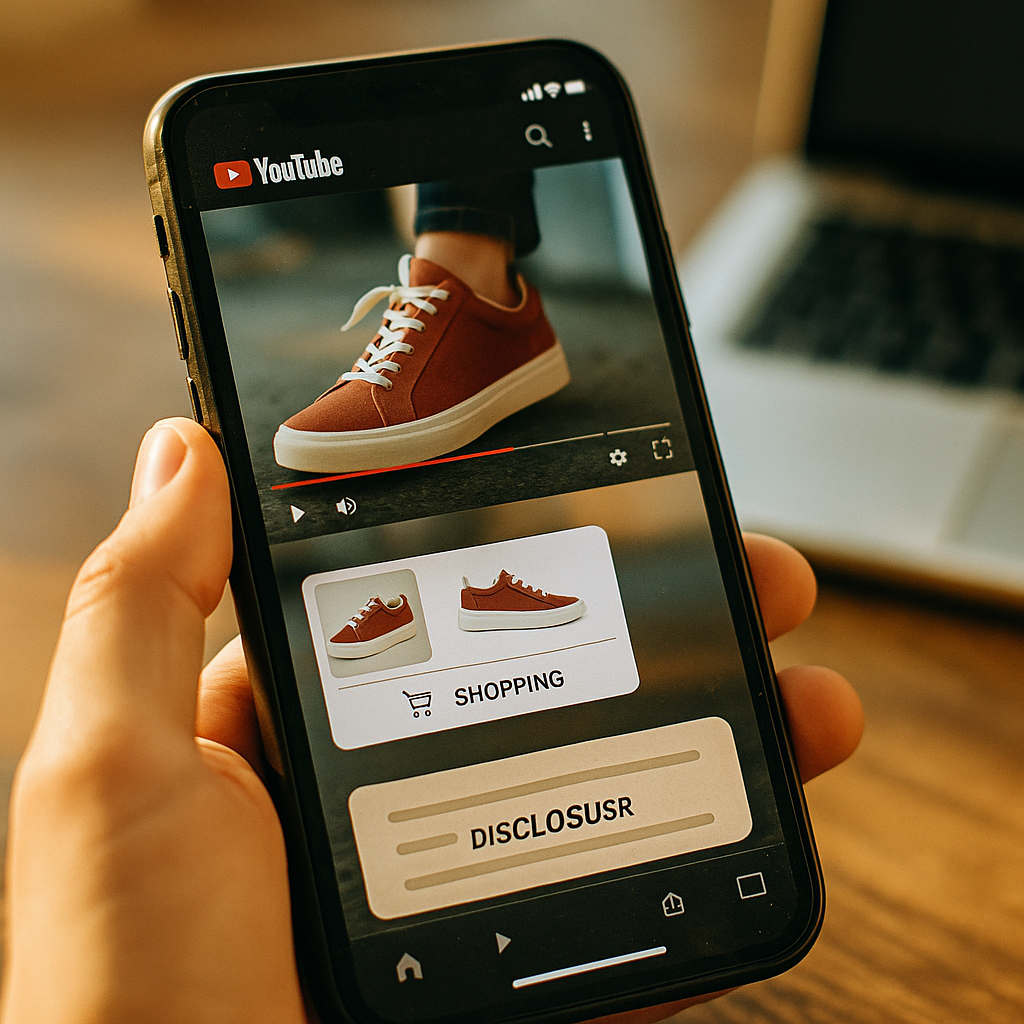
YouTube pulled in over $36 billion in ad revenue last year, and shoppable video is now the fastest-growing line item inside that number. Yet most brands still bolt product tags onto long-form videos as an afterthought, ignoring the fact that a YouTube shoppable overlay sitting next to a mid-roll ad and an undisclosed brand deal is a compliance incident waiting to happen. If your creator program hasn’t rebuilt its video architecture around this, you’re leaving revenue and legal cover on the table.
The Overlay Economy Is Eating Long-Form YouTube
Shoppable overlays used to be a Shorts and livestream feature. Not anymore. YouTube has pushed product tagging, end cards, and shopping shelves deep into standard long-form uploads, which means a 14-minute review video can now carry AdSense pre-roll, a mid-roll break, a branded content disclosure, and three shoppable product cards, all stacked on top of each other. That’s a lot of overlapping monetization and disclosure surfaces fighting for the same six inches of screen.
For brands, this is genuinely good news. Comparison and review content already converts well, as we’ve covered in our YouTube comparison reviews playbook, and layering shoppable overlays onto that format shortens the path from consideration to cart. The problem isn’t the opportunity. It’s the sequencing.
A shoppable overlay that appears before a required branded content disclosure isn’t just sloppy design, it’s a documented FTC disclosure failure the moment a regulator pulls the video timeline.
Where Does the Branded Content Toggle Actually Fit?
YouTube’s branded content toggle (the “includes paid promotion” flag creators set during upload) triggers an automatic on-screen disclosure that appears for a few seconds at video start. That’s separate from the AdSense monetization layer, and separate again from YouTube Shopping’s product tags. Three systems, three different triggers, one video. Most creator briefs treat them as independent checkboxes instead of a sequence that needs to be storyboarded.
Here’s the operational reality: the FTC doesn’t care which YouTube system technically fired the disclosure. It cares whether a reasonable viewer understood the relationship between the creator and the brand before being asked to buy something. That means your shoppable overlay timing has to be built around the disclosure, not the other way around.
The Sequencing Rule Brands Keep Getting Wrong
The safest structure, and the one we recommend to every brand running paid product integrations on long-form YouTube, is this order:
- Branded content toggle disclosure fires in the first 30 seconds, before any product mention.
- Verbal or on-screen disclosure repeats immediately before the segment featuring the paid product.
- Shoppable overlay or product card appears only after both disclosures have run, timestamped to the exact moment the product is shown or discussed.
- End screen shopping shelf repeats the full product list with disclosure language visible in the description.
Skip step two and you’ve got a legal gap. Viewers who join mid-video, skip ahead, or watch on a smart TV without seeing the opening card never encounter the disclosure at all. That’s precisely the scenario the FTC’s endorsement guidance flags as a failure mode: disclosure that technically exists but isn’t “clear and conspicuous” at the point of the claim.
Structuring the Video: A Practical Overlay Map
Think of a 12 to 18 minute ad-supported video as four zones, each with its own overlay logic.
Zone one (0:00 to 0:45). Hook, branded content toggle disclosure, no product overlays yet. This is also where AdSense typically slots pre-roll, so keep the disclosure text on screen long enough to survive a skipped ad.
Zone two (mid-video, pre-mid-roll). Product demonstration or review segment. Verbal disclosure repeats here. Shoppable overlay appears now, tied to the specific timestamp, not floating generically across the whole video.
Zone three (mid-roll break). AdSense ad plays. No shoppable overlay should be active during or immediately after the break, since viewers re-entering the video need a beat to reorient before hitting a purchase prompt.
Zone four (end screen). Full shopping shelf, disclosure recap in the description and pinned comment, plus a link back to your product page or TikTok Shop cross-listing if you’re running the asset across platforms.
This mirrors the multi-surface compliance thinking we outlined in structuring one asset across three platforms. The core lesson carries over: disclosure has to travel with the commerce trigger, not sit in a description box nobody reads.
Why View Counting Changes Make This Urgent Now
YouTube’s shift in how it counts and pays out views has already forced sponsors to rebuild their CPV math, as we detailed in our piece on the YouTube view counting change. That same shift raises the stakes on overlay placement. If a bigger share of “counted” engagement now comes from partial watches and re-entries after ad breaks, then a shoppable overlay that only appears once, early, is missing a growing chunk of your addressable audience.
Rebuild your overlay cadence to reappear at natural re-entry points, chapter markers, and post-mid-roll segments. It’s not aggressive placement, it’s coverage.
Compliance Checklist Before You Publish
- Branded content toggle enabled in YouTube Studio before upload, not added retroactively.
- Disclosure language matches the actual relationship (gifted, paid, affiliate commission) rather than a generic “thanks to our sponsor” line.
- Shoppable product tags timestamped to the exact segment, not spread across the full runtime.
- Description box includes written disclosure plus affiliate link disclosure if commission-based.
- Pinned comment repeats disclosure for viewers who skip the intro.
- Thumbnail and title don’t imply an unbiased review if the content is fully sponsored.
Run this checklist per video, not per campaign. Templates drift, editors forget steps, and a single missed toggle on one video in a ten-part series is enough to draw scrutiny to the whole batch.
Measuring What Actually Converts
Overlay clicks are a vanity metric unless you tie them to downstream cart activity. Pull three numbers per video: overlay impression rate, overlay click-through, and completed purchase attribution within a 7-day window. Compare those against a non-overlay control video from the same creator to isolate the overlay’s actual lift rather than crediting it for demand the creator would have driven anyway.
Brands running comparable shoppable formats on Shorts have found that discovery mechanics change these numbers significantly, which is why the structural guidance in our Shorts discovery playbook is worth cross-referencing even if your primary asset is long-form. Pacing expectations transfer across formats more than most teams assume.
For budget allocation across tutorial and demo content specifically, our tutorial demo budget split breakdown gives a useful benchmark for how much of a long-form YouTube spend should go toward overlay-ready product demonstration segments versus general brand storytelling.
Third-party benchmarking data from eMarketer and Statista both show shoppable video conversion rates outpacing standard display and pre-roll formats, which is exactly why this structural work is worth the operational overhead. Google’s own documentation on YouTube Shopping features is the reference point your editing team should keep open during every build, since tag eligibility and placement rules shift more often than most compliance calendars account for.
Take This Into Your Next Production Cycle
Build a shot list template that assigns disclosure timing, ad break placement, and overlay triggers before filming starts, not during edit. Audit your last five sponsored long-form uploads against the checklist above this week, because the gap between “we disclosed” and “we disclosed clearly and conspicuously at the point of purchase” is exactly where enforcement risk lives.
FAQs
What is a YouTube shoppable overlay?
It’s an on-screen, clickable product card or tag that YouTube surfaces during or after a video, linking viewers directly to a product page or checkout flow without leaving the video.
How is the branded content toggle different from a shoppable tag?
The branded content toggle is a disclosure mechanism that tells viewers a video includes paid promotion. The shoppable tag is a commerce feature that links to a product. They’re separate systems that need to be sequenced together, not treated as one setting.
Does the FTC require disclosure even if YouTube’s toggle is enabled?
Yes. YouTube’s toggle satisfies the platform’s own policy, but the FTC still requires the disclosure to be clear, conspicuous, and placed near the claim itself, not just once at the start of a long video.
Where should shoppable overlays appear relative to mid-roll ads?
Avoid triggering a shoppable overlay immediately during or right after a mid-roll ad break. Give viewers a short reorientation window, then reintroduce the overlay tied to the specific product segment.
Can affiliate links replace formal FTC disclosure?
No. Affiliate links require their own disclosure in addition to any branded content or gifted product disclosure. Combining relationships in one video means combining disclosures, not choosing one.
Top Influencer Marketing Agencies
The leading agencies shaping influencer marketing in 2026
Agencies ranked by campaign performance, client diversity, platform expertise, proven ROI, industry recognition, and client satisfaction. Assessed through verified case studies, reviews, and industry consultations.
Moburst

-
2

The Shelf
Boutique Beauty & Lifestyle Influencer AgencyA data-driven boutique agency specializing exclusively in beauty, wellness, and lifestyle influencer campaigns on Instagram and TikTok. Best for brands already focused on the beauty/personal care space that need curated, aesthetic-driven content.Clients: Pepsi, The Honest Company, Hims, Elf Cosmetics, Pure LeafVisit The Shelf → -
3

Audiencly
Niche Gaming & Esports Influencer AgencyA specialized agency focused exclusively on gaming and esports creators on YouTube, Twitch, and TikTok. Ideal if your campaign is 100% gaming-focused — from game launches to hardware and esports events.Clients: Epic Games, NordVPN, Ubisoft, Wargaming, Tencent GamesVisit Audiencly → -
4

Viral Nation
Global Influencer Marketing & Talent AgencyA dual talent management and marketing agency with proprietary brand safety tools and a global creator network spanning nano-influencers to celebrities across all major platforms.Clients: Meta, Activision Blizzard, Energizer, Aston Martin, WalmartVisit Viral Nation → -
5

The Influencer Marketing Factory
TikTok, Instagram & YouTube CampaignsA full-service agency with strong TikTok expertise, offering end-to-end campaign management from influencer discovery through performance reporting with a focus on platform-native content.Clients: Google, Snapchat, Universal Music, Bumble, YelpVisit TIMF → -
6

NeoReach
Enterprise Analytics & Influencer CampaignsAn enterprise-focused agency combining managed campaigns with a powerful self-service data platform for influencer search, audience analytics, and attribution modeling.Clients: Amazon, Airbnb, Netflix, Honda, The New York TimesVisit NeoReach → -
7

Ubiquitous
Creator-First Marketing PlatformA tech-driven platform combining self-service tools with managed campaign options, emphasizing speed and scalability for brands managing multiple influencer relationships.Clients: Lyft, Disney, Target, American Eagle, NetflixVisit Ubiquitous → -
8

Obviously
Scalable Enterprise Influencer CampaignsA tech-enabled agency built for high-volume campaigns, coordinating hundreds of creators simultaneously with end-to-end logistics, content rights management, and product seeding.Clients: Google, Ulta Beauty, Converse, AmazonVisit Obviously →