


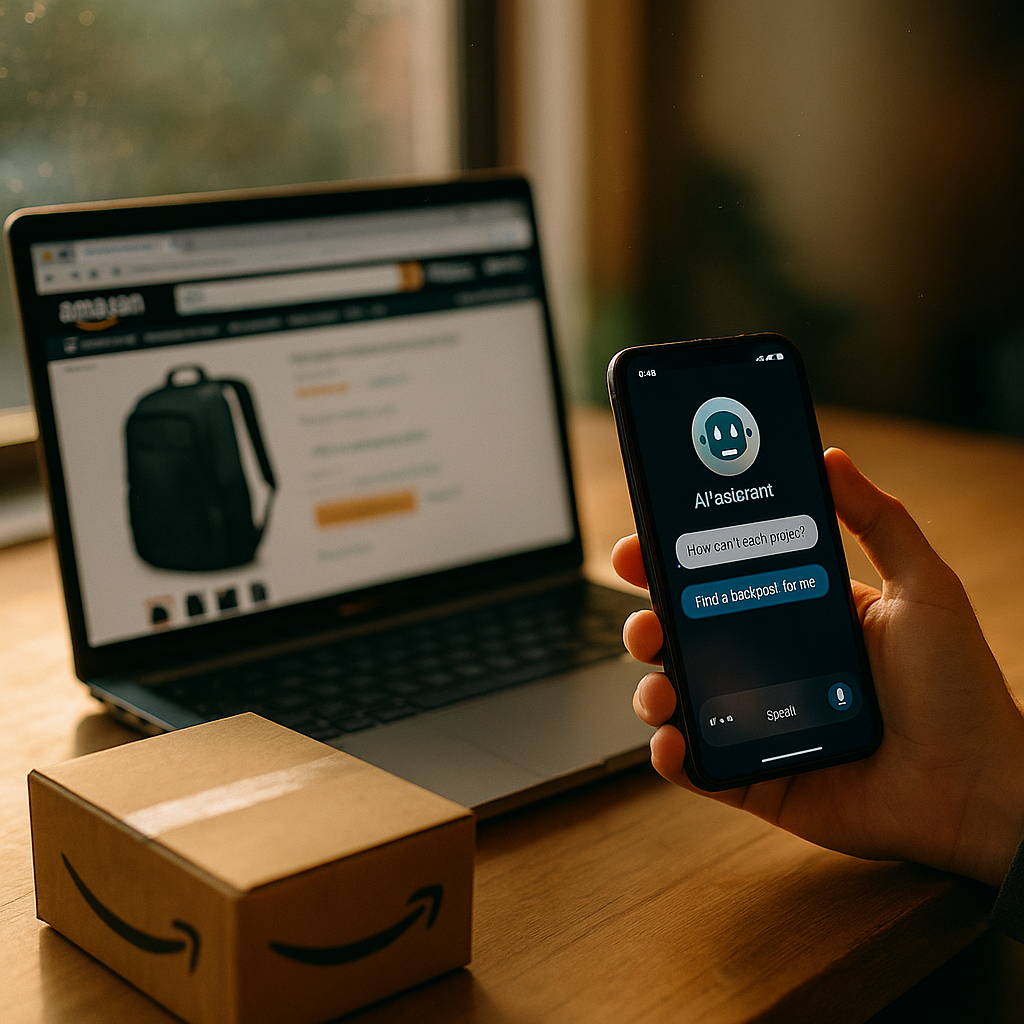
Amazon’s Buy For Me AI agent now completes purchases on competitor sites without a human clicking “add to cart.” If your product listing was built for a person scrolling on a phone, it may be invisible to the bot doing the buying instead. That’s not a hypothetical. It’s the current state of agentic commerce, and it changes what “optimized” even means.
For years, listing optimization meant hero images, keyword-stuffed titles, and review velocity aimed at swaying a human shopper’s gut. Now there’s a second audience: an autonomous agent parsing structured data, comparing specs across retailers, and making a purchase decision in milliseconds based on criteria you may never have thought to fill out. This is the operational shift brand teams need to plan for now, not after competitors figure it out first.
What Is Amazon’s Buy For Me Agent, Actually?
Buy For Me is Amazon’s agentic shopping feature that lets its AI navigate to a third-party retailer, select a product variant, fill in checkout details, and complete a purchase on the customer’s behalf, all without the shopper leaving the Amazon app. It launched to solve a real problem: Amazon doesn’t carry everything, and customers were leaving the ecosystem to buy on Nike.com or Best Buy’s site anyway. Rather than lose that intent, Amazon built an agent to close the loop.
The mechanics matter for marketers. The agent doesn’t “browse” the way a person does. It reads structured product data, pulls from APIs and schema markup, cross-references price and availability, and executes a transaction against a defined set of rules (budget ceiling, size or color match, delivery window). If your listing lacks the structured fields the agent needs, you don’t get skipped politely. You get passed over entirely, and a competitor’s SKU fills the cart instead.
An agent doesn’t reward a persuasive product description. It rewards a parseable one. Marketing copy written to charm a human can actively confuse a machine looking for a size, a material, or a shipping cutoff.
Why This Changes Product Listing Optimization
Traditional listing SEO optimized for two engines: Amazon’s A9 search algorithm and a human’s scroll behavior. Buy For Me introduces a third: an autonomous decision engine that doesn’t care about your brand story, only whether your data answers its query correctly and quickly.
That means fields brands historically treated as secondary, structured attributes, variant matrices, GTIN accuracy, inventory sync, now function as the primary interface. Get them wrong and the agent either fails silently or, worse, buys the wrong variant, triggering a return and a frustrated customer who blames your brand, not the AI.
eMarketer’s research on retail media has tracked how quickly AI-assisted discovery is reshaping purchase paths, and agentic checkout is the logical next step after conversational shopping assistants. Brands that treated schema markup as a “nice to have” are about to find out it’s the whole game.
Listing Fields That Matter Now
- Structured attributes over prose: Size, color, material, and compatibility need to live in dedicated fields, not buried in a paragraph description.
- Accurate GTINs and UPCs: Agents cross-reference identifiers across retailers to confirm they’re comparing the same product. Mismatched codes mean your listing gets excluded from the comparison set.
- Real-time inventory accuracy: An agent that attempts a purchase against an out-of-stock listing fails the transaction and may deprioritize that source going forward.
- Clear variant hierarchies: If “Blue, Medium” and “Medium, Blue” are treated as separate SKUs in your backend, you’re creating ambiguity an agent may not resolve in your favor.
- Machine-readable shipping and return terms: Delivery windows and return policies increasingly factor into agent decision logic, not just price.
None of this is exotic. It’s the same schema.org and product feed hygiene that’s mattered for Google Shopping for a decade. What’s new is the stakes: get it wrong, and you’re not just ranking lower, you’re structurally unpurchaseable by an agent that’s already decided.
Risk and Compliance: What Brands Need to Watch
Autonomous purchasing raises questions legal and compliance teams haven’t had to answer before. Who is liable if an agent buys the wrong item because your listing data was ambiguous? What disclosure obligations exist when a brand pays for placement that an AI agent, not a human, is evaluating? The FTC has already signaled interest in how algorithmic and AI-driven commerce intersects with consumer protection rules, and agentic shopping sits squarely in that lane.
There’s also a brand safety angle. If Buy For Me selects a competitor’s product because your listing was incomplete, you’ve effectively lost a sale to a data hygiene gap, not a pricing or quality gap. That’s a preventable loss, and it should be treated with the same urgency as a broken checkout flow on your own site.
A listing gap doesn’t just cost you a ranking position anymore. It can cost you the entire transaction, silently, with no error message telling you why.
Cross-functional teams need a shared playbook here: product data owners, e-commerce ops, and marketing compliance all have a stake in making sure listings are agent-ready. This mirrors the discipline brands have had to build around merchant compliance on social commerce platforms, where a single missing disclosure or metadata field can quietly tank performance without an obvious cause.
Cross-Retailer Implications for Multi-Channel Sellers
Buy For Me doesn’t confine its shopping to Amazon’s own catalog. It reaches out to third-party retail sites, which means brands selling across Amazon, Walmart, Target.com, and their own DTC storefront now need consistent, agent-readable data everywhere those SKUs live. Inconsistency across channels used to just confuse SEO crawlers. Now it confuses purchasing agents making real-time decisions with real money.
This is where multi-channel sellers often stumble. A product feed optimized for Amazon’s A9 algorithm might use different attribute naming conventions than the same brand’s Shopify or Walmart Marketplace listing. Humans can mentally reconcile “Navy” versus “Dark Blue.” An agent comparing across retailers may not, and could default to whichever listing resolves the query with the least ambiguity, regardless of price or brand loyalty.
Brands already managing cross-platform consistency for influencer-driven commerce have a head start here. The discipline required to keep a single asset compliant across three platforms is structurally similar to what’s needed for product data: one source of truth, syndicated consistently, with no field left to interpretation.
Building an Agent-Ready Listing Workflow
Practically, this means auditing your product data infrastructure before an agent audits it for you. Start with a feed health check: are your titles, bullets, and backend attributes structured consistently across every retailer where you sell? Then layer in monitoring, because agentic shopping behavior changes fast and a listing that worked last quarter may fail a new agent logic update without warning.
- Audit structured data against schema.org product markup standards across every sales channel.
- Standardize variant naming conventions in your PIM (product information management) system before syndicating to retailers.
- Set up inventory sync alerts so agents never attempt a purchase against stale stock data.
- Document return and shipping terms in structured, machine-readable formats, not just customer-facing FAQ pages.
- Run test purchases where possible to see how your listings actually perform against agentic checkout flows.
HubSpot’s guidance on product data management is a reasonable starting framework for teams that haven’t yet formalized this process, even though it predates agentic commerce specifically. The underlying principle, clean, consistent, structured data, hasn’t changed. What’s changed is who’s reading it.
Marketing teams that already run tight operational playbooks for shoppable content, like the sequencing work covered in shoppable overlay disclosure sequencing, will recognize the pattern: precision at the data layer prevents downstream compliance headaches and lost conversions alike.
What Happens to Influencer-Driven Product Discovery?
Here’s the wrinkle marketers haven’t fully grappled with yet: if agents are completing purchases based on structured data rather than persuasive content, does influencer-driven discovery lose relevance? Not exactly, but its job changes. Creator content still drives the initial intent, the “I want this” moment. The agent then executes the transaction, and it will do so based on whichever retailer’s listing data satisfies its criteria fastest.
That means the brand who wins the creator-driven attention might still lose the sale to a competitor with cleaner product data, if the shopper hands the purchase off to an agent. Live commerce formats, like the evergreen loop strategies reshaping Amazon Live, still build the demand. But demand without agent-ready fulfillment data is demand you’re handing to a competitor.
According to Sprout Social’s research on social commerce trends, purchase intent generated through social and creator content increasingly resolves across multiple retail touchpoints rather than a single closed-loop checkout. Agentic shopping accelerates that fragmentation, making listing consistency across every possible endpoint non-negotiable.
Teams already rebuilding KPIs around instant-view and instant-purchase metrics, as detailed in instant-view metric frameworks, should extend that same rigor to product data. The metric that matters isn’t just “did they watch,” it’s “can the agent actually complete the purchase when they decide to buy.”
Take this to your next product ops review: audit one high-volume SKU’s listing data across every retailer it appears on, fix the inconsistencies, and treat that as the template for the rest of your catalog before an agent decides for you.
FAQs
What is Amazon’s Buy For Me AI agent?
It’s an autonomous shopping feature that lets Amazon’s AI navigate to third-party retail sites, select the correct product variant, and complete checkout on a customer’s behalf, all within the Amazon app.
How does Buy For Me affect product listing optimization?
It adds a new requirement: listings must be structured and machine-readable enough for an AI agent to parse attributes, confirm inventory, and complete a transaction, not just persuasive enough for a human shopper.
What listing fields matter most for agentic shopping?
Structured attributes like size, color, and material, accurate GTINs or UPCs, real-time inventory sync, clear variant hierarchies, and machine-readable shipping and return terms all directly affect whether an agent can complete a purchase.
Does this only affect Amazon listings?
No. Buy For Me reaches out to third-party retailer sites, so brands selling across multiple channels need consistent, agent-readable product data everywhere those SKUs are listed, not just on Amazon.
Can influencer marketing still drive sales if agents complete the checkout?
Yes, creator content still generates purchase intent. But if a shopper hands the transaction to an agent, the sale can go to whichever retailer has the cleanest, most complete product data, even if a competitor’s brand won the attention.
What compliance risks come with autonomous purchasing agents?
Open questions remain around liability for incorrect agent purchases and disclosure obligations when brands pay for placement evaluated by AI rather than humans. Regulators, including the FTC, are actively examining AI-driven commerce practices.
Top Influencer Marketing Agencies
The leading agencies shaping influencer marketing in 2026
Agencies ranked by campaign performance, client diversity, platform expertise, proven ROI, industry recognition, and client satisfaction. Assessed through verified case studies, reviews, and industry consultations.
Moburst

-
2

The Shelf
Boutique Beauty & Lifestyle Influencer AgencyA data-driven boutique agency specializing exclusively in beauty, wellness, and lifestyle influencer campaigns on Instagram and TikTok. Best for brands already focused on the beauty/personal care space that need curated, aesthetic-driven content.Clients: Pepsi, The Honest Company, Hims, Elf Cosmetics, Pure LeafVisit The Shelf → -
3

Audiencly
Niche Gaming & Esports Influencer AgencyA specialized agency focused exclusively on gaming and esports creators on YouTube, Twitch, and TikTok. Ideal if your campaign is 100% gaming-focused — from game launches to hardware and esports events.Clients: Epic Games, NordVPN, Ubisoft, Wargaming, Tencent GamesVisit Audiencly → -
4

Viral Nation
Global Influencer Marketing & Talent AgencyA dual talent management and marketing agency with proprietary brand safety tools and a global creator network spanning nano-influencers to celebrities across all major platforms.Clients: Meta, Activision Blizzard, Energizer, Aston Martin, WalmartVisit Viral Nation → -
5

The Influencer Marketing Factory
TikTok, Instagram & YouTube CampaignsA full-service agency with strong TikTok expertise, offering end-to-end campaign management from influencer discovery through performance reporting with a focus on platform-native content.Clients: Google, Snapchat, Universal Music, Bumble, YelpVisit TIMF → -
6

NeoReach
Enterprise Analytics & Influencer CampaignsAn enterprise-focused agency combining managed campaigns with a powerful self-service data platform for influencer search, audience analytics, and attribution modeling.Clients: Amazon, Airbnb, Netflix, Honda, The New York TimesVisit NeoReach → -
7

Ubiquitous
Creator-First Marketing PlatformA tech-driven platform combining self-service tools with managed campaign options, emphasizing speed and scalability for brands managing multiple influencer relationships.Clients: Lyft, Disney, Target, American Eagle, NetflixVisit Ubiquitous → -
8

Obviously
Scalable Enterprise Influencer CampaignsA tech-enabled agency built for high-volume campaigns, coordinating hundreds of creators simultaneously with end-to-end logistics, content rights management, and product seeding.Clients: Google, Ulta Beauty, Converse, AmazonVisit Obviously →