


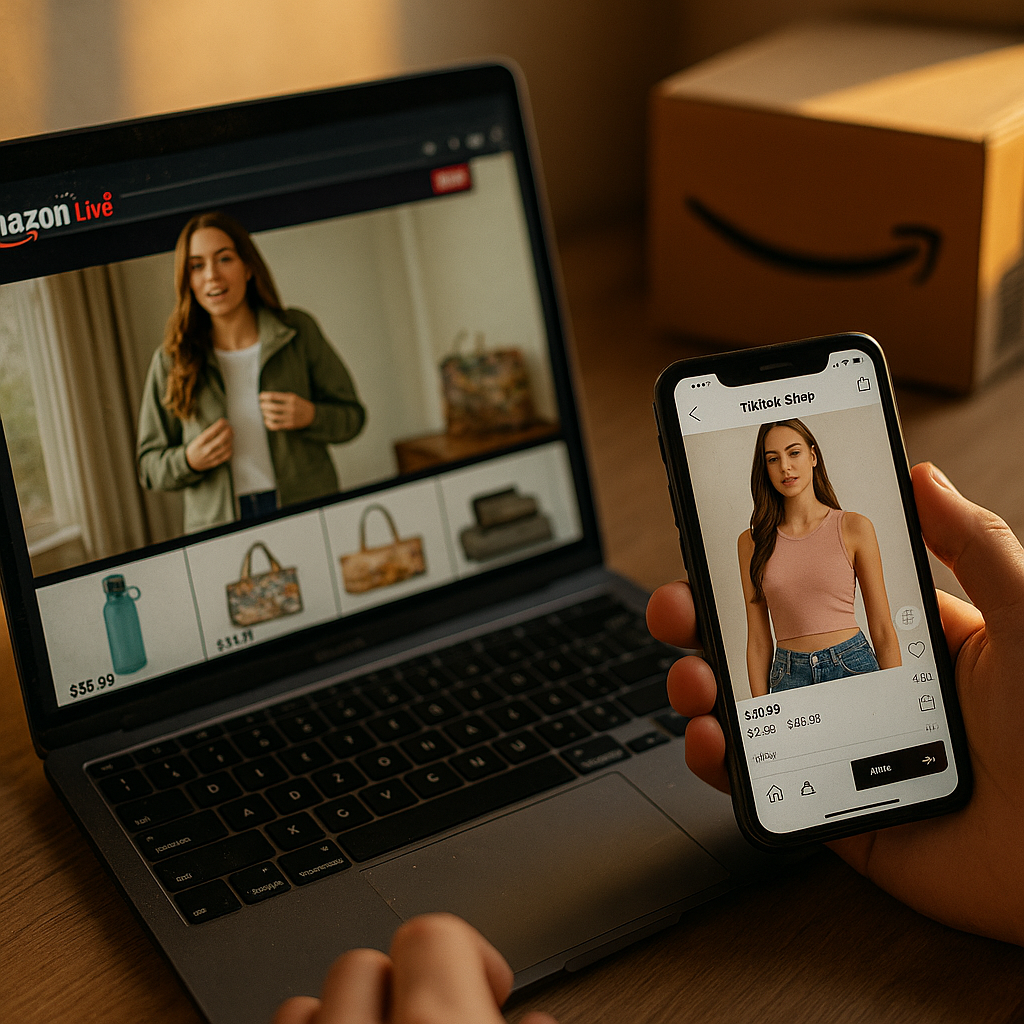
Amazon Live streams get rewatched an average of 3 to 5 times before purchase, according to seller data shared across Amazon’s advertising forums, yet most brands treat their broadcasts like disposable TikTok Lives: one take, one push, then silence. That’s the gap. While TikTok Shop chases velocity, Amazon Live rewards brands that build content designed to run for months, not minutes. If your team is still thinking “live event” instead of “evergreen loop,” you’re leaving conversion on the table.
Why Amazon Live Still Matters When TikTok Shop Gets All the Headlines
TikTok Shop dominates trade press for good reason. It’s fast, it’s algorithmically generous to new creators, and it turns impulse into checkout in under a minute. But speed cuts both ways. Content decays quickly, creator fees fluctuate, and platform policy shifts (like the recent AI-generated video restrictions) can upend a whole content pipeline overnight.
Amazon Live operates on a different clock. Streams live permanently on product detail pages, in the Amazon Live storefront, and inside the Amazon Shopping app’s video carousel. That means a well-built demo isn’t a campaign asset with a two-week shelf life. It’s closer to owned media: a permanent fixture next to your buy box that keeps working while your team focuses elsewhere.
A single Amazon Live recording, structured correctly, can generate impressions and conversions for 12 months or more without a single dollar of incremental ad spend.
That durability matters more as customer acquisition costs climb across every social platform. eMarketer has repeatedly flagged rising CPMs on short-form video as creators and brands compete for the same attention windows. Evergreen Amazon content sidesteps that inflation almost entirely.
The Evergreen Loop: What It Actually Is
An evergreen demo loop is a structured, repeatable video segment (usually 90 seconds to 4 minutes) that answers a single buying objection, then hands off to the next segment. Stitch four or five of these together and you’ve got a stream that can run on autoplay for hours, get clipped into shorter product-page snippets, and still make sense to a viewer who joins mid-stream.
Compare that to a typical TikTok Shop live session, which is built around momentum: countdown drops, flash discounts, real-time chat engagement. That format is powerful for countdown-driven urgency, but it doesn’t survive being rewatched a week later. Nobody wants to watch a stale flash sale.
Amazon Live’s structure forces the opposite discipline. Because the video sits statically on your listing, it needs to answer the same three questions every single viewer has, regardless of when they show up:
- What does this product actually do, shown in real use, not just described?
- What’s the objection a skeptical buyer would raise, and how is it addressed on camera?
- What’s the next step, stated clearly enough that a viewer who tunes in for 20 seconds still knows what to do?
Build a loop around those three beats and you’ve got something that performs whether it’s viewed live, on-demand, or clipped into an ad.
Structuring the Loop: A Practical Framework
Here’s the segment structure that’s worked across seller accounts running consistent Amazon Live programming:
- Hook segment (0:00 to 0:20). State the product category and the single biggest reason people hesitate to buy. Don’t bury this. Amazon’s autoplay preview only shows a few seconds before a viewer scrolls past.
- Demo segment (0:20 to 1:30). Show the product solving the stated problem, hands-on, unedited enough to feel credible. Amazon viewers are shopping with intent already; they don’t need TikTok-style entertainment value, they need proof.
- Objection-handling segment (1:30 to 2:30). Address shipping, sizing, durability, or whatever the top return reason is for that SKU. This is the segment most sellers skip, and it’s the one doing the heaviest lifting on conversion.
- Comparison segment (2:30 to 3:15, optional but powerful). Briefly contrast against a common alternative. This mirrors the approach that’s proven effective in comparison-style video reviews, which consistently outperform pure feature walkthroughs on purchase intent.
- Call-to-action loop close (3:15 to end). Restate the offer, mention any bundle or subscribe-and-save option, then loop back to the hook. The loop structure means viewers who join late still get a full narrative arc within a few minutes.
Once that structure exists, you can record variations for different seasons or promotions and swap segments without rebuilding the entire stream. That modularity is what makes the format genuinely evergreen instead of just “long.”
Metrics That Actually Predict Conversion
Amazon Live’s dashboard reports viewers, follows, and add-to-cart clicks, but the metric that correlates most tightly with sales lift is average watch duration relative to segment length. If viewers consistently drop off right at your objection-handling segment, that segment isn’t doing its job, or it’s addressing the wrong objection entirely.
Pull your return reasons and negative review themes before scripting anything. If “runs small” appears in 20% of your one-star reviews, that’s your objection segment, full stop. Guessing at objections is the single most common reason brands’ Amazon Live content underperforms.
The brands seeing the strongest evergreen performance treat their return-reason data as a script outline, not an afterthought.
Also track where clips get pulled for use elsewhere. A demo segment that performs well on the product page often works as a standalone YouTube Short or Instagram Reel with minimal editing. That’s not a nice-to-have, it’s how you stretch the ROI of a single production day across three distribution channels, an approach similar to the cross-platform efficiency covered in structuring one asset for three platforms.
Where TikTok Shop Still Wins, and How to Borrow From It
Let’s be honest about tradeoffs. TikTok Shop’s algorithm surfaces new content aggressively, and its trust-weighted ranking system means consistent creators get compounding reach. Amazon Live doesn’t have that same discovery engine; most traffic comes from your own product page and existing customer base, not algorithmic surfacing to cold audiences.
The smart move isn’t picking one platform. It’s using TikTok Shop for top-of-funnel discovery and Amazon Live for the bottom-of-funnel close, especially for buyers already comparing options on Amazon. This mirrors the funnel-matching logic outlined in matching format to funnel stage: don’t force one platform’s content style onto a channel with entirely different viewer intent.
You can also borrow TikTok Shop’s affiliate-creator model. Amazon Live allows influencer collaborations through Amazon Influencer Program storefronts, and pairing a creator’s authentic demo style with your evergreen loop structure tends to outperform either approach alone. Just make sure disclosure language is baked into the script itself, not left to chance, the same principle that governs shoppable overlay disclosure sequencing on other platforms. The FTC’s endorsement guidelines apply regardless of which shopping platform hosts the video, so treat disclosure as non-negotiable script real estate.
Common Mistakes That Kill Loop Performance
A few patterns show up repeatedly in underperforming Amazon Live content:
- Treating it as a one-off event. Brands record once, promote hard for a week, then let the video rot with zero updates for a year. Refresh objection segments quarterly at minimum.
- Skipping the comparison segment out of fear. Sellers worry that naming a competitor invites scrutiny. In practice, a brief, factual comparison builds credibility rather than risk.
- Over-editing. Amazon Live viewers expect a slightly rougher, more authentic feel than polished ad creative. Overproduced demos can actually suppress trust signals.
- Ignoring mobile framing. Most Amazon Shopping app traffic is mobile. Test every segment on a phone screen before publishing, not just on a monitor.
None of these are hard fixes. They’re discipline problems, and discipline is exactly what separates evergreen performers from one-hit streams.
Building the Habit, Not Just the Video
The brands winning with Amazon Live aren’t necessarily shooting better video than their competitors. They’re running a repeatable production cadence: quarterly objection audits pulled from return data, modular segment updates, and clip repurposing across owned channels. That operational rhythm is what turns a single demo into a compounding asset instead of a sunk cost.
Tools like HubSpot for tracking attributed conversions and Sprout Social for monitoring cross-platform clip performance can help tie Amazon Live data back into a broader influencer and content reporting stack, so it doesn’t live in a silo separate from your TikTok and YouTube metrics.
FAQ
Frequently Asked Questions
What makes Amazon Live content “evergreen” instead of a typical live stream?
Evergreen Amazon Live content is structured in modular segments (hook, demo, objection-handling, comparison, call-to-action) that make sense whether a viewer watches live or discovers the recording months later. Traditional live streams rely on time-sensitive urgency that doesn’t hold up on replay.
How long should an Amazon Live demo loop be?
Most effective loops run between 3 and 5 minutes total, broken into 20 to 90 second segments. Shorter segments allow viewers who join mid-stream to still get a complete narrative arc quickly.
Can Amazon Live really compete with TikTok Shop’s growth?
Not by matching TikTok Shop’s discovery speed, but by outperforming it on durability. Amazon Live content sits permanently on product pages and continues converting without repeated ad spend, while TikTok Shop content typically requires ongoing creator and promotion investment to stay visible.
Do I need an influencer to run Amazon Live demos?
No, but pairing brand-produced structure with a creator’s on-camera presence through the Amazon Influencer Program often boosts trust and watch time compared to brand-only talent.
How often should evergreen Amazon Live content be refreshed?
Review and update objection-handling segments at least quarterly, using updated return-reason and review data to ensure the content still addresses the most common purchase hesitations.
What FTC considerations apply to Amazon Live disclosures?
Any paid or affiliate relationship shown in an Amazon Live stream must be disclosed clearly and conspicuously, consistent with FTC endorsement guidelines. Disclosure should be scripted into the segment itself rather than added as an afterthought.
Stop treating Amazon Live like a one-time event and start treating it like owned media infrastructure. Build one modular demo loop this quarter, tie it to your actual return-reason data, and measure watch-time drop-off before you scale the format across your catalog.
Top Influencer Marketing Agencies
The leading agencies shaping influencer marketing in 2026
Agencies ranked by campaign performance, client diversity, platform expertise, proven ROI, industry recognition, and client satisfaction. Assessed through verified case studies, reviews, and industry consultations.
Moburst

-
2

The Shelf
Boutique Beauty & Lifestyle Influencer AgencyA data-driven boutique agency specializing exclusively in beauty, wellness, and lifestyle influencer campaigns on Instagram and TikTok. Best for brands already focused on the beauty/personal care space that need curated, aesthetic-driven content.Clients: Pepsi, The Honest Company, Hims, Elf Cosmetics, Pure LeafVisit The Shelf → -
3

Audiencly
Niche Gaming & Esports Influencer AgencyA specialized agency focused exclusively on gaming and esports creators on YouTube, Twitch, and TikTok. Ideal if your campaign is 100% gaming-focused — from game launches to hardware and esports events.Clients: Epic Games, NordVPN, Ubisoft, Wargaming, Tencent GamesVisit Audiencly → -
4

Viral Nation
Global Influencer Marketing & Talent AgencyA dual talent management and marketing agency with proprietary brand safety tools and a global creator network spanning nano-influencers to celebrities across all major platforms.Clients: Meta, Activision Blizzard, Energizer, Aston Martin, WalmartVisit Viral Nation → -
5

The Influencer Marketing Factory
TikTok, Instagram & YouTube CampaignsA full-service agency with strong TikTok expertise, offering end-to-end campaign management from influencer discovery through performance reporting with a focus on platform-native content.Clients: Google, Snapchat, Universal Music, Bumble, YelpVisit TIMF → -
6

NeoReach
Enterprise Analytics & Influencer CampaignsAn enterprise-focused agency combining managed campaigns with a powerful self-service data platform for influencer search, audience analytics, and attribution modeling.Clients: Amazon, Airbnb, Netflix, Honda, The New York TimesVisit NeoReach → -
7

Ubiquitous
Creator-First Marketing PlatformA tech-driven platform combining self-service tools with managed campaign options, emphasizing speed and scalability for brands managing multiple influencer relationships.Clients: Lyft, Disney, Target, American Eagle, NetflixVisit Ubiquitous → -
8

Obviously
Scalable Enterprise Influencer CampaignsA tech-enabled agency built for high-volume campaigns, coordinating hundreds of creators simultaneously with end-to-end logistics, content rights management, and product seeding.Clients: Google, Ulta Beauty, Converse, AmazonVisit Obviously →