


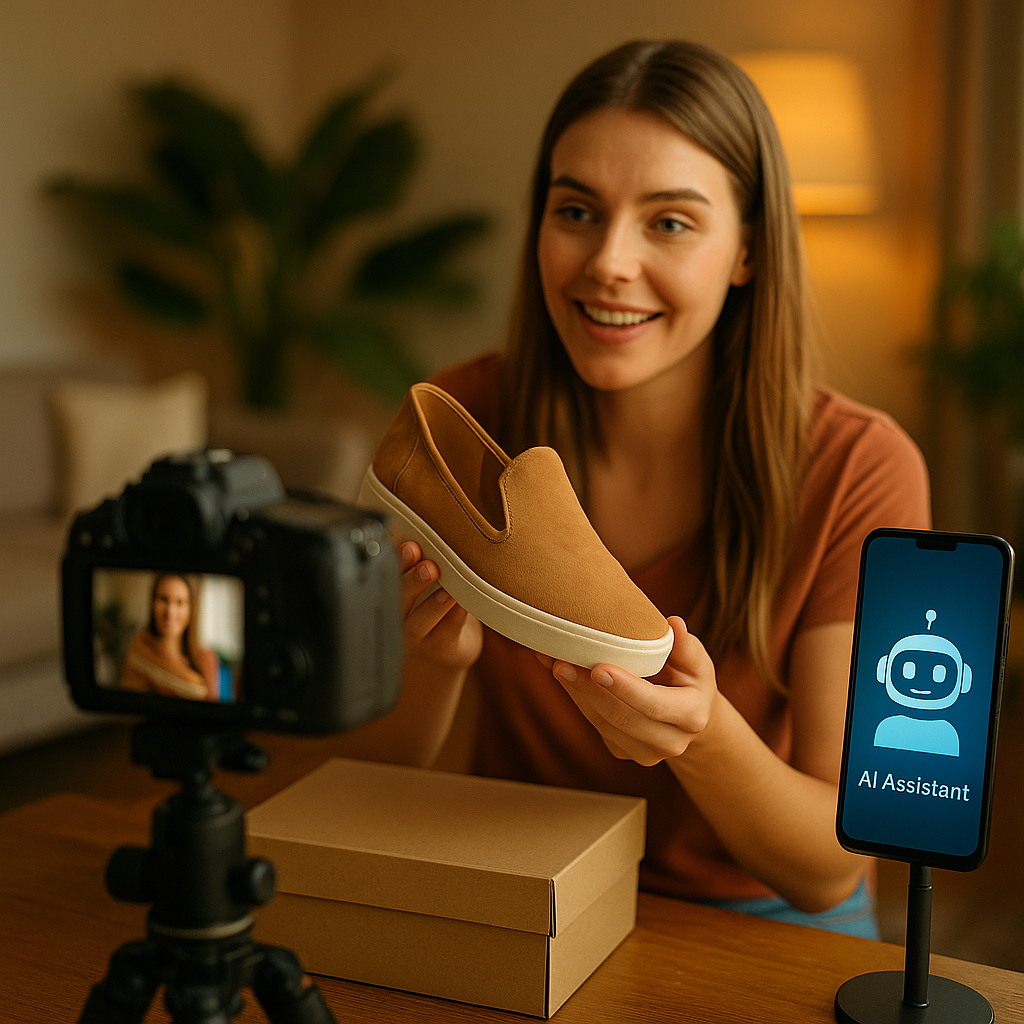
Ask Amazon’s Rufus what serum fixes dull skin and it won’t cite a hashtag. It’ll cite a transcript. That’s the uncomfortable shift facing brands right now: structuring creator video content for AI shopping assistant recommendations has quietly become as important as the content itself. If your creator videos aren’t built for machine comprehension, they’re invisible to the assistants now doing the recommending. This is the operational playbook for fixing that.
Why AI Shopping Assistants Now Decide What Gets Seen
Rufus, Google’s AI Mode, TikTok’s Symphony recommendations, Snapchat’s My AI: these systems don’t scroll a feed the way a human does. They ingest, summarize, and rank. A creator video that used to win on vibes and watch time now competes on whether an AI can extract a clear product claim, a use case, and a confidence signal from it.
This isn’t a niche concern. eMarketer has repeatedly flagged AI-assisted shopping as one of the fastest-growing entry points to purchase, and Google’s own guidance on AI-generated search summaries confirms these systems prioritize structured, unambiguous content over stylistic flourish. If your creator brief still optimizes purely for hook rate in the first three seconds, you’re optimizing for a human feed that’s steadily losing share of discovery.
An AI shopping assistant can’t infer intent from a wink or a trending sound. It needs the claim stated plainly, once, near the top of the transcript.
We covered the retail side of this in getting products into AI shopping carousels, but that piece focused on listings. This one is about the creator video layer, the raw content these assistants scrape, summarize, and cite.
What These Systems Actually Extract From a Video
Strip away the marketing language and here’s what’s actually happening under the hood: a language model transcribes the audio, reads on-screen text via OCR, checks metadata, and cross-references product mentions against a catalog. It then scores the content for relevance, specificity, and consistency with other reviews.
Three things matter most:
- Transcript clarity. Mumbled asides, slang-heavy hooks, and inside jokes don’t transcribe well. Clear, declarative product statements do.
- Repetition and consistency. If a creator calls a product “the blue serum” in one clip and “that vitamin C thing” in another, the assistant struggles to link them to a single SKU.
- On-screen text and captions. Burned-in text acts as a secondary data source. Assistants weight it almost as heavily as spoken audio, especially on TikTok and Reels where auto-captions are inconsistent.
None of this means creator content has to sound robotic. It means the structure underneath the personality needs to be machine-legible, the same way good SEO copy still reads naturally to a human while satisfying a crawler.
The Five-Layer Structure That Gets Creator Content Recommended
Think of this less as a script template and more as a checklist your creator brief should enforce, regardless of platform.
- Product identification, stated once, early. Full product name, brand, and category within the first 10 to 15 seconds. Not buried in a 45-second story intro.
- A single, explicit use case. “This is for oily skin that gets shiny by noon” beats “I’ve been loving this lately.” Specificity is what an AI assistant matches against a shopper’s query.
- A comparative or differentiating claim. Assistants weigh comparative language heavily because it maps directly to how shoppers phrase questions (“what’s better than X for Y”).
- Visual product-in-use proof. Not just a hand holding a box. Close-ups, application shots, or on-screen demonstrations that correlate with the spoken claim strengthen confidence scoring.
- A clean, consistent CTA and disclosure. Ambiguous or missing disclosure doesn’t just create legal exposure, it can suppress a video from being surfaced at all as platforms tighten AI-recommendation eligibility around compliant content.
Brands that have retrofitted older creator briefs around this structure report faster indexing into shopping surfaces and fewer instances of AI assistants misattributing claims to competitor products, a real and growing headache.
Platform Differences Brands Can’t Ignore
The five-layer structure holds across platforms, but the weighting shifts.
TikTok Shop leans heavily on Symphony’s automated tagging, which means product mentions need to sync tightly with the shoppable overlay window. We broke down the mechanics in the TikTok Shop instant-view metric piece, and the same logic applies here: if the spoken claim and the tagged product timestamp don’t align, the AI layer treats the content as low confidence.
Amazon’s ecosystem is arguably the most literal. Its Buy For Me agent and Rufus assistant lean on structured product attributes matched against creator content, which is why the shift we detailed in the Buy For Me AI agent breakdown matters just as much for creator briefs as it does for listing copy.
Snapchat’s My AI operates more conversationally, surfacing creator content in response to direct questions rather than passive scrolling, a dynamic we mapped out in the My AI sponsored recommendations playbook. That means creator videos built for Snapchat need to anticipate question phrasing, not just keyword density.
YouTube’s shoppable overlays add another wrinkle: disclosure timing interacts directly with how the AI layer sequences product cards, a detail covered in the shoppable overlays and disclosure sequencing guide. Get the sequencing wrong and the overlay can appear before the disclosure does, which is a compliance problem waiting to happen.
Compliance Doesn’t Get Easier, It Gets More Automated
Here’s the part legal teams should read twice. AI shopping assistants don’t just surface content, they can also synthesize and paraphrase creator claims into their own summaries. That means a poorly worded creator claim can get amplified and reworded by an AI assistant in ways the original disclosure language never anticipated.
The FTC’s endorsement guidance still applies regardless of who or what is surfacing the content. Brands relying on AI-recommended creator videos should treat disclosure as a structural requirement baked into the video itself, not a caption afterthought that an AI summarizer might strip out entirely.
If your disclosure only lives in a description field, an AI assistant summarizing the video may never surface it. Bake it into the spoken content.
Practically, that means asking creators to verbally state the partnership (“this is a paid partnership with…”) rather than relying solely on platform-native disclosure tags. It’s redundant by design, and redundancy is exactly what protects you when a third-party AI layer is doing the summarizing.
Measuring Whether It’s Actually Working
Traditional creator KPIs (views, engagement rate, watch time) don’t tell you whether an AI assistant is actually surfacing your content. You need a parallel measurement layer.
- Track branded query volume in AI shopping assistants where available (Amazon and Google are beginning to expose partial visibility data to advertisers).
- Monitor referral traffic tagged from AI assistant sessions versus standard social referral, a distinction most analytics stacks now support natively.
- Audit AI-generated summaries periodically by querying assistants directly with category questions and checking whether your creator content, or a competitor’s, gets cited.
Tools like Sprout Social and HubSpot are beginning to layer AI-visibility tracking into their reporting suites, though the category is young enough that manual auditing still catches gaps automated dashboards miss. Expect this to mature fast given how much retail search volume Statista now attributes to AI-assisted discovery.
Worth noting: this same structural discipline pays off even outside AI shopping contexts. The KPI rebuild we outlined in YouTube’s instant play views shift shows how platforms are already forcing brands toward more granular, machine-friendly measurement across the board.
Start with one creator category, rebuild the brief around the five-layer structure, and query the relevant AI assistant weekly to see if visibility shifts. If it doesn’t move in four to six weeks, the structure isn’t the bottleneck, the product claim itself is.
FAQs
What does “structuring creator video content for AI shopping assistants” actually mean?
It means organizing a creator video’s spoken claims, on-screen text, and product identification so AI systems like Rufus, Google AI Mode, or TikTok Symphony can accurately transcribe, summarize, and recommend it during a shopping query.
Do AI shopping assistants prioritize certain platforms over others?
They prioritize structured, well-tagged content regardless of platform, but each system pulls from different data sources: Amazon leans on catalog-matched attributes, TikTok relies on Symphony’s tagging layer, and Snapchat’s My AI responds to conversational query framing.
Does this replace traditional SEO or influencer briefing practices?
No. It layers on top. Traditional engagement metrics still matter for reach, but AI-recommendation structure determines whether that content gets surfaced in assistant-driven shopping moments at all.
How does disclosure factor into AI recommendation eligibility?
Platforms increasingly deprioritize or suppress content with unclear disclosure, and AI summarizers can strip out disclosure language that only exists in captions. Verbal, on-camera disclosure is the safer structural choice.
Can small or mid-sized brands realistically optimize for this?
Yes. The five-layer structure (identification, use case, comparison, visual proof, disclosure) doesn’t require large production budgets, just a disciplined creator brief and a review process before content goes live.
Top Influencer Marketing Agencies
The leading agencies shaping influencer marketing in 2026
Agencies ranked by campaign performance, client diversity, platform expertise, proven ROI, industry recognition, and client satisfaction. Assessed through verified case studies, reviews, and industry consultations.
Moburst

-
2

The Shelf
Boutique Beauty & Lifestyle Influencer AgencyA data-driven boutique agency specializing exclusively in beauty, wellness, and lifestyle influencer campaigns on Instagram and TikTok. Best for brands already focused on the beauty/personal care space that need curated, aesthetic-driven content.Clients: Pepsi, The Honest Company, Hims, Elf Cosmetics, Pure LeafVisit The Shelf → -
3

Audiencly
Niche Gaming & Esports Influencer AgencyA specialized agency focused exclusively on gaming and esports creators on YouTube, Twitch, and TikTok. Ideal if your campaign is 100% gaming-focused — from game launches to hardware and esports events.Clients: Epic Games, NordVPN, Ubisoft, Wargaming, Tencent GamesVisit Audiencly → -
4

Viral Nation
Global Influencer Marketing & Talent AgencyA dual talent management and marketing agency with proprietary brand safety tools and a global creator network spanning nano-influencers to celebrities across all major platforms.Clients: Meta, Activision Blizzard, Energizer, Aston Martin, WalmartVisit Viral Nation → -
5

The Influencer Marketing Factory
TikTok, Instagram & YouTube CampaignsA full-service agency with strong TikTok expertise, offering end-to-end campaign management from influencer discovery through performance reporting with a focus on platform-native content.Clients: Google, Snapchat, Universal Music, Bumble, YelpVisit TIMF → -
6

NeoReach
Enterprise Analytics & Influencer CampaignsAn enterprise-focused agency combining managed campaigns with a powerful self-service data platform for influencer search, audience analytics, and attribution modeling.Clients: Amazon, Airbnb, Netflix, Honda, The New York TimesVisit NeoReach → -
7

Ubiquitous
Creator-First Marketing PlatformA tech-driven platform combining self-service tools with managed campaign options, emphasizing speed and scalability for brands managing multiple influencer relationships.Clients: Lyft, Disney, Target, American Eagle, NetflixVisit Ubiquitous → -
8

Obviously
Scalable Enterprise Influencer CampaignsA tech-enabled agency built for high-volume campaigns, coordinating hundreds of creators simultaneously with end-to-end logistics, content rights management, and product seeding.Clients: Google, Ulta Beauty, Converse, AmazonVisit Obviously →