


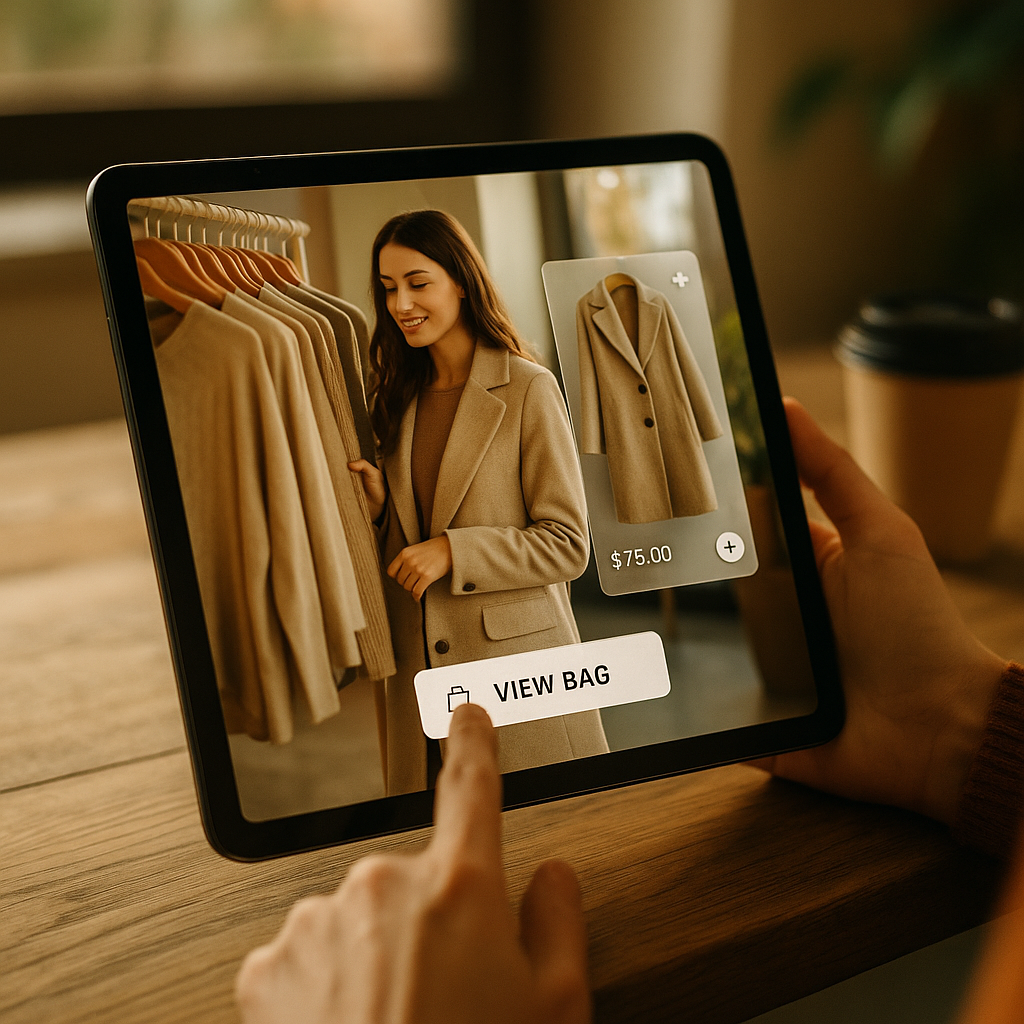
Viewers abandon checkout the moment they leave the video to find a product page. That single click, from watch to search to cart, is where most influencer-driven revenue quietly dies. Shoppable interactive video removes that click entirely, letting someone buy the exact product on screen without ever leaving the content. For brands chasing lower CPMs and cleaner attribution, this format is no longer experimental. It’s becoming table stakes.
What Shoppable Interactive Video Actually Means
Shoppable interactive video is content with embedded, clickable purchase points baked directly into the frame. Think tappable product tags that appear when a creator holds up a jacket, a “buy now” overlay that syncs to the exact second a lipstick shade gets applied, or a branching video where viewers choose which product demo to watch next and land on a cart pre-filled with their pick. Unlike a standard link-in-bio setup, the checkout lives inside the content experience itself.
This isn’t the same as a livestream shopping event, though the two overlap. Livestream shopping is real-time and ephemeral. Shoppable interactive video is typically pre-recorded, evergreen, and built for repeat viewing across TikTok Shop, Instagram Reels, YouTube Shorts, and owned site players. It’s a format, not a channel.
The core value proposition is friction removal: every extra tap between desire and purchase costs you conversion. Interactive video collapses a five-step funnel into one.
Why This Format Matters Right Now
Retail media and social commerce budgets keep climbing, but conversion rates on standard influencer content have plateaued for a lot of brands. eMarketer’s research on social commerce has repeatedly flagged checkout friction as a top reason shoppable content underperforms paid search. Platforms know this too. TikTok Shop, Instagram Checkout, and YouTube’s shopping tags all exist because the platforms are betting that in-content purchase will outperform outbound traffic long term.
There’s also a trust dimension. Shoppers increasingly buy based on creator recommendation rather than brand messaging, and interactive video preserves that creator context all the way through checkout. The product tag appears inside the creator’s voice and framing, not on a sterile product detail page that breaks the spell.
For brands already running affiliate-first product demos, shoppable interactive video is the natural next step. You’ve already got creators demoing product on camera. The format layer just makes that demo directly transactional instead of relying on a swipe-up or bio link.
The Core Format Variants
Not all shoppable interactive video looks the same. Brands should think of it as a family of formats, each suited to different funnel stages and creative constraints.
- Hotspot tagging: Static or moving tap points appear over products as they’re used or worn. Best for demo-heavy content like beauty tutorials or unboxings.
- Timed overlays: A buy button surfaces at a specific timestamp, synced to a key moment (the reveal, the “aha” reaction, the price drop). Works well with price tag flip reveal style content.
- Branching choice video: Viewers pick a path (skin type, budget, use case) and get routed to a tailored product recommendation and cart. Pairs naturally with formats like shoppable quiz videos.
- Shoppable carousel-in-video: A swipeable product rail sits beneath or beside the video player, letting viewers browse the full lineup shown without pausing playback.
- Livestream-to-VOD conversion: A live shopping event gets re-cut into an evergreen shoppable asset, preserving the urgency cues without the live-only constraint. This connects well to restock countdown livestreams that get repurposed after the drop.
Most brands start with hotspot tagging because it requires the least platform integration and the creative brief barely changes from a standard product demo.
How Do You Actually Brief Creators for This?
Here’s where most brands stumble. They treat shoppable interactive video as a post-production add-on rather than something that shapes the shoot itself. That’s backwards. If a creator doesn’t hold the product in frame long enough, or doesn’t verbally cue the moment of use, the interactive tag has nothing to attach to.
A workable brief needs to specify:
- Exact on-screen dwell time for each product (aim for 3 to 5 seconds minimum per SKU).
- Clear framing so tags don’t overlap with faces, text, or fast motion.
- A verbal or visual cue that signals “this is the moment” (a pause, a direct look at camera, a gesture toward the product).
- Multiple product moments if the video covers a routine or a multi-item look, so each item gets its own clean tag window.
This is nearly identical logic to what works in trust-first unboxing briefs and silent store walkthroughs, where the product needs visual clarity without over-scripted delivery. The difference here is that every clean product moment becomes a monetizable checkout point, so the production discipline pays for itself directly in revenue rather than just watch time.
Platform Reality Check
Not every platform supports native shoppable interactivity the same way, and brands need to plan around actual capability rather than assumed capability.
TikTok Shop has the most mature in-app checkout infrastructure right now, with product tags that link directly to catalog listings, per TikTok’s advertising resources. Instagram and Facebook support shoppable tags through Meta’s commerce tools, though the experience varies by market and merchant eligibility. YouTube’s shopping features lean more toward affiliate and product shelf integrations than true in-video hotspots. Owned site players (via tools like Bambuser or Firework) give brands the most creative control but require the most technical lift.
The practical implication: audit your platform mix before you brief the shoot. A branching-choice format built for a custom site player won’t translate cleanly to TikTok’s native tagging system, and you don’t want to discover that after the content is shot and paid for.
Brands that win with this format treat platform capability as a creative constraint from day one, not a distribution afterthought bolted on after editing.
Measuring What Actually Moves
Standard influencer metrics (views, engagement rate, saves) tell you almost nothing about whether shoppable interactive video is working. The metrics that matter here are tap-through rate on individual product tags, add-to-cart rate per SKU shown, and time-to-purchase from first tap. If you can get it, cross-reference which specific product moment in the video drove the tap, not just that a tap happened somewhere in the video.
This granularity is what makes the format valuable for creative testing too. You can A/B test two versions of the same video with different tag placement or timing and see which converts better, something that’s nearly impossible to isolate with traditional link-in-bio tracking. It also plays well with a discovery to conversion content ladder, where the same shoot gets cut into awareness, consideration, and purchase-stage assets, with interactivity added only to the bottom-funnel cut.
For a sanity check on baseline social commerce benchmarks before setting internal KPIs, tools like Sprout Social’s analytics resources and HubSpot’s marketing reports are useful starting points, since in-house benchmarks for a brand-new format rarely exist yet.
Compliance and Disclosure Still Apply
Adding a buy button doesn’t change disclosure obligations. If a creator is compensated or gifted product, the FTC’s endorsement guidance still requires clear, unambiguous disclosure regardless of whether the content is shoppable. Review the FTC’s endorsement guidelines before scaling any interactive format, and for UK-facing campaigns, check ICO guidance on data handling if you’re capturing checkout data through the video player itself. Interactive formats often collect more first-party data than a standard post (clicks, dwell time, cart entries), which raises the compliance stakes rather than lowering them.
Where This Format Fits in a Broader Content Strategy
Shoppable interactive video shouldn’t replace your existing UGC mix. It’s a conversion layer you add to content that’s already performing. A strong UGC storytelling arc or a well-tested three-episode test arc gives you the creative proof points before you invest in tagging infrastructure. Add interactivity once you know the underlying content resonates. Bolting checkout onto mediocre content just gets you a fast, well-tracked path to a low conversion rate.
Next Step
Pick your best-performing existing product demo from the last quarter, add hotspot tags to it using your platform’s native tool, and measure tap-through against the same video’s original click-through rate. That single comparison will tell you more about whether shoppable interactive video is worth scaling than any industry benchmark.
Frequently Asked Questions
What is shoppable interactive video?
It’s video content with embedded, clickable purchase points, such as product tags or timed overlays, that let viewers buy directly within the content without navigating to a separate page.
How is this different from livestream shopping?
Livestream shopping happens in real time and is typically time-limited. Shoppable interactive video is usually pre-recorded and evergreen, designed for repeat viewing across feeds and owned players.
Which platforms support shoppable interactive video natively?
TikTok Shop has the most developed native tagging and checkout system. Instagram and Facebook support commerce tags through Meta’s tools. YouTube leans toward affiliate and product shelf integration rather than in-video hotspots.
Do I need special creator briefing for this format?
Yes. Creators need to hold products in frame for a defined dwell time and provide a clear visual or verbal cue for each product moment, since interactive tags attach to those specific windows in the footage.
What metrics should I track for shoppable interactive video?
Focus on tap-through rate per product tag, add-to-cart rate by SKU, and time-to-purchase after the first tap, rather than generic engagement metrics like views or likes.
Does shoppable interactive video change disclosure requirements?
No. FTC endorsement guidelines still apply regardless of the checkout mechanism. Brands should also review data handling practices, since interactive players often capture more first-party behavioral data than standard posts.
Top Influencer Marketing Agencies
The leading agencies shaping influencer marketing in 2026
Agencies ranked by campaign performance, client diversity, platform expertise, proven ROI, industry recognition, and client satisfaction. Assessed through verified case studies, reviews, and industry consultations.
Moburst

-
2

The Shelf
Boutique Beauty & Lifestyle Influencer AgencyA data-driven boutique agency specializing exclusively in beauty, wellness, and lifestyle influencer campaigns on Instagram and TikTok. Best for brands already focused on the beauty/personal care space that need curated, aesthetic-driven content.Clients: Pepsi, The Honest Company, Hims, Elf Cosmetics, Pure LeafVisit The Shelf → -
3

Audiencly
Niche Gaming & Esports Influencer AgencyA specialized agency focused exclusively on gaming and esports creators on YouTube, Twitch, and TikTok. Ideal if your campaign is 100% gaming-focused — from game launches to hardware and esports events.Clients: Epic Games, NordVPN, Ubisoft, Wargaming, Tencent GamesVisit Audiencly → -
4

Viral Nation
Global Influencer Marketing & Talent AgencyA dual talent management and marketing agency with proprietary brand safety tools and a global creator network spanning nano-influencers to celebrities across all major platforms.Clients: Meta, Activision Blizzard, Energizer, Aston Martin, WalmartVisit Viral Nation → -
5

The Influencer Marketing Factory
TikTok, Instagram & YouTube CampaignsA full-service agency with strong TikTok expertise, offering end-to-end campaign management from influencer discovery through performance reporting with a focus on platform-native content.Clients: Google, Snapchat, Universal Music, Bumble, YelpVisit TIMF → -
6

NeoReach
Enterprise Analytics & Influencer CampaignsAn enterprise-focused agency combining managed campaigns with a powerful self-service data platform for influencer search, audience analytics, and attribution modeling.Clients: Amazon, Airbnb, Netflix, Honda, The New York TimesVisit NeoReach → -
7

Ubiquitous
Creator-First Marketing PlatformA tech-driven platform combining self-service tools with managed campaign options, emphasizing speed and scalability for brands managing multiple influencer relationships.Clients: Lyft, Disney, Target, American Eagle, NetflixVisit Ubiquitous → -
8

Obviously
Scalable Enterprise Influencer CampaignsA tech-enabled agency built for high-volume campaigns, coordinating hundreds of creators simultaneously with end-to-end logistics, content rights management, and product seeding.Clients: Google, Ulta Beauty, Converse, AmazonVisit Obviously →