


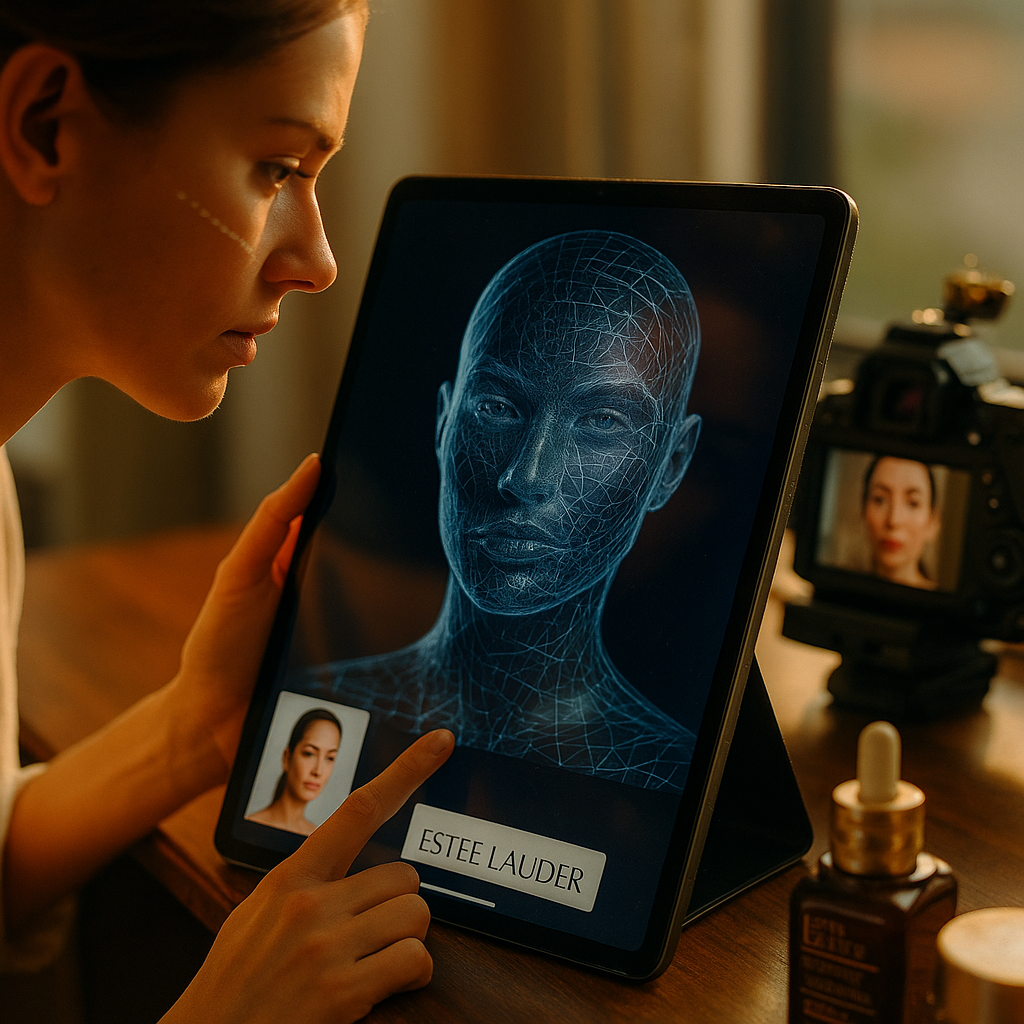
Estee Lauder now runs AI across R&D, supply chain, and marketing under one banner: “AI Everywhere.” If a $100 billion legacy beauty conglomerate is rebuilding its entire operating model around machine learning, the question for every brand strategist watching from the outside isn’t whether to follow. It’s how fast, and where to start. The Estee Lauder AI Everywhere strategy is less a campaign than a blueprint, and beauty marketers who ignore it are leaving efficiency on the table.
AI Everywhere: More Than a Marketing Slogan
Most brands treat AI adoption as a marketing department problem. Buy a chatbot, generate some ad copy, call it innovation. Estee Lauder’s approach is structurally different. The company has positioned AI as a connective layer running through product formulation, demand forecasting, retail media buying, and influencer content operations simultaneously.
That matters because beauty is a uniquely operations-heavy category. You’ve got shade matching, ingredient claims, regulatory review across dozens of markets, and a creator ecosystem that moves faster than any legal team can approve copy. A fragmented AI strategy (one tool for social listening, another for content tagging, a third for media buying) creates data silos that slow everything down. Estee Lauder’s bet is that unifying the stack pays off in speed and consistency, not just cost savings.
The real differentiator isn’t that Estee Lauder uses AI. It’s that the company built one connected system instead of a patchwork of point solutions bolted on department by department.
For brand strategists managing tighter budgets and leaner teams, that’s the actionable lesson. Integration beats accumulation. A dozen disconnected AI tools rarely outperform three well-integrated ones.
Where the AI Actually Touches the Creator Pipeline
Skip the R&D and supply chain applications for a moment. The part that matters most to marketers is what’s happening in creator and content operations, because that’s where budgets live and where ROI gets scrutinized every quarter.
- Creator matching and vetting: Machine learning models score creators against brand fit, audience quality, and historical conversion patterns rather than relying on follower count or gut instinct.
- Content triage at scale: AI tools sort incoming UGC and creator submissions by usability, brand safety, and licensing status before a human ever opens the file.
- Predictive spend allocation: Instead of locking budget to a handful of “hero” creators, models reallocate spend weekly based on real-time engagement and conversion signals.
- Compliance flagging: Automated review checks disclosure language, claims accuracy, and regional regulatory requirements before content goes live.
This isn’t theoretical. Brands like Chipotle have already proven the model at scale. AI-driven UGC sorting cut review time dramatically when the brand faced 200,000 TikTok submissions it simply couldn’t triage manually. Estee Lauder is applying the same logic to a category where claims review carries far more regulatory weight than a burrito bowl campaign ever will.
The parallel to programmatic creator tier matching is worth studying too. Beauty brands running hundreds of micro and nano partnerships face the same matching problem at even higher stakes, since a mismatched creator promoting an actives-heavy skincare line can trigger complaints faster than a snack brand ever would.
Is This Just Automation With Better PR?
Skeptics have a point worth addressing directly. Plenty of “AI transformation” announcements are rebranded automation with a press release attached. So what makes this different, if anything?
The distinction is scope. Estee Lauder isn’t just automating content approval. It’s using AI to close the loop between what creators post, how consumers respond, and how quickly that signal feeds back into media buying and even product development. That closed loop is the part most beauty brands haven’t built yet, and it’s the part that actually produces measurable ROI rather than just operational tidiness.
According to eMarketer, AI-assisted content workflows are becoming standard practice across retail and beauty marketing teams, not a novelty reserved for enterprise budgets. The gap isn’t access to tools anymore. It’s whether a brand has the data infrastructure to connect them meaningfully.
Brands without that infrastructure end up with what one skincare marketing lead described as “smart tools making dumb decisions in isolation.” The lakehouse approach to proving creator ROI is a useful reference point here: the underlying data architecture matters more than any single AI feature sitting on top of it.
What Mid-Market Beauty Brands Can Steal From This Playbook
You don’t need Estee Lauder’s budget to apply the same principles. You need discipline about where AI actually earns its keep in your operation.
- Start with content triage, not content creation. The fastest ROI usually comes from cutting review time on incoming creator submissions, not from generating new assets.
- Build compliance checks into the workflow, not after it. Beauty claims regulation varies by market, and retroactive fixes cost more than upfront automation. The FTC’s endorsement guidelines are a useful baseline for any disclosure logic you’re building.
- Match creators on data, not vibes. Look at what e.l.f. Cosmetics has done with turning UGC into paid ads through whitelisting. It’s a smaller-scale version of exactly what Estee Lauder is doing with predictive spend allocation.
- Treat retail media and creator content as one budget line, not two. The brands winning right now are the ones connecting creator output directly to retail conversion data, similar to how Henkel fuses creator commerce into retail media.
None of this requires a nine-figure AI budget. It requires deciding which manual process is costing you the most hours per week and automating that one first.
The Risks Hiding Inside the Rollout
Nobody talks enough about the failure modes. AI-driven creator matching can quietly homogenize a brand’s content if the model over-indexes on what already performed well, which is a real problem in a category built on individual skin tones, textures, and routines. Beauty audiences notice sameness fast, and they call it out publicly.
There’s also a trust dimension. Consumers are increasingly wary of AI-generated beauty content, particularly around before-and-after claims and virtual try-on accuracy. According to Sprout Social’s research on consumer trust, transparency about AI involvement in marketing content is now a factor in purchase decisions, not just a compliance checkbox. Brands that don’t disclose AI-assisted content risk backlash that outweighs whatever efficiency gains they captured.
Efficiency gains mean nothing if the audience stops trusting what they’re seeing. Beauty brands scaling AI need a disclosure standard as rigorous as their approval workflow.
Finally, there’s the talent question. AI can sort, score, and predict, but it can’t replace the human judgment that spots a rising creator before the data catches up. The most durable strategies pair AI triage with human relationship management, treating creators as long-term partners rather than line items, the way Alo Yoga structures its creator payments.
The Estee Lauder AI Everywhere strategy is a signal, not a template to copy line for line. Start by automating the single highest-volume manual task in your creator workflow, measure the time saved, and reinvest that capacity into the human relationships AI still can’t replicate.
FAQs
What is Estee Lauder’s AI Everywhere strategy?
It’s an internal initiative that applies artificial intelligence across the company’s operations, including product development, supply chain forecasting, marketing personalization, and creator content management, rather than confining AI to a single department.
How can smaller beauty brands apply this without a large budget?
Start with one high-friction process, usually content triage or creator vetting, and automate that first. Building a unified data foundation matters more than buying multiple disconnected AI tools.
Does AI reduce the need for human creator managers?
No. AI handles sorting, scoring, and predictive allocation well, but relationship management, brand voice judgment, and long-term partnership building still require human oversight.
What compliance risks come with AI-driven creator content?
The main risks involve disclosure accuracy, claims substantiation across regulatory markets, and consumer trust if AI involvement in content isn’t clearly communicated. Reviewing FTC endorsement guidance is a reasonable starting point.
How does AI creator matching differ from traditional influencer vetting?
Traditional vetting relies heavily on follower counts and manual review. AI matching scores creators against historical conversion data, audience quality signals, and brand fit patterns, allowing faster and more consistent decisions at scale.
Top Influencer Marketing Agencies
The leading agencies shaping influencer marketing in 2026
Agencies ranked by campaign performance, client diversity, platform expertise, proven ROI, industry recognition, and client satisfaction. Assessed through verified case studies, reviews, and industry consultations.
Moburst

-
2

The Shelf
Boutique Beauty & Lifestyle Influencer AgencyA data-driven boutique agency specializing exclusively in beauty, wellness, and lifestyle influencer campaigns on Instagram and TikTok. Best for brands already focused on the beauty/personal care space that need curated, aesthetic-driven content.Clients: Pepsi, The Honest Company, Hims, Elf Cosmetics, Pure LeafVisit The Shelf → -
3

Audiencly
Niche Gaming & Esports Influencer AgencyA specialized agency focused exclusively on gaming and esports creators on YouTube, Twitch, and TikTok. Ideal if your campaign is 100% gaming-focused — from game launches to hardware and esports events.Clients: Epic Games, NordVPN, Ubisoft, Wargaming, Tencent GamesVisit Audiencly → -
4

Viral Nation
Global Influencer Marketing & Talent AgencyA dual talent management and marketing agency with proprietary brand safety tools and a global creator network spanning nano-influencers to celebrities across all major platforms.Clients: Meta, Activision Blizzard, Energizer, Aston Martin, WalmartVisit Viral Nation → -
5

The Influencer Marketing Factory
TikTok, Instagram & YouTube CampaignsA full-service agency with strong TikTok expertise, offering end-to-end campaign management from influencer discovery through performance reporting with a focus on platform-native content.Clients: Google, Snapchat, Universal Music, Bumble, YelpVisit TIMF → -
6

NeoReach
Enterprise Analytics & Influencer CampaignsAn enterprise-focused agency combining managed campaigns with a powerful self-service data platform for influencer search, audience analytics, and attribution modeling.Clients: Amazon, Airbnb, Netflix, Honda, The New York TimesVisit NeoReach → -
7

Ubiquitous
Creator-First Marketing PlatformA tech-driven platform combining self-service tools with managed campaign options, emphasizing speed and scalability for brands managing multiple influencer relationships.Clients: Lyft, Disney, Target, American Eagle, NetflixVisit Ubiquitous → -
8

Obviously
Scalable Enterprise Influencer CampaignsA tech-enabled agency built for high-volume campaigns, coordinating hundreds of creators simultaneously with end-to-end logistics, content rights management, and product seeding.Clients: Google, Ulta Beauty, Converse, AmazonVisit Obviously →