


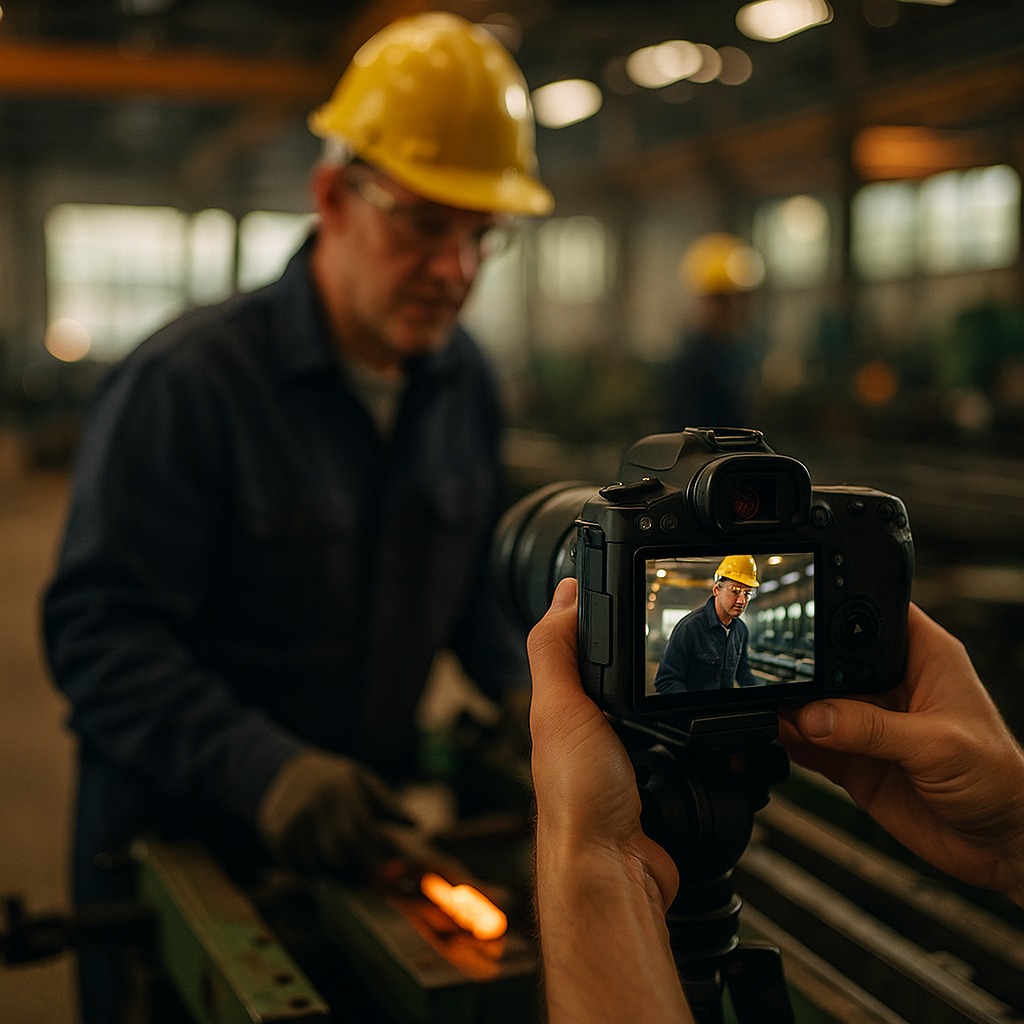
Only 34% of B2B buyers say they fully trust supplier claims about sourcing and production, according to research cited by eMarketer. So what happens when a brand stops describing its supply chain and starts filming it? Manufacturing content, raw, unscripted footage of factory floors, quality checks, and shipping docks, is quietly becoming the highest-trust format in B2B marketing. It works because it can’t be faked as easily as a claim on a landing page.
The Trust Gap That Started This Format
Every procurement team has been burned once. A supplier promised ethical sourcing, on-time delivery, or ISO-certified quality, and the reality didn’t match the pitch deck. That history makes buyers skeptical of anything that sounds like marketing copy. Certifications get photocopied. Sustainability claims get recycled across a dozen competitors’ websites with nearly identical language.
Video changes the calculus. A three-minute walkthrough of an actual production line, shot with visible timestamps, real employees, and unpolished lighting, reads as evidence rather than assertion. It’s the same psychological shift that made unboxing videos more persuasive than product photography a decade ago. Buyers don’t want to be told. They want to see it happen.
Manufacturing content works precisely because it looks unfinished. The moment it feels like a commercial, buyers stop trusting it.
What Manufacturing Content Actually Looks Like
This isn’t corporate video with a voiceover and stock music. The format that performs sits closer to a documentary clip than an ad. Think handheld footage of a quality inspector rejecting a defective part, a warehouse manager scanning inventory in real time, or a plant supervisor explaining a bottleneck fix on camera without a script.
- Process transparency clips: short segments showing raw material intake through final packaging, often stitched into a single linear sequence.
- Employee-led walkthroughs: line workers or engineers narrating their own station, which reads as more credible than executive talking heads.
- Third-party audit footage: cameras present during compliance inspections or certification renewals, published with minimal editing.
- Problem-and-fix segments: brands showing a defect, delay, or recall response and how it was resolved. Counterintuitively, these build more trust than flawless footage.
The format overlaps with what worked in ingredient deep dive videos, where brands proved formulation claims with lab footage instead of marketing copy. Manufacturing content just extends that logic upstream, into the plant itself.
Why This Beats a Glossy Corporate Video Every Time
Polished production actually hurts credibility in this category. A 2024 Sprout Social analysis of B2B video engagement found that lower-production, authentic-feeling clips consistently outperformed studio-shot content on watch-through rate, particularly among procurement and operations audiences. The reasoning tracks: a heavily produced video signals that someone had time to script and control the message. A shaky iPhone clip from a plant floor signals the opposite, and that’s exactly what buyers are looking for.
There’s also a practical budget angle here that agencies underplay. Manufacturing content is cheap to produce relative to its trust yield. No studio, no talent fees beyond a modest stipend for employees on camera, no elaborate set design. A single day on-site with a two-person crew can generate a quarter’s worth of assets across LinkedIn, sales enablement decks, and RFP responses.
Building the Brief Without Overproducing It
The single biggest mistake brands make is handing this to a creative team that defaults to polish. A brief for manufacturing content needs guardrails that protect authenticity as deliberately as any other format protects brand safety.
- Lock the camera style early. Handheld or fixed-angle, natural light, minimal color grading. Any hint of cinematic lighting undercuts the format’s core value.
- Script the constraints, not the dialogue. Give employees talking points, not lines. Overly rehearsed answers immediately signal staged content, the same trap that undermines street interview ad briefs when responses sound too polished.
- Include the messy parts. A rejected batch, a delayed shipment being rerouted, a machine being recalibrated. These moments do more for trust than a perfect run.
- Keep segments short. Three to five minutes per clip, broken into modular cuts for different channels: LinkedIn, sales decks, trade show loops, and RFP appendices.
Brands running multi-touch B2B campaigns have found success layering this format into broader content architecture, similar to the approach outlined in the three layer video stack, where raw trust-building footage sits alongside more polished conversion assets rather than replacing them entirely.
Compliance Is Not Optional Here
Showing your supply chain on camera means showing your suppliers’ facilities, employees, and sometimes proprietary processes on camera too. That creates real legal exposure if it’s not managed carefully. Get signed releases from every employee filmed, verify NDAs don’t restrict facility footage, and confirm with legal that no competitive-sensitive process details are visible in frame.
There’s also a disclosure dimension. If a third-party creator or influencer is producing manufacturing content on behalf of a brand, whether it’s a factory tour vlogger or a trade publication sponsorship, FTC guidance on material connections still applies. The same disclosure logic that governs sponsored product reviews governs sponsored plant tours. Brands that skip this step risk both regulatory penalties and the exact credibility loss the format was supposed to prevent.
The irony of manufacturing content is that the format built to prove honesty is also the format most easily undermined by hidden sponsorship or selective editing. Treat disclosure as part of the trust proposition, not a legal afterthought.
Brands operating internationally should also loop in region-specific guidance. The ICO in the UK, for example, has separate expectations around filming employees and data handling that differ from U.S. requirements.
Where This Format Fits in the Buyer Journey
Manufacturing content rarely works as a cold-traffic acquisition tool. It’s a mid-to-late-funnel asset, deployed after a prospect has expressed interest but before contract signing. Sales teams increasingly embed these clips directly into proposal decks and RFP responses, replacing static compliance documents with two-minute video evidence.
It also performs well at events. Brands filming their own production lines have started pairing that footage with live coverage strategies similar to trade show micro vlogs, giving prospects a two-part narrative: here’s the chaos of the show floor, and here’s the calm precision behind the product on display. For bigger reveals tied to new product lines, some manufacturers coordinate release timing with broader product launch simulcasts, using factory footage as proof-of-capacity content that reinforces the launch claims.
According to HubSpot research on B2B content consumption, buyers watch an average of more than four pieces of vendor-produced content before engaging sales, and video consistently ranks as the most-trusted format among those touchpoints. Manufacturing content slots directly into that consumption pattern, giving procurement teams something concrete to reference internally when building the case for a vendor switch.
Measuring Whether It’s Actually Working
Standard engagement metrics undersell this format. Watch-through rate matters, but the more useful signals are downstream: sales cycle length on deals where manufacturing content was shared, RFP win rate when video replaces static compliance PDFs, and direct sales rep feedback on whether prospects reference specific footage in follow-up calls. Track these quarterly rather than per-post, since the format’s value compounds over a longer consideration window than typical social content.
Data from Statista on B2B buying behavior consistently shows procurement decisions involve more stakeholders and longer timelines than consumer purchases, which means a single viral clip won’t move the needle. Consistency does. Brands publishing quarterly manufacturing updates build a library that sales can pull from indefinitely, turning a one-time production cost into a compounding asset.
Start small: pick one production line, one honest problem-and-fix story, and one employee willing to talk on camera without a script. That single clip, done right, will do more for supply chain trust than another glossy sustainability report ever could.
FAQs
What is manufacturing content in a B2B marketing context?
Manufacturing content refers to raw or lightly edited video footage showing actual production processes, quality checks, and supply chain operations, used to build buyer trust through visible evidence rather than written claims.
Why does unpolished footage perform better than studio production for this format?
Buyers associate high production value with scripted marketing messaging. Unpolished, handheld footage signals authenticity and reduces the perception that content was staged to hide problems.
Do employees need to sign releases before appearing in manufacturing content?
Yes. Any employee, contractor, or facility partner appearing on camera should sign a release, and legal teams should confirm the footage doesn’t violate existing NDAs or expose proprietary processes.
Does FTC disclosure guidance apply to sponsored factory tour content?
Yes. If a third-party creator or influencer produces manufacturing content on a brand’s behalf, standard material connection disclosure rules apply the same way they would for any sponsored review.
Where does manufacturing content fit in the sales funnel?
It performs best in mid-to-late funnel stages, particularly embedded in RFP responses, sales proposal decks, and post-trade-show follow-up sequences rather than as a cold-traffic acquisition asset.
How should brands measure the ROI of manufacturing content?
Track sales cycle length, RFP win rates on deals that included the content, and direct feedback from sales reps about whether prospects referenced the footage, rather than relying solely on social engagement metrics.
Top Influencer Marketing Agencies
The leading agencies shaping influencer marketing in 2026
Agencies ranked by campaign performance, client diversity, platform expertise, proven ROI, industry recognition, and client satisfaction. Assessed through verified case studies, reviews, and industry consultations.
Moburst

-
2

The Shelf
Boutique Beauty & Lifestyle Influencer AgencyA data-driven boutique agency specializing exclusively in beauty, wellness, and lifestyle influencer campaigns on Instagram and TikTok. Best for brands already focused on the beauty/personal care space that need curated, aesthetic-driven content.Clients: Pepsi, The Honest Company, Hims, Elf Cosmetics, Pure LeafVisit The Shelf → -
3

Audiencly
Niche Gaming & Esports Influencer AgencyA specialized agency focused exclusively on gaming and esports creators on YouTube, Twitch, and TikTok. Ideal if your campaign is 100% gaming-focused — from game launches to hardware and esports events.Clients: Epic Games, NordVPN, Ubisoft, Wargaming, Tencent GamesVisit Audiencly → -
4

Viral Nation
Global Influencer Marketing & Talent AgencyA dual talent management and marketing agency with proprietary brand safety tools and a global creator network spanning nano-influencers to celebrities across all major platforms.Clients: Meta, Activision Blizzard, Energizer, Aston Martin, WalmartVisit Viral Nation → -
5

The Influencer Marketing Factory
TikTok, Instagram & YouTube CampaignsA full-service agency with strong TikTok expertise, offering end-to-end campaign management from influencer discovery through performance reporting with a focus on platform-native content.Clients: Google, Snapchat, Universal Music, Bumble, YelpVisit TIMF → -
6

NeoReach
Enterprise Analytics & Influencer CampaignsAn enterprise-focused agency combining managed campaigns with a powerful self-service data platform for influencer search, audience analytics, and attribution modeling.Clients: Amazon, Airbnb, Netflix, Honda, The New York TimesVisit NeoReach → -
7

Ubiquitous
Creator-First Marketing PlatformA tech-driven platform combining self-service tools with managed campaign options, emphasizing speed and scalability for brands managing multiple influencer relationships.Clients: Lyft, Disney, Target, American Eagle, NetflixVisit Ubiquitous → -
8

Obviously
Scalable Enterprise Influencer CampaignsA tech-enabled agency built for high-volume campaigns, coordinating hundreds of creators simultaneously with end-to-end logistics, content rights management, and product seeding.Clients: Google, Ulta Beauty, Converse, AmazonVisit Obviously →