


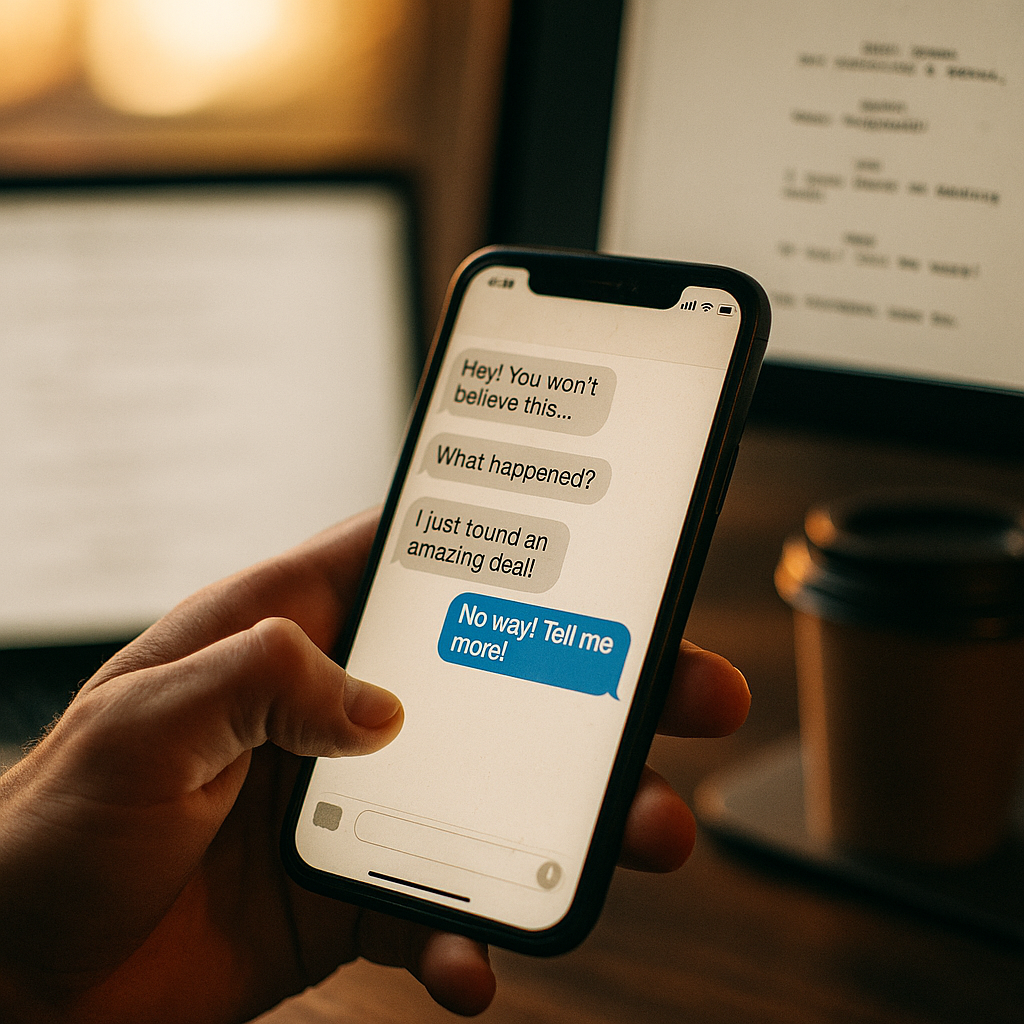
Scroll speed on Stories is brutal: users decide to skip in under half a second, per eMarketer engagement research. Yet a fake text thread, screen recorded and dropped into a Story, routinely earns full watch-throughs. Why? Because text message story ads don’t look like ads. They look like a screenshot your friend forgot to delete. That illusion of intimacy is the entire format, and scripting it wrong is the fastest way to torch the trust it’s built on.
What Text Message Story Ads Actually Are
The format is simple on the surface: a screen recording of an iMessage or WhatsApp thread, usually between two “friends,” discussing a product discovery. Bubbles pop up in real time. Typing indicators pulse. Someone sends a link. The recipient reacts. It plays like a private conversation the viewer happens to be watching over someone’s shoulder.
What makes it convert isn’t novelty anymore, it’s familiarity. Every viewer has sent a message exactly like the one on screen. That shared visual language does the persuasion work that a polished ad script can’t.
The format’s entire conversion advantage rests on one thing: it must never look produced. The moment a viewer clocks it as an ad script, the trust mechanic collapses.
Why Brands Are Shifting Budget Into the Format
Screen recording formats sit in a strange, useful zone between UGC and native platform behavior. They’re cheap to produce, don’t require a studio, and can be scripted in a Google Doc in under twenty minutes. For brands running high volume creator programs, that’s a meaningful operational win. No lighting setup, no b roll, no edit bay. Just two phones, a script, and a screen recorder.
They also solve a specific problem: banner blindness inside Stories. Viewers have learned to skip anything that looks like a testimonial or a product shot. A text thread doesn’t trigger that pattern recognition, at least not yet. That’s a shelf life worth acknowledging, more on that later.
Scripting the Thread: The Beats That Actually Convert
A converting text thread follows a rhythm closer to a sitcom cold open than a sales pitch. Here’s the structure that keeps performing across brand tests:
- The trigger message. One friend brings up a problem, not a product. “ok why is my skin so dry lately” beats “have you tried this serum” every time.
- The casual recommendation. The second friend name drops the product like it’s common knowledge, not a discovery. Underselling is the move here.
- The skepticism beat. A short pushback, “isn’t that expensive” or “does it actually work,” mirrors the viewer’s internal objection before they can raise it themselves.
- The proof point. A quick, specific detail. Not “it’s amazing” but “it fixed my flaky patches in like four days.”
- The link drop. The share happens almost as an afterthought, often with a lowercase “here” or a shortened URL, never a polished CTA.
Notice what’s missing: no brand voice, no feature list, no urgency language. The moment the copy sounds like marketing, the format’s core advantage disappears.
Pacing Is a Script Decision, Not an Editing Afterthought
Typing indicators and delayed bubbles aren’t cosmetic, they’re pacing tools. A three second typing pause before the punchline message builds the same anticipation a jump cut does in traditional video. Script the pauses explicitly. Note them in the brief the way you’d note a beat change in a text overlay meme script, because timing carries as much weight as the words themselves.
Most brands underuse this. They write the dialogue and let the creator “figure out the timing” during recording. That’s a mistake. Inconsistent pacing is the single biggest tell that a thread was scripted, and once viewers sense a script, engagement drops fast.
Casting Two Voices That Actually Sound Like Friends
The dialogue needs asymmetry. If both texters sound like copywriters, the illusion breaks immediately. Write one voice more clipped and reactive, the other more detailed and enthusiastic. Real friend group texts have uneven energy: one person always types in full sentences, the other in fragments and lowercase.
Brief creators to record their own natural typing habits rather than reading a rigid script verbatim. Give them the beats, not the exact words. This is the same principle that makes versus format scripts land: structure over verbatim dialogue keeps the format feeling unscripted even when it’s tightly directed.
Where This Format Sits in a Broader Story Ad Stack
Text message threads rarely work best as a standalone unit. They perform strongest as the opener in a sequence, followed by a product demo or a shoppable overlay that captures the intent the thread just built. Think of the text thread as the hook and the second Story as the close.
Some brands are pairing the format with poll and reaction overlays to capture a soft engagement signal before pushing to checkout. Others use it as episode one in a cliffhanger series, ending the thread on an unanswered question that resolves in the next Story. Either approach turns a single conversion moment into a sequence with multiple chances to close.
Compliance: The Part Brands Keep Skimming
Here’s the tension nobody wants to script around: the format’s power comes from looking undisclosed, but that’s exactly what regulators are watching for. The FTC’s endorsement guidelines require clear disclosure when a post is sponsored, regardless of how organic it looks. A fake text thread implying a genuine, unpaid recommendation between friends is a compliance risk if there’s no disclosure baked in.
The fix isn’t complicated, it just requires discipline. Add a disclosure text bubble or sticker before the payoff message, or use platform native paid partnership tags. Yes, it slightly dents the illusion. It’s still non-negotiable. Brands that skip this step are gambling with the same exposure covered in our FTC compliance breakdown for before and after content, and the enforcement risk is not hypothetical.
A text thread ad without disclosure isn’t clever creative, it’s an undisclosed endorsement wearing a friendly font. Build the disclosure into the script, not as an afterthought slapped on before publishing.
Measuring What Actually Moves: Beyond Watch Time
Standard video metrics undersell this format. Watch time matters less here than replay rate and screenshot shares, since the entire premise depends on viewers believing it’s worth forwarding to a friend, the same behavior the fake thread depicts. Track saves and shares as leading indicators, not just completion rate.
Platforms like TikTok Ads Manager and Meta Business Suite both surface share and save metrics separately from view counts, and both should be pulled into your reporting dashboard for this format specifically. If your agency is still reporting primarily on CPM and completion rate for text thread creative, you’re measuring the wrong layer of the funnel.
Benchmark against your existing UGC baseline, not against polished brand video. Per Sprout Social’s creator content research, low fidelity, high authenticity formats consistently outperform studio quality assets on save rate, which is exactly the metric this format is built to win.
Common Scripting Mistakes That Kill the Illusion
- Perfect grammar. Real texts have typos, missing punctuation, and abbreviations. Scrub the polish out.
- Brand name repetition. Friends don’t say the full product name twice in six messages. Once is plenty.
- Overlong messages. Real texts are short and fragmented, not paragraph blocks.
- No objection beat. Skipping the skepticism line makes the thread read as an ad, because real friends push back.
- Static timing. Uniform pacing between bubbles is a dead giveaway of a scripted recording.
If you’re running this across a multi platform strategy, worth reviewing how it fits into a layered video approach so text threads aren’t competing with heavier production assets for the same placement.
How Long Does This Format’s Advantage Last?
Fair question, and worth answering honestly. Formats that rely on audience unfamiliarity have a shelf life. As more brands adopt fake text threads, viewer pattern recognition catches up, the same arc that played out with founder testimonial videos and unboxing content. Expect performance to soften over the next several quarters as saturation increases. That’s not a reason to skip it now, it’s a reason to pair it with disclosure discipline and strong measurement so you’re not blindsided when engagement normalizes.
Brands scripting interactive AI chat overlays are already exploring the next evolution of this mechanic, layering in real time viewer response rather than a purely scripted thread. Worth watching as the format matures.
The Next Step
Script the objection beat, disclose clearly, and measure saves before watch time. That’s the difference between a text message story ad that converts and one that just looks like a screenshot nobody asked for.
FAQs
What makes text message story ads different from regular UGC video?
The format mimics a private conversation rather than a direct address to camera, which lowers viewer defenses and increases perceived authenticity compared to standard testimonial style UGC.
Do text message story ads need FTC disclosure?
Yes. If the thread is sponsored or scripted by a brand, it requires clear disclosure per FTC endorsement guidelines, even though the format is designed to look like an organic exchange between friends.
What’s the ideal length for a text thread ad?
Most high performing threads run between eight and fourteen messages, long enough to include a trigger, objection, and proof point but short enough to hold attention within a fifteen second Story slot.
Which metrics matter most for this format?
Save rate and share rate matter more than completion rate, since the format’s core value is believability worth forwarding, not just watch time.
Can this format work for B2B brands?
Yes, particularly for software or service products where a colleague to colleague recommendation thread mirrors real workplace Slack or text conversations about tools and vendors.
Top Influencer Marketing Agencies
The leading agencies shaping influencer marketing in 2026
Agencies ranked by campaign performance, client diversity, platform expertise, proven ROI, industry recognition, and client satisfaction. Assessed through verified case studies, reviews, and industry consultations.
Moburst

-
2

The Shelf
Boutique Beauty & Lifestyle Influencer AgencyA data-driven boutique agency specializing exclusively in beauty, wellness, and lifestyle influencer campaigns on Instagram and TikTok. Best for brands already focused on the beauty/personal care space that need curated, aesthetic-driven content.Clients: Pepsi, The Honest Company, Hims, Elf Cosmetics, Pure LeafVisit The Shelf → -
3

Audiencly
Niche Gaming & Esports Influencer AgencyA specialized agency focused exclusively on gaming and esports creators on YouTube, Twitch, and TikTok. Ideal if your campaign is 100% gaming-focused — from game launches to hardware and esports events.Clients: Epic Games, NordVPN, Ubisoft, Wargaming, Tencent GamesVisit Audiencly → -
4

Viral Nation
Global Influencer Marketing & Talent AgencyA dual talent management and marketing agency with proprietary brand safety tools and a global creator network spanning nano-influencers to celebrities across all major platforms.Clients: Meta, Activision Blizzard, Energizer, Aston Martin, WalmartVisit Viral Nation → -
5

The Influencer Marketing Factory
TikTok, Instagram & YouTube CampaignsA full-service agency with strong TikTok expertise, offering end-to-end campaign management from influencer discovery through performance reporting with a focus on platform-native content.Clients: Google, Snapchat, Universal Music, Bumble, YelpVisit TIMF → -
6

NeoReach
Enterprise Analytics & Influencer CampaignsAn enterprise-focused agency combining managed campaigns with a powerful self-service data platform for influencer search, audience analytics, and attribution modeling.Clients: Amazon, Airbnb, Netflix, Honda, The New York TimesVisit NeoReach → -
7

Ubiquitous
Creator-First Marketing PlatformA tech-driven platform combining self-service tools with managed campaign options, emphasizing speed and scalability for brands managing multiple influencer relationships.Clients: Lyft, Disney, Target, American Eagle, NetflixVisit Ubiquitous → -
8

Obviously
Scalable Enterprise Influencer CampaignsA tech-enabled agency built for high-volume campaigns, coordinating hundreds of creators simultaneously with end-to-end logistics, content rights management, and product seeding.Clients: Google, Ulta Beauty, Converse, AmazonVisit Obviously →