


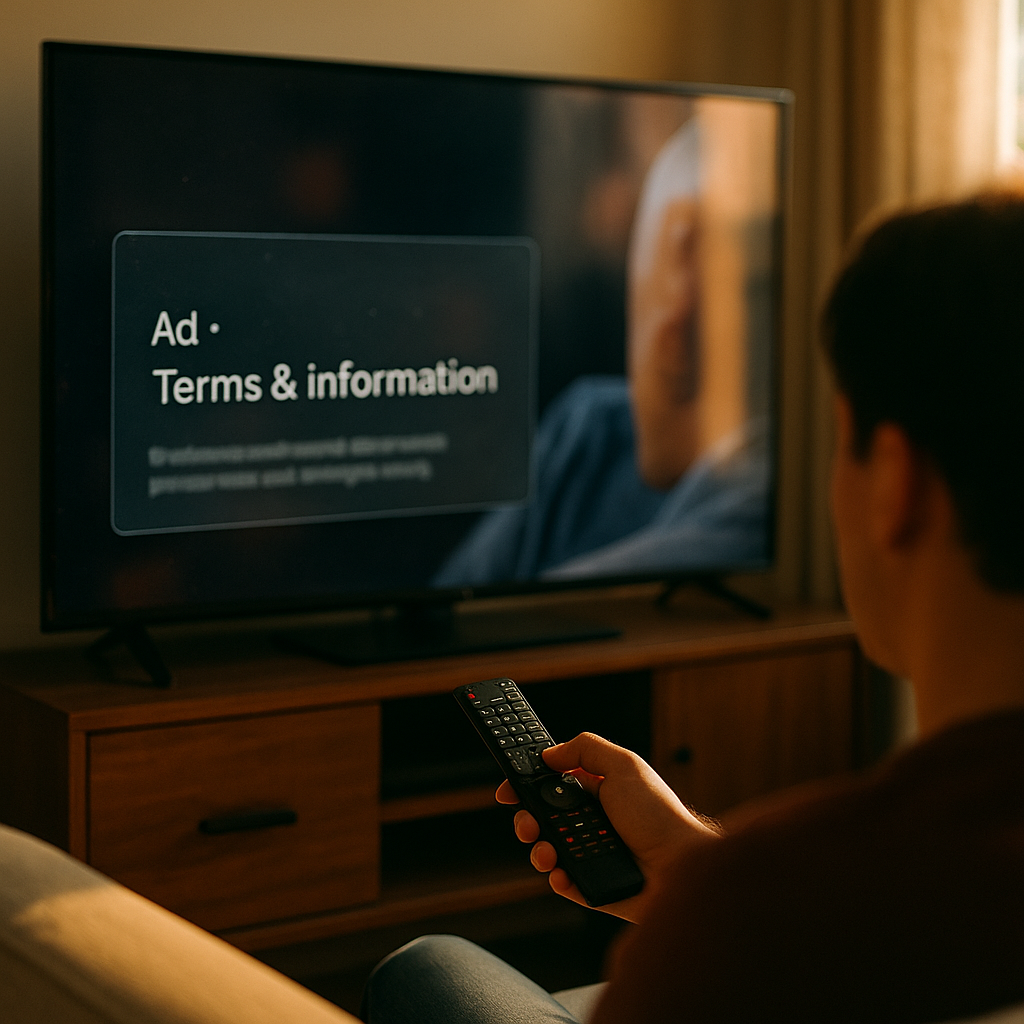
Connected TV just crossed a threshold most marketers missed: creator-hosted ads on streaming platforms now reach more households than traditional cable spots in several key demos, according to eMarketer viewership data. That growth has a downside. Connected TV ad disclosure expectations from the FTC haven’t caught up in public awareness, and brands running creator spots on Roku, Hulu, or Samsung TV Plus are exposed in ways their social campaigns aren’t.
The Format Changed, the Rules Didn’t
Here’s the thing nobody wants to say out loud: the FTC doesn’t have a separate rulebook for CTV. The same Endorsement Guides that govern a TikTok post govern a 30-second creator spot running before a true-crime documentary on a smart TV app. Material connections still need to be clear and conspicuous. The problem is that “clear and conspicuous” on a scrolling feed looks nothing like “clear and conspicuous” on a living room television screen viewed from eight feet away.
Brands are treating CTV like a broadcast placement when it’s legally closer to a native ad. That mismatch is where the risk lives.
A disclosure that’s technically present but unreadable at typical TV viewing distance does not satisfy the FTC’s clear and conspicuous standard, regardless of screen size.
Why Living Room Viewing Distance Breaks Standard Disclosure Formats
Think about how people actually watch CTV. They’re not holding a phone six inches from their face. They’re on a couch, ten feet back, sound sometimes muted, remote in hand ready to skip. A disclosure font size that reads perfectly on a mobile ad unit can be functionally invisible at that distance.
The FTC’s guidance has always emphasized proximity and prominence over technical presence. That standard doesn’t bend for the medium. If a viewer can’t reasonably see or hear a paid partnership disclosure during a fifteen-second creator-hosted CTV spot, the ad fails compliance regardless of whether the words technically appeared somewhere on screen.
- Text disclosures need larger fonts and longer hold times than social video equivalents.
- Verbal disclosures (the creator saying “this is a paid ad”) tend to perform better on CTV because sound often carries even when text doesn’t register.
- Lower-third banners common in influencer content get lost against busy backgrounds on larger screens.
Brands that simply resized a TikTok-native disclosure graphic for a CTV buy are gambling. That’s not a hypothetical, it’s the most common mistake agencies report seeing in the current wave of streaming ad expansion.
Who’s Actually Liable When a Streaming Platform Runs the Ad?
This is the question that keeps legal teams up at night. When a creator-hosted spot runs programmatically across a CTV network, there are usually three or four parties involved: the brand, the creator, the agency that packaged the deal, and the ad tech platform delivering the impression. The FTC’s position, consistent with how it’s approached social endorsement cases, is that the advertiser bears primary responsibility for ensuring disclosures are adequate. Platforms and ad networks are not the compliance backstop.
That mirrors the logic seen in dark posted ad enforcement, where brands assumed a platform’s ad label satisfied disclosure obligations and learned otherwise. CTV inherits that same blind spot, just with a bigger screen and a much bigger media budget attached.
Agencies negotiating CTV creator packages should push disclosure language and placement requirements into the media contract itself, not leave it as a verbal understanding with the creator. If your pre-launch review checklist doesn’t have a CTV-specific line item, it’s outdated.
What “Clear and Conspicuous” Actually Requires on CTV
The FTC has never published a CTV-specific format spec, and it likely never will. Instead, enforcement leans on a functional test: would a reasonable viewer notice and understand the disclosure without having to search for it? For creator-hosted CTV spots, that generally means:
- Verbal disclosure early in the spot. Saying “thanks to [Brand] for sponsoring this video” in the first few seconds beats a text overlay buried at the end.
- On-screen text held for the full relevant segment, not flashed for a second and gone. If the spot is 30 seconds, the disclosure should be visible for a meaningful portion of that runtime, not just a token frame.
- Contrast and font size appropriate to living room viewing, tested on an actual TV screen, not just a laptop preview window.
- No reliance on companion app or QR code disclosures as a substitute for in-video disclosure. A QR code that leads to fine print doesn’t count if the ad itself never flags the paid relationship.
This lines up with the same “real-time over bolted-on” principle Influencers Time has covered in the context of livestream shopping disclosures. The medium changes, the underlying enforcement logic doesn’t.
CTV Programmatic Buys Add a Layer Most Teams Forget
Unlike a direct creator post on Instagram, CTV ads often run through programmatic pipelines involving demand-side platforms, connected TV ad networks, and multiple intermediaries between the brand and the final impression. That creates a documentation gap. If regulators ask for proof of disclosure compliance, brands need to show what actually aired, not just what was approved in the creative brief.
Version drift is a real problem here. A creator-hosted spot approved with a prominent verbal disclosure can get trimmed for a 15-second cutdown that drops the disclosure entirely, and nobody catches it before it goes live across a dozen streaming apps. Brands running CTV creator campaigns should require sign-off on every cut length, not just the master version.
Every cutdown of a creator-hosted CTV spot needs its own disclosure audit. Approving the 30-second version does not clear the 15-second version.
Building an Audit Trail Before Regulators Ask For One
The FTC has shown, across multiple enforcement actions referenced in its own endorsement guidance resources, that it values documented process almost as much as the outcome. Brands that can produce creative briefs, creator contracts specifying disclosure language, and QA sign-offs for each ad version tend to fare better in any inquiry than brands that can only point to the final aired spot.
A practical audit trail for CTV creator campaigns should include:
- The original disclosure language approved in the creator contract.
- Screenshots or frame captures of the disclosure as it appeared in each aired version.
- Timestamps showing disclosure placement relative to total spot length.
- Sign-off records from legal or compliance for every cutdown or resize.
This is the same discipline brands need for street interview ad compliance and other formats where the FTC’s functional test matters more than a checkbox. If your compliance process only fires once per campaign instead of once per creative version, you have a gap.
It’s also worth building this into vendor contracts with CTV ad networks. Ask for delivery reports that confirm which creative version ran, when, and on which apps. Most CTV ad platforms, including those built on TikTok’s ad infrastructure for cross-screen buys, can provide this reporting if it’s requested at the contract stage rather than after a problem surfaces.
Age Gating and Regional Rules Compound the Problem
CTV distribution rarely respects state lines the way a targeted social ad campaign can. A streaming ad buy running nationally means the disclosure has to hold up under whichever state’s advertising rules are strictest, not just federal FTC guidance. Brands already navigating state privacy rules and age verification requirements know this pattern well: national reach means designing for the strictest applicable standard, then relaxing where permitted, not the reverse.
The same logic applies to location-gated disclosure policies. If a CTV creator spot runs across multiple markets with different disclosure expectations, the safest approach is a single, consistently strong disclosure format applied everywhere, rather than trying to maintain multiple versions tuned to each jurisdiction’s minimum requirement.
What Brands Should Do Before the Next CTV Buy
Before greenlighting another creator-hosted CTV spot, run these checks:
- Watch the ad on an actual television at normal viewing distance, not a desktop monitor.
- Confirm the disclosure is verbal, visual, or both, and that it appears early enough to matter.
- Verify every cutdown length carries its own disclosure, not just the master edit.
- Get delivery confirmation from the ad network showing which version aired where.
- Keep a dated record of legal or compliance sign-off tied to each creative asset.
None of this is complicated. It’s just easy to skip when a media team is racing to hit a launch date, and skipping it is exactly how brands end up fielding an FTC inquiry six months after a campaign wrapped.
Frequently Asked Questions
Does the FTC treat CTV ads differently from social media influencer posts?
No. The FTC applies the same Endorsement Guides and “clear and conspicuous” standard across formats. What changes is how that standard gets satisfied in practice, since living room viewing distance and screen size require different disclosure design than mobile feeds.
Who is responsible for disclosure compliance in a programmatic CTV buy?
The advertiser (the brand) holds primary responsibility, even when a creator, agency, or ad network handles execution. Platforms are not considered a compliance backstop under current FTC enforcement patterns.
Is a verbal disclosure enough on its own for a creator-hosted CTV spot?
A verbal disclosure early in the spot is strong practice, especially since text can be hard to read at typical TV viewing distances. Pairing verbal and visual disclosure gives the strongest compliance position, since it covers viewers who have sound muted or are seated far from the screen.
Do shorter cutdowns of a CTV ad need their own disclosure check?
Yes. A disclosure approved for a 30-second master version does not automatically carry over correctly to a 15-second cutdown. Each version needs its own review to confirm the disclosure still appears clearly.
How should brands document compliance for CTV creator campaigns?
Keep the approved disclosure language from the creator contract, frame captures of the disclosure as aired, timestamps showing placement within the spot, and sign-off records for every creative version and cutdown.
The brands that win in CTV won’t be the ones with the biggest streaming budgets. They’ll be the ones who treat every cutdown, every market, and every creator spot as its own compliance checkpoint rather than a single approval that covers everything downstream.
Top Influencer Marketing Agencies
The leading agencies shaping influencer marketing in 2026
Agencies ranked by campaign performance, client diversity, platform expertise, proven ROI, industry recognition, and client satisfaction. Assessed through verified case studies, reviews, and industry consultations.
Moburst

-
2

The Shelf
Boutique Beauty & Lifestyle Influencer AgencyA data-driven boutique agency specializing exclusively in beauty, wellness, and lifestyle influencer campaigns on Instagram and TikTok. Best for brands already focused on the beauty/personal care space that need curated, aesthetic-driven content.Clients: Pepsi, The Honest Company, Hims, Elf Cosmetics, Pure LeafVisit The Shelf → -
3

Audiencly
Niche Gaming & Esports Influencer AgencyA specialized agency focused exclusively on gaming and esports creators on YouTube, Twitch, and TikTok. Ideal if your campaign is 100% gaming-focused — from game launches to hardware and esports events.Clients: Epic Games, NordVPN, Ubisoft, Wargaming, Tencent GamesVisit Audiencly → -
4

Viral Nation
Global Influencer Marketing & Talent AgencyA dual talent management and marketing agency with proprietary brand safety tools and a global creator network spanning nano-influencers to celebrities across all major platforms.Clients: Meta, Activision Blizzard, Energizer, Aston Martin, WalmartVisit Viral Nation → -
5

The Influencer Marketing Factory
TikTok, Instagram & YouTube CampaignsA full-service agency with strong TikTok expertise, offering end-to-end campaign management from influencer discovery through performance reporting with a focus on platform-native content.Clients: Google, Snapchat, Universal Music, Bumble, YelpVisit TIMF → -
6

NeoReach
Enterprise Analytics & Influencer CampaignsAn enterprise-focused agency combining managed campaigns with a powerful self-service data platform for influencer search, audience analytics, and attribution modeling.Clients: Amazon, Airbnb, Netflix, Honda, The New York TimesVisit NeoReach → -
7

Ubiquitous
Creator-First Marketing PlatformA tech-driven platform combining self-service tools with managed campaign options, emphasizing speed and scalability for brands managing multiple influencer relationships.Clients: Lyft, Disney, Target, American Eagle, NetflixVisit Ubiquitous → -
8

Obviously
Scalable Enterprise Influencer CampaignsA tech-enabled agency built for high-volume campaigns, coordinating hundreds of creators simultaneously with end-to-end logistics, content rights management, and product seeding.Clients: Google, Ulta Beauty, Converse, AmazonVisit Obviously →