


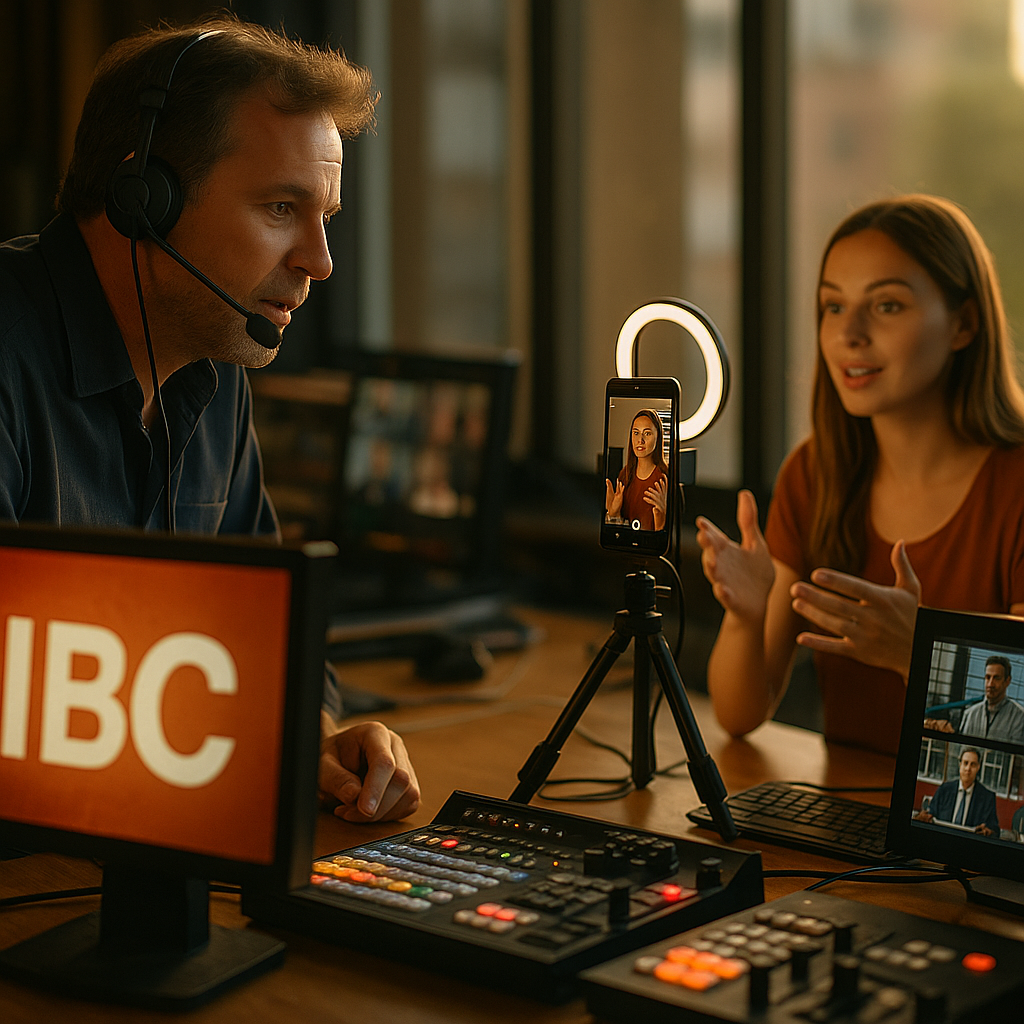
Broadcast engineers and TikTok strategists used to attend different conferences entirely. Not anymore. At IBC2026, the show floor in Amsterdam looked less like a hardware expo and more like a creator economy summit wearing a broadcast badge. If you run brand or agency budgets and skipped it, you missed the clearest signal yet that IBC2026 broadcast meets creator economy convergence, and it’s not a trend piece, it’s a budget line.
This matters because the money is already moving. Streaming platforms are courting creators directly, CTV inventory is absorbing influencer content, and broadcasters are quietly building creator divisions to defend ad revenue. Here are five takeaways that should shape how you plan the next two budget cycles.
Takeaway One: CTV Is Now a Creator Distribution Channel, Not Just a Media Buy
The dominant conversation at IBC2026 wasn’t 8K resolution or cloud production stacks, though those got their booth time. It was distribution logic: how does creator content get onto the big screen, and who gets paid when it does?
Connected TV has quietly become the second life for influencer content. A branded integration that runs on Instagram Reels one week can show up as a 30-second CTV spot the next, repackaged and reformatted for living room screens. That’s not a hypothetical. Our own reporting on a creator-made TV ad reaching 18.4 million homes showed this isn’t a fringe experiment, it’s a repeatable playbook that agencies are now building service lines around.
Creator content built for CTV reuse is outperforming purpose-built TV ads on cost-per-completed-view, according to multiple panel presentations at IBC2026, because it arrives with an audience relationship already attached.
What does this mean for brand marketers? Stop treating your creator content and your CTV media plan as separate line items. If your influencer agreements don’t already include usage rights for broadcast and streaming placement, renegotiate them now. The traditional broadcasters exhibiting at IBC2026 are actively scouting creator content libraries for programmatic CTV inventory, and the ones with cleanest usage rights win the placements first.
The Rights Problem Nobody Budgeted For
Here’s the friction point that came up in nearly every buyer conversation on the floor: usage rights. Most influencer contracts were written for social-first distribution, thirty, sixty, ninety days, platform-specific. Broadcast and CTV distribution windows don’t map cleanly onto that. Legal and procurement teams need to build multi-channel usage clauses into creator contracts from day one, or they’ll be renegotiating retroactively at a premium every time a piece of content performs well enough to warrant a second life.
Streaming Platforms Aren’t Waiting for Broadcasters to Catch Up
The second big theme: streaming platforms are building creator relationships that bypass traditional broadcast entirely. We’ve covered how streaming platforms are redrawing CTV ad budgets by courting creators directly, and IBC2026 confirmed the pace is accelerating, not plateauing.
What’s driving this? Streaming platforms need original, low-cost content to fill inventory gaps, and creators already have built-in audiences plus production speed that traditional studios can’t match. It’s a mutually beneficial arrangement, and brands that get in early on these creator-streaming partnerships are securing better placement rates than they’ll get once the market matures and pricing normalizes upward.
Practical move for brand marketers: audit your current streaming ad spend against your creator partnership roster. Are you paying twice for reach you could be consolidating? Several agency panelists at IBC2026 flagged this exact inefficiency, brands running parallel streaming and influencer budgets that overlap on audience without anyone noticing.
Vertical Video Formats Are Colonizing Broadcast Grids
Micro-drama and short-form vertical content aren’t staying confined to phone screens. Several IBC2026 sessions demonstrated vertical-native content being reformatted, letterboxed, and sequenced for broadcast and connected TV grids, particularly in markets where micro-drama apps have already proven engagement economics. Our coverage of vertical micro-drama apps racing past 100 million dollars in spend gives useful context here: this format isn’t a novelty anymore, it’s a proven revenue category that broadcast is now trying to absorb rather than compete against.
For brand marketers running product placement or sponsorship deals inside micro-drama content, this is good news. Your investment now has a second distribution surface without additional production cost. The catch: measurement standards for cross-format performance are still immature, so insist on unified reporting before you sign off on any broadcast reformatting deal.
Measurement Convergence Is the Real Story (and the Real Headache)
Broadcast has Nielsen-style ratings. Social has platform-native engagement metrics. Neither speaks the other’s language fluently, and that mismatch is the single biggest operational headache for anyone trying to prove ROI across a converged campaign.
IBC2026 featured multiple vendor pitches promising unified measurement across linear, streaming, and social. Skepticism is warranted here. We’ve written before about how the IAB framework unites brand lift and sales data into a single scorecard, and that kind of standardization effort is exactly what’s needed to make cross-format creator and broadcast campaigns auditable. Until measurement vendors and industry bodies fully align, brand marketers should build their own bridge metrics: track incremental site traffic, attributed revenue, and search visibility lift as your connective tissue between broadcast reach and creator-driven conversion.
Attribution gaps compound when content moves across formats, and closing that gap is worth the operational effort. Recent reporting on API-driven publishing layers closing a 37 percent attribution gap shows this is solvable with the right tech stack, not just a measurement wish list.
Why Attribution Gets Harder, Not Easier, at Scale
Common assumption: more distribution channels means more data, means better attribution. Wrong, usually. More channels means more fragmentation unless you’ve built the infrastructure to unify it before you scale. Brands entering broadcast and CTV distribution for the first time should budget for measurement infrastructure alongside media spend, not after it.
Compliance Rules Don’t Pause for Format Changes
One thing that didn’t get enough airtime at IBC2026, frankly: disclosure and compliance obligations don’t reset just because content moves from a phone screen to a television. The FTC’s endorsement guidelines apply regardless of distribution format, and broadcast standards bodies have their own disclosure requirements that can differ meaningfully from social platform norms.
If you’re a brand marketer greenlighting creator content for cross-format use, get your legal team to map disclosure requirements across every distribution surface before content goes live, not after a regulator flags it. This is especially relevant for international campaigns, where bodies like the ICO in the UK maintain separate advertising standards from US regulators.
This ties directly into a theme we’ve tracked closely: vendor due diligence now needs to include compliance capability, not just financial stability. A platform or agency that can’t guarantee cross-format disclosure compliance is a liability, full stop.
What This Means for Budget Planning Next Cycle
Pulling these five threads together, here’s the operational shift brand marketers should make heading into the next planning cycle:
- Build multi-channel usage rights into every creator contract, not as an add-on but as a default clause.
- Audit overlapping spend between streaming media buys and creator partnerships to eliminate redundant reach purchases.
- Treat vertical-native content as broadcast-ready inventory, and negotiate reformatting rights upfront.
- Invest in bridge measurement infrastructure before scaling cross-format campaigns, not after.
- Map compliance obligations across every distribution surface a piece of content will touch.
None of this requires a bigger budget necessarily. It requires a different allocation logic, one that treats broadcast, streaming, and creator content as a single continuum rather than three separate procurement processes. Industry data from eMarketer continues to show CTV ad spend climbing while linear declines, and creator-originated content is filling an increasing share of that growth. Ignoring the convergence isn’t a neutral choice, it’s a competitive disadvantage.
Agencies are adapting faster than in-house teams in many cases. We covered how full-stack platform models are replacing one-off campaign structures, and that same full-stack logic is exactly what’s needed to manage broadcast, streaming, and creator distribution under one operational umbrella instead of three disconnected teams reporting to three disconnected budget owners.
FAQs
Frequently Asked Questions
What does “broadcast meets creator economy” actually mean for brand marketers?
It means creator content is increasingly being distributed through CTV, streaming, and traditional broadcast channels rather than staying confined to social platforms, which changes how brands negotiate usage rights, measure performance, and budget for cross-format campaigns.
Should brands renegotiate existing creator contracts because of this shift?
Yes, if those contracts don’t already include multi-channel usage clauses covering broadcast and streaming distribution windows, brands risk paying premium rates later or losing the opportunity to repurpose high-performing content entirely.
How is measurement different when creator content moves to CTV or broadcast?
Broadcast measurement traditionally relies on ratings-style metrics while social platforms use native engagement data, and the two don’t align automatically, so brands need bridge metrics like attributed revenue and site traffic lift to track performance across formats consistently.
Are disclosure and compliance rules different for broadcast versus social creator content?
Requirements can differ by distribution surface and jurisdiction, so brands should map FTC and relevant regional disclosure obligations across every format a piece of creator content will appear in before publishing, not after.
Is this convergence relevant for smaller or mid-size brands, or only enterprise advertisers?
Mid-size brands can benefit significantly since repurposing existing creator content for CTV or streaming distribution is often cheaper than producing new broadcast-specific ads, provided usage rights and measurement infrastructure are in place first.
The brands winning this convergence aren’t the ones with the biggest budgets, they’re the ones who fixed their contracts and measurement stack before the next planning cycle forced their hand. Start with your usage rights language this quarter.
Top Influencer Marketing Agencies
The leading agencies shaping influencer marketing in 2026
Agencies ranked by campaign performance, client diversity, platform expertise, proven ROI, industry recognition, and client satisfaction. Assessed through verified case studies, reviews, and industry consultations.
Moburst

-
2

The Shelf
Boutique Beauty & Lifestyle Influencer AgencyA data-driven boutique agency specializing exclusively in beauty, wellness, and lifestyle influencer campaigns on Instagram and TikTok. Best for brands already focused on the beauty/personal care space that need curated, aesthetic-driven content.Clients: Pepsi, The Honest Company, Hims, Elf Cosmetics, Pure LeafVisit The Shelf → -
3

Audiencly
Niche Gaming & Esports Influencer AgencyA specialized agency focused exclusively on gaming and esports creators on YouTube, Twitch, and TikTok. Ideal if your campaign is 100% gaming-focused — from game launches to hardware and esports events.Clients: Epic Games, NordVPN, Ubisoft, Wargaming, Tencent GamesVisit Audiencly → -
4

Viral Nation
Global Influencer Marketing & Talent AgencyA dual talent management and marketing agency with proprietary brand safety tools and a global creator network spanning nano-influencers to celebrities across all major platforms.Clients: Meta, Activision Blizzard, Energizer, Aston Martin, WalmartVisit Viral Nation → -
5

The Influencer Marketing Factory
TikTok, Instagram & YouTube CampaignsA full-service agency with strong TikTok expertise, offering end-to-end campaign management from influencer discovery through performance reporting with a focus on platform-native content.Clients: Google, Snapchat, Universal Music, Bumble, YelpVisit TIMF → -
6

NeoReach
Enterprise Analytics & Influencer CampaignsAn enterprise-focused agency combining managed campaigns with a powerful self-service data platform for influencer search, audience analytics, and attribution modeling.Clients: Amazon, Airbnb, Netflix, Honda, The New York TimesVisit NeoReach → -
7

Ubiquitous
Creator-First Marketing PlatformA tech-driven platform combining self-service tools with managed campaign options, emphasizing speed and scalability for brands managing multiple influencer relationships.Clients: Lyft, Disney, Target, American Eagle, NetflixVisit Ubiquitous → -
8

Obviously
Scalable Enterprise Influencer CampaignsA tech-enabled agency built for high-volume campaigns, coordinating hundreds of creators simultaneously with end-to-end logistics, content rights management, and product seeding.Clients: Google, Ulta Beauty, Converse, AmazonVisit Obviously →