


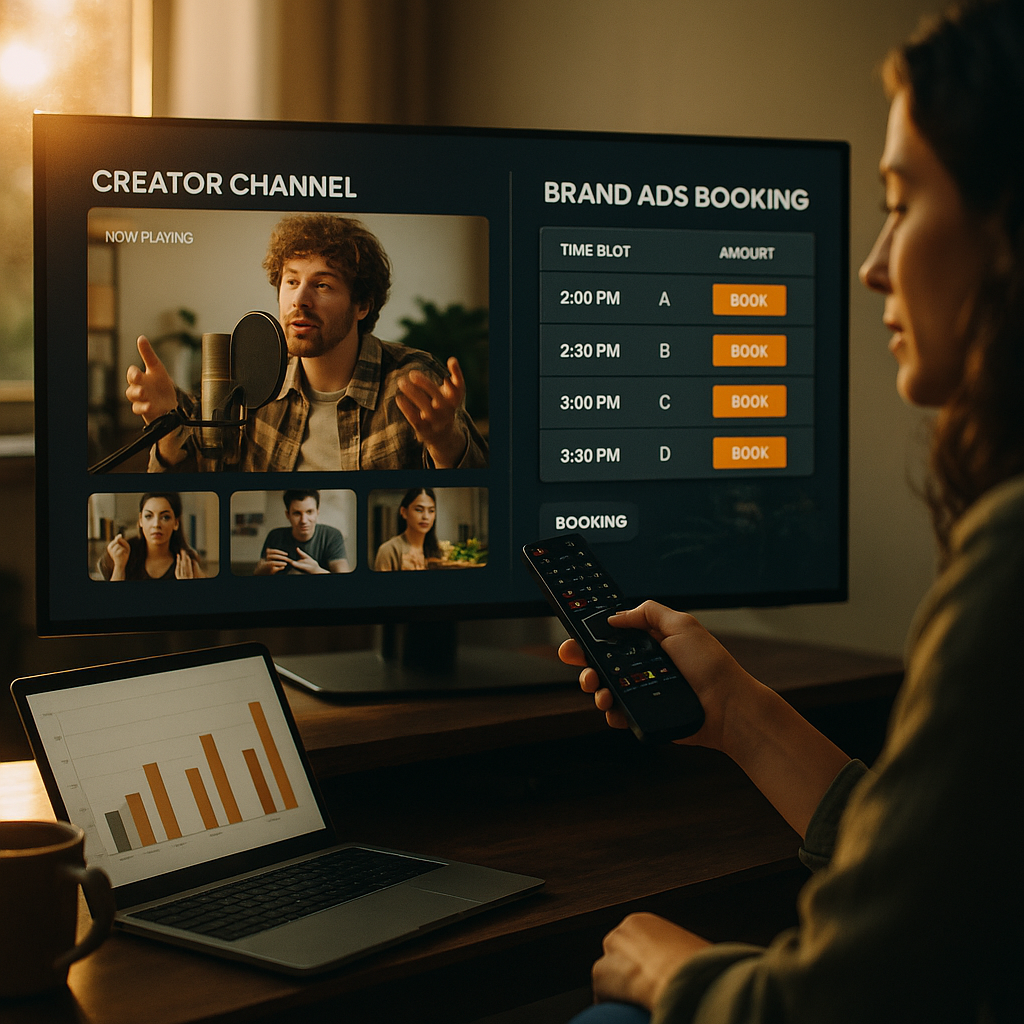
FAST channel ad inventory tied to creator content is projected to pull in billions in ad spend as viewers migrate from cable to free, ad-supported streaming built around personalities they already follow. If your media plan still treats Creator TV Plus and similar FAST channels as an afterthought, you’re leaving reach and lower CPMs on the table. This playbook breaks down how to actually book 15 and 30 second creator ad spots without getting lost in unfamiliar inventory systems.
What Are Creator FAST Channels, and Why Should Brands Care?
FAST stands for free ad-supported streaming television. Think Pluto TV, Tubi, The Roku Channel, and now a growing crop of channels built entirely around creator programming rather than licensed reruns. Creator TV Plus is part of this wave: linear-style, ad-supported channels that stitch together creator-produced video into a scheduled, TV-like viewing experience.
Why does this matter to a brand strategist? Because it merges two things that used to live in separate budgets: the trust and relatability of creator content, and the premium, brand-safe ad slots of traditional television. You get a 30 second spot format that performance marketers understand, wrapped around content that already has an engaged, habitual audience.
The pitch is simple: creator audiences at TV ad prices, without the production overhead of a traditional broadcast buy.
According to eMarketer’s connected TV forecasts, ad-supported streaming continues to eat into linear TV budgets year over year, and creator-driven FAST channels are one of the fastest-growing subcategories within that shift.
The Inventory Structure: How 15s and 30s Actually Get Sold
Unlike programmatic display or social feed ads, creator FAST channel inventory is sold in discrete ad breaks scheduled around blocks of creator content, much like a traditional TV pod. A typical hour of programming might carry two to four ad breaks, each holding anywhere from two to six spots. Slots come in 15 and 30 second increments, occasionally 6 second bumpers for top-tier advertisers.
Three ways brands typically access this inventory:
- Direct IO buys. You negotiate a fixed number of spots at a set CPM directly with the platform’s ad sales team, similar to a traditional upfront.
- Programmatic guaranteed. Reserved inventory bought through a demand-side platform with a locked price and guaranteed delivery volume.
- Open exchange. Remnant inventory available through real-time bidding, cheaper but far less predictable in terms of placement and audience quality.
For most mid-market brands, programmatic guaranteed hits the sweet spot: enough control over placement and frequency without the six-figure minimums that direct IO deals often require.
Reading a Media Kit Without Getting Lost
Creator FAST channel media kits look different from social platform rate cards. Expect to see terms like “content adjacency,” “genre pod,” and “companion display.” Content adjacency tells you which creator verticals your ad will run against (beauty, gaming, food, finance). Genre pods group similar creators into themed blocks, which matters if you want your spot to run near contextually relevant content rather than randomly interspersed.
Ask for a sample schedule before committing. If the sales rep can’t tell you which creator blocks your spot will run in, that’s a red flag worth pushing back on.
Booking Playbook: From RFP to Air Date
Here’s the operational sequence that keeps this process from turning into a scheduling nightmare.
- Define the objective first. Awareness campaigns can tolerate broader creator adjacency. Performance campaigns need tighter genre targeting and ideally a shoppable QR overlay or companion display unit.
- Request a genre and demo breakdown. Ask for viewership data by creator category, average watch time per pod, and completion rates for 15 versus 30 second formats.
- Lock creative specs early. Most FAST platforms require broadcast-quality MP4 or MOV files, specific bitrate and resolution standards, and closed captioning. This is not the place to repurpose a vertical TikTok cut with black bars slapped on.
- Negotiate frequency caps. Because FAST audiences skew toward habitual viewers, uncapped frequency burns budget fast. Cap impressions per household per day, typically between two and four.
- Build in a mid-flight optimization window. Reserve at least 20 percent of budget for reallocation after the first two weeks based on completion rate and genre performance data.
Booking lead times run longer than social. Plan for two to four weeks between IO signature and air date for direct deals, and expect creative approval cycles that mirror traditional broadcast standards rather than the same-day turnaround you’re used to with influencer feed content.
Pricing Benchmarks: What Should You Actually Pay?
CPMs for creator FAST channel inventory generally land between traditional CTV and open social video, often in the range that industry data from Statista’s video advertising reports pegs mid-tier CTV CPMs at, though creator-specific inventory can run leaner because platforms are still building sales volume and want to prove out the format.
A few pricing levers worth knowing:
- 15 second spots typically price at 60 to 70 percent of the equivalent 30 second CPM, not a flat 50 percent discount as many buyers assume.
- Genre-specific pods (finance, tech, parenting) command a premium over general entertainment blocks, sometimes 15 to 25 percent higher.
- First-in-pod placement (the first ad shown in a break) carries the highest completion rates and is priced accordingly.
If a sales rep quotes you a flat CPM regardless of pod position or genre, negotiate. This inventory is granular enough that pricing should reflect placement quality.
Brands running parallel spend on social video platforms should benchmark against comparable formats. If you’ve already built rate card logic for other creator inventory, our breakdown on resetting creator rate cards is a useful companion reference for how impression-based pricing conversations should go.
Creative Specs and Compliance Landmines
Here’s where a lot of brands trip. Creator FAST channels blend social-native creative sensibilities with broadcast-grade technical and legal requirements, and the two don’t always play nicely.
Technical basics: 1920×1080 minimum resolution, stereo audio at broadcast loudness standards, no burned-in captions unless specified, and file formats that meet the platform’s ingestion specs (usually ProRes or high-bitrate MP4). Vertical creative shot for TikTok or Reels will almost never pass muster without a proper 16:9 re-edit.
Compliance is the bigger issue. Because these are ad-supported TV-style environments, disclosure rules from the Federal Trade Commission still apply if the spot involves a creator endorsing your product within the ad itself. If your 30 second spot features the same creator whose content surrounds it in the pod, make sure sponsorship disclosure is baked into the creative, not just assumed because it’s “obviously an ad.”
Treating a FAST channel spot like a social post with a disclosure hashtag tacked on is a compliance gap waiting to happen. These are regulated ad placements, not organic content.
If you’re already navigating disclosure requirements across creator formats, the logic in our branded content compliance playbook translates well here, particularly around when a label or verbal disclosure is legally sufficient versus when it isn’t.
Measurement Without Cookies: What You Can Actually Track
CTV and FAST measurement has never relied heavily on third-party cookies, which is actually a point in this format’s favor as the broader ad ecosystem keeps adjusting to privacy changes. Most platforms report on completion rate, frequency, and household reach through their own ad servers or via integrations with measurement partners.
What you should ask for before signing:
- Completion rate broken out by 15 versus 30 second creative
- Household reach and frequency distribution
- Brand lift study availability (many platforms partner with third-party research firms for this)
- Companion QR code or shoppable overlay scan data, if applicable
Don’t expect click-through attribution like you’d get from a social video ad. FAST channel measurement is closer to traditional TV: directional, aggregate, and best paired with a brand lift study or incrementality test rather than last-click logic. If your team is used to pixel-perfect attribution from platforms like TikTok Shop or Instagram checkout, this is a mental reset worth having before the campaign kicks off, not after the first report comes in.
For brands weighing this format against other emerging ad-supported streaming options, our Netflix ad tier playbook covers similar measurement tradeoffs on a bigger platform, and the commerce media playbook is worth a read if you’re trying to avoid overpaying for walled garden reporting across multiple channels.
General benchmarking resources like HubSpot’s marketing statistics and Sprout Social’s platform data can help you sanity-check completion and engagement rates against broader video advertising norms when a FAST platform’s self-reported numbers seem too good to be true.
Is This Worth the Budget Shift?
Not every brand needs to move dollars here immediately. If your audience skews younger and lives almost entirely in short-form vertical feeds, FAST channel spend is a slower, more deliberate bet. But if you’re already running AI generated creative or testing formats to lower blended CPMs, adding a small FAST channel test budget is a reasonable diversification move, particularly for categories like CPG, finance, and home goods where TV-style trust signals still move purchase decisions.
Start with a 90-day test: one genre pod, one creative pair (15 and 30 second versions of the same spot), and a fixed frequency cap. Measure completion rate and brand lift before scaling further.
The Next Move
Book a small test flight before committing upfront-style budget: one genre pod, both spot lengths, a hard frequency cap, and a brand lift study attached from day one. That’s the fastest way to know if Creator TV Plus inventory earns a permanent line in your media plan.
Frequently Asked Questions
What is the difference between a FAST channel and traditional CTV advertising?
FAST stands for free ad-supported streaming television. It refers to channels that are free to viewers and monetized entirely through ads, similar to old-school broadcast TV but delivered over streaming devices. Traditional CTV advertising can include both FAST channels and ad-supported tiers of subscription services like Netflix or Hulu.
Are 15 second spots actually cheaper than 30 second spots on creator FAST channels?
Usually, but not by half. Most platforms price 15 second spots at roughly 60 to 70 percent of the 30 second CPM rather than a flat 50 percent discount, since production and ad-serving overhead don’t scale down linearly with runtime.
Do I need creator involvement to book a spot on a creator FAST channel?
No. Brands can book standard ad spots that run within or between creator content blocks without the creator appearing in the ad itself. If the creator does appear in your ad, disclosure requirements under FTC guidance apply.
How much lead time should I plan for booking creator FAST channel inventory?
Direct IO deals typically need two to four weeks between contract signature and air date, factoring in creative approval and technical ingestion. Programmatic guaranteed deals can move faster but still require broadcast-compliant creative assets in advance.
Can I use vertical social video creative for these ad spots?
Not without re-editing. Most FAST platforms require 16:9 horizontal creative at broadcast resolution and audio standards, so vertical TikTok or Reels content needs a proper reformat rather than a simple crop.
Top Influencer Marketing Agencies
The leading agencies shaping influencer marketing in 2026
Agencies ranked by campaign performance, client diversity, platform expertise, proven ROI, industry recognition, and client satisfaction. Assessed through verified case studies, reviews, and industry consultations.
Moburst

-
2

The Shelf
Boutique Beauty & Lifestyle Influencer AgencyA data-driven boutique agency specializing exclusively in beauty, wellness, and lifestyle influencer campaigns on Instagram and TikTok. Best for brands already focused on the beauty/personal care space that need curated, aesthetic-driven content.Clients: Pepsi, The Honest Company, Hims, Elf Cosmetics, Pure LeafVisit The Shelf → -
3

Audiencly
Niche Gaming & Esports Influencer AgencyA specialized agency focused exclusively on gaming and esports creators on YouTube, Twitch, and TikTok. Ideal if your campaign is 100% gaming-focused — from game launches to hardware and esports events.Clients: Epic Games, NordVPN, Ubisoft, Wargaming, Tencent GamesVisit Audiencly → -
4

Viral Nation
Global Influencer Marketing & Talent AgencyA dual talent management and marketing agency with proprietary brand safety tools and a global creator network spanning nano-influencers to celebrities across all major platforms.Clients: Meta, Activision Blizzard, Energizer, Aston Martin, WalmartVisit Viral Nation → -
5

The Influencer Marketing Factory
TikTok, Instagram & YouTube CampaignsA full-service agency with strong TikTok expertise, offering end-to-end campaign management from influencer discovery through performance reporting with a focus on platform-native content.Clients: Google, Snapchat, Universal Music, Bumble, YelpVisit TIMF → -
6

NeoReach
Enterprise Analytics & Influencer CampaignsAn enterprise-focused agency combining managed campaigns with a powerful self-service data platform for influencer search, audience analytics, and attribution modeling.Clients: Amazon, Airbnb, Netflix, Honda, The New York TimesVisit NeoReach → -
7

Ubiquitous
Creator-First Marketing PlatformA tech-driven platform combining self-service tools with managed campaign options, emphasizing speed and scalability for brands managing multiple influencer relationships.Clients: Lyft, Disney, Target, American Eagle, NetflixVisit Ubiquitous → -
8

Obviously
Scalable Enterprise Influencer CampaignsA tech-enabled agency built for high-volume campaigns, coordinating hundreds of creators simultaneously with end-to-end logistics, content rights management, and product seeding.Clients: Google, Ulta Beauty, Converse, AmazonVisit Obviously →