


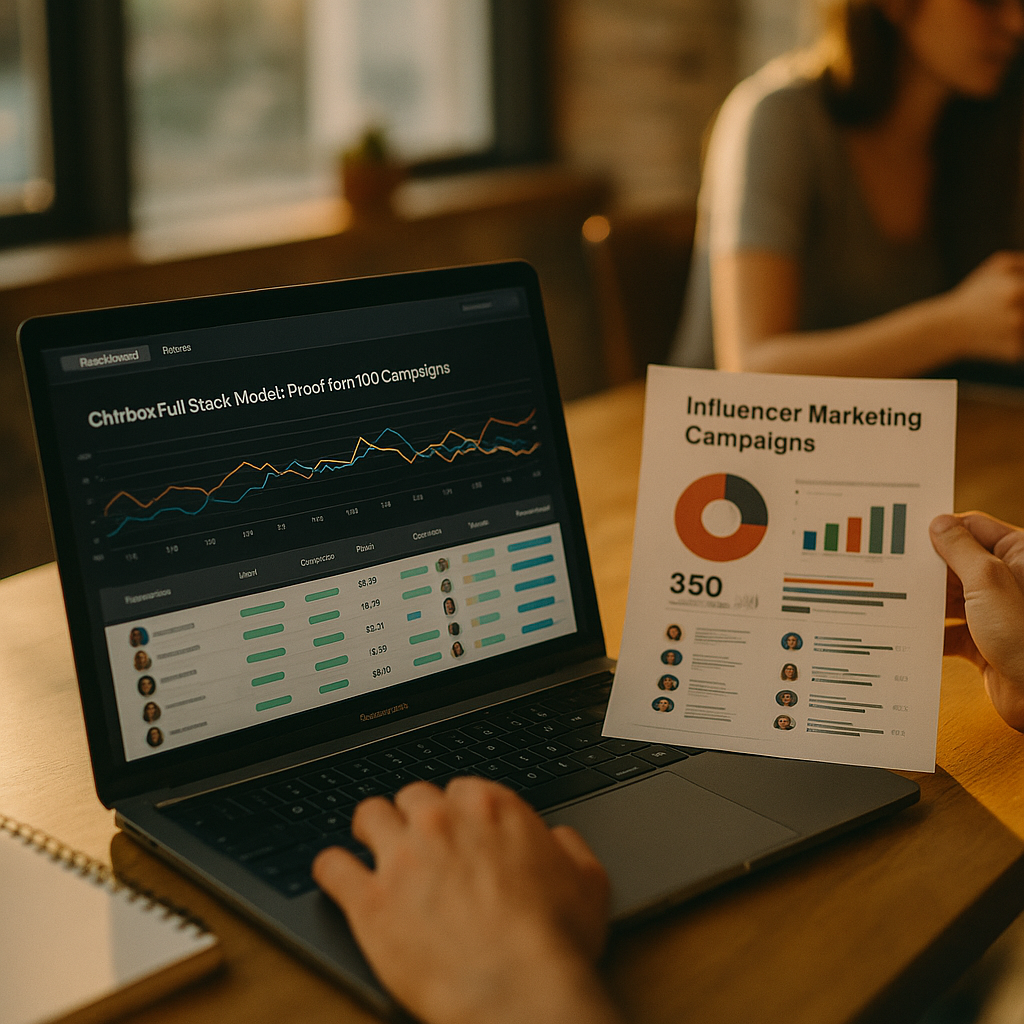
Most influencer agencies pitch a “full stack” service and deliver a glorified spreadsheet with a creative deck attached. Chtrbox has now run over 1,000 executed campaigns through an actual full stack model, and the data from that volume tells a different story than the pitch decks. If you’re a brand marketer evaluating agency partners, the question isn’t whether an agency claims full stack capability. It’s whether they have the campaign volume to prove it holds up under pressure.
What “Full Stack” Actually Means Once You Strip the Buzzword
Every agency deck now says “full funnel” or “full stack.” Few define it in terms a CFO would accept. In Chtrbox’s case, the model spans four operational layers: creator sourcing and vetting, contracting and compliance, content production oversight, and post-campaign attribution reporting. The point isn’t that all four exist. It’s that they’re integrated into one workflow instead of stitched together across three vendors and a shared Google Drive.
That distinction matters more than it sounds. A brand running influencer campaigns through disconnected vendors (a sourcing agency, a separate legal reviewer, a freelance content auditor) loses time and visibility at every handoff. Chtrbox’s model consolidates that into a single accountable process, which is the actual definition of “full stack” that holds up at scale.
The 1000-Campaign Dataset: What Changes at Scale
Running ten campaigns teaches you what works in theory. Running a thousand teaches you what breaks in practice: which creator tiers flake on deliverables, which content formats get flagged by platform compliance bots, which contract clauses actually prevent disputes instead of just looking thorough on paper.
At volume, the difference between a good agency and a great one isn’t creative talent. It’s the operational discipline to catch problems before they become brand crises.
Chtrbox’s internal benchmarking across its executed campaign base shows a few consistent patterns worth noting for any brand evaluating creator partnerships at scale:
- Campaigns with pre-vetted creator pools (rather than open casting calls) show meaningfully fewer content revision cycles.
- Contracts with explicit disclosure language reduce post-publish compliance flags, a detail that matters given ongoing FTC enforcement around influencer disclosure.
- Campaigns with built-in attribution tracking from day one report cleaner ROI data than those bolted on after launch.
None of this is revolutionary. It’s operational maturity, the kind that only surfaces after enough repetitions to expose the weak points.
Where Brands Actually See the ROI Difference
Ask any brand marketer what “ROI” means in influencer marketing and you’ll get five different answers. Some mean media value equivalency. Some mean conversion attribution. Some mean just not getting burned by a creator who ghosts mid-campaign. A full stack model earns its keep across all three, but the most underrated one is time-to-launch.
Brands working with fragmented vendor stacks routinely report six to eight week lead times just to get a campaign live, factoring in sourcing, negotiation, legal review, and content approval. Chtrbox’s integrated model compresses that because the same team owns sourcing through reporting, with no external handoffs waiting on someone else’s queue. Faster launch cycles mean brands can respond to trend windows instead of missing them, which is increasingly the difference between a campaign that lands and one that arrives after the cultural moment has passed.
On the attribution side, the full stack approach pays off because tracking infrastructure gets built into the campaign brief rather than retrofitted. That’s a lesson plenty of brands have learned the hard way when trying to reconcile creator-driven sales after the fact, a challenge covered in depth in our look at fixing creator attribution gaps.
Compliance Isn’t a Line Item, It’s the Whole Model
Here’s an uncomfortable truth: most influencer marketing compliance failures aren’t caused by bad creators. They’re caused by brands and agencies that treat disclosure and contract review as an afterthought bolted onto the creative process. When your legal review happens after content is already filmed, you’re negotiating from a position of weakness.
Chtrbox’s model bakes compliance checkpoints into the workflow at three stages: pre-contract (disclosure language, usage rights, exclusivity terms), pre-publish (platform-specific labeling requirements), and post-publish (monitoring for edits or reposts that violate original terms). This mirrors the kind of structured risk mitigation brands should be demanding across every platform they use for creator content, whether that’s Kick streams, where moderation risk runs high as outlined in our Kick moderation risk playbook, or more established platforms like YouTube, where branded content labeling rules keep shifting.
Regulatory scrutiny on influencer disclosure isn’t loosening either. Between FTC guidance updates and the UK’s ICO tightening data and advertising transparency expectations, brands running programs without embedded compliance review are carrying risk they probably haven’t priced correctly.
What Brands Should Expect in the First 90 Days
If you’re onboarding into a full stack model for the first time, the first quarter looks different from a typical agency ramp-up. Expect an audit phase before a single creator gets contacted. Chtrbox’s process front-loads brand safety parameters, past campaign performance data (if you have any), and category-specific compliance requirements before sourcing begins.
This front-loading feels slower initially. It isn’t. Brands that skip the audit phase in favor of “let’s just start posting” tend to spend weeks later fixing avoidable mistakes: wrong creator tier for the budget, missing usage rights for paid amplification, disclosure language that doesn’t match the platform’s actual requirements.
A realistic 90-day expectation:
- Weeks 1 to 2: brand safety audit, category benchmarking, KPI alignment.
- Weeks 3 to 5: creator sourcing and contracting.
- Weeks 6 to 9: content production, review cycles, and publish.
- Weeks 10 to 12: attribution reporting and optimization recommendations for round two.
Brands expecting instant turnaround will find this pacing frustrating. Brands who’ve been burned by rushed campaigns will recognize it as the reason the next 900 campaigns tend to perform better than the first hundred.
Where the Model Still Has Limits
No agency model, full stack or otherwise, eliminates every risk. Creator behavior is still unpredictable. Platform algorithm shifts, like the ongoing changes affecting Reels watch depth, can undercut even a well-executed campaign’s reach regardless of how tight the contract is. And full stack integration works best at a certain volume threshold. Brands running one or two campaigns a year may find the audit and onboarding overhead disproportionate to the output.
It’s also worth being honest that “1,000 executed campaigns” is a volume claim, not a guarantee of uniform quality across every single one. Aggregate data smooths over outliers. A brand should still ask for category-specific case studies, not just the headline number, before assuming past performance predicts their specific outcome. Industry benchmarks from sources like eMarketer and Statista are useful for sanity-checking any agency’s performance claims against broader market trends.
The Bigger Shift This Reflects
Chtrbox’s evolution toward a full stack model reflects a broader shift happening across the creator economy: brands are done treating influencer marketing as a discrete “campaign” line item and starting to treat it as always-on infrastructure, closer to how they’d manage a paid media channel. That shift demands agencies that can operate like a media partner, not just a booking agent.
That’s a similar operational logic to what we’ve seen brands adopt when splitting budget between owned commerce platforms and creator programs, a tension explored in our Amazon budget split guide. The agencies winning long-term brand retainers aren’t the ones with the flashiest creator rosters. They’re the ones who can show operational proof at volume, the same proof point Chtrbox is now leaning on with its 1,000-campaign benchmark.
Frequently Asked Questions
What does “full stack” mean in an influencer marketing agency context?
It refers to an agency owning the entire campaign lifecycle in one integrated workflow: creator sourcing, contracting and compliance, content production oversight, and attribution reporting, rather than outsourcing pieces to separate vendors.
Why does campaign volume matter when evaluating an agency’s model?
Volume exposes operational weaknesses that don’t show up in small pilot campaigns. An agency with data from hundreds or thousands of executed campaigns can point to actual patterns in creator reliability, compliance risk, and attribution accuracy rather than theoretical promises.
How long does onboarding into a full stack model typically take?
A realistic first cycle runs about 90 days, covering brand safety audit and KPI alignment, creator sourcing and contracting, content production, and post-campaign attribution reporting.
Does a full stack model eliminate influencer marketing compliance risk?
No model eliminates risk entirely. It reduces it by building disclosure language, usage rights, and platform-specific labeling checks into the workflow at multiple stages instead of reviewing compliance only after content is published.
Is a full stack agency model worth it for brands running only a handful of campaigns a year?
Not always. The audit and onboarding overhead is easier to justify for brands running influencer marketing as an always-on channel rather than a one-off campaign.
Bottom line: before signing with any agency claiming full stack capability, ask for campaign volume data broken down by category, not just a headline number. If they can’t show you what changed operationally between campaign 10 and campaign 1,000, they haven’t actually built a stack, they’ve built a pitch.
Top Influencer Marketing Agencies
The leading agencies shaping influencer marketing in 2026
Agencies ranked by campaign performance, client diversity, platform expertise, proven ROI, industry recognition, and client satisfaction. Assessed through verified case studies, reviews, and industry consultations.
Moburst

-
2

The Shelf
Boutique Beauty & Lifestyle Influencer AgencyA data-driven boutique agency specializing exclusively in beauty, wellness, and lifestyle influencer campaigns on Instagram and TikTok. Best for brands already focused on the beauty/personal care space that need curated, aesthetic-driven content.Clients: Pepsi, The Honest Company, Hims, Elf Cosmetics, Pure LeafVisit The Shelf → -
3

Audiencly
Niche Gaming & Esports Influencer AgencyA specialized agency focused exclusively on gaming and esports creators on YouTube, Twitch, and TikTok. Ideal if your campaign is 100% gaming-focused — from game launches to hardware and esports events.Clients: Epic Games, NordVPN, Ubisoft, Wargaming, Tencent GamesVisit Audiencly → -
4

Viral Nation
Global Influencer Marketing & Talent AgencyA dual talent management and marketing agency with proprietary brand safety tools and a global creator network spanning nano-influencers to celebrities across all major platforms.Clients: Meta, Activision Blizzard, Energizer, Aston Martin, WalmartVisit Viral Nation → -
5

The Influencer Marketing Factory
TikTok, Instagram & YouTube CampaignsA full-service agency with strong TikTok expertise, offering end-to-end campaign management from influencer discovery through performance reporting with a focus on platform-native content.Clients: Google, Snapchat, Universal Music, Bumble, YelpVisit TIMF → -
6

NeoReach
Enterprise Analytics & Influencer CampaignsAn enterprise-focused agency combining managed campaigns with a powerful self-service data platform for influencer search, audience analytics, and attribution modeling.Clients: Amazon, Airbnb, Netflix, Honda, The New York TimesVisit NeoReach → -
7

Ubiquitous
Creator-First Marketing PlatformA tech-driven platform combining self-service tools with managed campaign options, emphasizing speed and scalability for brands managing multiple influencer relationships.Clients: Lyft, Disney, Target, American Eagle, NetflixVisit Ubiquitous → -
8

Obviously
Scalable Enterprise Influencer CampaignsA tech-enabled agency built for high-volume campaigns, coordinating hundreds of creators simultaneously with end-to-end logistics, content rights management, and product seeding.Clients: Google, Ulta Beauty, Converse, AmazonVisit Obviously →