


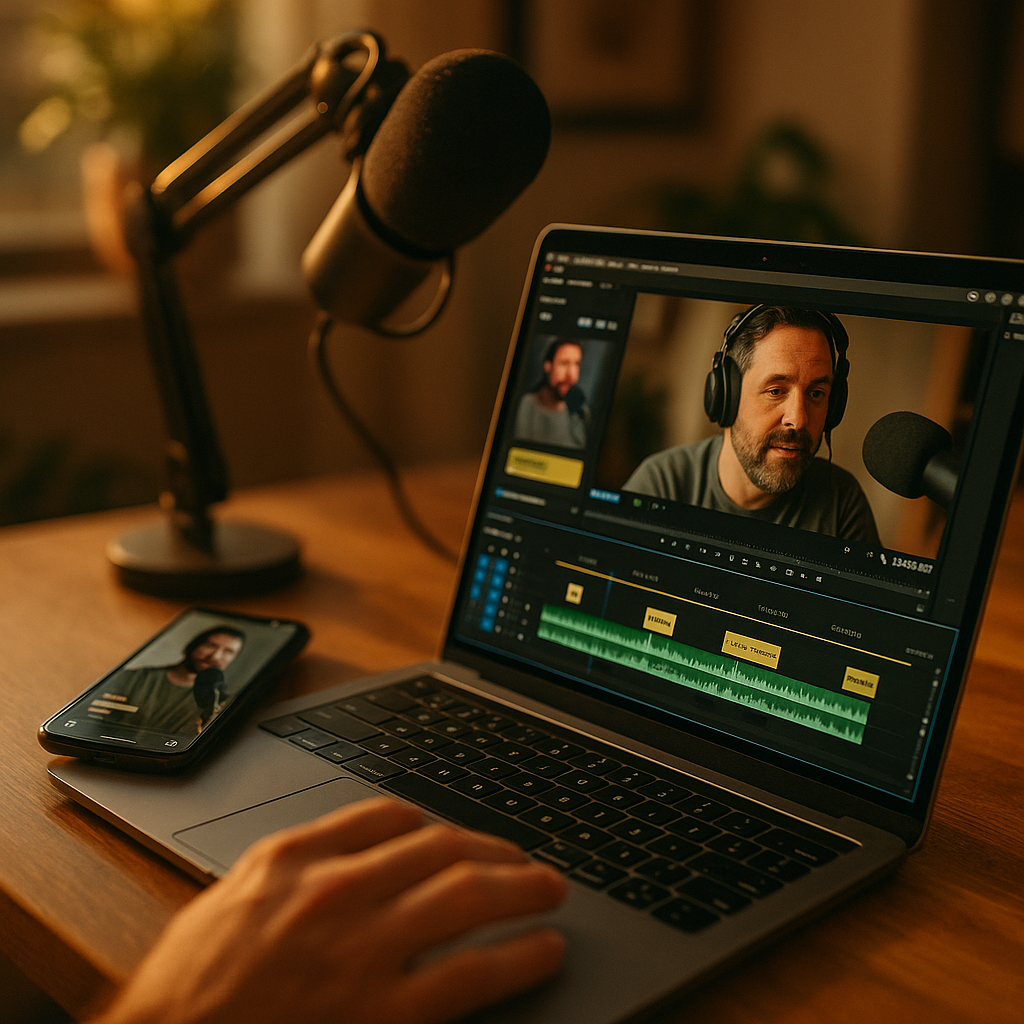
Ninety percent of a podcast episode never gets watched by anyone outside the true fans who already subscribe. That’s not a failure of the content, it’s a distribution problem. Podcast clip repurposing for paid social ads solves it by taking your best 30 seconds and putting media dollars behind it, turning a sunk production cost into a renewable ad asset. If your podcast budget stops at the RSS feed, you’re leaving performance media on the table.
Why Podcasts Make Unusually Good Ad Source Material
Long form audio has something most ad creative doesn’t: unscripted credibility. When a guest stumbles into a genuine reaction, or a host pushes back on a claim, that friction reads as authenticity to a cold audience. Paid social thrives on stopping the scroll, and a raw, slightly messy clip often outperforms a polished 15 second spot because it doesn’t look like an ad.
There’s also a volume advantage. A single 60 minute episode can yield a dozen usable clips if you’re scripting or briefing with repurposing in mind from the start. That’s a dozen creative variants for A/B testing without a dozen separate shoots.
Treat every podcast episode as a creative batch, not a single asset. One good conversation can fund a month of ad testing if you cut it right.
What Makes a Clip “Ad Ready”?
Not every quotable moment survives the jump from passive listening to a paid feed. Podcast listeners opted in. Social scrollers didn’t. That gap changes what “good” looks like.
- A hook inside the first two seconds. No slow build, no “so today we’re talking about.” Cold audiences need the payoff up front.
- A complete thought in 15 to 45 seconds. Longer clips work on YouTube in-stream, but Meta and TikTok feeds punish anything that meanders.
- Visual interest, even if the source is audio only. Waveforms, captions, and b-roll matter more than most teams expect.
- A claim, tension, or specific number. “This changed how I think about pricing” beats “great conversation today.”
If you’re pulling clips after the fact, you’re relying on luck. Smarter teams brief hosts to create these moments deliberately, similar to how weekly production briefs engineer trust signals into recurring content rather than hoping they appear organically.
The Caption and Subtitle Problem Nobody Warns You About
Most podcast audio was never designed to be watched on mute in a feed, and that’s exactly how most people will encounter it. Sound-on rates on Meta and TikTok hover well below half of impressions, depending on placement and time of day, according to data platforms like Sprout Social regularly track. If your clip depends on hearing the tone of voice to land the joke or the insight, it dies silently.
This is where subtitle discipline matters more than most media buyers realize. Burned-in captions need to carry the full meaning of the clip, not just transcribe it. That means punchy line breaks, emphasis on the key word, and captions timed to the beat of speech rather than dumped in three-line blocks. The same principles that govern subtitle rules for muted autoplay feeds apply directly here, podcast clips just tend to have denser dialogue, so the editing has to work harder to compress it.
Format by Platform: What Actually Runs Where
A clip that crushes on YouTube can flop on TikTok, and vice versa. Platform-native formatting isn’t optional if you’re spending media dollars.
Meta feeds and Reels placements reward 9:16 vertical cuts with captions burned in and a text overlay hook that restates the audio hook visually. Meta’s own Meta Business guidance recommends front-loading the value proposition within the first three seconds, which lines up almost exactly with what makes a podcast clip work as an ad.
TikTok’s feed tolerates rougher production but demands faster pacing. A clip pulled straight from a video podcast recording, two people at a table, static camera, tends to underperform unless you add motion through zooms, cutaways, or animated captions. TikTok’s own ad specs and creative best practices, available through TikTok Ads Manager, favor native-feeling edits over broadcast polish.
YouTube in-stream and Shorts are the two formats where podcast clips feel most at home, since the audience already associates the platform with long form talk content. Longer 45 to 90 second cuts can work here, especially with chapter-style framing that previews what’s coming, similar to the pacing logic in chaptered YouTube series structuring.
Connected TV is the wildcard. Podcast clips rarely translate well to the living room without a full reformat, since horizontal framing, lower-thirds, and pacing all need to change. If you’re stretching podcast content into CTV inventory, follow a proper vertical to horizontal reformatting checklist rather than just stretching the frame, which looks amateurish on a 55 inch screen.
Building the Repurposing Pipeline (So It Doesn’t Die After Episode Three)
Most podcast-to-ad initiatives collapse within a quarter because the workflow depends on one editor manually scrubbing through hour-long files. That doesn’t scale, and it definitely doesn’t survive when that editor goes on vacation.
A durable pipeline needs three things: a tagging system during recording (hosts or producers flag timestamps live), a templated edit style so clips don’t require creative decisions from scratch each time, and a review gate that checks claims before anything touches paid media. That last part matters more than teams think. A guest making an unverified health or income claim in a casual conversation is one thing, running it as paid ad copy in front of thousands of cold impressions is a different regulatory exposure entirely. The FTC’s endorsement guidance applies to paid amplification of organic-style content just as much as it applies to a standard sponsored post.
A clip that was fine as organic podcast content can become a compliance problem the moment you attach a media budget to it. Review claims before you boost, not after legal flags the campaign.
Voice matters too. If you’re filling gaps between clips or adding narration for context, tools covered in same-day voiceover ad production can keep turnaround fast without booking studio time. And if your podcast has international audiences or you’re testing new markets, AI dubbing workflows built to protect ROI let a single English-language episode fund ad variants in multiple languages without re-recording anything.
Measuring What Actually Matters
Vanity metrics from the podcast world (downloads, average listen duration) don’t transfer to paid social performance, so stop reporting on them to your CMO as proof the strategy works. What matters instead: hook rate (three second view rate as a percentage of impressions), thumb-stop ratio, cost per click relative to your other ad creative, and downstream conversion once the click lands. HubSpot’s benchmarking resources are a reasonable starting point if you need category context for what “good” looks like in your vertical.
Run podcast clips in the same testing rotation as your other UGC and creator content, not in a separate silo. If a clip is underperforming your caption-driven product videos or your standard influencer cuts, it doesn’t deserve budget just because the source material took longer to produce. Sunk cost is a trap here like anywhere else in media buying.
Track it over a full quarter if you can. eMarketer and Statista both publish periodic creator and podcast ad spend data that’s useful for benchmarking your own CPMs against category norms, since podcast-native ad inventory often prices differently than standard social feed inventory.
FAQs
How long should a repurposed podcast clip be for paid social?
Fifteen to 45 seconds works best for Meta and TikTok feed placements. YouTube in-stream and Shorts can tolerate 45 to 90 seconds if the pacing stays tight and the hook lands in the first two seconds.
Do I need video for podcast clips to work as ads, or can audio-only clips run?
Audio-only clips can run, but they need strong visual support, waveforms, animated captions, or supporting b-roll, since most feed impressions happen with sound off. Pure static audio waveforms without caption emphasis tend to underperform.
What’s the biggest compliance risk in podcast clip repurposing?
Unverified claims made casually during a conversation can become a regulatory problem once you attach paid media to them. Review any claim-based clip against FTC endorsement guidance before boosting it as an ad.
How many ad-ready clips can I realistically get from one episode?
Teams that brief for repurposing in advance typically extract eight to twelve usable clips from a single hour-long episode. Teams that edit reactively after recording usually get two or three.
Should podcast clip ads be measured differently than other creator ad formats?
No. Use the same hook rate, thumb-stop ratio, and cost-per-click benchmarks you apply to other UGC and creator ad formats. Podcast clips should earn their budget in the same testing rotation, not sit in a protected category.
Next step: pull your last three published episodes, tag every moment that made you sit up and pay attention, and cut just five of them into vertical, captioned, sub-45-second variants this week. Run them against your current best-performing ad creative and let the data, not the production budget you already spent, decide what earns a place in your paid rotation.
FAQs
How long should a repurposed podcast clip be for paid social?
Fifteen to 45 seconds works best for Meta and TikTok feed placements. YouTube in-stream and Shorts can tolerate 45 to 90 seconds if the pacing stays tight and the hook lands in the first two seconds.
Do I need video for podcast clips to work as ads, or can audio-only clips run?
Audio-only clips can run, but they need strong visual support, waveforms, animated captions, or supporting b-roll, since most feed impressions happen with sound off. Pure static audio waveforms without caption emphasis tend to underperform.
What’s the biggest compliance risk in podcast clip repurposing?
Unverified claims made casually during a conversation can become a regulatory problem once you attach paid media to them. Review any claim-based clip against FTC endorsement guidance before boosting it as an ad.
How many ad-ready clips can I realistically get from one episode?
Teams that brief for repurposing in advance typically extract eight to twelve usable clips from a single hour-long episode. Teams that edit reactively after recording usually get two or three.
Should podcast clip ads be measured differently than other creator ad formats?
No. Use the same hook rate, thumb-stop ratio, and cost-per-click benchmarks you apply to other UGC and creator ad formats. Podcast clips should earn their budget in the same testing rotation, not sit in a protected category.
Top Influencer Marketing Agencies
The leading agencies shaping influencer marketing in 2026
Agencies ranked by campaign performance, client diversity, platform expertise, proven ROI, industry recognition, and client satisfaction. Assessed through verified case studies, reviews, and industry consultations.
Moburst

-
2

The Shelf
Boutique Beauty & Lifestyle Influencer AgencyA data-driven boutique agency specializing exclusively in beauty, wellness, and lifestyle influencer campaigns on Instagram and TikTok. Best for brands already focused on the beauty/personal care space that need curated, aesthetic-driven content.Clients: Pepsi, The Honest Company, Hims, Elf Cosmetics, Pure LeafVisit The Shelf → -
3

Audiencly
Niche Gaming & Esports Influencer AgencyA specialized agency focused exclusively on gaming and esports creators on YouTube, Twitch, and TikTok. Ideal if your campaign is 100% gaming-focused — from game launches to hardware and esports events.Clients: Epic Games, NordVPN, Ubisoft, Wargaming, Tencent GamesVisit Audiencly → -
4

Viral Nation
Global Influencer Marketing & Talent AgencyA dual talent management and marketing agency with proprietary brand safety tools and a global creator network spanning nano-influencers to celebrities across all major platforms.Clients: Meta, Activision Blizzard, Energizer, Aston Martin, WalmartVisit Viral Nation → -
5

The Influencer Marketing Factory
TikTok, Instagram & YouTube CampaignsA full-service agency with strong TikTok expertise, offering end-to-end campaign management from influencer discovery through performance reporting with a focus on platform-native content.Clients: Google, Snapchat, Universal Music, Bumble, YelpVisit TIMF → -
6

NeoReach
Enterprise Analytics & Influencer CampaignsAn enterprise-focused agency combining managed campaigns with a powerful self-service data platform for influencer search, audience analytics, and attribution modeling.Clients: Amazon, Airbnb, Netflix, Honda, The New York TimesVisit NeoReach → -
7

Ubiquitous
Creator-First Marketing PlatformA tech-driven platform combining self-service tools with managed campaign options, emphasizing speed and scalability for brands managing multiple influencer relationships.Clients: Lyft, Disney, Target, American Eagle, NetflixVisit Ubiquitous → -
8

Obviously
Scalable Enterprise Influencer CampaignsA tech-enabled agency built for high-volume campaigns, coordinating hundreds of creators simultaneously with end-to-end logistics, content rights management, and product seeding.Clients: Google, Ulta Beauty, Converse, AmazonVisit Obviously →