


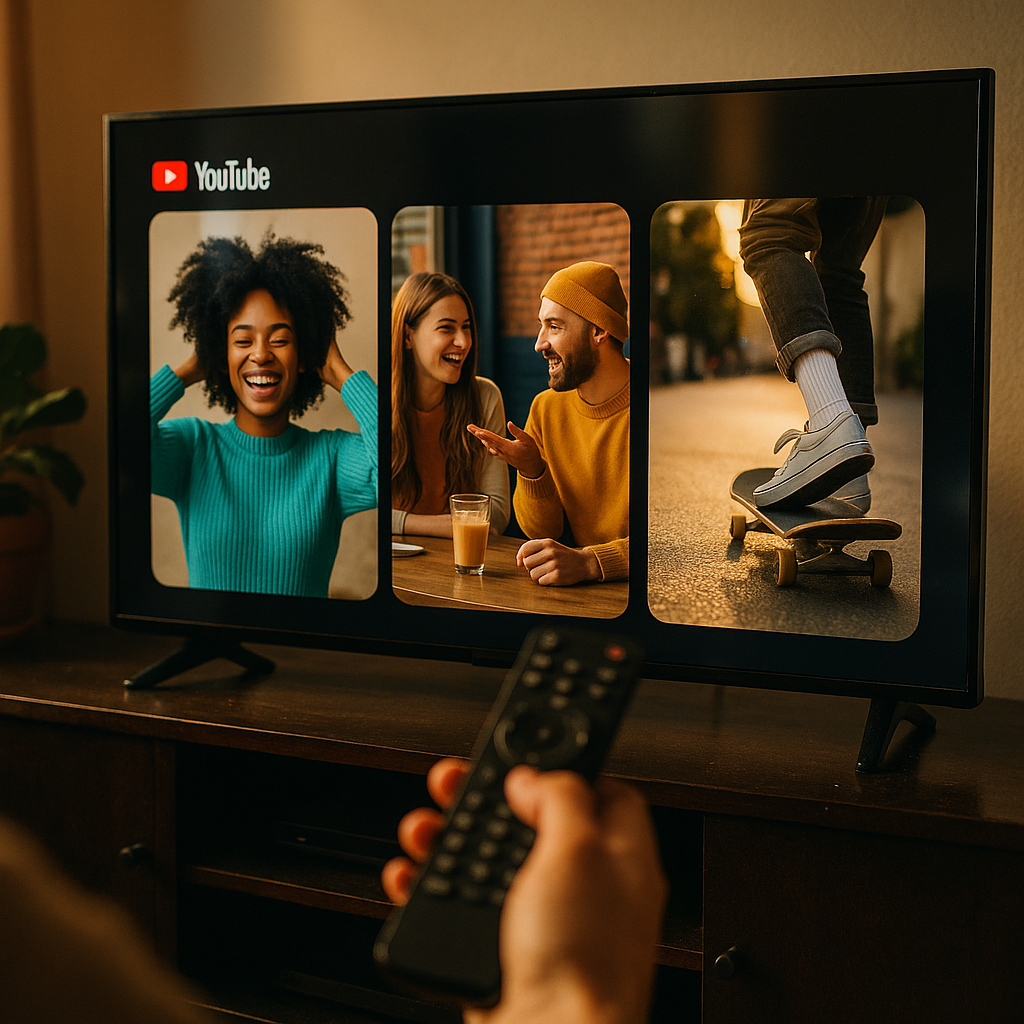
Your Shorts strategy was probably built for a phone screen held six inches from someone’s face. But YouTube now says a growing share of Shorts watch time happens on television sets, stretched across 55 inches in a living room. That single shift rewires everything about YouTube Shorts monetization: pacing, sound design, product framing, even where you place a call to action. Brands still treating Shorts like short-form mobile filler are missing a primetime-adjacent ad slot that behaves nothing like the TikTok clone they think it is.
The Couch Is the New Scroll
Connected TV isn’t a side channel anymore. It’s where a huge chunk of streaming attention now lives, and YouTube has consistently ranked as one of the top apps on TV screens in the US according to Nielsen’s streaming rankings. What’s changed recently is that Shorts, YouTube’s vertical feed, has followed viewers onto that bigger screen through a dedicated Shorts shelf on the TV app.
That matters because the living room is a fundamentally different viewing context than a subway platform. Sound defaults to on. Multiple people are often watching together. The remote, not a thumb, controls skipping, which changes the rhythm of how fast people bail on a clip. A brand placement that reads fine on a 6 inch screen can look cheap, pixelated, or oddly cropped when it’s blown up across a TV, and a joke that lands solo on a phone can fall flat when three people are watching and judging it out loud.
Check reach data at the source too. Statista’s streaming and CTV data and eMarketer’s connected TV forecasts both show the living room screen absorbing more daily video minutes every reporting cycle, and Shorts is riding that wave whether brands have noticed or not.
Do Shorts RPMs Actually Hold Up on Connected TVs?
Here’s the uncomfortable truth: YouTube Shorts ad revenue is pooled, not sold placement by placement the way long-form pre-roll is. Creators get a share of a revenue pool split by watch time, and that structure hasn’t changed just because more views now originate from a TV app. RPMs on Shorts remain notably lower than long-form YouTube, regardless of screen size, because the ad load per view is thinner.
The real money in YouTube Shorts monetization for brands was never the AdSense split. It’s the brand deal layered on top, and TV viewing habits now make that placement worth renegotiating.
This is why smart brand teams stopped thinking of Shorts as a standalone buy and started bundling it with the creator’s broader YouTube footprint. If you’re already leaning on CPM renegotiation tactics for long-form inventory, apply the same lens here: ask creators for their TV-app view breakdown before you finalize a rate card, because a creator whose Shorts are getting meaningful living room play deserves a different conversation than one stuck entirely on mobile scroll. It’s also worth revisiting how retroactive payout structures handle Shorts differently from long-form, since budget planning gets messy if finance assumes one flat rate across formats.
The Brand Placement Playbook: Five Moves That Work
None of this requires reinventing your creator brief from scratch. It requires a handful of deliberate adjustments that account for a bigger screen and a more passive viewing posture.
- Front-load the brand mention, but slow the cut rate. TV remotes make impulsive skipping harder than a thumb flick, so you get slightly more grace before drop-off. Use it, don’t waste it with rapid jump cuts that read as chaotic on a large screen.
- Design text for distance viewing. Product names, discount codes, and captions that look crisp on mobile can turn into an illegible blur from ten feet away on a couch. Bump font sizes and contrast in the creative brief.
- Lean into audio branding. Sound-on is the default in living rooms in a way it isn’t on a crowded train. A distinct sonic cue tied to your brand does more work here than it does on mobile-first platforms.
- Bundle Shorts with a long-form or companion asset. Pairing a Shorts placement with a longer video or an AVOD companion post gives viewers a second, trackable touchpoint after the passive TV impression.
- Use the Community tab to drive appointment viewing. A teaser posted to a creator’s Community tab before a Shorts drop can pull mobile-first followers back to watch the same content on the big screen, effectively doubling your placement’s shelf life.
None of these moves are expensive. They’re briefing discipline, and most creators will implement them happily once you explain why it matters for their own view counts too.
Disclosure Rules Don’t Pause for a Bigger Screen
Compliance doesn’t get a pass because the ad happens to autoplay on someone’s television. The FTC’s endorsement guidance still applies in full, and a disclosure that’s technically present but too small to read on a TV screen is a real risk, not a technicality. Review the FTC’s endorsement guidelines with your legal team specifically through the lens of screen size, because “clear and conspicuous” has always been evaluated from the viewer’s actual vantage point.
Practically, that means pushing creators toward verbal disclosure (“this is a paid partnership with…”) rather than relying solely on YouTube’s built-in paid promotion label, which can render small on TV interfaces. Confirm creators are toggling the platform’s native disclosure tool correctly too. YouTube’s own Creator support documentation walks through how the paid promotion setting displays across surfaces, and it’s worth a five-minute check before any campaign goes live.
Measuring What a Living Room Impression Is Worth
This is the part nobody loves talking about: there’s no click on a TV remote the way there’s a tap on a phone. Attribution gets fuzzier the moment a placement moves from mobile scroll to living room screen, and brands need to adjust expectations before the campaign, not after the report comes back thin on last-click conversions.
A few workable fixes exist. QR codes shown on screen still convert when a viewer grabs their phone mid-episode. Brand lift studies, run through YouTube’s own measurement tools, capture recall and favorability shifts that a click-based model misses entirely. And if you’re running affiliate or local tie-ins, the kind of geo-tagged tracking used in local shopping tag campaigns can help bridge the gap between a passive TV view and an eventual in-store visit. For a broader methodology on multi-touch measurement, Sprout Social’s attribution resources are a solid starting point for building an incrementality framework your finance team will actually trust.
If your only success metric is a click-through rate, you’ll systematically undervalue every living room Shorts impression, and you’ll end up cutting a channel that’s actually working.
Where the Budget Should Move Next
Expect more brands to start treating YouTube Shorts monetization like a hybrid buy, part social content, part TV ad slot, priced and briefed accordingly. That means shifting some budget away from one-off Shorts posts and toward always-on creator retainers that keep a consistent brand presence in the feed over months, not days. It also means watching how ad-supported streaming inventory, including creator FAST channel placements, starts to overlap with Shorts buys as YouTube blurs the line between its social feed and its TV app further.
The brands winning this transition aren’t the ones with the biggest Shorts budgets. They’re the ones who briefed for the couch instead of the commute, and who renegotiated rates the moment their creators’ view data showed a shift toward the living room screen.
Frequently Asked Questions
Does YouTube Shorts monetization pay differently when views come from TV screens?
The revenue pool structure doesn’t change based on device, but a creator with heavy TV-app viewership often has stronger watch time and completion rates, which can indirectly boost their share of the ad pool and their leverage in brand deal negotiations.
How can brands tell if a creator’s Shorts are being watched on television?
Ask creators to pull device breakdown data from YouTube Studio analytics before finalizing a deal. Most creators can export this easily, and it should factor directly into rate discussions.
Do FTC disclosure rules change for Shorts viewed on a TV app?
No, the standard remains the same: disclosures must be clear and conspicuous to the viewer. In practice that often means larger on-screen text and a verbal mention, since small mobile-style captions can be hard to read from typical living room viewing distances.
What’s the best way to measure ROI on Shorts placements that get watched on TV?
Combine brand lift studies with QR code or promo code tracking, since click-based attribution largely breaks down on TV interfaces. Treat the placement more like a traditional TV ad slot for measurement purposes.
Should brands still prioritize mobile-first creative for Shorts given the TV shift?
Yes, mobile still represents the majority of Shorts views. The smarter move is designing creative that holds up on both screens rather than choosing one over the other, with particular attention to text legibility and audio cues that work in either environment.
Top Influencer Marketing Agencies
The leading agencies shaping influencer marketing in 2026
Agencies ranked by campaign performance, client diversity, platform expertise, proven ROI, industry recognition, and client satisfaction. Assessed through verified case studies, reviews, and industry consultations.
Moburst

-
2

The Shelf
Boutique Beauty & Lifestyle Influencer AgencyA data-driven boutique agency specializing exclusively in beauty, wellness, and lifestyle influencer campaigns on Instagram and TikTok. Best for brands already focused on the beauty/personal care space that need curated, aesthetic-driven content.Clients: Pepsi, The Honest Company, Hims, Elf Cosmetics, Pure LeafVisit The Shelf → -
3

Audiencly
Niche Gaming & Esports Influencer AgencyA specialized agency focused exclusively on gaming and esports creators on YouTube, Twitch, and TikTok. Ideal if your campaign is 100% gaming-focused — from game launches to hardware and esports events.Clients: Epic Games, NordVPN, Ubisoft, Wargaming, Tencent GamesVisit Audiencly → -
4

Viral Nation
Global Influencer Marketing & Talent AgencyA dual talent management and marketing agency with proprietary brand safety tools and a global creator network spanning nano-influencers to celebrities across all major platforms.Clients: Meta, Activision Blizzard, Energizer, Aston Martin, WalmartVisit Viral Nation → -
5

The Influencer Marketing Factory
TikTok, Instagram & YouTube CampaignsA full-service agency with strong TikTok expertise, offering end-to-end campaign management from influencer discovery through performance reporting with a focus on platform-native content.Clients: Google, Snapchat, Universal Music, Bumble, YelpVisit TIMF → -
6

NeoReach
Enterprise Analytics & Influencer CampaignsAn enterprise-focused agency combining managed campaigns with a powerful self-service data platform for influencer search, audience analytics, and attribution modeling.Clients: Amazon, Airbnb, Netflix, Honda, The New York TimesVisit NeoReach → -
7

Ubiquitous
Creator-First Marketing PlatformA tech-driven platform combining self-service tools with managed campaign options, emphasizing speed and scalability for brands managing multiple influencer relationships.Clients: Lyft, Disney, Target, American Eagle, NetflixVisit Ubiquitous → -
8

Obviously
Scalable Enterprise Influencer CampaignsA tech-enabled agency built for high-volume campaigns, coordinating hundreds of creators simultaneously with end-to-end logistics, content rights management, and product seeding.Clients: Google, Ulta Beauty, Converse, AmazonVisit Obviously →