


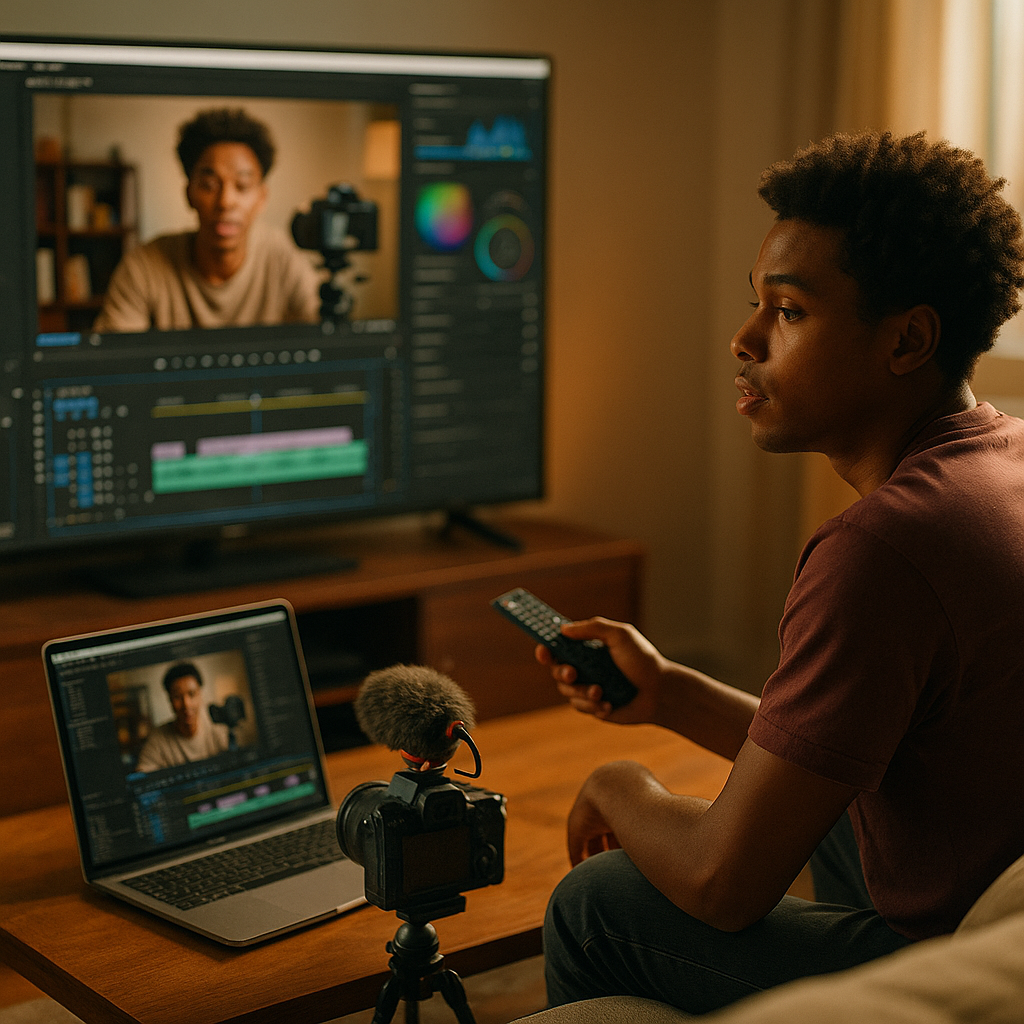
Connected TV now reaches more U.S. households than cable, and creators are the ones filling its ad breaks. Living room marketing, the practice of building creator content specifically for CTV screens, has moved from experimental to expected. Brands that once treated CTV as a broadcast leftover are now briefing creators the same way they’d brief a TikTok campaign, just with a bigger canvas and a much less forgiving audience.
The Big Screen Is Back in the Media Plan
For a decade, the media conversation was mobile-first. Vertical video, six-second hooks, thumb-stopping openers. Then streaming ate the living room, and suddenly brands had a screen the size of a wall with an audience that wasn’t scrolling past anything. According to eMarketer, connected TV ad spend has climbed steadily as linear budgets shrink, and a meaningful chunk of that spend is now going toward creator-produced content rather than traditional commercials.
That shift matters because CTV inventory behaves nothing like a cable pod. Viewers on Hulu, Roku, or YouTube’s living room app aren’t captive in the same way. They can skip, they can mute, they can just walk to the kitchen. Brands figured out that the content earning attention on phones, the casual, creator-led, slightly imperfect stuff, actually performs better on the big screen than polished 30-second spots. YouTube’s CTV ad revenue crossing the billion-dollar mark in a single quarter forced a lot of media planners to rewrite their briefs almost overnight.
The brands winning in living room marketing aren’t just resizing their vertical creator content. They’re rebuilding the pacing, sound design, and call to action from scratch for a screen viewers watch from ten feet away.
Why Vertical Video Falls Apart on a 65-Inch Screen
Here’s the uncomfortable truth a lot of brand teams learned the hard way: a creator video shot for a phone, cropped and stretched onto a television, looks cheap. Not authentic-cheap, which works on TikTok, but actually-cheap, which reads as low production value on a screen viewers associate with premium content. Text overlays that were legible on a five-inch screen become unreadable blur at ten feet. Fast jump cuts that felt punchy on mobile feel frantic and disorienting on a television.
The fix isn’t reshooting everything in 16:9 and calling it done. It’s rethinking pacing. CTV viewers, sitting on a couch with a remote in hand, give content a few extra seconds of patience compared to a thumb hovering over a phone screen. That means creators can open a little slower, let a product shot breathe, and use ambient sound instead of jump-cut sound effects. Agencies producing for both formats are increasingly shooting two distinct edits from the same session rather than trying to make one asset do both jobs.
What Living Room Ready Creator Content Actually Looks Like
So what does a “CTV-native” creator asset actually include? Based on briefs circulating among mid-market and enterprise brands this year, a few patterns show up consistently:
- Wider framing with intentional negative space. Creators leave room at the edges of the frame so text and lower-thirds don’t get clipped by different TV aspect ratios.
- Slower narrative arcs. A 30-second mobile ad might get compressed into 15 seconds of pure hook. A CTV spot built from creator footage often runs a full minute, sometimes longer, because it’s competing for attention differently.
- QR codes and second-screen prompts. Since viewers can’t tap a TV screen to shop, brands lean on QR codes, voice remote search prompts, or companion mobile campaigns to close the loop.
- Sound that works without captions. Mobile creator content is often built to be watched muted. Living rooms are the opposite: sound is usually on, so voiceover quality and music licensing suddenly matter a lot more.
This is also where the line between “creator content” and “commercial” gets blurry, and that’s intentional. Brands want the credibility of a creator’s voice with the production polish of a TV spot. Coty’s decision to bring creator casting in house was partly driven by exactly this need: speed and control over how a creator’s face and voice get repurposed across formats, including CTV.
The Attribution Problem Nobody’s Solved Yet
Living room marketing has one glaring weakness: measurement. Mobile and social platforms give brands granular click and conversion data. CTV doesn’t, at least not natively. There’s no swipe-up, no in-app checkout, no pixel firing the second someone reaches for their wallet.
Brands are patching this gap a few ways. Some rely on incrementality testing, comparing sales lift in markets running CTV creator content against holdout markets that aren’t. Others push viewers toward affiliate codes or unique URLs that creators mention on screen, a tactic that’s already proven itself in other channels, as detailed in Skift Summit’s findings on affiliate codes outperforming impressions. A few enterprise teams are experimenting with server-side tracking tied to smart TV operating systems, though that raises its own privacy questions.
The honest answer is that CTV attribution is still catching up to the spend flowing into it. Statista data shows CTV ad spend growing faster than the measurement tools built to justify it, which is exactly the kind of gap that makes CFOs nervous and CMOs need better proof points. That’s part of why frameworks like the 4 Rs framework replacing vanity metrics have gained traction: reach, resonance, retention, and revenue give teams a shared language when a channel doesn’t offer clean last-click data.
Building the Workflow: From Brief to Broadcast
Operationally, living room marketing forces a different production rhythm than typical social campaigns. A brand can turn around a TikTok brief in days. A CTV-ready creator campaign usually needs weeks, because there’s more at stake: broadcast standards, music clearance, platform-specific specs for Roku versus Samsung TV Plus versus YouTube’s living room app.
Teams that handle this well tend to build a shared production checklist upfront rather than discovering format problems in post. That checklist usually covers:
- Aspect ratio and safe-zone requirements for each target CTV platform
- Music licensing cleared for broadcast-style distribution, not just social use
- A secondary, shorter cutdown for social retargeting that reinforces the CTV spot
- A clear on-screen or verbal call to action, since viewers can’t click through directly
This is also pushing brands to rethink who owns the relationship with creators in the first place. Programs built around one-off deliverables struggle to keep up with multi-format demands like this. That’s part of the broader move toward treating creator marketing as permanent infrastructure rather than a campaign line item, with in-house teams managing format variations instead of re-briefing agencies every time a new placement type shows up.
Live Shopping Adds Another Wrinkle
Just as brands get comfortable with pre-produced CTV creator content, live shopping is pulling budgets in a different direction. The growth in live commerce is forcing some brands to rethink how much of their video budget should go toward polished, evergreen CTV assets versus real-time, creator-hosted shopping streams. As covered in recent coverage of live shopping’s growth rate, the two formats aren’t necessarily competing for the same dollars, but they do compete for the same creator relationships and production calendars.
Trust Still Does the Heavy Lifting
None of this matters if viewers don’t trust the person on screen. Shoppers already trust creators significantly more than branded content, and that trust gap doesn’t disappear just because the content is playing on a television instead of a phone. If anything, the bigger screen amplifies whatever the viewer already feels about the creator, good or bad. Data showing shoppers trust creators 2.4x more than traditional advertising is exactly why brands are willing to spend the extra production budget to get creator-led CTV content right instead of falling back on a generic TV commercial with a creator’s face pasted in.
That trust also raises the compliance stakes. The FTC’s endorsement guidelines apply to CTV content just as much as they do to Instagram posts, and disclosure requirements don’t get simpler just because the format changed. On-screen text disclosures need to be legible from a couch, not just technically present in a corner pixel. Brands running CTV creator campaigns without a clear disclosure strategy are taking on regulatory risk that’s easy to avoid with a bit of upfront planning.
What Comes Next for Living Room Budgets
Expect the line between CTV ad budgets and creator budgets to keep dissolving. Media planners who used to sit in separate rooms, one buying linear and streaming inventory, the other negotiating creator contracts, are increasingly working off the same brief. That convergence is already showing up in how brands structure spend, as outlined in coverage of living room commerce merging CTV and creator ad budgets. The practical effect: creators are getting asked to think like TV producers, and TV buyers are getting asked to think like community managers.
Tools that help here include platforms like Sprout Social for tracking cross-format creator performance, and CRM-style systems similar to what’s recommended by HubSpot for connecting campaign data to actual pipeline. Neither was built specifically for CTV, but brands are stitching together existing martech rather than waiting for a purpose-built solution to arrive.
Frequently Asked Questions
What is living room marketing in the context of creator content?
Living room marketing refers to creator content specifically produced or adapted for connected TV screens, including streaming platforms like Roku, Samsung TV Plus, and YouTube’s living room app, rather than repurposed mobile-first video.
Why doesn’t vertical creator content work well on CTV?
Vertical video shot for phones often looks low quality when stretched or cropped for a television, and fast-paced editing that works on a five-inch screen can feel disorienting at ten feet on a 65-inch display.
How do brands measure ROI on CTV creator campaigns?
Most brands rely on incrementality testing, affiliate codes or unique URLs mentioned by creators, and broader frameworks that track retention and resonance rather than last-click conversion, since CTV lacks native click tracking.
Do FTC disclosure rules apply to creator content on CTV?
Yes. FTC endorsement guidelines apply regardless of screen or platform, and on-screen disclosures need to be clearly legible from typical television viewing distance, not just technically present.
Is CTV creator content more expensive to produce than social content?
Generally yes, because it requires broadcast-standard music licensing, wider safe-zone framing, and often a separate shoot or edit distinct from the mobile-first version of the same campaign.
Next step: before your next creator brief goes out, add a CTV-specific spec sheet covering safe zones, music licensing, and disclosure placement, so your production team isn’t retrofitting mobile content for the living room after the fact.
FAQs
What is living room marketing in the context of creator content?
Living room marketing refers to creator content specifically produced or adapted for connected TV screens, including streaming platforms like Roku, Samsung TV Plus, and YouTube’s living room app, rather than repurposed mobile-first video.
Why doesn’t vertical creator content work well on CTV?
Vertical video shot for phones often looks low quality when stretched or cropped for a television, and fast-paced editing that works on a five-inch screen can feel disorienting at ten feet on a 65-inch display.
How do brands measure ROI on CTV creator campaigns?
Most brands rely on incrementality testing, affiliate codes or unique URLs mentioned by creators, and broader frameworks that track retention and resonance rather than last-click conversion, since CTV lacks native click tracking.
Do FTC disclosure rules apply to creator content on CTV?
Yes. FTC endorsement guidelines apply regardless of screen or platform, and on-screen disclosures need to be clearly legible from typical television viewing distance, not just technically present.
Is CTV creator content more expensive to produce than social content?
Generally yes, because it requires broadcast-standard music licensing, wider safe-zone framing, and often a separate shoot or edit distinct from the mobile-first version of the same campaign.
Top Influencer Marketing Agencies
The leading agencies shaping influencer marketing in 2026
Agencies ranked by campaign performance, client diversity, platform expertise, proven ROI, industry recognition, and client satisfaction. Assessed through verified case studies, reviews, and industry consultations.
Moburst

-
2

The Shelf
Boutique Beauty & Lifestyle Influencer AgencyA data-driven boutique agency specializing exclusively in beauty, wellness, and lifestyle influencer campaigns on Instagram and TikTok. Best for brands already focused on the beauty/personal care space that need curated, aesthetic-driven content.Clients: Pepsi, The Honest Company, Hims, Elf Cosmetics, Pure LeafVisit The Shelf → -
3

Audiencly
Niche Gaming & Esports Influencer AgencyA specialized agency focused exclusively on gaming and esports creators on YouTube, Twitch, and TikTok. Ideal if your campaign is 100% gaming-focused — from game launches to hardware and esports events.Clients: Epic Games, NordVPN, Ubisoft, Wargaming, Tencent GamesVisit Audiencly → -
4

Viral Nation
Global Influencer Marketing & Talent AgencyA dual talent management and marketing agency with proprietary brand safety tools and a global creator network spanning nano-influencers to celebrities across all major platforms.Clients: Meta, Activision Blizzard, Energizer, Aston Martin, WalmartVisit Viral Nation → -
5

The Influencer Marketing Factory
TikTok, Instagram & YouTube CampaignsA full-service agency with strong TikTok expertise, offering end-to-end campaign management from influencer discovery through performance reporting with a focus on platform-native content.Clients: Google, Snapchat, Universal Music, Bumble, YelpVisit TIMF → -
6

NeoReach
Enterprise Analytics & Influencer CampaignsAn enterprise-focused agency combining managed campaigns with a powerful self-service data platform for influencer search, audience analytics, and attribution modeling.Clients: Amazon, Airbnb, Netflix, Honda, The New York TimesVisit NeoReach → -
7

Ubiquitous
Creator-First Marketing PlatformA tech-driven platform combining self-service tools with managed campaign options, emphasizing speed and scalability for brands managing multiple influencer relationships.Clients: Lyft, Disney, Target, American Eagle, NetflixVisit Ubiquitous → -
8

Obviously
Scalable Enterprise Influencer CampaignsA tech-enabled agency built for high-volume campaigns, coordinating hundreds of creators simultaneously with end-to-end logistics, content rights management, and product seeding.Clients: Google, Ulta Beauty, Converse, AmazonVisit Obviously →