


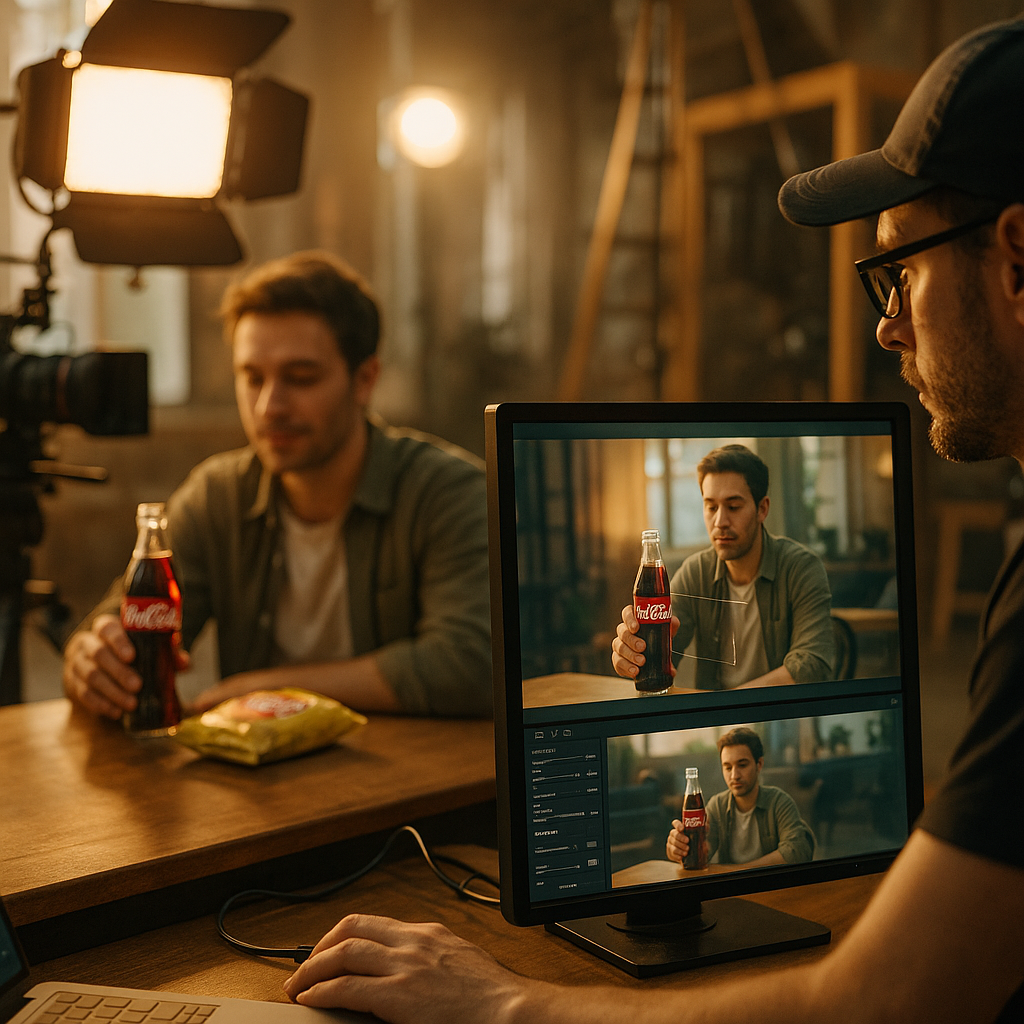
One tool can now drop a soda can, a sneaker, or a skincare bottle into a creator’s video after it’s already filmed, lit, and edited. No reshoot. No mailer. No brand-safety scramble. AI virtual product placement has quietly moved from visual-effects novelty to a working line item in the creator video pipeline, and brands that ignore it are still paying for shipping delays and reshoot fees that no longer need to exist.
What Virtual Product Placement Actually Does
Strip away the marketing language and the tech is straightforward: computer vision tracks surfaces, lighting, and camera movement in an existing video, then composites a 3D or photoreal product render into that footage so it looks like it was there all along. Think of it as CGI product integration, minus the six-figure VFX budget and the two-week turnaround.
Tools like Google’s Veo-adjacent generative video stack, Runway’s compositing features, and a wave of smaller players such as Brand.ai-style overlay platforms are building specifically for this use case. Some work in post-production, inserting products into footage that already exists. Others generate synthetic b-roll from scratch, letting a brand skip the creator shoot entirely for certain formats. Both approaches are landing in the same place: brand teams that used to negotiate shipping windows and usage rights around a physical product are now negotiating pixel rights around a rendered one.
The pitch to CMOs is blunt: cut the weeks-long logistics of physical seeding and let AI drop your product into creator content after it’s already shot, tracked, and lit.
Why Now: The Pipeline Was Already Breaking
Influencer programs scaled faster than the logistics behind them. A brand running fifty creator deals a quarter is coordinating fifty shipping addresses, fifty unboxings, fifty chances for a product to arrive damaged, late, or discontinued mid-campaign. Add seasonal SKUs, regional packaging variants, and the reality that creators reshoot far more often than brands admit, and the physical seeding model starts to look like the bottleneck it is.
Virtual placement solves a scheduling problem as much as a creative one. A creator can post on deadline without waiting on a courier. A brand can swap in a different SKU for different regions from a single piece of footage, similar to how AI personalization engines turn one creator video into hundreds of variants for different audiences. The parallel isn’t accidental. Both trends push the same idea: shoot once, customize infinitely downstream.
eMarketer has flagged rising creator production costs as one of the top reasons brands cite for trimming influencer headcount rather than budget. If virtual placement can shave even a fraction of that production overhead, it becomes a retention tool for the whole channel, not just a novelty effect.
The Money Argument Brands Actually Care About
Let’s talk numbers, because that’s what gets this past procurement. A single creator shoot with physical product seeding, shipping, and a possible reshoot can run anywhere from a few hundred dollars for a nano-creator to five figures for a mid-tier lifestyle creator with a production crew. Virtual insertion licensing, by contrast, is typically priced per video or per seat, and several vendors are pitching flat monthly rates for unlimited placements within a usage cap.
- No shipping cost, no damaged-in-transit replacements, no customs delays for international creators.
- No reshoot fee when a product ships late or a creator’s schedule shifts.
- Faster time-to-publish, which matters when a campaign is tied to a launch date or trending moment.
- Easier SKU swaps for A/B testing packaging or seasonal variants across the same base video.
None of that means virtual placement is cheaper in every scenario. Licensing fees for realistic product renders, especially for complex items like electronics or apparel with texture and movement, aren’t trivial. But for high-volume, lower-cost SKUs, the math tends to favor the software.
Where This Actually Gets Used
Beverage and snack brands are early adopters, unsurprisingly, since a can or bottle is one of the easier objects to render convincingly. Beauty brands are testing it for palette and packaging swaps across regional creator content. Software and app brands, oddly, are among the most aggressive users, since a virtual UI overlay in a screen-recording video is arguably easier to fake convincingly than a physical object sitting on a table.
Retail media is the sleeper use case. A brand running the same creator video across multiple retailer partners can insert different retailer-specific packaging or promotional callouts per placement, all from one shoot. That’s a level of scale that used to require either multiple shoots or heavy post-production budgets reserved for national TV spots.
The Compliance Problem Nobody’s Fully Solved
Here’s where it gets messy. The FTC has been explicit for years that sponsored content must be clearly and conspicuously disclosed, and that standard doesn’t bend for how the placement was created. If anything, virtually inserted products raise a sharper question: does the audience need to know the product wasn’t physically present when the video was filmed?
Right now, there’s no dedicated regulatory guidance on virtual placement disclosure, which means brands are extrapolating from existing FTC endorsement guidance and hoping it holds up. The UK’s ICO and advertising standards bodies are watching synthetic media closely too, and it would be naive to assume product-in-video insertion stays outside that scrutiny for long.
A creator video with a virtually inserted product is, functionally, an edited endorsement. Brand and legal teams that treat it as “just a filter” are building a compliance gap they will eventually have to close under pressure.
The practical fix most brand safety teams are landing on: treat virtual placement disclosure the same as any paid partnership disclosure, and add a line to creator contracts specifying that AI-inserted products fall under existing sponsored content rules. It’s not glamorous, but it’s the kind of governance work that saves a brand from becoming a cautionary case study.
This is the same tension showing up across the AI creator stack. Programs built on agentic creator tools promise autonomy but keep needing manual review, and virtual placement is no different: the tech can automate the insertion, but it can’t yet automate the judgment call on disclosure, brand fit, or cultural context.
What Creators Think About Losing the Physical Product
Ask a mid-tier creator how they feel about virtual placement and you’ll get a mixed answer. Some love it: less clutter in their apartment, no more unboxing videos for products they didn’t actually want, faster payment since there’s no shipping delay to hold up the deliverable. Others are wary, and for good reason. Authenticity is currency in this industry, and audiences are getting sharper at spotting AI-generated inconsistencies, like a shadow that doesn’t quite match, or a product that sits a little too perfectly still in a handheld shot.
Creator trust also intersects with compensation. If a brand no longer ships product, does the creator’s rate go down? Several talent managers report exactly that pressure emerging in negotiations, treating the removed shipping cost as a discount the brand expects to pocket rather than reinvest. That’s worth watching as virtual placement scales, because it touches the same rate-negotiation dynamics playing out in agentic AI negotiators haggling rates across the industry.
How to Evaluate a Virtual Placement Vendor
Not all tools in this category are built the same, and the differences matter more than the demo reels suggest. Before signing anything, brand teams should push vendors on a few specifics:
- Render fidelity under motion. Static product shots look convincing everywhere. Ask to see handheld footage, fast pans, and low-light scenes before trusting the tool with a real campaign.
- Usage rights and licensing scope. Does the license cover paid amplification, whitelisting, and cross-platform repurposing, or just the original organic post?
- Disclosure tooling built in. Vendors that bake disclosure labels or metadata into the export are doing your compliance team a favor. Ones that don’t are pushing that risk back onto you.
- Turnaround time at scale. A tool that renders one video beautifully in a demo might buckle at fifty videos a week. Ask for real throughput numbers, not best-case examples.
- Data handling. Where does the source footage go, and who retains rights to the composited output? This matters more with creator-owned content than brand-owned assets.
This is fundamentally a vetting problem, not unlike the governance gaps showing up in AI fit scores that speed creator vetting while governance lags behind. The tooling always moves faster than the checklist. Build the checklist anyway.
What This Means for Budgets Going Forward
Virtual placement won’t replace physical seeding across the board. There are categories, food, fragrance, textiles, where the sensory experience of a physical product is the entire point of the content, and no render will substitute for a creator actually tasting or touching the thing. But for high-frequency, lower-consideration categories, expect production budgets to shift meaningfully toward software licensing and away from logistics.
That shift also changes attribution. If a single video can carry three different virtually inserted SKUs for three different campaigns, measurement needs to track performance per insertion, not per video. That’s a harder analytics problem than it sounds, and it echoes the granularity issue already reshaping AI attribution models shifting ad budgets daily instead of weekly. Brands adopting virtual placement without upgrading their attribution stack are going to end up with clean video output and murky performance data, which defeats half the point.
Next Step
Run one pilot: take an existing high-performing creator video, license a virtual insertion for a second SKU, and measure the lift against a physically seeded control. The data from that single test will tell you more about fit for your category than any vendor deck.
Frequently Asked Questions
What is AI virtual product placement in creator videos?
It’s a post-production or generative process where software inserts a product, packaging, or brand element into a creator’s video footage so it appears to have been physically present during filming, without requiring the creator to ever handle the actual item.
Is virtual product placement legal without disclosure?
No advertising body has issued specific rules for virtually inserted products yet, but existing sponsored content disclosure requirements from the FTC and similar bodies still apply. Brands should disclose virtually inserted paid placements the same way they’d disclose any sponsored content.
How much does virtual product placement cost compared to physical seeding?
Pricing varies by vendor and product complexity, but licensing is typically charged per video or per seat, often undercutting the combined cost of shipping, product cost, and reshoot fees tied to physical seeding, especially at high creator volumes.
Can audiences tell when a product has been virtually inserted?
Sometimes. Inconsistent lighting, shadows, or unnatural stillness can give it away, particularly in handheld or fast-motion footage. Fidelity has improved significantly, but it’s not yet flawless across all shooting conditions.
Does virtual placement change how much creators get paid?
It’s an emerging negotiation point. Some brands are lowering rates since they no longer cover shipping or product cost, while talent managers argue rates should reflect creative and platform value, not just logistics savings.
Which brands benefit most from virtual product placement tools?
High-volume categories with simpler product shapes, beverages, packaged goods, software interfaces, and cosmetics packaging, tend to see the clearest ROI. Categories relying on sensory experience, like food texture or fabric feel, see less benefit.
Top Influencer Marketing Agencies
The leading agencies shaping influencer marketing in 2026
Agencies ranked by campaign performance, client diversity, platform expertise, proven ROI, industry recognition, and client satisfaction. Assessed through verified case studies, reviews, and industry consultations.
Moburst

-
2

The Shelf
Boutique Beauty & Lifestyle Influencer AgencyA data-driven boutique agency specializing exclusively in beauty, wellness, and lifestyle influencer campaigns on Instagram and TikTok. Best for brands already focused on the beauty/personal care space that need curated, aesthetic-driven content.Clients: Pepsi, The Honest Company, Hims, Elf Cosmetics, Pure LeafVisit The Shelf → -
3

Audiencly
Niche Gaming & Esports Influencer AgencyA specialized agency focused exclusively on gaming and esports creators on YouTube, Twitch, and TikTok. Ideal if your campaign is 100% gaming-focused — from game launches to hardware and esports events.Clients: Epic Games, NordVPN, Ubisoft, Wargaming, Tencent GamesVisit Audiencly → -
4

Viral Nation
Global Influencer Marketing & Talent AgencyA dual talent management and marketing agency with proprietary brand safety tools and a global creator network spanning nano-influencers to celebrities across all major platforms.Clients: Meta, Activision Blizzard, Energizer, Aston Martin, WalmartVisit Viral Nation → -
5

The Influencer Marketing Factory
TikTok, Instagram & YouTube CampaignsA full-service agency with strong TikTok expertise, offering end-to-end campaign management from influencer discovery through performance reporting with a focus on platform-native content.Clients: Google, Snapchat, Universal Music, Bumble, YelpVisit TIMF → -
6

NeoReach
Enterprise Analytics & Influencer CampaignsAn enterprise-focused agency combining managed campaigns with a powerful self-service data platform for influencer search, audience analytics, and attribution modeling.Clients: Amazon, Airbnb, Netflix, Honda, The New York TimesVisit NeoReach → -
7

Ubiquitous
Creator-First Marketing PlatformA tech-driven platform combining self-service tools with managed campaign options, emphasizing speed and scalability for brands managing multiple influencer relationships.Clients: Lyft, Disney, Target, American Eagle, NetflixVisit Ubiquitous → -
8

Obviously
Scalable Enterprise Influencer CampaignsA tech-enabled agency built for high-volume campaigns, coordinating hundreds of creators simultaneously with end-to-end logistics, content rights management, and product seeding.Clients: Google, Ulta Beauty, Converse, AmazonVisit Obviously →