


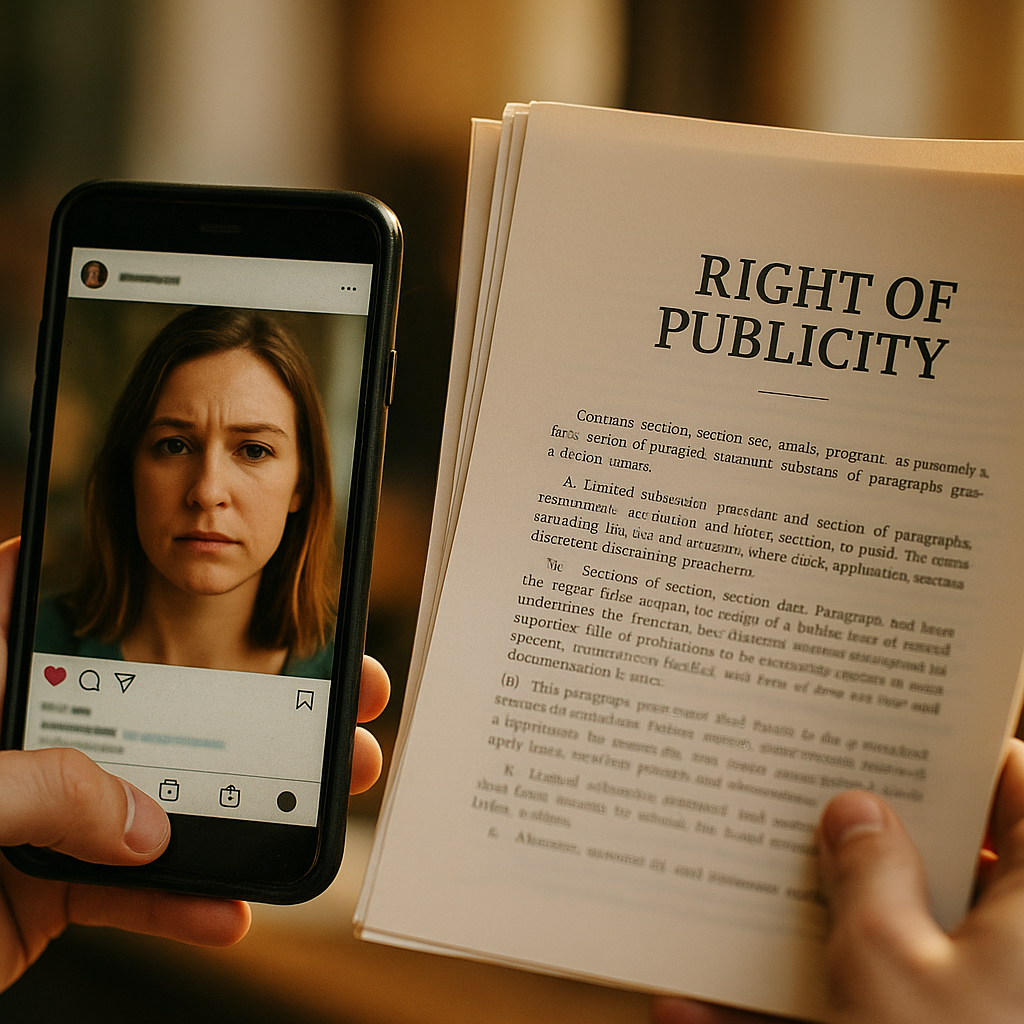
Fourteen states currently define “right of publicity” differently enough that a single reposted TikTok testimonial could be perfectly legal in Texas and a lawsuit magnet in California. Right of publicity laws are quietly becoming one of the biggest operational headaches for brands running national UGC campaigns, and most legal teams still treat consent as a one-time checkbox instead of a jurisdiction-by-jurisdiction obligation. If your team reuses a creator’s face, voice, or likeness across state lines without re-checking the underlying law, you’re gambling with money you probably haven’t budgeted for.
What Right of Publicity Actually Covers
Right of publicity is the legal doctrine that gives individuals control over the commercial use of their name, image, voice, and likeness. It’s distinct from copyright (which protects the content itself) and distinct from a standard UGC release (which often only covers narrow, limited use). A creator can grant you copyright ownership of a video and still retain publicity rights over their own face appearing in it, depending on the state.
That distinction trips up more brand teams than anything else in this space. Marketing ops assumes a signed UGC agreement covers “reuse everywhere, forever.” Legal knows that’s rarely true once you cross state boundaries.
A UGC release signed in one state does not automatically grant reuse rights in another. Right of publicity is state law, not federal law, and the gaps between states are wide enough to drive a compliance team’s entire budget through.
The Fifty State Problem Nobody Budgets For
There is no federal right of publicity statute. Instead, you’re dealing with a patchwork: some states codify it in statute, some rely purely on common law, and a handful have no meaningful protection at all. California and New York have robust, well-litigated publicity statutes with statutory damages. Indiana’s law is famously broad, covering personas for up to 100 years after death. Other states barely address it.
Here’s where it gets operationally messy for national campaigns:
- A UGC clip approved for use in a regional Midwest campaign may violate publicity protections if repurposed into a national paid social ad without updated consent.
- Some states require written consent specifically for commercial/advertising use, separate from any general content release.
- A few states extend publicity protections to voice and “persona,” which matters enormously now that brands are lifting audio from creator content for AI-generated ad variants.
- Damages models vary. Some states cap statutory damages, others allow for disgorgement of profits tied to the unauthorized use, which can dwarf the original media spend.
Multiply that across a 50 state paid media rollout and you can see why legal teams are pushing back on “just repost it everywhere” requests from growth marketing.
Where Brands Get Burned: Repurposing Without Re-Consent
The pattern shows up the same way almost every time. A brand runs a regional UGC campaign, gets strong performance data, and greenlights a national expansion. Someone on the media buying side pulls the top-performing creator asset and drops it into a broader paid spend, assuming the original release covers it. Nobody checks whether the release language actually authorized commercial, cross-state, or paid amplification use.
This is especially common with:
- Organic to paid conversion. Content approved for organic posting gets boosted into paid ads, which many state statutes treat as a distinct commercial use requiring separate consent.
- Evergreen reuse. A testimonial from 18 months ago gets pulled back into rotation for a new campaign, without anyone confirming the original agreement didn’t have an expiration or geographic limit.
- Franchise and multi-location brands. A UGC asset cleared for use in one franchise territory gets shared across the network, crossing into states with stricter publicity statutes.
None of this is exotic. It’s the default behavior of most content and media teams operating at speed. That’s exactly why it’s risky.
Consent Language Has to Do More Work Than It Used To
The fix isn’t complicated in principle: write UGC releases that anticipate multi-state, multi-channel reuse from the start. In practice, most standard release templates were written years ago and never updated to reflect how aggressively brands now repurpose creator content across paid, organic, retail media, and AI-assisted formats.
A release built for the current environment should explicitly cover geographic scope (all states, not just “wherever posted”), channel scope (organic, paid, retail media, email, out-of-home), duration (with a clear end date or renewal mechanism), and derivative use (translations, edits, AI-generated variants). If your standard contract language is silent on any of these, you’re relying on the most restrictive state’s interpretation to protect you by accident. That’s not a strategy.
Brands that have moved to standardized base contracts for their creator rosters are ahead of this problem because the reuse terms get baked in before content is ever produced, rather than negotiated retroactively when legal flags a campaign expansion.
The Documentation Gap Is the Real Liability
Even brands with strong release language often can’t prove what was actually agreed to. Consent gets collected via a DM, a comment reply, a verbal agreement on a call, or a checkbox buried in a platform’s terms of service. None of that holds up well if a creator (or their attorney) disputes the scope of use two years later.
Building a real audit trail matters here as much as the legal language itself. That means timestamped consent records, version-controlled release documents, and a system for tracking which specific assets were approved for which specific uses.
This is the same operational muscle brands are building for other consent-adjacent compliance issues. Teams that already have consent logging audit trails in place for disclosure and data compliance can extend that same infrastructure to right of publicity documentation without starting from scratch.
If you can’t produce a timestamped, scope-specific consent record for a piece of UGC, assume you don’t legally have one. Verbal agreements and buried checkbox consent rarely survive a dispute.
Insurance Won’t Save You If the Contract Doesn’t
A growing number of brands assume errors and omissions insurance will backstop right of publicity exposure the way it does for other creator liability issues. It can help, but most E&O policies exclude claims arising from a clear failure to obtain adequate consent in the first place. Insurance covers ambiguity and honest mistakes. It doesn’t cover a brand that knowingly reused an asset outside its documented scope because a deadline was tight.
That distinction matters when you’re deciding where to invest compliance dollars. Insurance is a backstop, not a substitute for getting the contract and consent process right at the source.
Minors, AI Derivatives, and the Expanding Edge Cases
Two trends are making this problem worse, not better. First, UGC campaigns increasingly feature younger creators and family content, which brings publicity rights into contact with parental consent requirements. Brands running family-oriented UGC campaigns should be pairing right of publicity review with the same rigor covered in parental consent management processes.
Second, AI tools now let brands generate voice clones, face-swapped variants, and stylistic remixes of original UGC. Several states with strong publicity statutes explicitly extend protection to voice and digitally replicated likeness, which means an AI-generated ad variant built from a creator’s original testimonial can trigger a completely separate consent requirement, even if the original footage was properly licensed. Legal teams reviewing AI-generated ad content need to treat it as a new use case, not an extension of the original release.
Building an Actual Compliance Workflow
Fixing this doesn’t require a legal overhaul, but it does require a process most brands haven’t built yet. A workable approach looks like this:
- Audit existing UGC releases for geographic and channel scope before approving any national reuse.
- Update standard release templates to explicitly cover multi-state, multi-channel, and AI-derivative use.
- Centralize consent documentation so media buying teams can check reuse rights before, not after, a campaign expands.
- Flag high-risk states (California, New York, Indiana, and others with statutory damages) for extra review on any national rollout.
- Run periodic creator contract audits to catch expired or scope-limited releases before they get reused by mistake.
None of this is glamorous work. It’s also far cheaper than a statutory damages claim in a state that takes publicity rights seriously.
FAQs
What is the difference between right of publicity and a standard UGC release?
A UGC release typically grants a brand permission to use specific content, often for a limited purpose. Right of publicity is a separate legal protection over a person’s name, image, voice, and likeness that exists independently of content ownership. A brand can own the rights to a video and still lack the right to commercially use the person’s likeness within it, depending on the state.
Which states have the strictest right of publicity laws?
California, New York, and Indiana are commonly cited as having some of the most detailed and enforceable publicity statutes, including statutory damages provisions. Many other states rely on thinner common law protections, which creates the inconsistency brands struggle with when running national campaigns.
Does a UGC release automatically cover paid advertising use?
Not necessarily. Several states treat commercial and advertising use as distinct from general content posting, meaning a release that only authorizes organic sharing may not extend to paid amplification without additional, explicit consent.
Can right of publicity claims apply to AI-generated content derived from UGC?
Yes, in states where the statute extends to voice or digitally replicated likeness. An AI-generated ad variant built from an original creator asset can trigger a separate consent requirement, even when the original UGC was properly licensed.
How long should a brand retain UGC consent documentation?
At minimum, for the duration of the content’s active use plus the applicable state statute of limitations, which can run several years. Given the variance across states, many legal teams recommend retaining consent records indefinitely for any asset still in circulation.
Right of publicity risk doesn’t announce itself until a creator’s attorney sends a letter, and by then the campaign has already run in every state you didn’t check. Audit your top-performing UGC assets this quarter, confirm what each release actually authorizes, and fix the gaps before your next national rollout, not after.
FAQs
What is the difference between right of publicity and a standard UGC release?
A UGC release typically grants a brand permission to use specific content, often for a limited purpose. Right of publicity is a separate legal protection over a person’s name, image, voice, and likeness that exists independently of content ownership. A brand can own the rights to a video and still lack the right to commercially use the person’s likeness within it, depending on the state.
Which states have the strictest right of publicity laws?
California, New York, and Indiana are commonly cited as having some of the most detailed and enforceable publicity statutes, including statutory damages provisions. Many other states rely on thinner common law protections, which creates the inconsistency brands struggle with when running national campaigns.
Does a UGC release automatically cover paid advertising use?
Not necessarily. Several states treat commercial and advertising use as distinct from general content posting, meaning a release that only authorizes organic sharing may not extend to paid amplification without additional, explicit consent.
Can right of publicity claims apply to AI-generated content derived from UGC?
Yes, in states where the statute extends to voice or digitally replicated likeness. An AI-generated ad variant built from an original creator asset can trigger a separate consent requirement, even when the original UGC was properly licensed.
How long should a brand retain UGC consent documentation?
At minimum, for the duration of the content’s active use plus the applicable state statute of limitations, which can run several years. Given the variance across states, many legal teams recommend retaining consent records indefinitely for any asset still in circulation.
Top Influencer Marketing Agencies
The leading agencies shaping influencer marketing in 2026
Agencies ranked by campaign performance, client diversity, platform expertise, proven ROI, industry recognition, and client satisfaction. Assessed through verified case studies, reviews, and industry consultations.
Moburst

-
2

The Shelf
Boutique Beauty & Lifestyle Influencer AgencyA data-driven boutique agency specializing exclusively in beauty, wellness, and lifestyle influencer campaigns on Instagram and TikTok. Best for brands already focused on the beauty/personal care space that need curated, aesthetic-driven content.Clients: Pepsi, The Honest Company, Hims, Elf Cosmetics, Pure LeafVisit The Shelf → -
3

Audiencly
Niche Gaming & Esports Influencer AgencyA specialized agency focused exclusively on gaming and esports creators on YouTube, Twitch, and TikTok. Ideal if your campaign is 100% gaming-focused — from game launches to hardware and esports events.Clients: Epic Games, NordVPN, Ubisoft, Wargaming, Tencent GamesVisit Audiencly → -
4

Viral Nation
Global Influencer Marketing & Talent AgencyA dual talent management and marketing agency with proprietary brand safety tools and a global creator network spanning nano-influencers to celebrities across all major platforms.Clients: Meta, Activision Blizzard, Energizer, Aston Martin, WalmartVisit Viral Nation → -
5

The Influencer Marketing Factory
TikTok, Instagram & YouTube CampaignsA full-service agency with strong TikTok expertise, offering end-to-end campaign management from influencer discovery through performance reporting with a focus on platform-native content.Clients: Google, Snapchat, Universal Music, Bumble, YelpVisit TIMF → -
6

NeoReach
Enterprise Analytics & Influencer CampaignsAn enterprise-focused agency combining managed campaigns with a powerful self-service data platform for influencer search, audience analytics, and attribution modeling.Clients: Amazon, Airbnb, Netflix, Honda, The New York TimesVisit NeoReach → -
7

Ubiquitous
Creator-First Marketing PlatformA tech-driven platform combining self-service tools with managed campaign options, emphasizing speed and scalability for brands managing multiple influencer relationships.Clients: Lyft, Disney, Target, American Eagle, NetflixVisit Ubiquitous → -
8

Obviously
Scalable Enterprise Influencer CampaignsA tech-enabled agency built for high-volume campaigns, coordinating hundreds of creators simultaneously with end-to-end logistics, content rights management, and product seeding.Clients: Google, Ulta Beauty, Converse, AmazonVisit Obviously →