


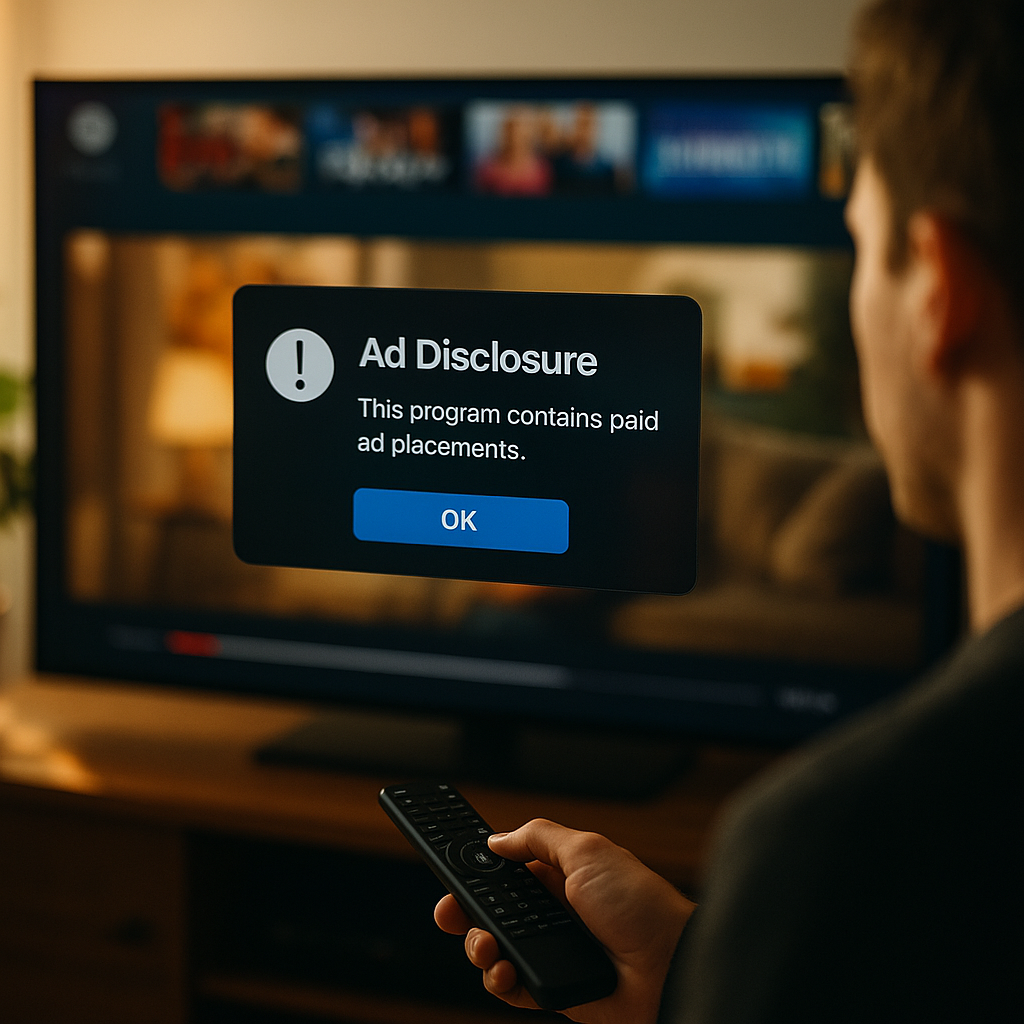
Only 12% of shoppable CTV ads carry a disclosure that would survive an FTC audit. That’s not a guess, it’s the pattern compliance teams keep finding when they actually pull creative from Roku Channel, Amazon Fire TV, and YouTube CTV placements. Brands have spent three years perfecting influencer disclosure on Instagram and TikTok, then walked into streaming with zero playbook. Streaming platform native ad disclosure rules are stricter, less forgiving, and structured completely differently than social media, and most marketing teams don’t realize it until a complaint lands.
Why OTT Disclosure Isn’t Just “Social Rules on a Bigger Screen”
Here’s the mistake we see constantly: a brand’s legal team signs off on influencer disclosure language built for Instagram captions and TikTok on-screen text, then that same language gets ported into a connected TV buy without modification. The problem is structural. Social platforms give creators a caption field, a comment section, and persistent on-screen text tools. OTT environments often don’t.
Connected TV ads run in fixed pods. Shoppable overlays on FAST channels (free ad-supported streaming TV) have limited real estate and, on some devices, no persistent text at all. A disclosure that works perfectly on a nine-second TikTok clip becomes unreadable, or entirely absent, when that same creator content gets repurposed into a 30-second CTV spot or a branded FAST channel segment.
Repurposing influencer content into CTV or FAST channel placements without re-evaluating disclosure format is one of the fastest ways to convert a compliant social post into a non-compliant streaming ad.
The FTC has been explicit that disclosures must be “clear and conspicuous” in whatever format the ad ultimately appears, not just in its original context. That guidance predates streaming’s boom, but it applies with full force. Review the FTC’s endorsement guidance and you’ll find nothing that exempts CTV, FAST channels, or shoppable streaming formats from the same clear-and-conspicuous standard applied to a blog post.
The Format Gap Nobody Budgets For
Three formats keep tripping up brands:
- Shoppable CTV overlays. QR codes or “buy now” prompts that appear over creator-produced content, often stripped of the original disclosure that ran on the social version.
- FAST channel branded segments. Long-form influencer content repackaged into a dedicated channel (think Roku Channel or Samsung TV Plus branded rows) where the sponsorship relationship gets buried in channel metadata instead of on-screen.
- Addressable ad insertion. Programmatic CTV buys that swap in different creative per household, sometimes without carrying forward the disclosure baked into the original creative asset.
Each of these formats has its own technical constraints, and each requires its own disclosure treatment. A single “as seen on TikTok” tag copied across all three doesn’t cut it.
Platform Policies Are Inconsistent, and That’s the Real Risk
Unlike Meta or TikTok, which publish detailed branded content policies, most streaming platforms treat sponsorship disclosure as a general ad-standards issue rather than an influencer-specific one. YouTube’s CTV inventory follows the same paid promotion rules as its main platform, which you can confirm through Google’s advertising policy help center, but Roku, Amazon, Samsung, and Vizio each maintain separate ad content guidelines with varying levels of specificity around influencer or creator-sourced material.
That inconsistency creates a false sense of safety. Brands assume that if a placement passed platform ad review, it must be compliant. Ad review checks for content standards, not FTC disclosure adequacy. Those are two different bars, and platforms generally don’t hold your brand’s regulatory hand.
This mirrors a pattern already well documented in social. Our coverage of native ad disclosure placement found the same dynamic: platform approval and legal compliance are not the same gate, and treating them as interchangeable is how brands end up exposed.
What “Clear and Conspicuous” Means When There’s No Comment Section
On streaming, you generally lose the layered disclosure options social gives you (caption, on-screen text, verbal mention, hashtag). That means the disclosure that does appear has to work harder. Practical standards worth building into your CTV production brief:
- On-screen disclosure text must persist for the full duration a reasonable viewer would need to read it, not flash for one second at the start.
- Verbal disclosure (“this video is sponsored by…”) should accompany on-screen text wherever the platform’s audio track allows it, since accessibility and second-screen viewing both reduce the chance a viewer reads text alone.
- Shoppable overlay CTAs need disclosure language adjacent to the CTA itself, not buried in a channel description page the viewer never visits.
None of this is exotic. It’s the same clear-and-conspicuous logic marketers already apply to influencer live selling disclosure requirements, just adapted for a screen with different constraints.
Repurposed Creator Content Is the Biggest Blind Spot
Ask most media teams where their CTV creative comes from and you’ll hear the same answer: it’s repurposed influencer content, often licensed or whitelisted from a creator partnership that started on Instagram or TikTok. That repurposing pipeline is exactly where disclosure falls apart.
When a brand licenses creator content for paid media distribution, whether through Meta’s Partnership Ads tools, TikTok Spark Ads, or a direct whitelisting agreement, the underlying disclosure obligation travels with the content. It doesn’t reset just because the destination changed from a social feed to a CTV ad pod. Yet production teams handling the CTV cut often aren’t the same people who negotiated the original creator contract, and disclosure language gets lost in the handoff.
This is a contract problem as much as a creative one. If your creator agreements don’t explicitly address downstream repurposing into streaming and FAST channel environments, you’re relying on goodwill rather than obligation. Brands that have tightened their standardized base contracts are already ahead here, because they’ve built repurposing rights and disclosure continuity into the master agreement instead of negotiating it per campaign.
AI-Generated and AI-Edited Creative Adds Another Layer
Streaming buys increasingly run through programmatic pipelines that auto-generate creative variants, resize assets, or use AI tools to cut long-form content into shorter CTV spots. If disclosure text lives in a specific frame range that an automated editing tool trims out, the disclosure disappears without anyone noticing until after launch. This is the same liability pattern flagged in our review of AI-generated influencer ad liability: automation moves faster than compliance review, and nobody is explicitly assigned to catch the gap.
Building an OTT Disclosure Audit Into Your Workflow
Most brands don’t have a checkpoint dedicated to streaming disclosure. It usually gets absorbed into general ad trafficking QA, which isn’t built to catch FTC-specific issues. A better approach:
- Require a disclosure sign-off step specifically for any creative repurposed from social into CTV, FAST, or addressable TV formats.
- Maintain a per-platform disclosure spec sheet (Roku, Amazon, Samsung, YouTube CTV, Vizio) since screen real estate and text persistence rules vary by device and ad server.
- Audit programmatic creative variants after automated resizing or editing, not just the master asset.
- Extend your existing FTC compliance audit process to cover streaming placements as a distinct line item rather than folding it into general influencer audits.
Data from eMarketer shows CTV ad spend continuing to climb as brands shift budget out of linear TV, and much of that growth is flowing toward shoppable and influencer-adjacent formats. Statista tracking of FAST channel viewership shows similar momentum. Spend is moving into streaming faster than compliance frameworks are catching up, which is precisely the gap creating exposure right now.
There’s a broader pattern worth watching too. Platform-level policy shifts have already been shown to quietly affect how much organic reach creator content gets, as we covered in how platform regulations affect organic reach. Streaming platforms are following the same trajectory: policy tightens first, enforcement follows, and brands caught flat-footed absorb the cost.
The Enforcement Reality Brands Underestimate
FTC enforcement actions against streaming-specific disclosure failures are still relatively rare compared to social media cases, and that scarcity breeds complacency. But rare doesn’t mean absent, and the agency has repeatedly stated that its endorsement guidelines are medium-neutral. A violation on a CTV placement carries the same legal exposure as one on Instagram, it’s just less litigated so far because enforcement resources have focused where volume is highest.
That will shift as CTV ad spend keeps growing. Brands that get ahead of it now, by building streaming-specific disclosure review into their compliance stack, avoid becoming the test case that sets precedent for everyone else.
Next step: Pull your last three CTV or FAST channel campaigns that used repurposed influencer content, check whether the original disclosure survived the format conversion, and if it didn’t, fix the production handoff before your next streaming buy goes live.
Frequently Asked Questions
Do FTC disclosure rules apply to streaming and CTV ads the same way they apply to social media?
Yes. The FTC’s endorsement guidelines are medium-neutral, meaning the clear-and-conspicuous standard applies regardless of whether the ad runs on Instagram, TikTok, connected TV, or a FAST channel.
Why does repurposing influencer content into CTV ads create disclosure risk?
Disclosure language designed for a social caption or on-screen text overlay often doesn’t survive the resizing, editing, or automated trimming used to convert content into a CTV spot, leaving the final ad without adequate disclosure.
Do streaming platforms like Roku or Amazon enforce their own disclosure requirements?
Most enforce general ad content standards rather than influencer-specific disclosure rules, so passing platform ad review does not guarantee FTC compliance. Brands need a separate compliance check.
What’s the biggest disclosure mistake brands make on shoppable CTV ads?
Placing disclosure language somewhere the viewer isn’t looking, such as a channel description page, instead of adjacent to the on-screen shoppable call to action itself.
Should creator contracts explicitly cover streaming and FAST channel repurposing?
Yes. Contracts should specify that disclosure obligations travel with the content into any downstream format, including CTV, FAST channels, and programmatic ad variants, not just the original social placement.
Top Influencer Marketing Agencies
The leading agencies shaping influencer marketing in 2026
Agencies ranked by campaign performance, client diversity, platform expertise, proven ROI, industry recognition, and client satisfaction. Assessed through verified case studies, reviews, and industry consultations.
Moburst

-
2

The Shelf
Boutique Beauty & Lifestyle Influencer AgencyA data-driven boutique agency specializing exclusively in beauty, wellness, and lifestyle influencer campaigns on Instagram and TikTok. Best for brands already focused on the beauty/personal care space that need curated, aesthetic-driven content.Clients: Pepsi, The Honest Company, Hims, Elf Cosmetics, Pure LeafVisit The Shelf → -
3

Audiencly
Niche Gaming & Esports Influencer AgencyA specialized agency focused exclusively on gaming and esports creators on YouTube, Twitch, and TikTok. Ideal if your campaign is 100% gaming-focused — from game launches to hardware and esports events.Clients: Epic Games, NordVPN, Ubisoft, Wargaming, Tencent GamesVisit Audiencly → -
4

Viral Nation
Global Influencer Marketing & Talent AgencyA dual talent management and marketing agency with proprietary brand safety tools and a global creator network spanning nano-influencers to celebrities across all major platforms.Clients: Meta, Activision Blizzard, Energizer, Aston Martin, WalmartVisit Viral Nation → -
5

The Influencer Marketing Factory
TikTok, Instagram & YouTube CampaignsA full-service agency with strong TikTok expertise, offering end-to-end campaign management from influencer discovery through performance reporting with a focus on platform-native content.Clients: Google, Snapchat, Universal Music, Bumble, YelpVisit TIMF → -
6

NeoReach
Enterprise Analytics & Influencer CampaignsAn enterprise-focused agency combining managed campaigns with a powerful self-service data platform for influencer search, audience analytics, and attribution modeling.Clients: Amazon, Airbnb, Netflix, Honda, The New York TimesVisit NeoReach → -
7

Ubiquitous
Creator-First Marketing PlatformA tech-driven platform combining self-service tools with managed campaign options, emphasizing speed and scalability for brands managing multiple influencer relationships.Clients: Lyft, Disney, Target, American Eagle, NetflixVisit Ubiquitous → -
8

Obviously
Scalable Enterprise Influencer CampaignsA tech-enabled agency built for high-volume campaigns, coordinating hundreds of creators simultaneously with end-to-end logistics, content rights management, and product seeding.Clients: Google, Ulta Beauty, Converse, AmazonVisit Obviously →