


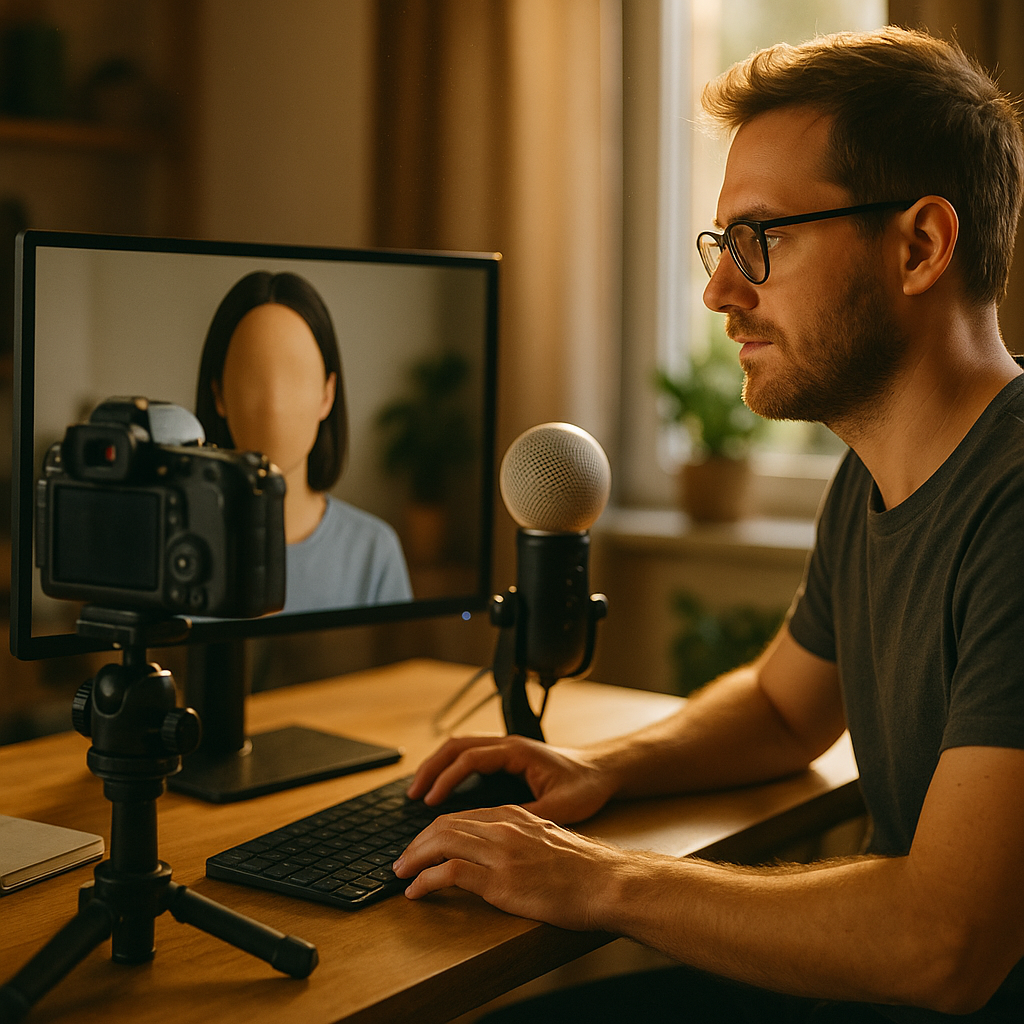
Ninety seconds of studio time versus three days of casting, coaching, and reshoots: that’s the gap AI avatar hosts have opened up in brand video production. A growing share of mid-market and enterprise marketing teams are now piloting AI avatar hosts, synthetic on-screen presenters that read scripts, front product explainers, and anchor social series without a single human talent contract. Faceless doesn’t mean lower quality anymore. It means scale without the burnout bill.
What Exactly Is an AI Avatar Host?
An AI avatar host is a synthetic, photorealistic or stylized on-screen presenter generated from text scripts, powered by tools like Synthesia, HeyGen, or D-ID. You type a script, pick a voice and face, and the platform renders a finished video in minutes. No lighting rig. No wardrobe. No talent fee negotiation at 11pm before a launch deadline.
This isn’t the uncanny-valley novelty act it was a few years ago. Enterprise brands in fintech, SaaS, and retail are using avatar hosts for product walkthroughs, onboarding tutorials, localized ad variants, and even recurring “news desk” style social series. The output looks less like a gimmick and more like a production line.
Why Creator Burnout Made This Format Inevitable
Ask any brand managing a always-on content calendar what their biggest bottleneck is, and the answer is rarely budget. It’s people. Creators and in-house talent get tired. They go on leave, they negotiate higher rates after a viral hit, they leave for competitors, and they occasionally say something off-brand on a livestream that legal has to scrub for a week. Every one of those human variables introduces risk and delay into a content operation that’s supposed to run like clockwork.
Brands running high-frequency formats, think daily explainer videos, weekly localized ad refreshes, or a rotating cast for serialized creator series, have felt this most acutely. The math doesn’t work when your fastest-growing channel needs ten new videos a week and your on-camera talent needs sleep, vacation, and a reasonable workload.
Faceless, avatar-led formats aren’t replacing creators wholesale. They’re absorbing the repetitive, high-volume production load that burns creators out in the first place.
That’s the operational thesis. AI avatar hosts don’t get sick, don’t renegotiate mid-campaign, and don’t need six takes because the lighting shifted. For the parts of a content calendar that are genuinely repetitive, an FAQ script read fifty different ways for fifty regional markets, a synthetic host is simply the more efficient tool.
Where the Format Actually Works (and Where It Doesn’t)
Avatar hosts shine in specific lanes. Product explainers, internal training, compliance disclosures, localization at scale, and recurring low-emotion formats like weekly stat roundups all translate well to synthetic presenters. Viewers expect information delivery, not intimacy, so the slightly-too-smooth avatar delivery doesn’t break trust.
Where it struggles is anywhere authenticity or lived experience is the entire point. A skincare transformation testimonial, a founder story, an unboxing reaction, these formats depend on visible human imperfection. That’s the same reason blooper reel marketing and unscripted diary formats keep outperforming polished ads. Audiences are getting sharper at spotting synthetic delivery, and using it in the wrong context reads as a shortcut, not innovation.
A useful rule of thumb: if the content’s job is to inform or explain, avatar hosts are fair game. If the content’s job is to prove a claim or build emotional trust, keep a human in front of the camera.
The ROI Case Marketing Leaders Are Actually Making
Budget owners aren’t adopting avatar hosts because it’s trendy. They’re adopting it because the unit economics of video production have been broken for years, and this is the first tool that meaningfully fixes it. A single script can be rendered into a dozen language variants without rebooking talent, without translation studio time, and without waiting on a creator’s schedule.
- Speed to publish: scripts to finished video in hours, not days.
- Localization at scale: one avatar, dozens of languages and accents, no dubbing studio.
- Consistency: the same “host” across every market and product line, no brand-voice drift.
- Lower legal exposure: no talent likeness disputes, no contract renewals, no scheduling conflicts.
Compare that to the traditional model: book a creator, brief them, shoot, review, revise, and republish for every regional variant. Teams already running format-agnostic distribution briefs to squeeze more value out of a single shoot will recognize the same logic here, just applied to production itself rather than distribution.
Marketers tracking spend closely should still benchmark this against creator-led content performance. Data from eMarketer continues to show creator-led video outperforming brand-produced content on trust metrics, so avatar hosts are best positioned as a volume play, not a full replacement for creator partnerships.
Disclosure, Trust, and the Compliance Question Nobody Can Skip
Here’s where legal and comms teams need to be in the room from day one. Synthetic media disclosure isn’t optional anymore, and regulators are paying attention. The FTC has been explicit that deceptive AI-generated endorsements and undisclosed synthetic media can trigger enforcement action under existing endorsement guidelines. The ICO in the UK has flagged similar concerns around transparency and consumer protection when AI-generated personas are used in marketing.
The practical fix is simple: label it. A visible “AI-generated presenter” tag or a spoken disclosure at the top of the video costs nothing and removes almost all of the downside risk. Brands that skip this step are betting that nobody notices, which is a bad bet given how fast audiences are learning to spot synthetic tells: overly even pacing, slightly mismatched blinking, audio that’s a touch too clean.
Undisclosed AI hosts aren’t just an ethics problem. They’re a trust liability that can undo years of brand credibility in a single viral callout post.
Platforms are catching up too. Meta and TikTok have both rolled out AI-content labeling requirements as part of their ad policies, so building disclosure into your production workflow now avoids a scramble later. Check current policy details directly on Meta for Business and TikTok Ads before launching a campaign at scale.
Briefing an Avatar Host Like You’d Brief a Human Presenter
The teams getting the best results treat avatar host scripting with the same rigor they’d apply to a human on-camera brief, not less. That means writing for spoken cadence, not written copy, keeping sentences short enough to sound natural, and testing pacing before a full production run. Brands already using vertical video style guides to keep editing consistent should extend those same guardrails to avatar scripts: tone, pacing, and visual framing all need documented standards.
It’s also worth pressure-testing scripts the way you’d test pacing briefs for watch time. Avatar delivery has zero natural hesitation or ad-libbed emphasis, so a script that reads fine on paper can sound robotic on playback. Run a short test render before committing to a full batch, and keep a human editor in the loop to catch tonal mismatches before publish.
One more operational note: avatar hosts don’t eliminate your approval bottleneck, they just move it earlier in the pipeline. If your team already struggles with creative approval bottlenecks, front-load script sign-off before rendering, because revising a finished avatar video still means a full re-render, not a quick reshoot.
What This Means for Human Creators Long Term
The honest answer is that avatar hosts and human creators aren’t competing for the same job. Creators bring lived experience, community trust, and the kind of unscripted authenticity that audiences actively seek out, the same reasons formats like silent vlogging and diary-style content keep winning engagement. Avatar hosts absorb the repetitive, high-volume, low-emotion production work that was never a good use of a creator’s time or personality anyway.
Smart brands are already splitting their content calendars this way: creators for anything requiring trust, story, or emotional resonance, avatar hosts for anything requiring volume, speed, or localization. That division of labor is likely to become standard operating procedure rather than a stopgap, especially as tools from HubSpot and social suites like Sprout Social add native support for managing hybrid human and synthetic content pipelines.
Next step: audit your content calendar this quarter and flag every format that’s purely informational, explainers, FAQs, localized ad copy. Pilot AI avatar hosts on that segment first, keep disclosure visible, and measure watch-through rate against your creator-led benchmark before scaling further.
FAQs
What is an AI avatar host in marketing content?
An AI avatar host is a synthetic, digitally generated on-screen presenter created from a text script using platforms like Synthesia, HeyGen, or D-ID. It delivers video content without requiring a human talent shoot.
Do brands need to disclose when a video uses an AI avatar host?
Yes. Regulatory bodies including the FTC expect clear disclosure of AI-generated endorsements and synthetic presenters, and major ad platforms like Meta and TikTok now require labeling of AI-generated content in ads.
Are AI avatar hosts cheaper than hiring creators?
For high-volume, repetitive formats like product explainers or localized ad variants, avatar hosts typically cost less per video because they eliminate reshoots, talent fees, and translation studio time. For trust-driven or emotional content, human creators still deliver stronger ROI.
Can AI avatar hosts replace human creators entirely?
No. They’re best suited to informational, repetitive, or high-volume content. Human creators remain more effective for authenticity-driven formats like testimonials, transformation content, and community-building series.
What content formats work best with AI avatar hosts?
Product explainers, internal training videos, compliance disclosures, recurring stat or news-style updates, and multi-language ad localization all perform well with synthetic presenters.
FAQs
What is an AI avatar host in marketing content?
An AI avatar host is a synthetic, digitally generated on-screen presenter created from a text script using platforms like Synthesia, HeyGen, or D-ID. It delivers video content without requiring a human talent shoot.
Do brands need to disclose when a video uses an AI avatar host?
Yes. Regulatory bodies including the FTC expect clear disclosure of AI-generated endorsements and synthetic presenters, and major ad platforms like Meta and TikTok now require labeling of AI-generated content in ads.
Are AI avatar hosts cheaper than hiring creators?
For high-volume, repetitive formats like product explainers or localized ad variants, avatar hosts typically cost less per video because they eliminate reshoots, talent fees, and translation studio time. For trust-driven or emotional content, human creators still deliver stronger ROI.
Can AI avatar hosts replace human creators entirely?
No. They’re best suited to informational, repetitive, or high-volume content. Human creators remain more effective for authenticity-driven formats like testimonials, transformation content, and community-building series.
What content formats work best with AI avatar hosts?
Product explainers, internal training videos, compliance disclosures, recurring stat or news-style updates, and multi-language ad localization all perform well with synthetic presenters.
Top Influencer Marketing Agencies
The leading agencies shaping influencer marketing in 2026
Agencies ranked by campaign performance, client diversity, platform expertise, proven ROI, industry recognition, and client satisfaction. Assessed through verified case studies, reviews, and industry consultations.
Moburst

-
2

The Shelf
Boutique Beauty & Lifestyle Influencer AgencyA data-driven boutique agency specializing exclusively in beauty, wellness, and lifestyle influencer campaigns on Instagram and TikTok. Best for brands already focused on the beauty/personal care space that need curated, aesthetic-driven content.Clients: Pepsi, The Honest Company, Hims, Elf Cosmetics, Pure LeafVisit The Shelf → -
3

Audiencly
Niche Gaming & Esports Influencer AgencyA specialized agency focused exclusively on gaming and esports creators on YouTube, Twitch, and TikTok. Ideal if your campaign is 100% gaming-focused — from game launches to hardware and esports events.Clients: Epic Games, NordVPN, Ubisoft, Wargaming, Tencent GamesVisit Audiencly → -
4

Viral Nation
Global Influencer Marketing & Talent AgencyA dual talent management and marketing agency with proprietary brand safety tools and a global creator network spanning nano-influencers to celebrities across all major platforms.Clients: Meta, Activision Blizzard, Energizer, Aston Martin, WalmartVisit Viral Nation → -
5

The Influencer Marketing Factory
TikTok, Instagram & YouTube CampaignsA full-service agency with strong TikTok expertise, offering end-to-end campaign management from influencer discovery through performance reporting with a focus on platform-native content.Clients: Google, Snapchat, Universal Music, Bumble, YelpVisit TIMF → -
6

NeoReach
Enterprise Analytics & Influencer CampaignsAn enterprise-focused agency combining managed campaigns with a powerful self-service data platform for influencer search, audience analytics, and attribution modeling.Clients: Amazon, Airbnb, Netflix, Honda, The New York TimesVisit NeoReach → -
7

Ubiquitous
Creator-First Marketing PlatformA tech-driven platform combining self-service tools with managed campaign options, emphasizing speed and scalability for brands managing multiple influencer relationships.Clients: Lyft, Disney, Target, American Eagle, NetflixVisit Ubiquitous → -
8

Obviously
Scalable Enterprise Influencer CampaignsA tech-enabled agency built for high-volume campaigns, coordinating hundreds of creators simultaneously with end-to-end logistics, content rights management, and product seeding.Clients: Google, Ulta Beauty, Converse, AmazonVisit Obviously →