


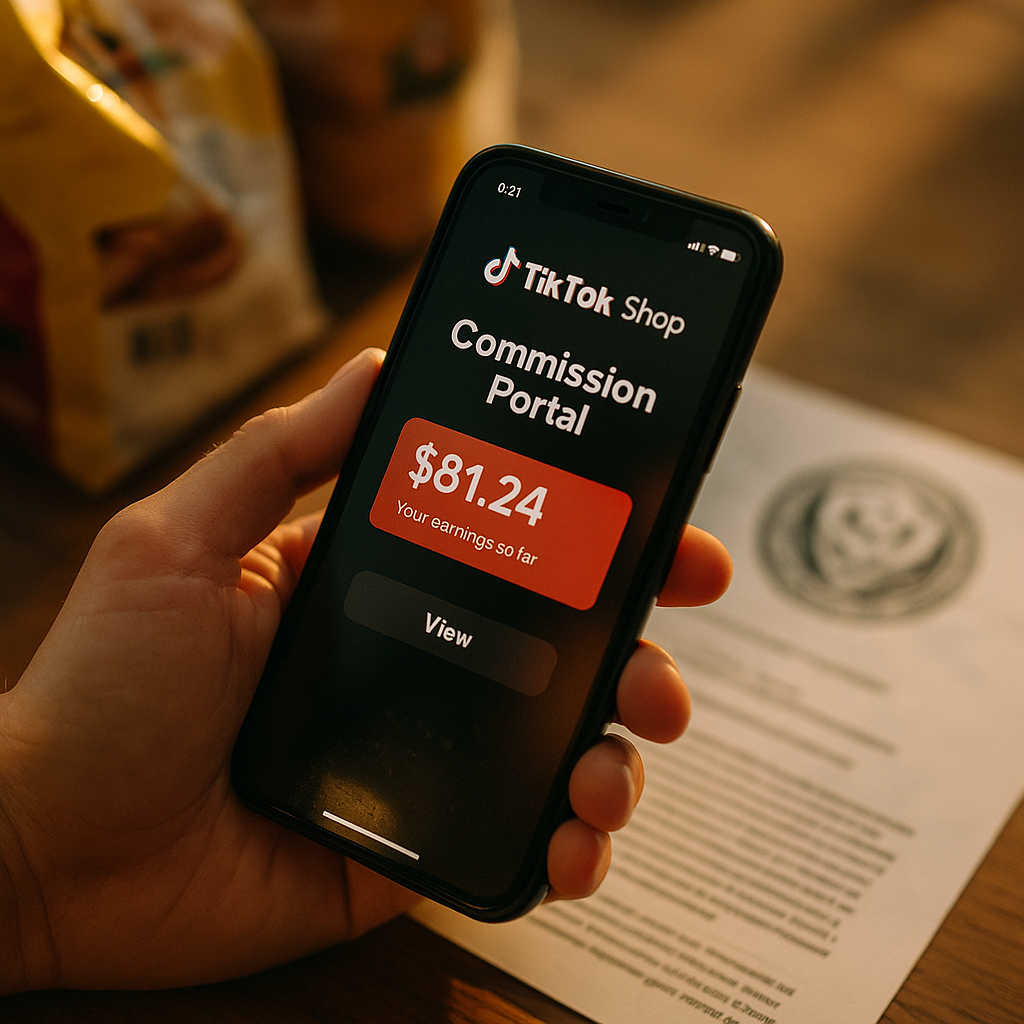
Roughly 40% of TikTok Shop creators earn commission on every sale their content drives, yet a shocking number never disclose that arrangement to viewers. That’s not a gray area. Under FTC endorsement guidelines, TikTok Shop platform commissions are textbook material compensation, and brands that treat affiliate payouts as “just how the platform works” are building their commerce strategy on a legal fault line.
What Counts as “Material Compensation” Under FTC Rules?
The FTC doesn’t care whether money changes hands upfront, on the back end, or never touches the creator’s bank account directly. Its Endorsement Guides define material connection broadly: any relationship that might affect how much weight a consumer gives an endorsement. Cash payments count. Free product counts. And yes, commission on sales absolutely counts.
Here’s the part brands keep getting wrong. Many marketing teams assume disclosure obligations only kick in when a brand directly pays a flat fee for a sponsored post. TikTok Shop’s affiliate model doesn’t work that way. Creators join the Shop’s affiliate program, browse a catalog, tag products in organic-looking videos, and earn a percentage when a viewer buys through their link. No contract negotiation. No invoice. Just a commission rate set by the seller and an algorithm that rewards conversion.
That structure feels informal. The FTC doesn’t see it that way. A commission arrangement is a financial relationship between the creator and the brand (or seller) whose product is being pushed, full stop. Whether the payout is $12 or $12,000 doesn’t change the disclosure requirement.
If a creator stands to profit from every click, the FTC treats that as material compensation, regardless of whether the brand ever signed a formal contract with them.
TikTok Shop’s Commission Structure Muddies the Disclosure Line
TikTok Shop was designed for velocity. Sellers set commission rates, creators opt in, and content goes live within minutes. That speed is the entire value proposition for brands chasing conversion, but it’s also exactly what makes compliance oversight so difficult.
Compare it to a traditional influencer contract, where legal review, disclosure language, and content approval happen before anything publishes. TikTok Shop’s affiliate marketplace skips most of that. A creator can add your product to their showcase, film a haul video, and earn commission without ever discussing disclosure with your team. You didn’t approve the content. You didn’t review the caption. You still own the compliance exposure.
This is where a lot of brand teams get caught flat-footed. They think of TikTok Shop as a distribution channel, not an influencer relationship. But the FTC doesn’t distinguish between a formal brand deal and an open affiliate program. If your product is being sold through creator commission, you’re in scope.
Why Brands Carry the Risk, Not Just Creators
Creators can face FTC enforcement individually, but in practice, the agency tends to go after the party with the deepest pockets and the clearest pattern of institutional benefit. That’s the brand. The FTC’s own enforcement actions over the past several years have repeatedly named advertisers alongside (or instead of) the influencers who posted the content.
Think about the incentive structure. A brand running a TikTok Shop affiliate program with thousands of creators has essentially outsourced its advertising to a decentralized sales force. Each undisclosed commission-based post is, functionally, an unlabeled ad. Multiply that across a program with 500 or 5,000 active affiliates, and you’ve got a compliance surface area most legal teams have never had to think about before.
This is the same dynamic explored in TikTok disclosure detection coverage: platforms move faster than brand oversight, and the gap between the two is where liability accumulates.
According to the FTC, disclosures need to be clear, conspicuous, and understandable to an average consumer scrolling quickly. A hashtag buried at the bottom of a caption after ten other tags doesn’t meet that bar. Neither does a disclosure spoken quietly at the end of a fifteen-second video. TikTok Shop content, built for speed and low friction, is particularly prone to both failures.
The Disclosure Gap Nobody’s Auditing
Ask most brand marketing leads how many of their TikTok Shop affiliates are properly disclosing commission relationships, and you’ll get a shrug. Nobody’s counting. That’s the honest answer, and it’s a dangerous one.
Part of the problem is scale. Nano and micro creators make up the bulk of TikTok Shop’s affiliate base, and most brand compliance programs were never built to monitor thousands of small accounts. The nano creator disclosure audits challenge that shows up across influencer marketing generally becomes even sharper inside a commission-driven affiliate model, where the barrier to entry is near zero and creator turnover is constant.
The other part of the problem is mindset. Marketing teams have internalized “sponsored content” as a category that requires legal review. Affiliate commission content doesn’t trigger the same alarm bells, even though it should. Data from eMarketer shows social commerce spending continuing to climb sharply, with TikTok Shop cited repeatedly as a primary growth driver. As dollars flow toward the channel, so does regulatory attention. The FTC has made clear it’s watching influencer marketing broadly, and a fast-growing, high-volume channel like TikTok Shop is a logical next target.
Every day a commission-based affiliate posts without disclosure, the exposure compounds. It’s not a one-time risk, it’s a running liability that scales with your program’s success.
What Proper Disclosure Actually Looks Like
The fix isn’t complicated in theory. TikTok’s own creator tools support commission disclosure through built-in labels, and the platform’s TikTok for Business resources outline expectations for paid partnership tagging. The problem is adoption, not availability.
- Require affiliates to use TikTok’s paid partnership label on any content tied to your Shop catalog, not just formally contracted posts.
- Add plain-language disclosure requirements (“#ad” or “#commission” near the front of the caption, not buried) to your affiliate program terms of service.
- Spot-check a statistically meaningful sample of affiliate content monthly, not just your top ten earners.
- Document your monitoring process. If the FTC ever asks, “what did you do to ensure compliance,” a shrug isn’t an answer.
That last point matters more than most brands realize. The FTC has shown it cares about process, not just outcomes. A brand that can demonstrate an active monitoring system, even an imperfect one, is in a materially better position than one with no system at all. This overlaps directly with the retention practices covered in influencer content retention guidance: if you can’t produce records showing what was posted and when disclosure occurred, you can’t defend your program.
Insurance is part of this conversation too. Programs relying heavily on affiliate commission structures should revisit coverage, since standard media liability policies don’t always anticipate FTC enforcement tied to decentralized affiliate networks. The gaps outlined in creator E&O insurance analysis apply directly here.
The Cost of Getting This Wrong
FTC penalties for endorsement violations aren’t hypothetical anymore. Settlements have run into the millions, and the agency has signaled it’s willing to pursue smaller, repeated violations across a program rather than waiting for a single dramatic case. For a brand running thousands of TikTok Shop affiliates, “small” violations at scale add up fast.
There’s also the reputational cost, which doesn’t show up on a settlement line but hurts just as much. Consumer trust in influencer content is already fragile. Research from Statista shows a meaningful share of consumers say they’ve felt misled by undisclosed sponsored content at some point. A public FTC action against a brand’s TikTok Shop program is exactly the kind of story that erodes trust in the entire commerce channel, not just the offending post.
Waste is the other quiet cost. Programs with weak disclosure oversight often show up in broader audits as underperforming or high-risk, the exact pattern flagged in the ANA influencer waste report. Compliance failures and budget inefficiency tend to travel together, because both stem from the same root cause: nobody’s actually reviewing what the program is doing at scale.
Take Action Before the FTC Does
Treat every TikTok Shop commission relationship as a material connection requiring clear disclosure, because that’s exactly how the FTC will treat it. Audit your active affiliate roster this quarter, tighten your program terms to mandate visible disclosure, and start documenting your monitoring process now, before an enforcement letter forces you to reconstruct it after the fact.
FAQs
Does TikTok Shop commission count as compensation under FTC rules?
Yes. The FTC’s Endorsement Guides define material connection to include any payment, commission, or benefit that could affect how a consumer views an endorsement. Commission earned through TikTok Shop’s affiliate program qualifies regardless of the payout amount.
Who is liable if a TikTok Shop affiliate fails to disclose?
Both the creator and the brand can face FTC scrutiny, but enforcement has historically targeted brands more often, since they benefit institutionally from the sales generated and typically have greater resources to implement compliance controls.
Is a hashtag like #TikTokMadeMeBuyIt sufficient disclosure?
No. That hashtag signals trend participation, not a paid or commission relationship. The FTC requires disclosure that clearly communicates a material connection, such as “#ad” or a paid partnership label placed prominently in the content.
Do brands need to monitor affiliates they never directly contracted with?
Yes. If a creator earns commission through your TikTok Shop catalog, that relationship falls under your compliance responsibility even without a formal contract, since the FTC evaluates the financial relationship, not the paperwork behind it.
What’s the first step in fixing a TikTok Shop disclosure gap?
Start with an audit of your active affiliate roster to identify who’s posting without proper disclosure labels, then update your program terms to make disclosure a condition of continued commission eligibility.
Top Influencer Marketing Agencies
The leading agencies shaping influencer marketing in 2026
Agencies ranked by campaign performance, client diversity, platform expertise, proven ROI, industry recognition, and client satisfaction. Assessed through verified case studies, reviews, and industry consultations.
Moburst

-
2

The Shelf
Boutique Beauty & Lifestyle Influencer AgencyA data-driven boutique agency specializing exclusively in beauty, wellness, and lifestyle influencer campaigns on Instagram and TikTok. Best for brands already focused on the beauty/personal care space that need curated, aesthetic-driven content.Clients: Pepsi, The Honest Company, Hims, Elf Cosmetics, Pure LeafVisit The Shelf → -
3

Audiencly
Niche Gaming & Esports Influencer AgencyA specialized agency focused exclusively on gaming and esports creators on YouTube, Twitch, and TikTok. Ideal if your campaign is 100% gaming-focused — from game launches to hardware and esports events.Clients: Epic Games, NordVPN, Ubisoft, Wargaming, Tencent GamesVisit Audiencly → -
4

Viral Nation
Global Influencer Marketing & Talent AgencyA dual talent management and marketing agency with proprietary brand safety tools and a global creator network spanning nano-influencers to celebrities across all major platforms.Clients: Meta, Activision Blizzard, Energizer, Aston Martin, WalmartVisit Viral Nation → -
5

The Influencer Marketing Factory
TikTok, Instagram & YouTube CampaignsA full-service agency with strong TikTok expertise, offering end-to-end campaign management from influencer discovery through performance reporting with a focus on platform-native content.Clients: Google, Snapchat, Universal Music, Bumble, YelpVisit TIMF → -
6

NeoReach
Enterprise Analytics & Influencer CampaignsAn enterprise-focused agency combining managed campaigns with a powerful self-service data platform for influencer search, audience analytics, and attribution modeling.Clients: Amazon, Airbnb, Netflix, Honda, The New York TimesVisit NeoReach → -
7

Ubiquitous
Creator-First Marketing PlatformA tech-driven platform combining self-service tools with managed campaign options, emphasizing speed and scalability for brands managing multiple influencer relationships.Clients: Lyft, Disney, Target, American Eagle, NetflixVisit Ubiquitous → -
8

Obviously
Scalable Enterprise Influencer CampaignsA tech-enabled agency built for high-volume campaigns, coordinating hundreds of creators simultaneously with end-to-end logistics, content rights management, and product seeding.Clients: Google, Ulta Beauty, Converse, AmazonVisit Obviously →