


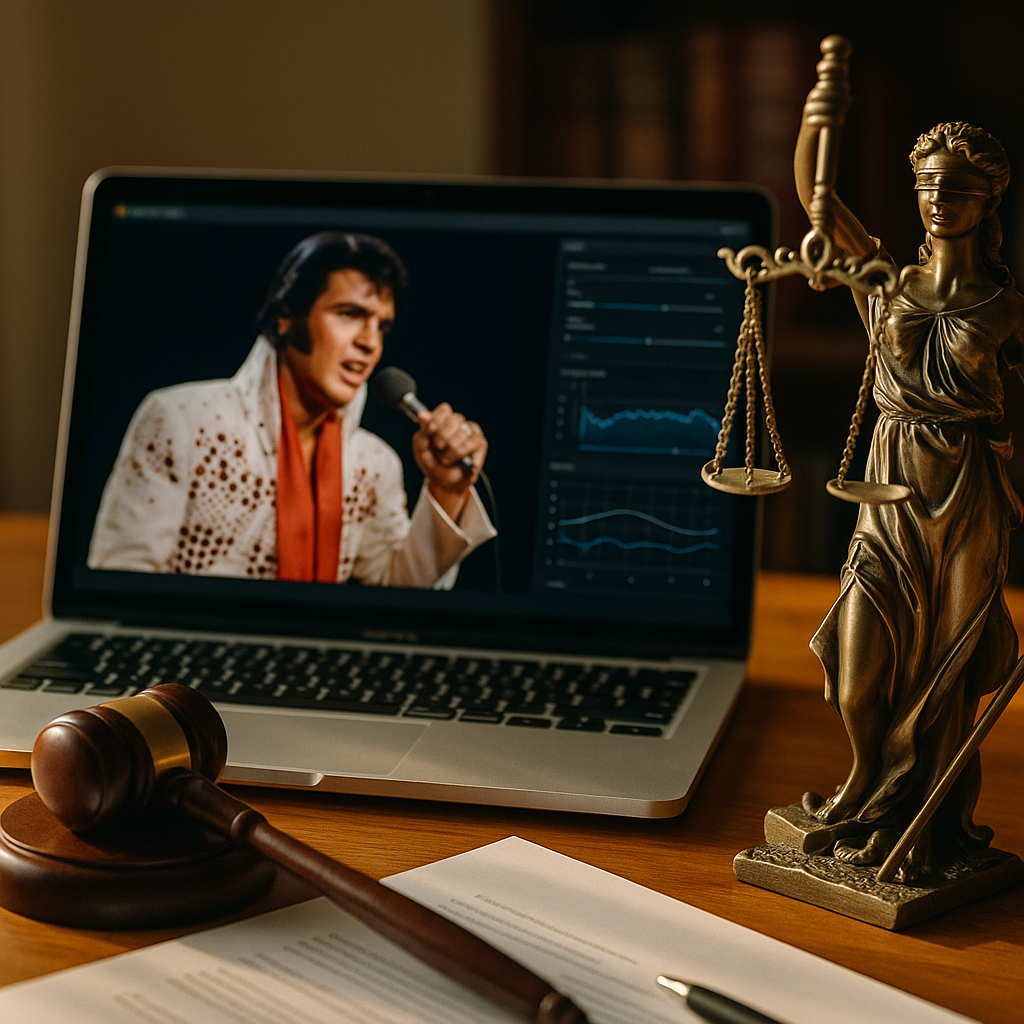
Forty three states now have some version of a right of publicity law on the books, but only one has built a statute specifically to fight AI voice cloning. State AI likeness laws just got a lot sharper, and Tennessee’s ELVIS Act is the reason legal teams at agencies are rewriting virtual influencer contracts this quarter. If your brand runs a synthetic spokesperson, licenses a digital human, or even trains a chatbot on a real creator’s voice, this law probably touches your business already.
What the ELVIS Act Actually Does
Tennessee passed the Ensuring Likeness Voice and Image Security Act, and it took effect with an explicit target: AI generated voice cloning that mimics a real person without consent. Unlike older right of publicity statutes that focused on name, image, and likeness in the traditional sense, ELVIS extends protection to a person’s voice as a distinct, protectable property right. That is a meaningful shift. Voice cloning tools have gotten good enough that a fifteen second audio clip can produce a convincing synthetic version of a musician, actor, or influencer saying anything you want.
The law creates civil liability not just for the person who creates an unauthorized clone, but for anyone who distributes or makes available a tool whose primary purpose is producing unauthorized voice or likeness replicas. That second part matters enormously for brands. It means the exposure does not stop at the studio that generated the deepfake voiceover. It extends to the platform that hosted it and, in many interpretations, the brand that paid for the campaign.
ELVIS was written for musicians fighting unauthorized clones, but its language covers any commercial use of a synthetic voice, which puts virtual influencer campaigns squarely inside its reach.
Why Virtual Influencer Contracts Are Suddenly a Legal Minefield
Virtual influencers like Lil Miquela or brand owned digital avatars operate in a different legal category than human creators, and that has always made contracts messier. Who owns the likeness? Who is liable if the avatar’s voice is generated using a real person’s vocal data without full consent? Before ELVIS, most contracts leaned on generic IP assignment clauses and hoped state right of publicity law would fill the gaps. That approach is no longer defensible.
Here is the practical problem. Many virtual influencer voice models are built by training on a voice actor’s recordings, sometimes under a work for hire agreement that was drafted before anyone anticipated AI cloning. If that original agreement did not explicitly grant rights to create derivative synthetic voice models, the brand deploying the virtual influencer could be building a campaign on a foundation with no clear title. Tennessee gives affected voice actors a direct cause of action, and other states are watching closely.
- Voice provenance: Does your contract document exactly whose voice was used to train the model, and did that person consent to synthetic derivative use?
- Tool liability: Does your vendor agreement indemnify you if the AI tool itself is later classified as a “voice cloning technology” under a state statute?
- Territorial scope: Is your virtual influencer campaign running in Tennessee, or reaching Tennessee residents through paid social, even if your production is based elsewhere?
How Other States Are Following Tennessee’s Lead
Tennessee was first to pass a dedicated voice cloning statute, but it will not be last. California’s AB 1836 restricts the use of AI generated digital replicas of deceased performers without estate consent, and several other legislatures introduced likeness and voice protection bills. New York expanded its civil rights law to cover digital replicas in commercial contexts. The pattern is consistent: state lawmakers are treating synthetic likeness and voice as property that requires explicit, documented consent, not something a vendor’s terms of service can quietly cover.
This matters for brands running national campaigns because a virtual influencer or AI spokesperson does not stay inside one state’s borders. A campaign built in Los Angeles, hosted on TikTok, and consumed by users in Nashville can trigger Tennessee jurisdiction. Compliance teams that treated AI likeness risk as a niche entertainment industry issue are discovering it is actually a multi state exposure problem, similar to how multi state brand risk already complicates minor influencer payments.
The Contract Clauses You Need to Rewrite Now
Most virtual influencer agreements were drafted for a world where the “creator” was a design studio and an animation team. That world assumed away the voice cloning question entirely. Legal and brand teams need to update four areas immediately.
- Consent chain documentation. Require vendors to produce a signed chain of consent from every human source whose voice, likeness, or performance data contributed to the AI model. Verbal assurances are not enough anymore.
- Indemnification scope. Standard indemnification clauses often cap liability or exclude “third party IP claims” in vague language. Rewrite this to specifically address voice cloning and digital replica claims under state statutes like ELVIS.
- Termination triggers. Add a clause allowing immediate campaign termination without penalty if a state or federal regulator issues a cease and desist related to the AI likeness technology used.
- Insurance requirements. Confirm your production vendor carries coverage that explicitly names AI likeness and voice cloning claims, not just general media liability. This overlaps directly with the coverage gaps discussed in creator E&O insurance analysis.
None of this is theoretical legal hygiene. Brands that skip this step are betting the campaign budget on the assumption that no affected party ever notices or ever sues. Given how easily voice clones spread across platforms and how motivated talent unions have become about enforcement, that is a bad bet.
Disclosure Obligations Are Piling Up Too
ELVIS focuses on consent and property rights, but it lands on top of an already crowded disclosure landscape. The FTC has made clear that AI generated endorsements still require the same clarity as human ones when there is a material connection to the brand. If your virtual influencer’s voice is itself the subject of a state law dispute, a weak disclosure practice compounds the legal exposure rather than offsetting it. Brands already navigating similar disclosure friction with AI generated reviews should recognize the pattern here: regulators are stacking consent, disclosure, and provenance requirements on top of each other, and a gap in one area rarely stays isolated.
There is also a practical operations angle. Brands running virtual influencer programs at scale need the same content retention discipline used for human creator campaigns, because a regulator or plaintiff’s attorney investigating a voice cloning claim will ask for the full production trail. The same logic that drives content retention practices for human influencer deals applies directly to AI generated talent, arguably with higher stakes given the underlying property rights involved.
What This Means for Budget and Vendor Selection
Marketing leaders evaluating AI talent vendors now have a new due diligence line item: legal exposure under state likeness statutes. That should factor into vendor selection the same way platform selection factors into influencer marketing spend generally. A cheaper voice cloning vendor that cannot document consent chains is not actually cheaper once you price in litigation risk, campaign takedown risk, and reputational damage from a public dispute with a voice actor or musician.
Industry spend on AI generated influencer content continues climbing according to eMarketer forecasts, and Statista data shows brand interest in synthetic talent accelerating faster than legal frameworks can keep pace. That gap is exactly where ELVIS style enforcement lands hardest, on brands that scaled AI talent programs before building the compliance infrastructure to match.
The brands that treat state AI likeness law as a procurement checklist item, not just a legal footnote, will be the ones still running virtual influencer programs a year from now.
There is also a tax and payment layer that gets overlooked. If your virtual influencer program pays human voice talent, animators, or performance capture artists across state lines, the same jurisdictional complexity that affects international creator tax compliance can apply domestically too, particularly when consent payments or royalty structures are involved.
Next Step
Pull every active virtual influencer and AI voice contract this month and check for three things: documented consent chains, indemnification language specific to voice cloning statutes, and vendor insurance that names AI likeness claims explicitly. If any of those three are missing, renegotiate before the next campaign flight, not after a demand letter arrives.
FAQs
Does the ELVIS Act apply to brands outside Tennessee?
Yes, if the campaign reaches Tennessee residents or the affected person has ties to the state. Digital distribution makes geographic limits difficult to enforce, so most national campaigns should assume exposure.
What counts as a voice clone under state AI likeness laws?
Generally, any AI generated audio that recreates a real person’s distinctive vocal characteristics without their consent, used for a commercial or expressive purpose. The threshold is recognizability, not exact duplication.
Are virtual influencers with no real human voice model still at risk?
Lower risk, but not zero. If any component, including facial motion capture, mannerisms, or scripted personality traits, was modeled on a specific real person without consent, likeness claims can still apply even without a cloned voice.
Who is liable if a vendor’s AI tool violates the ELVIS Act?
Potentially both the vendor and the brand that commissioned the campaign, depending on how the contract allocates liability. This is exactly why indemnification language needs to be updated rather than assumed adequate.
How does this connect to FTC disclosure requirements?
ELVIS addresses consent and property rights, while the FTC addresses whether audiences are misled about who or what is endorsing a product. A campaign can violate one, both, or neither, so brands need to check compliance against each framework separately.
Top Influencer Marketing Agencies
The leading agencies shaping influencer marketing in 2026
Agencies ranked by campaign performance, client diversity, platform expertise, proven ROI, industry recognition, and client satisfaction. Assessed through verified case studies, reviews, and industry consultations.
Moburst

-
2

The Shelf
Boutique Beauty & Lifestyle Influencer AgencyA data-driven boutique agency specializing exclusively in beauty, wellness, and lifestyle influencer campaigns on Instagram and TikTok. Best for brands already focused on the beauty/personal care space that need curated, aesthetic-driven content.Clients: Pepsi, The Honest Company, Hims, Elf Cosmetics, Pure LeafVisit The Shelf → -
3

Audiencly
Niche Gaming & Esports Influencer AgencyA specialized agency focused exclusively on gaming and esports creators on YouTube, Twitch, and TikTok. Ideal if your campaign is 100% gaming-focused — from game launches to hardware and esports events.Clients: Epic Games, NordVPN, Ubisoft, Wargaming, Tencent GamesVisit Audiencly → -
4

Viral Nation
Global Influencer Marketing & Talent AgencyA dual talent management and marketing agency with proprietary brand safety tools and a global creator network spanning nano-influencers to celebrities across all major platforms.Clients: Meta, Activision Blizzard, Energizer, Aston Martin, WalmartVisit Viral Nation → -
5

The Influencer Marketing Factory
TikTok, Instagram & YouTube CampaignsA full-service agency with strong TikTok expertise, offering end-to-end campaign management from influencer discovery through performance reporting with a focus on platform-native content.Clients: Google, Snapchat, Universal Music, Bumble, YelpVisit TIMF → -
6

NeoReach
Enterprise Analytics & Influencer CampaignsAn enterprise-focused agency combining managed campaigns with a powerful self-service data platform for influencer search, audience analytics, and attribution modeling.Clients: Amazon, Airbnb, Netflix, Honda, The New York TimesVisit NeoReach → -
7

Ubiquitous
Creator-First Marketing PlatformA tech-driven platform combining self-service tools with managed campaign options, emphasizing speed and scalability for brands managing multiple influencer relationships.Clients: Lyft, Disney, Target, American Eagle, NetflixVisit Ubiquitous → -
8

Obviously
Scalable Enterprise Influencer CampaignsA tech-enabled agency built for high-volume campaigns, coordinating hundreds of creators simultaneously with end-to-end logistics, content rights management, and product seeding.Clients: Google, Ulta Beauty, Converse, AmazonVisit Obviously →